Best Backpacking Chairs of 2026

A backpacking chair is a negotiation with your own pack weight — every ounce you add for a place to sit is an ounce you carry uphill. The good ones barely register on your back and still get you off the cold, wet ground at the end of the day, when your knees have opinions and every log within a hundred yards is already taken.

I've spent the last six months rotating 11 of them through real trips: overnighters, a three-day stretch on rocky ground, and plenty of evenings in my own backyard when I couldn't get out. What I learned is that the numbers on the box barely tell the story — a chair can weigh next to nothing and still be miserable to sit in, one that sets up in four seconds can wobble every time you lean back, and the cheapest option isn't a bargain if a hub joint gives out in a season. The picks below are the ones that held up.

1

Best Overall

Helinox Chair Zero

93 /100
Angler Score Outstanding

Key details

Weight
1.1 lb
Packed Size
4 x 4 x 13.5 in
Seat Height
6.5 in
Weight Capacity
265 lb
Check Details on Amazon

A pound and a tenth, in a bundle 4 inches across and 13.5 inches long: the Chair Zero makes its case with the numbers before you ever sit in it. It slides into a pack the way a water bottle does, and the aluminum frame underneath is rated to 265 pounds.

For backpackers who count ounces, this is the chair we recommend without much hedging. The next lightest framed chair here weighs about twice as much, and nothing else in this group packs as small. Helinox put the money into the frame rather than the features, which is why the seat is a single sheet of ripstop and the whole thing comes in at 6.5 inches off the ground.

Height is what you give up. Standing out of a 6.5-inch seat takes a little intention at the end of a long day, and on soft ground the back legs press into the turf. We look for a firm patch or slide a flat stone under the back legs on damp ground, and treat this as a chair for trail camps and hard-packed sites rather than beaches.

Check the capacity before you commit, because 265 pounds is at the bottom of this group, tied with the Naturehike. If you are near that line, or you simply want a seat you can push out of, the Chair One is the same idea with three and a half inches more height and a 320-pound rating.

Pros

  • 1.1 pounds, the lightest framed chair here
  • Packs to the size of a water bottle
  • Five-year manufacturer warranty on the frame

Cons

  • Seat sits only 6.5 inches off the ground
  • 265 lb capacity is the lowest in this set
Our verdict

We recommend the Chair Zero to anyone counting ounces on a backpacking trip: at 1.1 pounds it disappears into a pack and still gives you a real seat at the end of the day.

Check Latest Price
2

Best for Soft Ground

iClimb Anti-Sinking Chair

87 /100
Angler Score Excellent

Key details

Weight
2.6 lb
Packed Size
13.8 x 5.5 x 5.1 in
Seat Height
13.8 in
Weight Capacity
330 lb
Check Details on Amazon

Sinking legs are what turn a light chair into a nuisance on wet ground, and the iClimb's answer is four wide detachable feet that spread the load instead of concentrating it on a pole tip. That single addition is why we rate it the most useful chair here for damp meadows, sand, and soft forest floor.

The frame is a square rather than a triangle, which is the other half of why it feels planted, since the legs sit further apart at the base. The seat is 13.8 inches up, so you step out of it rather than climbing, and the mesh backrest makes a difference on a hot afternoon. It carries a 330-pound rating and packs to 13.8 by 5.5 by 5.1 inches, still a cylinder that drops into a side pocket.

On hard-packed ground the extra weight buys you less, and there the standard height and mesh back still make a pleasant seat, just a heavier one than the Helinox. Our choice between the two comes down to where you camp: firm ground, take the Zero; anything soft, take this.

Pros

  • Wide detachable feet resist sinking
  • 330 lb capacity
  • 13.8-inch seat is easy to stand up from
  • Mesh backrest for hot weather

Cons

  • About 2.6 lb, more than double the Chair Zero
  • Four separate feet are easy to misplace
Our verdict

For trips that end on soft, sandy, or boggy ground, we pick the iClimb: its detachable feet and 13.8-inch seat fix what the ultralight chairs handle worst.

Check Latest Price
3

Best for Comfort

Helinox Chair One

87 /100
Angler Score Excellent

Key details

Weight
2.1 lb
Seat Height
10 in
Weight Capacity
320 lb
Check Details on Amazon

A seat 10 inches off the ground instead of 6.5, and 320 pounds of capacity instead of 265: the Chair One is the Chair Zero redesigned for people who would rather sit back than shave ounces. Same approach, scaled up, with a bungee-strung aluminum frame, a removable ripstop seat and a stuff sack.

The seat unclips and the fabric is machine washable, which matters more than it sounds on a trip where everything ends up smelling of woodsmoke, and the frame carries a five-year warranty. Helinox's own line is that it packs smaller than a bottle of wine; in practice it is a bundle you push into the middle of a pack rather than strap to the outside.

This is the chair we point people toward when they want one seat for backpacking and car camping both. It is the comfortable end of the ultralight spectrum: light enough to justify the space in a pack, but with enough seat under you that a long evening doesn't turn into a balancing act.

Pros

  • 10-inch seat height suits long evenings
  • 320 lb capacity, the higher of the two Helinox models
  • Removable, machine-washable seat
  • Five-year frame warranty

Cons

  • Twice the packed weight of the Chair Zero
Our verdict

We recommend the Chair One to campers who want a roomier seat and 320 pounds of capacity, and who will carry the extra pound to get both.

Check Latest Price
4

Best for Taller or Heavier Hikers

ONETIGRIS Tigerblade

90 /100
Angler Score Outstanding

Key details

Weight
2.9 lb
Packed Size
5.9 x 5.1 x 13 in
Weight Capacity
330 lb
Check Details on Amazon

Ultralight chairs tend to squeeze bigger campers: narrow seats, short backs, and a capacity that reads more hopeful than real. The Tigerblade is built the other way round, with a 330-pound rating on a 2.9-pound frame, a back around 21 inches wide, and a seat that doesn't fold you forward.

The materials are standard for the class and done properly: 7075 aluminum, 600D polyester that shrugs off dirt and splashes, a triangle base that stays put on flat ground, and a folded size of 5.9 by 5.1 by 13 inches. It goes back into its bag without a fight, which is not something every chair here manages.

Just under three pounds makes it the heaviest of the low-cost picks, and that is the honest trade: roughly half a pound more than the Marchway in exchange for more room and a higher rating. For taller hikers, and for anyone who has felt a light chair flex underneath them, that is a half pound we are happy to spend.

Pros

  • 330 lb capacity
  • Roomier seat and wider back than the budget norm
  • Folds to 5.9 x 5.1 x 13 in
  • Priced with the budget chairs

Cons

  • Heaviest of the low-cost chairs at 2.9 lb
Our verdict

We recommend the Tigerblade to taller or heavier backpackers: 330 pounds of capacity and a roomier seat for under three pounds of pack weight.

Check Latest Price
5

Best Budget Ultralight

MARCHWAY Square Chair

87 /100
Angler Score Excellent

Key details

Weight
2.3 lb
Setup Size
19.5 x 20.9 x 26.2 in
Weight Capacity
300 lb
Check Details on Amazon

At 2.3 pounds, the Marchway square-base chair is the lightest of the low-cost options here, and it does the basic job without drama: shock-corded poles that snap together, a fabric seat that slides over four posts, two Velcro straps to bundle it, and a bag small enough to sit beside a sleeping bag. For a first backpacking chair, we think that is the sensible place to start.

The square base with four independent legs is what keeps it from feeling tippy, and the seat angle leans you back a little rather than folding you forward. Setup takes a minute or two of practice, and stripping the fabric off is the fiddly half, which is where the Velcro straps earn their keep. At this price the money goes into the frame rather than the finish, and that is the trade we want in a chair that lives in a pack.

Pros

  • Lightest of the low-cost chairs at 2.3 lb
  • Square base resists tipping
  • Packs smaller than a shoebox
  • Cheapest chair in this set

Cons

  • Front leg joints can fail under heavy loads
  • 300 lb capacity sits below the 330 lb picks
Our verdict

We recommend the Marchway square-base chair as a first backpacking seat: 2.3 pounds and a stable four-leg base for less than the better-known brands charge.

Check Latest Price
6

Ground Seating

Crazy Creek HEX 2.0

91 /100
Angler Score Outstanding

Key details

Weight
1.2 lb
Rolled Size
4 in diameter
Open Dimensions
16.5 x 15.5 x 16.5 in
Check Details on Amazon

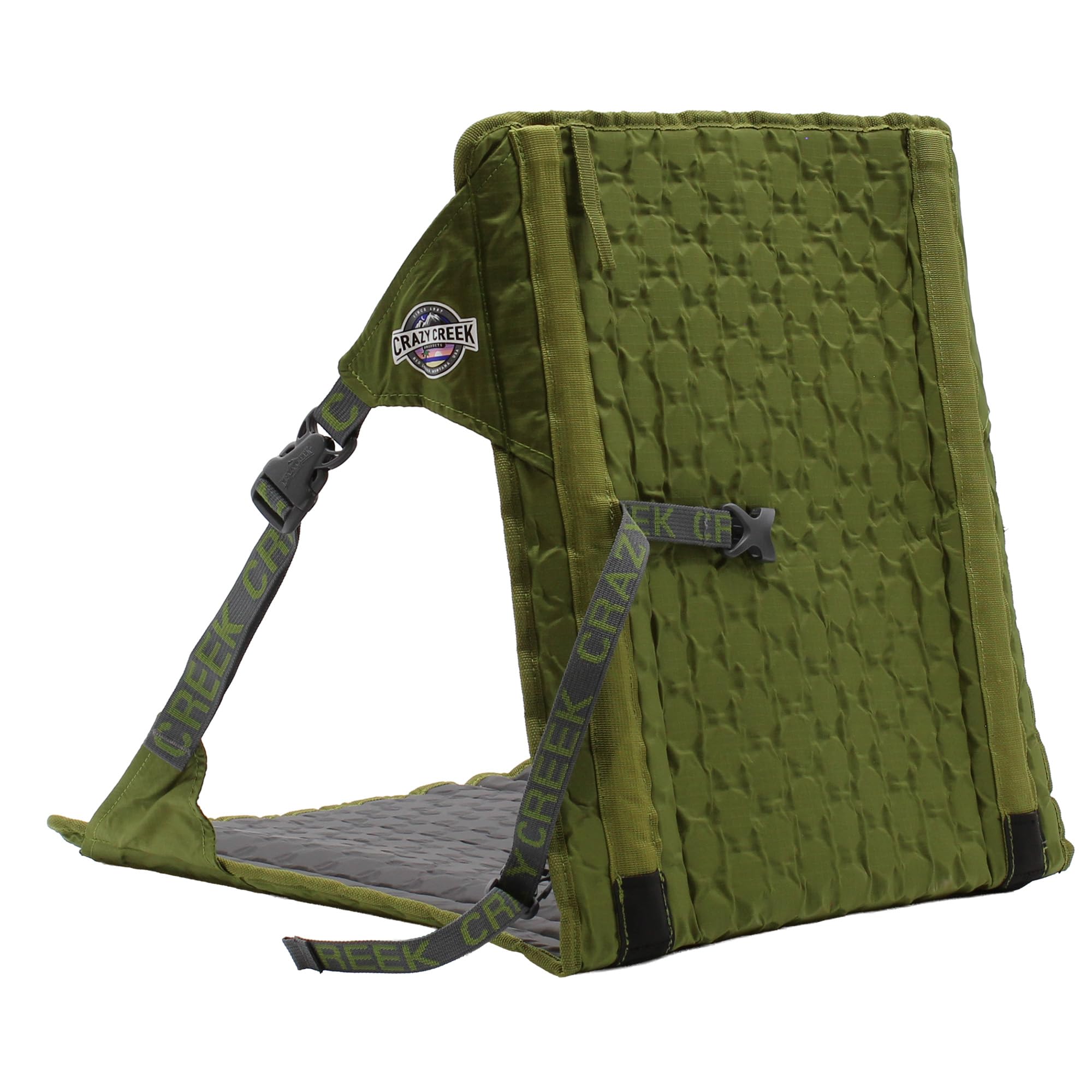
This isn't a frame chair. The HEX 2.0 is a foam pad with carbon-fiber stays and a back, and it rolls to about 4 inches across at 1.2 pounds, lighter than any framed chair here. You sit on the ground with your back supported and your legs out in front of you.

The padding is 8mm closed-cell EVA, the outer shell is coated ripstop nylon that keeps wet ground off you, and straps on both sides run through Rock Lockster buckles, so the back can stand upright or let out into a recliner. In a tent, on a river bar, or against a pack at lunch, it turns a cold sit into a comfortable one.

It also does things no framed chair does: bleachers, stadium seats, a pad to kneel on while glassing. The design has been around for 35 years and the details show it, because the foam is dense rather than pillowy, which is what we want on rough ground.

Where it stops is soft or sharp ground. With no legs, your seat is wherever the ground is, so mud, snow and a slope of loose rock are exactly where a framed chair earns its weight. For a backpacker who is happy on the ground and wants a backrest for 1.2 pounds, nothing here is lighter.

Pros

  • 1.2 lb, lighter than any framed chair here
  • Adjustable back angle, from upright to recliner
  • Rolls to about 4 inches across
  • Doubles as a stadium or bleacher seat

Cons

  • No legs, so mud, snow, or rock is a problem
Our verdict

We recommend the HEX 2.0 to backpackers who don't mind sitting on the ground and want back support for barely a pound of pack weight.

Check Latest Price
7

Light Budget Trips

Naturehike YL08

86 /100
Angler Score Excellent

Key details

Weight
2.1 lb
Seat Height
13.6 in
Weight Capacity
265 lb
Check Details on Amazon

The detail we keep coming back to on the YL08 is small: the carry bag clips onto the frame as a pouch once the chair is up, so a phone, keys and a headlamp have somewhere to live that isn't the dirt. It costs nothing to add and gets used every evening.

The chair underneath is a good one: 2.1 pounds, a 13.6-inch seat height, 265 pounds of capacity, 600D Oxford with mesh panels down the sides, and four anti-sink feet in the box. It is light enough to justify its place in a pack on a multi-day trip, and the seat is high enough that you step out of it rather than climb.

Its limits are at the frame. There is more sideways wobble than the iClimb's square base has, and 265 pounds is at the bottom of this group, so heavier campers should look at the Tigerblade instead. For a light hiker watching the budget, it still earns a second look.

Pros

  • 2.1 lb with anti-sink feet included
  • 13.6-inch seat height
  • Carry bag doubles as a frame-mounted pouch
  • Mesh side panels for airflow

Cons

  • Seat fabric needs real force to stretch over the last pole
Our verdict

We recommend the YL08 to light hikers who want a two-pound chair with anti-sink feet without paying Helinox prices.

Check Latest Price
8

Couples and Families

MOON LENCE 2-Pack

86 /100
Angler Score Excellent

Key details

Weight
2.7 lb each
Packed Size
5.9 x 5.1 x 13 in
Seat Height
15.7 in
Chairs Included
2
Check Details on Amazon

Two chairs for less than the price of a single Helinox is the pitch, and if you camp with a partner it is a good one. Each chair weighs 2.7 pounds and folds to 5.9 by 5.1 by 13 inches, so a pair splits cleanly between two packs.

The build is familiar: 7075 aluminum, a bungee frame, 600D ripstop with a mesh back, side pockets for a phone and a bottle, and a seat 15.7 inches off the ground, the highest here, which makes a real difference at the end of a long day.

What sold us on the pair is that seat height and the mesh back: 15.7 inches is high enough to sit at a camp table, and the mesh stops your back going clammy on a warm evening. The catch is the maker's own comfort note, which puts comfortable use below 180 pounds, so the headline capacity is a ceiling rather than a promise for a big hiker.

For two people splitting a tent and a stove, it is the least fussy way to seat both of you, and one bag each means nobody carries both. Solo backpackers should ignore it and buy a single chair instead.

Pros

  • Two chairs for less than one premium chair
  • 15.7-inch seat height, the highest here
  • Mesh back and side pockets
  • Folds to 5.9 x 5.1 x 13 in each

Cons

  • 2.7 lb per chair is well above the ultralight picks
Our verdict

We recommend the Moon Lence pair to couples and families who want two packable chairs with high seats for less than one premium chair.

Check Latest Price

How We Tested Backpacking Chairs

We started by gathering everything that genuinely claimed to be a backpacking chair — not a stool, not a folding camp chair with arms — then filtered by packed weight, packed size, listed capacity, and price. Anything that packed longer than a one-liter bottle or weighed much over two and a half pounds got cut, since at that point most hikers leave it at home anyway. That left 11 chairs, which we've been living with since early spring.

Each one was weighed on a kitchen scale and stuffed into a 40-liter pack alongside a sleeping bag and a day of food, so we could see how it actually nested rather than how it looked in a product photo. We timed the first solo setup and the tenth, once in daylight and once by headlamp with cold hands, and noted which designs needed the fabric stretched onto the frame versus which snapped together on their own. Then we sat, a full hour at a stretch, paying attention to where the seat dug into our backs, how low the seat sat relative to the ground, and whether getting up at the end was a push or a scramble.

Stability got tested where it matters: a sloped, rooty site, soft sand, and gravel, leaning side to side and rocking back to see which frames flexed and which feet quietly sank. Durability showed up in less glamorous places — hub joints, the fabric corners where the frame presses, and the feet after a dozen setups. We kept a running note on value, too: what the extra money actually bought in ounces, packed size, or capacity, and where a cheaper chair did the same job just as well.

How to Choose a Backpacking Chair

Decide How Many Ounces You Will Carry

Weights in this group run from 1.1 pounds to just under three, and every step up buys something real: a higher seat, a wider frame, more capacity. The Chair Zero sits at the bottom, the Naturehike and Chair One around two pounds, the iClimb and Moon Lence in the middle, the Tigerblade at the top.

Two questions settle it. Do you carry the chair for miles, or from the car to a site? And how many nights a year will it come out? For a handful of overnights, the two-to-three-pound group is the better use of your money. If you count base weight, the Zero is the one that never gets left behind. Ignore the word ultralight on the label and read the listed weight instead, bag and feet included.

Check the Packed Bundle Against Your Pack

Packed length matters more than volume. A 13-to-14-inch bundle slides down inside most packs against the back panel, while something closer to 4 inches across drops into a side pocket or a lid. The Chair Zero packs to 4 by 4 by 13.5 inches, the Tigerblade and Moon Lence to about 5.9 by 5.1 by 13, the iClimb to 13.8 by 5.5 by 5.1.

Anything much longer than 14 inches will end up strapped outside, so measure the pocket you plan to use before ordering. Compact in a listing often means compact next to a campsite chair, not compact next to a sleeping bag.

Match Seat Height to Your Knees

Seat heights here run from 6.5 inches to 15.7, and that number decides how often the chair gets used. A 6.5-inch seat like the Chair Zero is comfortable once you are in it, but you are getting up from ground level. A 13-to-16-inch seat, which is where the iClimb, Naturehike and Moon Lence sit, lets you stand without pushing off the dirt.

If you have knee or hip trouble, or you plan to sit for hours, spend the weight. If you are flexible and hiking hard, the low chair is fine, especially with a log or your pack to brace against.

Plan for Soft Ground

Pole tips put your whole weight on four small points, and on damp turf, sand or mud they sink until the chair tips or the fabric bottoms out. Wide detachable feet spread that load, and the iClimb and Naturehike both ship with a set.

Seat the back feet first and check the frame is level before you commit. Keep the feet in the bag between trips, because four loose caps are exactly the sort of thing that disappears in the dark. If your camping is all hard-packed trail and rock, the feet are dead weight.

Setup, Capacity, and Where Cheap Chairs Fail

Every chair here uses a bungee-strung frame, so the variable is the fabric. A seat that has to be stretched over the last pole is the difference between a 15-second setup and a two-minute wrestle, and it is the detail most worth reading about before you buy.

Read the capacity the same way. Figures from 265 to 330 pounds are ceilings, and some makers state a lower comfortable limit, as Moon Lence does below 180 pounds. Leave yourself margin, and look at the joints and end caps, which are where budget frames give out first.

Frequently Asked Questions

Final Verdict

The Helinox Chair Zero is the chair we recommend to most backpackers, and it earns that on a single number: 1.1 pounds, packed to the size of a water bottle, on a 265-pound frame.

If your trips end on soft or uneven ground, the iClimb's detachable feet and 13.8-inch seat fix the two things the Zero handles worst, at double the carry weight. And if you want one chair for the trail and the car campground both, the Chair One is the compromise we make ourselves.