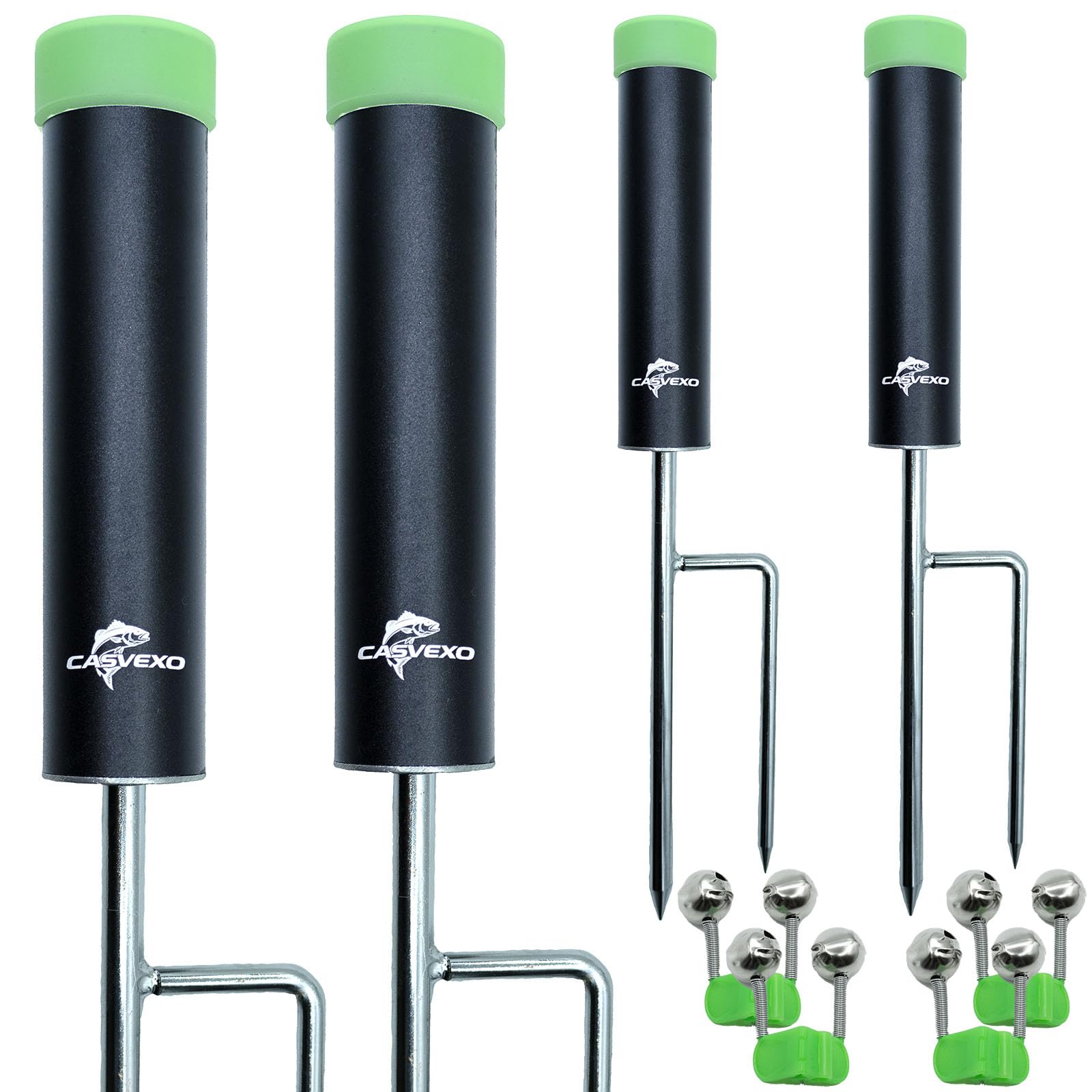
Best Bank Fishing Rod Holders of 2026

The worst part of bank fishing isn't the casting — it's the second you set the rod down to re-bait and something takes it. I've watched a rod skid into a river off a forked stick, and I've held one for three hours because I didn't trust the mud to hold it. A rod holder plants your rod at the angle you pick and keeps it there while you rig a second line, eat, or doze, letting the clicker or a spring-loaded trigger do the watching.

Over five months we fished 14 of them from riverbanks, lake shores, and one very windy stretch of beach, and the pattern was obvious: the ground decides more than the holder does. A double spike that's rock solid in packed sand leans in soft mud; a short single spike that bites in clay skates across gravel. Fit matters too — a narrow cradle lets a thick surf blank twist until the reel swings down. The picks below hold up in the conditions most of us actually fish.

1

Best Overall

Croch Fishing Rod Pole Holders (Set of 2)

91 /100
Angler Score Outstanding

Key details

Pack
2 holders
Rod Fit
1.5 in
Material
Stainless steel
Overall Length
15 in
Check Details on Amazon

The Croch locks its angle with teeth. The head sits in a dentate groove, you pick the notch that points the rod where you want it, and a bolt clamps it there. That sounds like a small thing until you've spent a morning re-tipping a rod that a friction nut let sag. Set this pair on a gravel bar into a crosswind and the rods are still on the same line hours later.

Stainless steel throughout is the other half of the argument. The tip is sharpened so it slides past pebbles and into small rock cracks instead of skating off them, and 15 inches overall is long enough to get under the loose top layer of a bank without turning into a hiking pole. Broken down, the head lies fairly flat and the pair slides into a rod bag.

The cradle takes handles up to 1.5 inches, which covers the spinning, casting and spincast rods most bank anglers carry. What we noticed on the water is how little fiddling there is in the middle of a session: rod in, head turned to face the flow, angle locked, hands free. Two of these plus a couple of rods is a complete bank kit.

The compromise is granularity. A toothed groove gives you set positions rather than a stepless tilt, so there is almost always a notch between the two you want. And a 1.5-inch cradle is snug — a thick surf grip with a long foregrip won't seat comfortably. Neither cost us a fish on a riverbank, but if you throw big bait with a big rod, look at the wider cradles below.

Pros

  • Toothed angle lock resists wind and current
  • Sharpened stainless tip gets past pebbles
  • Breaks down fairly flat for a rod bag
  • Two holders per set

Cons

  • Angle adjusts in fixed notches, not steplessly
  • 1.5-inch cradle is snug on thick surf handles
Our verdict

The pair we reach for on gravel and river rock: a toothed lock that holds its angle and a sharpened stainless tip that gets past stones.
Check Latest Price
2

Best for Soft Ground

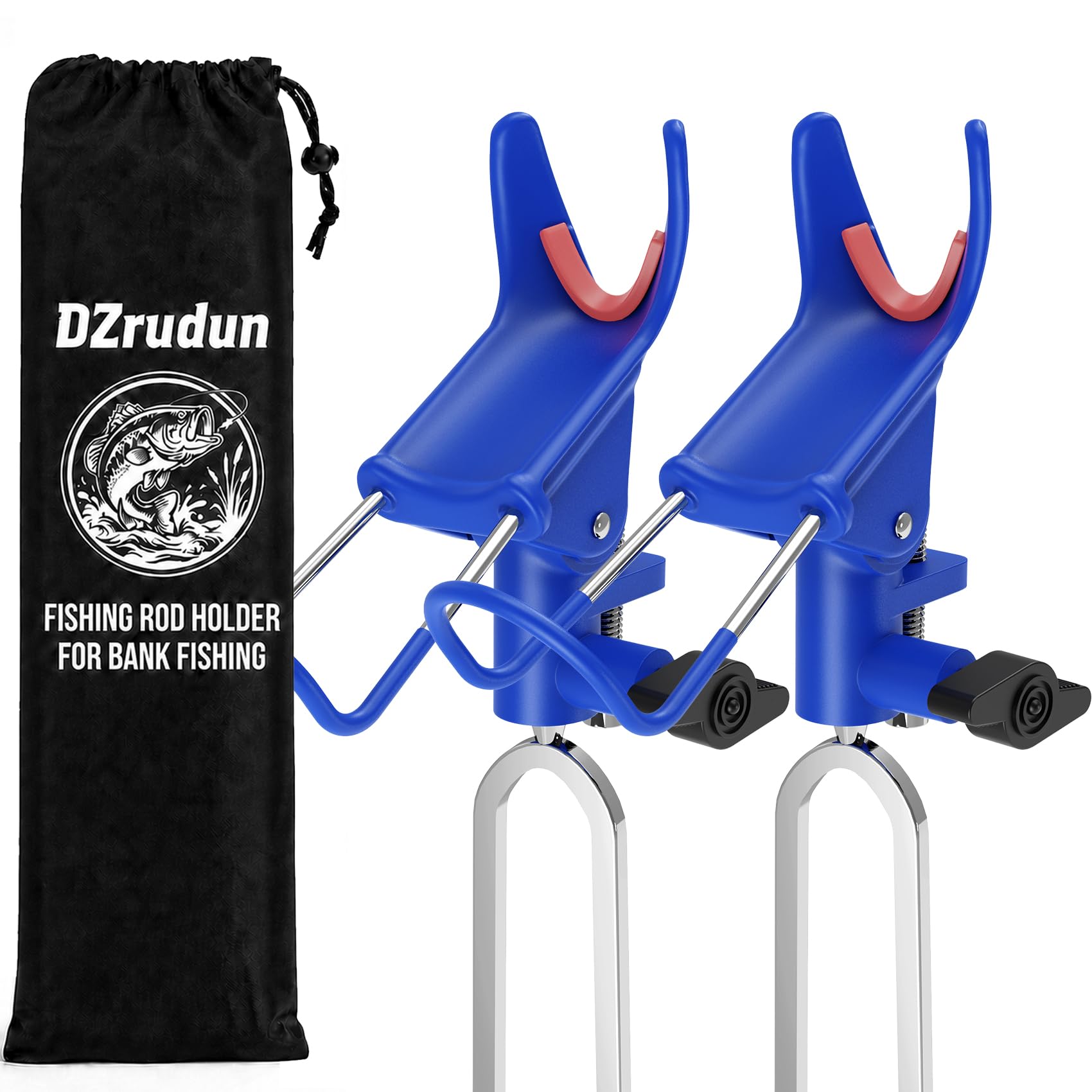
DZrudun Fishing Rod Holder for Ground

91 /100
Angler Score Outstanding

Key details

Pack
2 holders plus pouch
Adjustment
360° horizontal, 130° vertical
Stake Length
12.95 in stainless
Head Material
Reinforced nylon
Check Details on Amazon

The stake on the DZrudun measures 12.95 inches, tapered to a point, and length is what buys depth in mud and wet sand. That's the whole argument for this pair: on a soft bank you drive it until the head sits just above the surface, and the rod stops leaning.

The head is reinforced nylon on a stainless stake, with a wider U-shaped opening than the steel cradles here and a rubber cushion where the handle sits. Adjustment covers 360 degrees horizontally and 130 vertically, which is the range the rest of this group works in, and the whole thing comes apart for packing.

What we appreciated on a silty stretch was how little it moved once it was in. Set the angle, cinch the head, and a pair of rods will sit through a slow bite without the stakes working loose — the long taper seems to keep finding more ground as the bank softens. The two-pack also ships with a drawstring pouch, a small thing that keeps muddy spikes away from everything else in the truck.

Hard ground is the limit. In packed gravel or hardpan the long stake has less to bite and the holder can twist in place. Work the point into a seam or a soft patch rather than forcing it into flat hardpack and it behaves.

Pros

  • 12.95-inch stainless stake drives deep in soft ground
  • Cushioned U-opening protects rod handles
  • 360-degree horizontal and 130-degree vertical adjustment
  • Drawstring carry pouch included with the pair

Cons

  • Loosens in hard-packed gravel and rock
Our verdict

Our pick for mud, silt, and wet sand, where the long stainless stake is what keeps two rods standing instead of leaning.

Check Latest Price
3

Best for One-Rod Setups

PLUSINNO 360 Degree Adjustable Rod Holder

0 /100
Angler Score Fair

Key details

Pack
1 holder
Cradle
Cushioned U-opening
Adjustment
360° horizontal, 130° vertical
Head Material
Reinforced nylon
Check Details on Amazon

Almost everything here comes as a pair or a four-pack. The PLUSINNO comes as one, and for the angler who fishes a single rod off a lake or river bank, that's not a small difference — it's the difference between buying what you need and buying a spare to lose in the garage.

The head is reinforced nylon with a set screw, turning 360 degrees horizontally and 130 vertically. The cradle is shaped and cushioned so the rod handle isn't sitting against a hard edge, a small detail that matters over a season — a chewed-up handle is a rotten way to end a good day.

On a medium spinning or casting setup it does what a holder should: rod upright, tip where you aimed it, hands free for bait, coffee or the net. What we noticed most is how little there is to think about. Push the stake in, drop the rod in, point the head at the water, and the holder disappears from your attention until a tip starts moving.

Loose, dry sand is where it comes up short: set the rod high and a take can rock the whole stake. Keep the angle low and drive the point in as far as it goes. And if you fish two rods, you're buying twice.

Pros

  • Sold as a single holder
  • Cushioned cradle protects the handle finish
  • Head detaches from the stake for packing
  • 360-degree horizontal, 130-degree vertical range

Cons

  • One holder only, so two rods cost double
Our verdict

We like it as a single-holder buy: one lined cradle for the angler who fishes one rod and doesn't want a spare in the bag.

Check Latest Price
4

Best Adjustable Height

Leeko Height Adjustable Ground Rod Holder

87 /100
Angler Score Excellent

Key details

Pack
2 holders
Stake
Three-pronged, chrome-plated
Adjustment
360° horizontal, 130° vertical
Height Range
22.4–34.3 in
Check Details on Amazon

Height is the feature nobody thinks to want until they're standing behind a wall of grass. The Leeko's shaft runs from about 22 inches to just over 34, so you can drop it low on a steep bank and keep the rod tip near the water, or run it up to lift the line clear of stems, brush and the top of a weed bed.

The business end is a three-pronged chrome-plated drill rod, and the prongs are why we trust it in gravel: a single taper can spin in loose stone, while three points catch different edges and settle. On top of the height there's the familiar 360 degrees of horizontal rotation and 130 of vertical tilt, so once the stake is in you can point the rod without pulling it out and resetting.

The trade for all that is leverage. Run the shaft to full height with a long rod in a crosswind and the assembly wants to lean, so keep it short when the wind is up and save the height for calm days and awkward banks. It's also the pricier of the two-holder sets here, and the extra buys the telescoping stainless shaft rather than anything in the head.

The head detaches and the shaft collapses, so the pair breaks down small enough for a tackle bag — worth having if you walk in and don't want two 34-inch poles strapped to a pack.

Pros

  • Height adjusts from 22.4 to 34.3 inches
  • Three-pronged stake grips loose gravel
  • Stainless and nylon, so no rust to chase
  • Breaks down for a tackle bag

Cons

  • Full height plus wind levers the stake
  • Pricier than the fixed-length pairs here
Our verdict

We reach for this one when the bank is steep or overgrown, since the shaft runs from 22 to 34 inches.

Check Latest Price
5

Best for Surf Fishing

casvexo Aluminum Sand Spike

85 /100
Angler Score Excellent

Key details

Pack
1 holder plus bag
Height
31 in
Rod Fit
Short and long grips
Construction
2-stage telescopic aluminum
Check Details on Amazon

A sand spike is a different animal from a bank holder, and the casvexo is the only one here built as one. Thirty-one inches of telescopic aluminum, two stages, a storage bag — this is the shape you want when you're standing in the surf and need the rod tip high and the reel well clear of the wash.

The two-stage adjustment is the part that earns it. Short grips and long surf grips both seat, because the holder telescopes to take up handle length instead of asking the rod to fit a fixed tube. Aluminum keeps it light for the walk from the lot to the waterline, and collapsing it back down takes a couple of seconds when the tide chases you up the beach.

Where it doesn't fit is a gravel bar or a packed riverbank. On hard ground there's nothing for the long spike to sink into, and it's more tool than the job needs. It's also the most expensive holder here and you get one of them, which is the right trade only if surf is where you actually fish.

Rinse it after salt. Aluminum and saltwater are not a long-term friendship, and a minute with the hose at the end of the day is easier than working a seized spike loose in the spring.

Pros

  • Telescopes in two stages for short and long grips
  • 31 inches keeps the reel above the wash
  • Collapses into a sleeve and storage bag
  • Light aluminum for the walk in

Cons

  • One holder at the top of the price range
  • Long spike is overkill on packed banks
Our verdict

Our surf pick — 31 inches of telescopic aluminum that keeps a reel well clear of the wash.

Check Latest Price
6

Best Budget Multi-Rod Set

Tendiren 4 Pack Ground Rod Holders

85 /100
Angler Score Excellent

Key details

Pack
4 holders, 4 bells
Mount
Tapered drill rod
Rod Fit
2 in
Body Material
PVC
Check Details on Amazon

Four holders and four clip-on bells, and the whole set costs less than a single premium spike. The Tendiren isn't trying to be the last rod holder you buy — it's trying to get four baits in the water on a Saturday morning.

Each holder is a PVC tube on a tapered drill rod, and the storage trick is the detail we like best: the rod mounts inside the tube when it's packed, so the point is shielded and the whole thing rolls up in a bucket or a bag. The tube opening runs to about 2 inches, which takes light spinning and spincast handles comfortably.

In the ground they go in easily, and the taper does the work in gravel and soft soil. The bells clip to the rod tip and ring when a fish moves the rod, which is the point of a set-and-wait spread and genuinely useful at dusk, when four tips are more than you can watch at once.

What you give up is size. These are compact holders for compact rods — a surf stick or a heavy catfish setup will feel like too much rod for them. The PVC bodies are what makes the price possible, and they're the part to look after.

Pros

  • Four holders and four bite bells in one set
  • Drill rod stores inside the tube, point shielded
  • Tapered point pushes into gravel and soft soil
  • 2-inch opening fits standard light-rod handles

Cons

  • Best for light rods, not surf or heavy catfish
  • Bells can slip off during a hard cast
Our verdict

We keep this four-pack for a spread of light rods — the cheapest way here to fish several baits at once.

Check Latest Price
7

Budget Two-Rod Kit

ReeMoo 2 Pack Ground Rod Holder

88 /100
Angler Score Excellent

Key details

Pack
2 holders
Height
16.14 in
Adjustment
360° horizontal, 130° vertical
Head Material
Reinforced nylon
Check Details on Amazon

This is the least expensive two-holder set here, and it says so in the details: nylon bodies, detachable heads, and a chunky profile that isn't going to win any packing contests.

The formula is the one the other nylon holders use — a U-shaped rubber cradle at the back, non-slip pads in the middle, 360 degrees of horizontal rotation and 130 of vertical tilt. The head measures about six inches across at its widest, which is bigger than the steel holders here and noticeably bigger in a pack.

In the ground it does the job. The rubber at the back of the cradle stops a handle sliding, the tilt covers the angles you'd fish from a bank, and the head comes off so the spikes can travel in a bucket rather than a bag. Two of these and a couple of rods make a light kit for a pond or a small lake.

A slimmer head is the change this set needs. Until then it's the budget pick for people who park close to the water, and a slightly annoying one for anyone walking a mile of trail to get there.

Pros

  • Lowest-priced pair in this set
  • Rubber cradle and non-slip pads hold the handle
  • Heads detach so the stakes pack separately
  • 360-degree rotation and 130-degree tilt

Cons

  • Bulky head eats pack space on a long hike
Our verdict

We rate it the budget pair for short walks — the cheapest two-holder set here, and fine on a pond bank you can drive to.

Check Latest Price
8

Firm Ground

casvexo 4 Pack Aluminum Rod Holders

85 /100
Angler Score Excellent

Key details

Pack
4 holders, 4 bells
Height
14.2 in
Rod Fit
1.6 in
Body Material
Powder-coated aluminum
Check Details on Amazon

Two spikes per holder is the idea, and it's a good one. Instead of a single point that can pivot in firm ground, this set plants a pair of aluminum spikes and the holder stays where you pressed it — push, twist, done, with no bolts to find in the dark.

The tube is where the set narrows its audience. At 1.6 inches it's built around standard handles, so a thick surf grip or a long baitcasting handle won't seat properly. Measure the butt of the rod you plan to use before ordering; if your gear is ordinary spinning and spincast tackle, you won't have a problem.

What the money buys is four holders, four bells, powder-coated aluminum that won't rust, and a 14-inch height that keeps the rod butt out of the mud on a soft bank. As a leave-in-the-truck set for pond and lake fishing, that's a lot of holders for the outlay, and the double spike means you're not chasing a leaning rod across the bank.

Treat it as a set you plant and leave — four rods, four baits, four bells and a folding chair. It isn't the one to buy if you move from spot to spot with a single rod in your hand.

Pros

  • Double ground spikes resist pivoting on firm ground
  • Four holders and four bells
  • Powder-coated aluminum won't rust
  • Tool-free push-and-twist setup

Cons

  • 1.6-inch tube won't take thick or long handles
Our verdict

We like it for a fixed spread on firm ground: four double-spiked aluminum holders, provided your handles fit 1.6 inches.

Check Latest Price
9

Budget Steel

GOLDEAL Bank Fishing Rod Rack Stand

87 /100
Angler Score Excellent

Key details

Pack
2 holders
Material
Stainless steel
Adjustment
360° horizontal, 130° vertical
Item Weight
14.8 oz
Check Details on Amazon

Set the GOLDEAL beside our top pick and you'll do a double take: two stainless holders, tapered points, a head that turns 360 degrees horizontally and 130 vertically, a rubber gasket where the rod sits. The family resemblance is not a coincidence.

The difference is the lock. Ours holds an angle in a toothed groove; this one relies on a nut running up a threaded shank, and that nut decides whether the setting survives a current. Tightened properly it holds. Left shy, a heavy flow works the head around, and the steepest angles are where it gives first.

Everything else is solid. The tapered stake gets into mud, sand and rock cracks, the gasket protects the rod handle, and the stainless body has the heft you want from something you leave standing in a bank.

Where it lands: a good second pair, or a first pair for someone who wants steel without premium money and doesn't mind putting a hand on the nut whenever the angle changes. If you set one angle and fish it all day, that's a fine trade.

Pros

  • Stainless body and tapered stake
  • Rubber gasket protects the rod handle
  • Full 360-degree horizontal and 130-degree vertical range
  • Two holders for budget money

Cons

  • Rubber saddle pads can work loose
Our verdict

A stainless pair that looks like our top pick and mostly behaves like it, as long as you cinch the angle nut hard.

Check Latest Price
10

Hands-Free Hooksets

weyleity Automatic Spring Rod Holder

83 /100
Angler Score Excellent

Key details

Pack
2 holders
Material
304 stainless steel
Stake Length
9.8 in
Folded Length
12.6 in
Check Details on Amazon

This one does something no other holder here does. A spring-loaded arm holds the rod tip down until a fish takes line, then snaps up and sets the hook while you're baiting another rod or eating lunch.

The frame is 304 stainless with rubber fittings, it folds to 12.6 inches for a pack, and the ground end is a 9.8-inch grooved drill pipe. The grooves are the part we rate: they catch an edge in mud, sand and rock cracks instead of spinning the way a smooth taper can. The cradle takes handles up to about 1.57 inches.

The catch is tension. The spring load is fixed, so the holder is tuned for one weight of fish and one weight of line. Bear down with a heavy catfish rod and a light take may never trip the trigger; put a good fish on it and the snap can pull the hook instead of driving it home. That's the whole trade, and it's why this is a specialist's tool rather than a holder for everyone.

Buy it for still fishing with a bait that sits, and keep a plain holder for the days you're casting lures. It's also the only one here that will set a hook while your back is turned — which is either the reason to buy it or the reason to leave it, depending on how you fish.

Pros

  • Spring arm sets the hook without you
  • Folds to 12.6 inches for a pack
  • Grooved 9.8-inch drill pipe bites mud and rock cracks
  • 304 stainless and rubber, rust-resistant

Cons

  • Fixed spring tension can trip late or snap hard
Our verdict

We keep this for one rod and one size of fish: a spring-loaded holder that sets the hook while you're busy.

Check Latest Price

How We Tested These Rod Holders on the Bank

We started with about 40 holders pulled from tackle shop shelves and the biggest online listings, then dropped the ones that looked like the same stamped metal wearing a different label. A spike under 8 inches, a plastic collar where there should be a metal locking nut, or a cradle too narrow for a standard reel seat was enough to cut a model. That left 14 to fish with.

Testing ran from late spring into early fall — five months of Saturday mornings on a riverbank, a handful of weeknight catfishing sessions, and one beach trip in a stiff crosswind. Every holder got planted in the same four ground types: packed sand, soft mud, gravel, and root-tangled dirt. We drove each spike in with a boot heel, then pushed on the upright with two fingers to see how far it leaned before it held.

At the water we loaded a rigged rod, set the drag, and walked away for twenty minutes at a time, counting how often the butt crept up the cradle or the tip drifted off target. We counted the turns the locking collar needed to grab a rod, and whether it slipped when a fish pulled line. Spring-loaded models got a slow pull on the trigger to see how cleanly they released and whether the tension screw changed anything real. Setup was timed one-handed with wet hands, because that's how it happens.

Value got judged at the end of the season, once we'd seen which spikes bent, which collars seized, and which holders came out of the mud still straight. All 14 are still in the rotation.

How to Choose a Bank Fishing Rod Holder

Pick the Stake for the Ground You Fish

Mud and wet sand want length and a taper: a long, sharpened stainless stake drives deep and holds because there's material for it to grip. Gravel and rock cracks want a narrow point that finds a seam rather than a broad one that skates over the surface, and hardpack wants either a second spike or a pronged end that resists twisting.

If you fish one kind of bank all season, buy for that bank and stop there. If you move between a muddy river and a gravel tailrace, the holders with the longest stake and the sharpest point cover both, like the DZrudun and the Croch. The mistake is buying the longest stake you can find and then trying to plant it in three inches of gravel over bedrock.

Check the Lock Before Anything Else

A holder that won't hold its angle is a stick. Two locking styles dominate: a nut or set screw clamped against a threaded shank, and a toothed groove that seats the head in a notch. The toothed version, which our top pick uses, gives up stepless adjustment in exchange for a setting that doesn't creep. Nut-based heads work, but they depend on you tightening them hard every time you move the head, and steep angles are where they give first.

Whichever you buy, test it before you drive it in. Set the angle, tighten, and try to push the head out of position with your hand — that tells you more than any listing photo.

Match the Cradle to Your Rod Handles

The opening on these holders runs from about 1.5 to 2.1 inches, and that figure decides which rods fit. Standard spinning and spincast handles seat in almost anything in that range. Long surf grips, thick baitcasting handles, and heavy catfish rods with a wide butt are where a narrow cradle becomes a problem — the rod sits proud of the holder or won't seat at all.

Measure the butt of your heaviest rod before you order, and favor holders with a rubber or padded cradle if you care about the handle finish.

Height, Packs, and the Walk In

Fixed holders sit around 14 to 16 inches tall, which is enough on a flat bank. If you fish behind tall grass, below a steep drop, or in a surf wash, a height-adjustable shaft that runs into the thirties clears the line and keeps the rod butt dry. Height costs leverage, though: run it out full and the wind works on the rod harder.

Pack count matters as much as anything. Four holders are a bargain until you're carrying them a mile, and detachable heads and telescoping shafts pack far smaller than fixed ones.

Decide Whether You Want the Rod to Set the Hook

Spring-loaded holders hold the rod tip down and snap it up when a fish takes line. That's a real advantage when you're running several baits and can't watch every tip, and it's how some anglers connect on soft takes they'd otherwise miss.

The trade is control. The spring load is usually fixed, so the holder is tuned for one weight of fish and one weight of line, and a hard take gets a violent set that can pull the hook. Buy one as a second holder for bait fishing rather than as your only holder.

Frequently Asked Questions

Final Verdict

The Croch earns the top spot on the two things that decide a bank holder: a sharpened stainless stake that gets into gravel, and a toothed lock that keeps the rod pointed where you set it. Make it your default pair. If your banks are soft mud or wet sand, the DZrudun's longer stake drives deeper and holds better; if you fish behind tall grass or off a steep drop, the Leeko's adjustable shaft is worth the extra money. Surf anglers should skip both and take the casvexo spike.