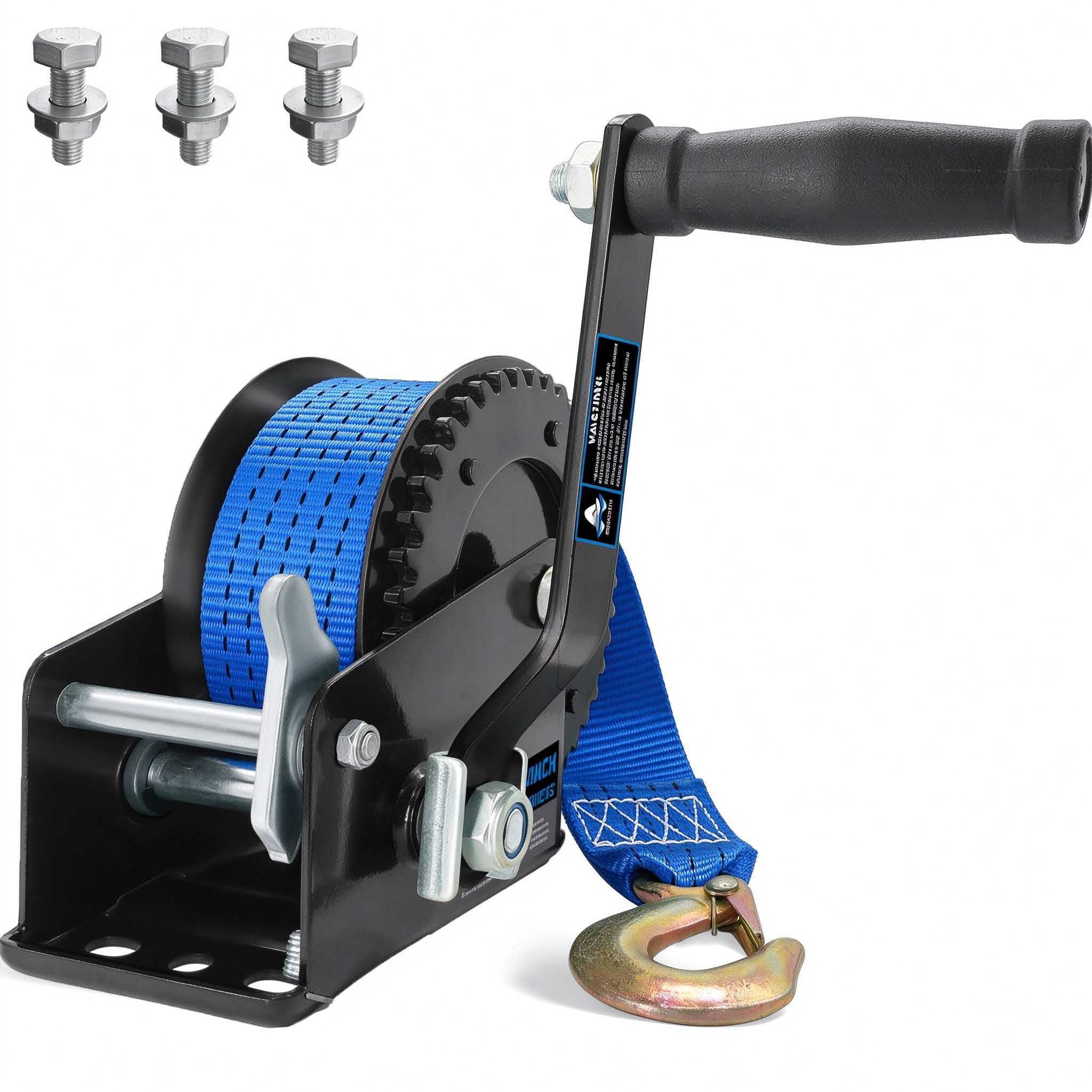
Best Boat Trailer Winches of 2026

The last few feet of the ramp are where a boat winch earns its keep. The hull is wet, the bunks are slick, and someone still has to haul the bow eye up tight against the roller before the truck moves. A good manual winch makes that one short, controlled pull instead of a skipping ratchet, a fraying strap, and a boat that creeps back an inch at a time — leverage and a hold you can actually trust.

For this round I gathered 12 manual winches, from 600-pound to 3,500-pound ratings, and my team and I spent eight months winching boats onto trailers at gravel launches and concrete ramps. Here's what nobody tells a first-time buyer: the capacity printed on the box is a ceiling, not a target. Size yours to roughly twice the combined weight of boat and trailer and you'll crank with two fingers instead of your whole back, and check the bolt pattern on your winch post before you fall for a gear ratio. The picks below are the ones that pulled straight and held, launch after launch.

1

Best Overall

AC-DK 1600 lb Boat Trailer Winch

88 /100
Angler Score Excellent

Key details

Strap
26 ft x 2 in polyester
Gear Ratio
4:1
Handle Length
8.6 in
Pulling Capacity
1,600 lb
Check Details on Amazon

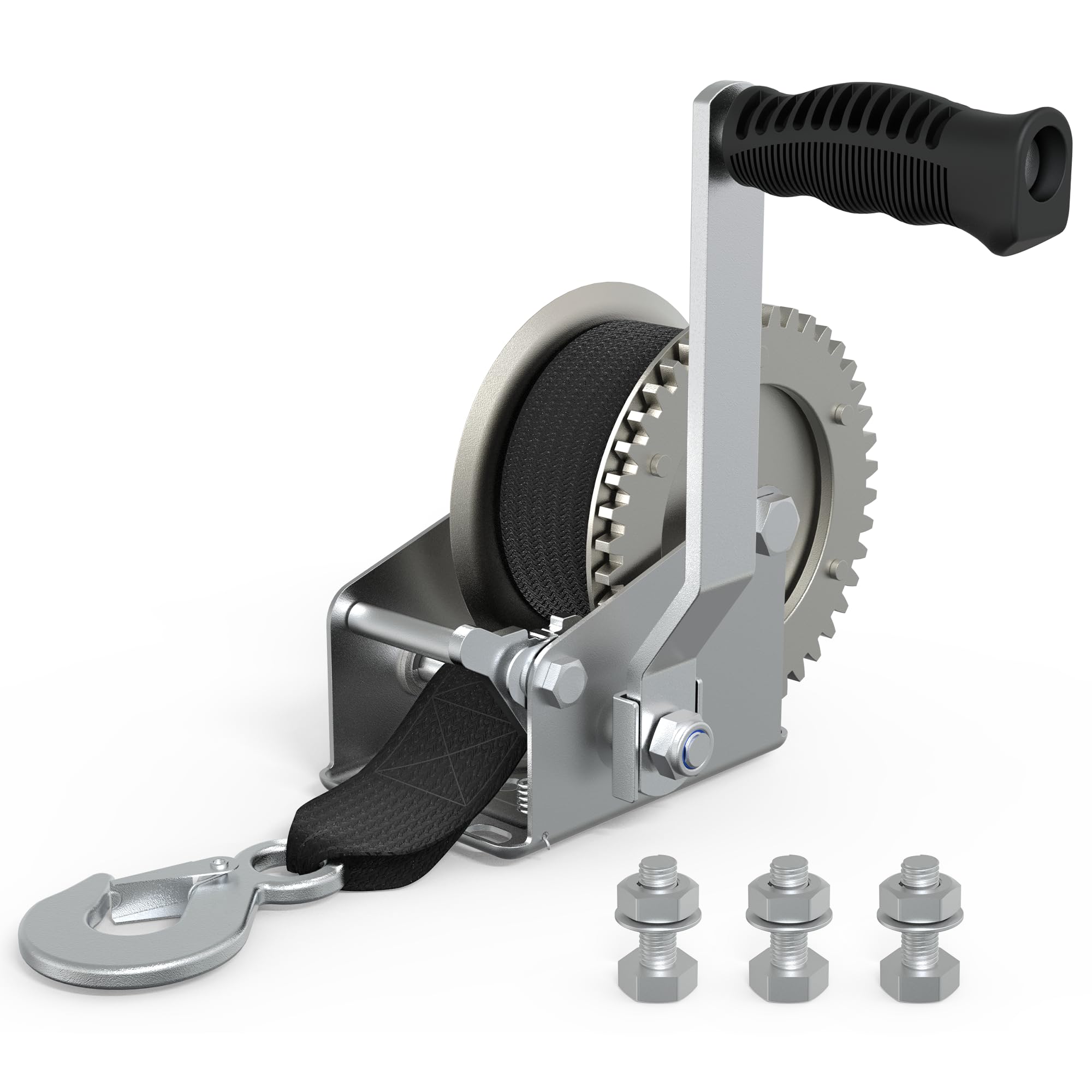
Sixteen hundred pounds of pull, a 26-foot strap, and 4:1 gearing is the combination that suits the boats most of us actually trailer: aluminum fishing boats, runabouts, and small cruisers with an outboard on the transom. We came back to this one because nothing about it gets in the way. The crank turns under load without a fight, the ratchet clicks over positively, and the boat tracks up the bunks straight.

The details are right for a part that lives outdoors and gets dunked. The 2-inch polyester webbing reaches a bow eye with the trailer backed in shallow, the 8.6-inch handle gives wet gloves something to hold, and the two-way ratchet lets you pay line out at launch instead of dragging the boat forward against a locked drum. Galvanized steel underneath handles ramp spray, and the mounting holes are the standard pattern, so a replacement usually lines up with the holes already in the tongue.

Capacity is where to be honest with yourself. The 1,600 lb figure is a pulling limit, not a target — add hull, motor, fuel, and gear, and leave real margin, because a winch worked at its ceiling is a winch working its weakest parts hardest. For a 16- to 18-foot aluminum boat with a modest outboard, you have room to spare.

Where the others here edge ahead: the Favorite-Trade's two speeds make a heavy glass boat noticeably easier to crank, and the WINSBULL ships with stainless mounting hardware instead of leaving you to source it. For a typical rig, neither changes our answer. Buy a spare strap with the winch — webbing is the part that ages fastest on a trailer that lives outside.

Pros

  • 1,600 lb capacity with 26 feet of strap
  • Two-way ratchet pays line out at launch
  • 8.6-inch handle stays workable in wet gloves
  • Galvanized finish for ramp spray

Cons

  • Lock clasp can fail under a hard pull
Our verdict

The default we recommend for a typical aluminum boat or small cruiser: enough capacity with margin, a strap long enough for a shallow ramp, and gearing that doesn't fight back.
Check Latest Price
2

Best for Heavy Boats

Favorite-Trade 3500 lb Hand Winch

87 /100
Angler Score Excellent

Key details

Line
32.8 ft steel cable
Weight
12.9 lb
Gear Ratio
3.4:1 and 6.8:1, two speed
Pulling Capacity
3,500 lb
Check Details on Amazon

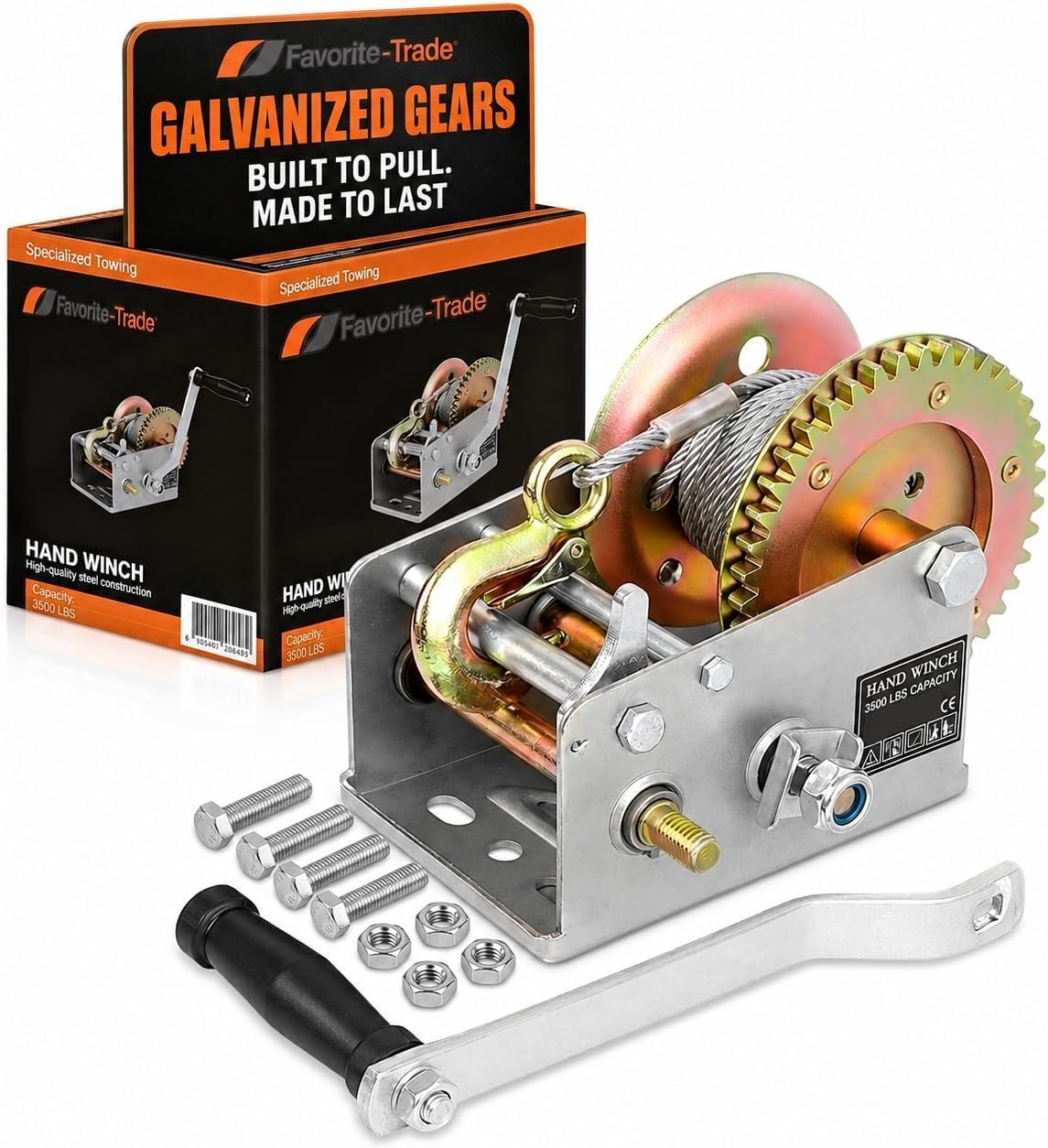
Two gear ratios in one housing is the whole reason to look at this one. The 3.4:1 setting spins fast for a light boat on a good ramp; the 6.8:1 setting is for the times the hull is heavy, the bunks are dry, and someone has to actually work for it. You change ratios at the handle, so the same winch whips a runabout up in a few turns and then grunts a 3,500 lb load without you hanging your weight off the crank.

We found the two-speed worth the 12.94 pounds it costs. This is a two-hand, hold-it-while-you-bolt-it install, not something you dangle from one wrist. The 32.8 feet of steel cable buys reach on a deep-set ramp and shrugs off abrasion that would fray webbing on a rough roller.

Zinc plating over galvanized gears is the right finish for saltwater, and the overlong anti-slip handle gives you leverage without gloves. That leverage goes somewhere, and the place it goes is the mounting bolts: check them after the first few loaded pulls, because a winch that shifts on its base is a winch that's about to bind. If your boat is light, this is more winch and more line fuss than you need — the strap winches here are friendlier day to day.

Pros

  • Two-speed 3.4:1 and 6.8:1 gearing
  • 3,500 lb rating for heavy hulls
  • Long handle gives leverage on hard pulls

Cons

  • 12.94 lb needs two hands to mount
  • Steel cable can kink if spooled slack
Our verdict

Buy this for a heavy glass boat or a steep ramp — the two-speed gearing is the real feature, and the extra weight is the honest cost of it.

Check Latest Price
3

Best for Saltwater

WINSBULL 1600 lb Boat Trailer Winch

88 /100
Angler Score Excellent

Key details

Strap
26 ft x 2 in polyester
Gear Ratio
4:1
Pulling Capacity
1,600 lb
Included Hardware
Stainless bolts, nuts, washers
Check Details on Amazon

Most winches at this level leave you to source your own bolts. This one arrives with stainless steel bolts, nuts, and washers in the box, and that tells you something about how the rest of it was put together: galvanized steel body, galvanized hook, stainless fasteners, and a 26-foot polyester strap. We appreciated that the hardware matches the finish rather than being the plated afterthought you end up replacing.

The working parts are conventional and sensible: a 4:1 gear set, a two-way ratchet, and an ergonomic handle on a 7.55 lb body one person can hold in place while starting a bolt. At 1,600 lb it's aimed at the same boats as our top pick — aluminum hulls, small cruisers, jet skis — and the standard bolt pattern means it usually drops onto an existing winch post without drilling. The hook is galvanized rather than stainless, which is the one place the saltwater story weakens. It's also the only winch in this group that states a warranty, one year from purchase, so keep the order confirmation where you'll find it.

Pros

  • Stainless bolts, nuts, and washers included
  • Galvanized body resists ramp spray
  • 26-foot strap with 4:1 gearing
  • One-year warranty stated

Cons

  • Galvanized hook is the weak link in saltwater
Our verdict

The one to buy if your trailer lives outside and gets dunked in salt water — stainless fasteners in the box are worth more than they sound.

Check Latest Price
4

Best for Small Boats and Jet Skis

TR Industrial 600 lb Trailer Winch

91 /100
Angler Score Outstanding

Key details

Weight
3.6 lb
Gear Ratio
3.2:1
Drum Capacity
15 ft x 2 in strap or 36 ft x 1/4 in cable
Pulling Capacity
600 lb
Check Details on Amazon

At 3.6 pounds, this is a winch you can hold in one hand while you line the bolt holes up with the other. It's a 600 lb unit, so it belongs on a jet ski trailer, a kayak rig, or a small aluminum boat — put it on a 20-foot glass boat and you're asking it to do something it wasn't built for. The drum is the interesting part: it takes webbing, steel cable, or rope, so you can run whatever line you already trust.

That flexibility is why it's our pick for light loads. The all-steel frame and gears are plated in zinc and black, the 3.2:1 ratio spins fast enough that a light hull comes up in a handful of turns, and the rotating handle is comfortable enough to crank one-handed. Fifteen feet of 2-inch webbing is the stated maximum, and the drum is small enough that you'll want to stay under it — 10 feet spools more predictably and leaves room for the hook.

Nothing in the box holds it to the trailer. The mounting bolts and the drum's through-bolt are both on you to supply, so buy them with the winch rather than the morning you're trying to launch. It's a plain, honest little unit otherwise, and the price of that honesty is that it will not grow with your boat.

Pros

  • 3.6 lb body is easy to hold and mount
  • Drum takes strap, cable, or rope
  • All-steel frame and gears
  • Fast 3.2:1 cranking for light hulls

Cons

  • No mounting bolts or drum bolt included
Our verdict

Our pick for jet ski trailers and light aluminum boats, where a 3.6-pound winch you can hold with one hand beats capacity you'll never use.

Check Latest Price
5

Best Value

AOFCRELI 1600 lb Boat Trailer Winch

89 /100
Angler Score Excellent

Key details

Strap
26 ft x 2 in polyester
Ratchet
Two-way with free spool
Gear Ratio
4:1
Pulling Capacity
1,600 lb
Check Details on Amazon

The ratchet lever on this winch has three positions instead of two, and the middle one free-spools the drum. That means you can pull strap off by hand to reach the bow eye, then flip to ratchet and crank, instead of paying line out a click at a time while the ramp queue watches. It's a small thing on paper and a noticeable one in practice.

The rest of the package is what you want at this capacity: 2-inch by 26-foot polyester webbing, a forged steel hook with a safety latch, high-carbon steel gears on a 4:1 ratio, and an electro-coated finish for saltwater work. The 1,600 lb rating puts it in the same job as our top pick — aluminum boats, small cruisers, jet skis — and the bright blue webbing is easier to find than black when you're sorting lines on a crowded dock.

What sold us on it is how little you give up. Same capacity, same strap length, and the savings go toward the boat instead. The trade-off is small hardware: the strap can slip on the drum for the first few cranks until it beds in. Load it evenly across the drum on that first spool and it settles down.

Pros

  • Free-spool center position speeds hooking up
  • 1,600 lb capacity with 26-foot strap
  • Forged hook with safety latch
  • Electro-coated finish for saltwater

Cons

  • Strap-retaining bolt can bend when tightened
Our verdict

The value pick for a first winch or a budget rebuild: same 1,600 lb capacity and 26-foot strap as our top pick, with a ratchet that's easier to live with.

Check Latest Price
6

Long Strap Reach

OPENROAD 3500 lb Boat Trailer Winch

84 /100
Angler Score Excellent

Key details

Strap
32 ft x 2 in polyester
Weight
11.8 lb
Gear Ratio
4:1/8:1
Pulling Capacity
3,500 lb
Check Details on Amazon

Thirty-two feet of strap is a lot of reach, and on a shallow ramp it's the difference between hooking up comfortably and wading out to the bow eye. The rest of the spec sheet is aimed at heavy boats: 3,500 lb of pull, a 4:1/8:1 two-speed gear set, a 9.8-inch handle, and galvanized steel underneath. Installation screws come in the box, which is more than several picks here manage.

We think it's the easier of the two 3,500 lb winches here to live with day to day, and the reason is webbing instead of cable — no kinks to work out, no burrs to catch a glove, and a strap you can see the wear on before it lets go. You give up the abrasion resistance cable has, so inspect the strap where it crosses the roller.

At 11.75 lb it's a two-hand install, and that long strap fills the drum in more layers than a shorter one, so keep the wraps even on the first spool. The orange webbing is also a good deal easier to spot when someone else's trailer looks like yours in a crowded ramp line.

Pros

  • 32-foot strap for shallow ramps
  • 3,500 lb rating with two-speed gearing
  • Installation screws included

Cons

  • 11.75 lb takes two hands to mount
Our verdict

A 3,500 lb strap winch with unusually long reach — the right call if your ramp is shallow and you'd rather not handle steel cable.

Check Latest Price
7

Light Loads

TYT 600 lb Boat Trailer Winch

89 /100
Angler Score Excellent

Key details

Cable
19 ft x 4 mm steel
Weight
4.6 lb
Gear Ratio
3.2:1
Pulling Capacity
600 lb
Check Details on Amazon

Steel cable instead of webbing is the argument for this one. A 4 mm cable doesn't rot, doesn't sun-fade, and shrugs off the abrasion that finishes a strap dragged across a rusty roller. There are 19 feet of it, which is enough for a jet ski or a 14-foot aluminum boat and shorter than the 26-foot straps on the bigger picks.

The rest is scaled to match: 600 lb of pulling force, a 3.2:1 gear ratio that spins quickly, an 8.26-inch curved handle with an anti-slip grip, hardened steel gears, and a zinc-black finish. The two-way ratchet with a safety pawl lets you pay cable out at the ramp rather than fighting a locked drum.

Cable has habits. It wants tension while it spools, and under a hard pull it can bury itself in the layer beneath, which you feel as a slack-then-bind at the handle. Hand-feed the first layer and keep the wraps tight against each other and it behaves.

It's the least expensive winch here, and for a light rig that's the right trade: no 3,500 lb gears you'll never load and no long handle to store. We minded the shorter reach less than we expected. Keep a pair of gloves in the truck — cable burrs are the one thing webbing never gave you.

Pros

  • Steel cable resists sun and abrasion
  • Fast 3.2:1 cranking for light hulls
  • Least expensive winch in this group

Cons

  • 600 lb rating suits only light hulls
Our verdict

The budget cable winch we'd put on a jet ski or a 14-foot aluminum boat, as long as you accept 600 lb of pull and a short line.

Check Latest Price

How We Tested Boat Trailer Winches

We started by pulling together every manual hand-crank winch we could find that was genuinely rated for trailer duty, in both strap and steel-cable versions, then narrowed the field by gear ratio, drum design, and whether the mounting holes lined up with common winch post patterns. Twelve made it to the ramp. Price never decided a winner on its own — a couple of the cheapest impressed us and one of the pricier ones did not.

Each winch was bolted to a trailer winch post and used to recover a boat from the water, twice a session: a light aluminum hull on weekdays and a heavier fiberglass boat on weekends. We counted cranks for the final ten feet and paid attention to how much shoulder went into each one, whether the ratchet clicked cleanly or skipped under load, and whether the pawl held when we deliberately let go mid-pull. Then we ran the same winches dry in a driveway against a loaded drum, which is where weak frames flex, straps twist, and reverse levers start to fight back.

Build quality and durability got the long view. Four winches stayed mounted through a full season, and we left a couple unrinsed after brackish launches to see where corrosion appeared first — the fasteners, the pawl spring, or the drum. We timed installation solo with a socket set and only the hardware in the box, since missing bolts and mismatched bolt patterns are the most common reason a decent winch goes back. We also watched adjustability, meaning how cleanly the strap spooled back on and how easily the ratchet flipped between pull and free-spool, and stability, looking for any wobble at the post once a real load came on.

How to Choose a Boat Trailer Winch

Size the Winch to the Load, Not the Boat's Length

The number on the box is a pulling limit, and it's a limit you want headroom under. Add hull, motor, fuel, and gear, then shop above that total rather than at it: a 1,600 lb winch is a sensible default for an aluminum boat with an outboard, while a heavy glass boat or a deep-V wants the 3,500 lb class. A winch worked at its ceiling wears its gears and pawl first.

Boat length tells you surprisingly little — a 16-foot glass boat can weigh more than a 19-foot aluminum one. Work from the loaded weight on the trailer, and treat the rating as the point where you stop, not the point you aim for.

Gear Ratio Decides How Hard You Crank

Lower ratios crank faster, higher ratios crank easier. Something around 3.2:1 is quick and fine for a light hull; 4:1 is the general-purpose middle that suits most trailer boats; 6.8:1 or 8:1 is for heavy boats and steep ramps where effort matters more than speed. Remember the trade — easier cranking means more turns, so a high-ratio winch feels slow on a light boat.

A two-speed winch buys you both, which is the single most useful upgrade in this group if you tow anything heavy. It also costs weight: the two-speed pick here is the heaviest winch on the page.

Strap, Cable, and How Much Line You Need

Webbing is the friendlier choice for most trailer boats. It's easy to inspect, it doesn't kink, and if it ever lets go it does less damage than steel cable under load. Cable resists abrasion and sun and takes less room on the drum, but it burrs, it kinks when spooled slack, and it needs tension on the first layer.

Length matters more than shoppers expect. Twenty-six feet is the useful standard for a trailer winch; 19 feet can leave you short on a deep-set ramp. Check the drum's stated capacity before buying a longer strap, because a drum only holds so much of it.

Ratchet Control, Mounting, and Salt Air

A two-way ratchet with a safety pawl lets you pay line out under control at launch, and a free-spool position is a small convenience that saves real time on a busy ramp. One-way ratchets mean releasing the pawl and controlling the drum by hand, which is fine on a light boat and annoying on a heavy one.

Check the bolt pattern before you buy — the common four-bolt layout is what turns a replacement into a swap rather than a drilling session — and budget for bolts, since several winches ship without them. For saltwater, galvanized steel with stainless fasteners is the combination that lasts. A galvanized hook on an otherwise stainless winch is exactly where rust starts.

Frequently Asked Questions

Final Verdict

The AC-DK 1600 is the winch we point most trailer owners to. Sixteen hundred pounds of pull covers an aluminum boat or a small cruiser with margin, the 26-foot strap reaches the bow eye on a shallow ramp, and the 4:1 gearing hauls it up without turning launch into a workout.

Go to the Favorite-Trade 3500 if your loaded rig pushes past what a 1,600 lb winch should be asked to pull, or if your ramp is steep enough that cranking is the hard part of the day. Drop to the TR Industrial 600 if you're hauling a jet ski or a light tin boat.