
Best Camping Coffee Makers of 2026

Camp coffee has a reputation for tasting like scorched instant and leaving you with a gritty cup, a scalded hand, and a stove covered in grounds. The right camping coffee maker fixes that without turning your pack into a coffee bar: it brews something you want to drink, works when your hands are cold and the wind is up, and comes apart for a real wash. It also has to survive being jammed into a tote beside a camp stove and pull double duty as a server or cup.

I’ve made coffee on tailgates, picnic tables, and a damp log, and the difference between a keeper and a gadget I leave home comes down to whether it earns its pack space. Over the past four months, my team and I tested 15 camping coffee makers, from collapsible drippers to percolators and presses, judging coffee quality, fuss-free use, easy cleaning, durable parts, and value for money. The picks below are the ones that kept earning a spot in the camp box.

1

Best Overall

AeroPress Original

95 /100
Angler Score Outstanding

Key details

Filter
Paper micro-filter
Weight
6.4 oz
Capacity
10 oz
Brew Method
Manual air press
Check Details on Amazon

Six point four ounces is the whole argument. The AeroPress packs smaller than a paperback and lighter than most of the mugs you'll drink from, and it still brews ten ounces — a big mug, or two smaller cups — in about two minutes once the water is hot. That ratio of pack weight to coffee quality is why we recommend it first to almost anyone camping with a kettle.

The cup is why we keep choosing it over a press. Air pressure pushes the water through a paper micro-filter, so the fines stay behind and the coffee comes out bright and clean instead of muddy, closer to pour-over than to the silty cup a French press gives you. The grind doesn't have to be perfect, the water doesn't have to be precisely off the boil, and the whole routine is stir, wait thirty seconds, press.

One mug at a time is the honest limit: a group turns into a queue, and the second cup waits while you reload. Give it a mug with a wide, stable base, too — you're pressing down into the cup, and a flimsy camp cup is the wrong partner. For solo paddling trips and two-person car camping, neither point has ever slowed us down.

Pros

  • Packs to 6.4 ounces, a fraction of the stovetop pots
  • Paper micro-filter keeps the grit out of the cup
  • Brews and rinses in about two minutes
  • Control over brew time, temperature and grind

Cons

  • Paper micro-filters are a consumable to restock
Our verdict

If you want genuinely good coffee at a campsite without carrying a pot, this is the one we point people to: 6.4 ounces, two minutes, one clean mug.
Check Latest Price
2

Best All-In-One Kit

AeroPress Go

95 /100
Angler Score Outstanding

Key details

Filter
Paper micro-filter
Weight
11.2 oz
Capacity
8 oz
Included
Brewer and mug
Check Details on Amazon

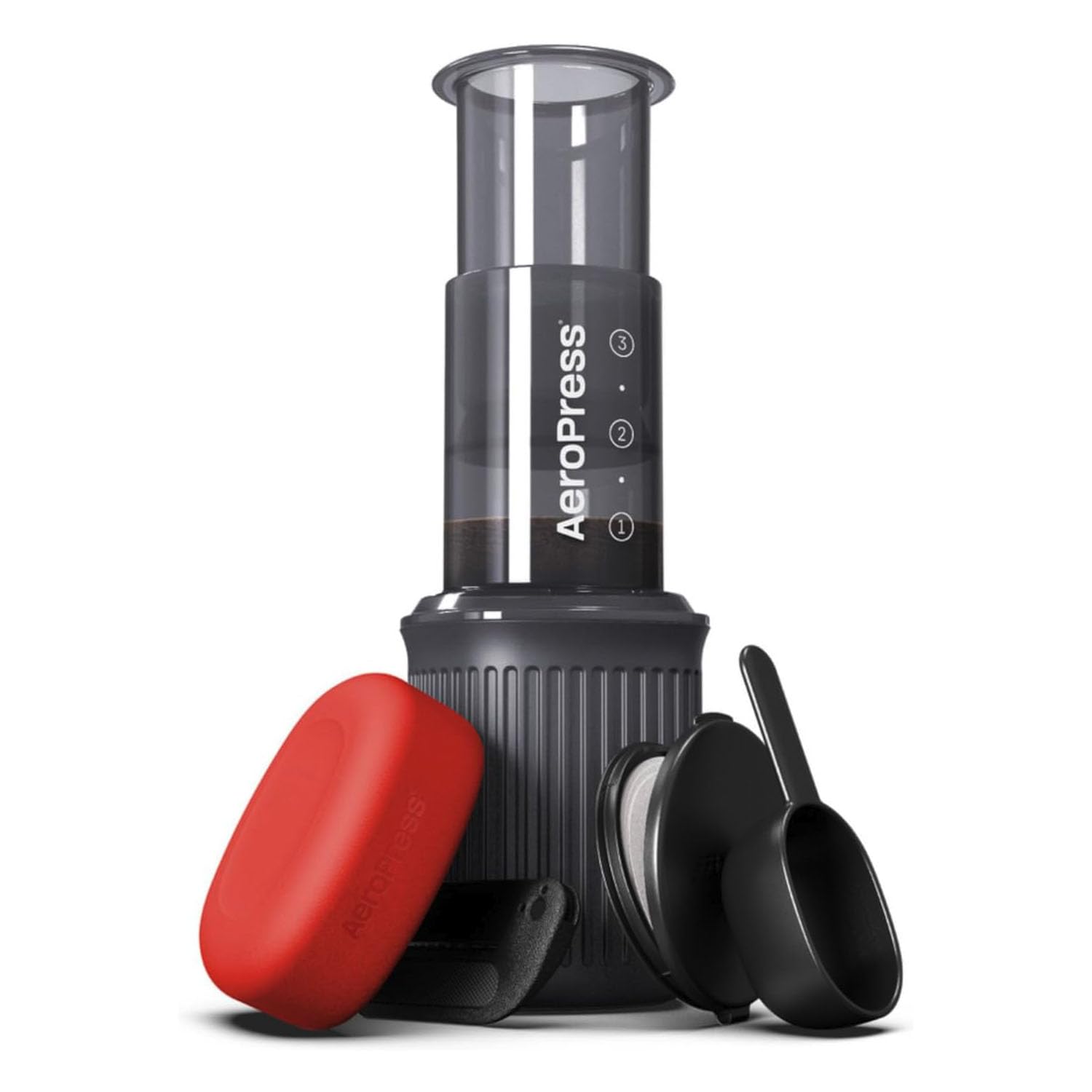
The Go is the same brewer in a smaller size with the missing pieces included: a mug and a lid. The brewer nests inside the mug, the lid goes on, and what you have in the pack is one cylinder instead of three separate things to remember.

We expected the smaller brewer to feel like a compromise and it doesn't. Eight ounces is a proper cup, the press still takes about thirty seconds, and the mug is good enough to drink from at home. At 318 grams the whole kit is heavier than the Original, and the difference is mostly the mug and lid you're no longer carrying separately.

Where the Go earns its place is the trip where the car stays at the trailhead: one object in the pack, nothing left on the picnic table, and a mug that survives being sat on. For car camping, the Original's extra capacity and lower weight make more sense.

Pros

  • Brewer, mug and lid nest into one packable cylinder
  • Brews in about two minutes with no power
  • Mug included, so nothing else has to be packed

Cons

  • Costs more than the Original for a smaller brew
  • Filter holder does not snap shut
Our verdict

For backpacking, hotel rooms and any trip where the truck isn't the kitchen, the Go is the version we pack — a complete kit in one cylinder.

Check Latest Price
3

Best Ultralight Option

Attsky Collapsible Pour Over

92 /100
Angler Score Outstanding

Key details

Material
Food-grade silicone
Quantity
2-pack
Filter Size
#2 cone
Heat Rating
Up to 464°F
Check Details on Amazon

The Attsky is the cheapest thing on this list and the smallest, and those two facts are most of its case. Two food-grade silicone cones, each rated to 464°F and BPA-free, each folding flat enough to disappear into a jacket pocket. We keep one in the daypack and one in the car and have stopped noticing either.

It's a holder, not a filter. The cone takes a standard #2 paper filter, which you supply, and forgetting them means drinking grounds. Our fix is to fold a small stack of filters inside one of the cones before the trip, which keeps both the filters and the cone corralled in the bag.

The silicone is soft, and that has one consequence worth knowing: pour a full kettle through and the walls flex a little, so you steady the cone with one hand while the other pours. The other is that you can't see how full the mug is getting, so lift it once mid-pour or brew into something you can see through. Neither one is a dealbreaker for what this costs.

Pros

  • Folds flat enough for a jacket pocket
  • Two drippers in every pack
  • Food-grade silicone rated to 464°F
  • Dishwasher safe at home

Cons

  • Needs your own #2 paper filters
Our verdict

For a trip where every ounce is accounted for, this is the dripper we take: two silicone cones, a filter, and nothing else.

Check Latest Price
4

Best Budget Percolator

Farberware Yosemite Percolator

91 /100
Angler Score Outstanding

Key details

Filter
Permanent basket
Weight
2.3 lb
Capacity
8 cups
Material
Stainless steel
Check Details on Amazon

The glass knob on the lid is the whole appeal: you watch the coffee rise, count the perking, and turn the burner down when it's the color you like. There's a reason this shape has barely changed in a century, and it's that a percolator turns a burner and a pot of water into eight cups of coffee with no filters and no fuss.

The body is stainless steel polished to a mirror finish, the basket is permanent, and the pot goes in the dishwasher once you're home. For four people on a two-burner stove, this is the pot we take over everything else here — least fuss per cup of the stovetop options: fill, load, light, watch, pour. Nothing to prime, nothing to plunge, nothing to remember at 6 a.m.

At 2.3 pounds it's a car-camping pot rather than a backpacking one, which is exactly how we treat it: it lives in the tote with the enamel mugs and never goes in a pack.

Two things to check. It's specified for gas stovetops, which suits a propane camp stove perfectly; on a coil or induction burner at home, confirm the base before you buy. And give it a level, wide burner, because a full eight-cup pot is tippy on a tiny canister stove.

Pros

  • Stainless steel body with a mirror finish
  • Permanent basket means no filters to buy
  • Dishwasher safe once you're home
  • Eight cups from a single burner

Cons

  • Lid knob is the weakest point
Our verdict

For a group with a camp stove and a tote full of mugs, this is the percolator we reach for: eight cups, stainless, and no filters to remember.

Check Latest Price
5

Best Large-Capacity Percolator

COLETTI Bozeman Percolator

89 /100
Angler Score Excellent

Key details

Filter
Disc filter
Weight
2 lb
Capacity
12 cups
Material
Stainless steel, glass view top
Check Details on Amazon

The Bozeman's pitch is what's missing. No aluminum, no plastic in the brew path — just stainless steel and a glass view top. If you've avoided percolators because of the cheap aluminum pots you remember, this is the correction.

For a basecamp of five or six, this is the percolator we take over the Farberware. Twelve cups — about five mugs, or a full 60 ounces — covers a crowd with seconds, and the coffee comes out full-bodied without the metallic edge that gives cheap pots away. Watching the perk through the glass top is also the easiest way to learn your own timing; the coffee tells you when it's done.

The basket is a disc filter, the whole pot is dishwasher safe, and it's listed for gas, electric and campfire heat, which is more than most stovetop pots will claim. Two pounds of stainless means it rides in the truck rather than in the pack.

Twelve cups is a lot of coffee for two, and this pot makes no apology for it — fine if yours is the camp that drinks a pot. If your camp is a couple and a dog, the Farberware's eight cups is the better fit and less to carry.

Pros

  • Brews 60 ounces for a crowd
  • Stainless steel throughout, no aluminum or plastic
  • Listed for gas, electric and campfire heat
  • Dishwasher safe back home

Cons

  • Glass view top is the fragile point
Our verdict

For five or six people who all want a second mug, this is the pot we bring: 60 ounces, all stainless, and a glass top to watch the perk.

Check Latest Price
6

Best Unbreakable French Press

Utopia Kitchen Stainless French Press

93 /100
Angler Score Outstanding

Key details

Weight
2 lb
Capacity
946.35 ml
Material
304 stainless steel
Filtration
4-layer
Check Details on Amazon

A glass French press gives you one hot mug and a lukewarm second one. The double wall here is the reason it earns a place in the camp box: the coffee stays hot long enough for a refill, and the outside stays cool enough to hold while you pour.

The rest is ordinary done properly. 304 stainless inside and out, a four-layer filter stack — spiral plate, cross plate, two mesh screens — that traps the fines, and a body that comes apart for washing. At 946 milliliters it's about a quart, which is a big mug each for two people and just about breakfast for four.

What settled it for us is the material. Stainless doesn't shatter in a camp box, doesn't pick up the smell of last night's chili, and rinses clean without a brush if you get to it before the grounds dry. It's the press we point people to after their second broken carafe.

Pros

  • Double wall keeps the second cup hot
  • Stainless body won't shatter like glass
  • Four-layer filter keeps grit out of the cup
  • About a quart, enough for two big mugs

Cons

  • Two pounds of steel in the pack
Our verdict

If you've already broken a glass carafe at camp, buy this one: steel, double-walled, and still hot when you come back for the second mug.

Check Latest Price
7

Group Mornings

Belwares 50 oz French Press

93 /100
Angler Score Outstanding

Key details

Capacity
50 fluid ounces
Included
2 spare filter screens
Material
304 stainless steel
Filtration
4-level
Check Details on Amazon

Fifty ounces is the number that matters. That's up to twelve four-ounce cups, or in practice four large mugs — enough that you brew once and everybody gets coffee without a second round of boiling water.

The body is double-walled 304 stainless, the filter stack is four levels deep, and there are two spare filter screens in the box, the sort of thing you only appreciate after you've lost one at a campsite. The plunger comes fully apart for cleaning, the lid twists on, and the spout pours without dribbling down the side.

It also does cold brew, which sounds like a marketing line until you're somewhere hot and want coffee without lighting a stove — coarse grounds, cold water, and time. The insulated body holds temperature either way, so the last mug of the morning is still warm.

For basecamp mornings with four or five people, this is the press we fill: one plunge covers the camp, it stays hot through breakfast, and the steel body shrugs off a truck bed. It's also the one press here that looks good enough to leave out on the picnic table.

Pros

  • Fifty ounces covers four large mugs
  • Double-wall steel holds heat through breakfast
  • Two spare filter screens included
  • Works for cold brew too

Cons

  • Matte finish chips and peels over time
Our verdict

When four or five people want coffee at once, the Belwares does it in one plunge: 50 ounces, insulated, and tough enough for the truck bed.

Check Latest Price

How We Tested Camping Coffee Makers

We started with a shortlist of more than 40 camping coffee makers and narrowed it by capacity, packed size, material, and whether replacement parts were available. The goal was a mix of pour-over drippers, percolators, French presses, and press-style makers that could plausibly earn space in a camp box. Over four months, we tested 15 of them on weekend car-camping trips, at picnic tables, on tailgates, and on a camp stove in my driveway on cold, windy mornings.

Each maker got the same medium roast, measured to its recommended dose, and we tasted every batch black and with milk, noting bitterness, sediment, and whether the coffee stayed hot through a second cup. We timed the brew from first pour to last, assembled each one with cold hands, and used it a second time without the instructions. After breakfast, we washed everything in a camp basin with cold water and a little soap, looking for grounds trapped in mesh, oily film on carafes, and parts that needed a bottle brush.

We also packed each maker into a cook kit and a daypack, checked whether lids leaked in a tote, and noted whether it doubled as a server or cup. Durability got the least gentle treatment: repeated pack-unpack cycles, knocks off the picnic table, and a few rides loose in the truck bed, followed by checks for dents, loose handles, stretched seals, and cracks. At the end, we compared construction and cleanup effort against what each maker cost, because value matters more when a gadget has to justify its pack space.

How to Choose a Camping Coffee Maker

Start With How You Boil Water

Two families of brewer live here. Presses, pour-over cones and the AeroPress need nothing but hot water and a mug, so a canister stove and a kettle is the whole setup. Percolators sit on the burner themselves, which means more weight but no separate kettle and no balancing a cone in the wind. If you already carry a stove for dinner, a press costs you almost nothing extra; if you cook over a fire ring, a percolator is the simpler answer.

Do the Cup Math First

The word cup is where camp coffee goes wrong. Percolators count a cup as five ounces and some presses count four, so a twelve-cup pot is really about five mugs and a thirty-four-ounce press is two. Count the actual mugs you'll fill at 6 a.m., then allow a little extra if there's a thermos to top up. Our rule of thumb is ten ounces of brewed coffee per person for a single round.

Weigh It Against the Rest of Your Kit

An AeroPress is 6.4 ounces; a stainless percolator is two pounds or more before you add coffee. That gap is irrelevant when the car is twenty feet away and decisive when it isn't. Think about which bag it goes in, not just which brewer makes the better cup — a two-pound pot that stays in the truck beats a six-ounce press you left on the kitchen counter.

Know Which Part Breaks

On this list, the failures cluster in glass. Carafes crack in the sink, view tops break in transit, and one hot pour into a cold carafe can finish the job. Stainless bodies dent rather than shatter, which is why every press and pot we recommend is steel. If you're set on glass, pack it in a towel and expect to replace it before the season is out.

Count What You'll Consume and Wash

Paper is the quiet recurring cost: the AeroPress takes micro-filters, the silicone dripper takes #2 cones, and percolators and steel presses take none. Then there's the washing up. A press leaves a slurry of grounds, a dripper leaves a filter and a cone to rinse, and a percolator basket knocks out into the fire pit. If water is scarce, the brewer with the fewest parts wins.

Frequently Asked Questions

Final Verdict

Pack the AeroPress Original. It weighs less than a mug, needs nothing but hot water, and makes a cup that stands with what you drink at home, and the paper filter means no grit and no carafe to break on the way back.

The one thing that changes the answer is volume. For four or more people, the COLETTI Bozeman's 60 ounces or the Belwares' 50-ounce press gets everyone served before the first cup goes cold.