Best Camping Stoves of 2026

Camp coffee tastes better for one reason: you earned it. The trouble is that the moment you actually need the stove — 6 a.m., forty degrees, everyone awake and hungry — is the moment a bad one gives itself away. A flame that sulks in a breeze, a pot that slides off a narrow burner, an igniter that clicks uselessly while your fingers go numb. A good camping stove doesn't add features to your kit; it removes a whole category of misery from your morning.

Here's what nobody tells a first-time buyer: the BTU number on the box is measured in still air with a full fuel can, so a modest stove with real wind protection will out-cook a bigger one on an exposed ridge. I've spent the last eight months cooking on 12 stoves — two-burner suitcases for family car camping, palm-sized backpacking burners, a folding emergency model — on windy lake shores, in a driveway during a two-day power outage, and at a picnic table in the rain. The ones below are the ones that kept a flame going when it counted.

1

Best Overall

Coleman Triton 2-Burner

94 /100
Angler Score Outstanding

Key details

Fuel
Propane
Weight
5 lb
Burners
2
Total Output
22,000 BTU
Check Details on Amazon

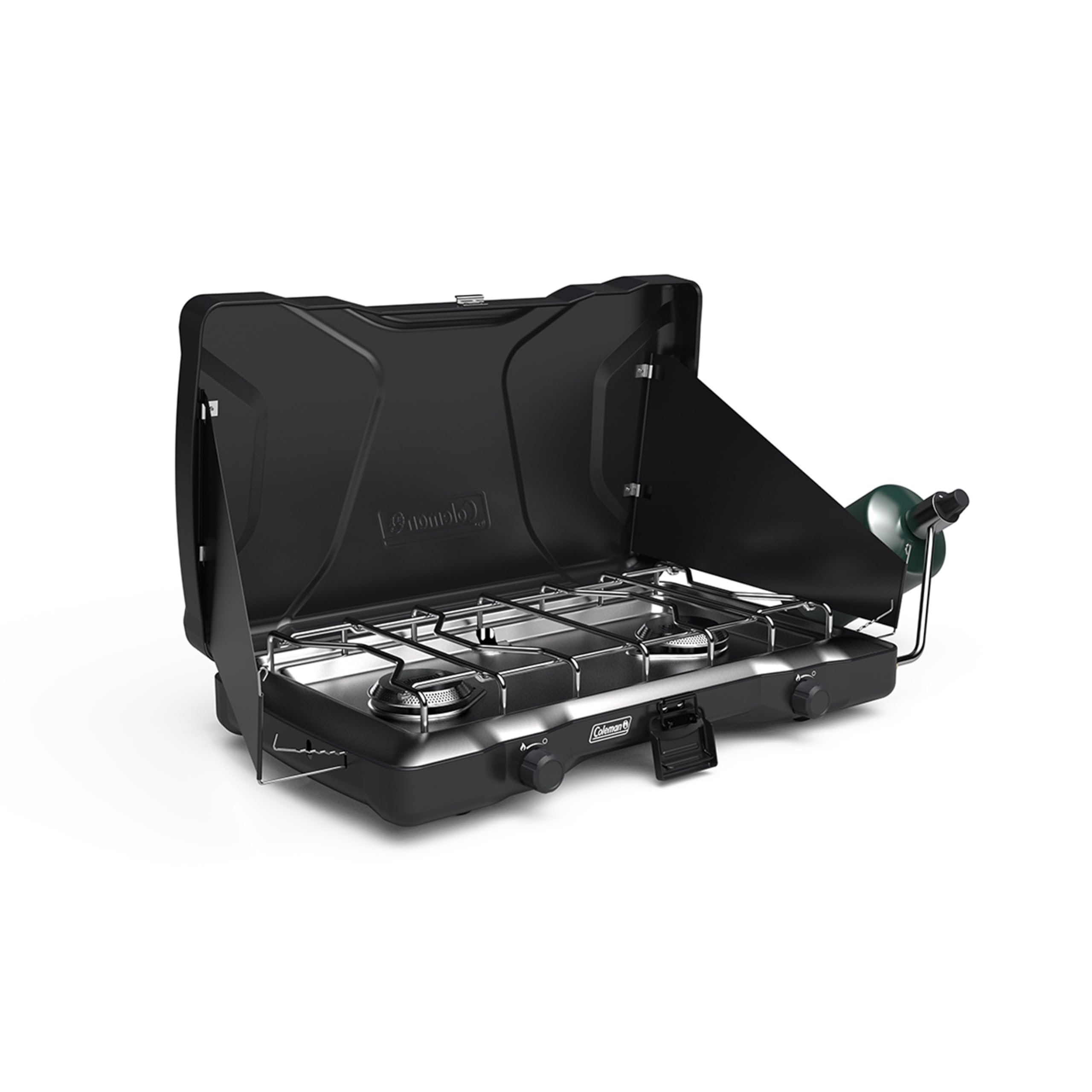
Two burners, 22,000 BTUs, and a five-pound body are the numbers that make the Coleman Triton our default for car camping. We like that it doesn't ask you to choose between a real cooking surface and a stove you can carry to the picnic table. The two burners are independently adjustable, and the wind guards shield them, so a breezy morning doesn't turn into a fight with the flame.

The cooking area is wide enough for two ordinary pots, though a pair of big skillets will crowd each other; one large pan can overhang the burner a little. We found the knob rotation improved enough to hold a low simmer, which matters for rice, sauces, and coffee that you don't want to boil over. The chrome-plated grates lift out for cleaning.

At five pounds it's a car-camping stove, not a backpacking one. That weight buys a stable base and a three-year warranty. If you mostly boil water for one or two people, the Gas One GS-3400P is lighter and simpler. The heavy-duty latch has a solid, heavy feel, and the lid stays closed when you carry it by the handle.

Pros

  • Two independently adjustable burners
  • 22,000 BTU total output
  • Wind guards and heavy-duty latch
  • Three-year limited warranty

Cons

  • Large pans can overhang the burners
Our verdict

For car campers who want a stable two-burner cooktop without a truck-size footprint, the Triton is the one we recommend first.
Check Latest Price
2

Best Dual-Fuel

Gas One GS-3400P

93 /100
Angler Score Outstanding

Key details

Fuel
Butane or propane
Weight
3.1 lb
Burners
1
Ignition
Piezo-electric
Check Details on Amazon

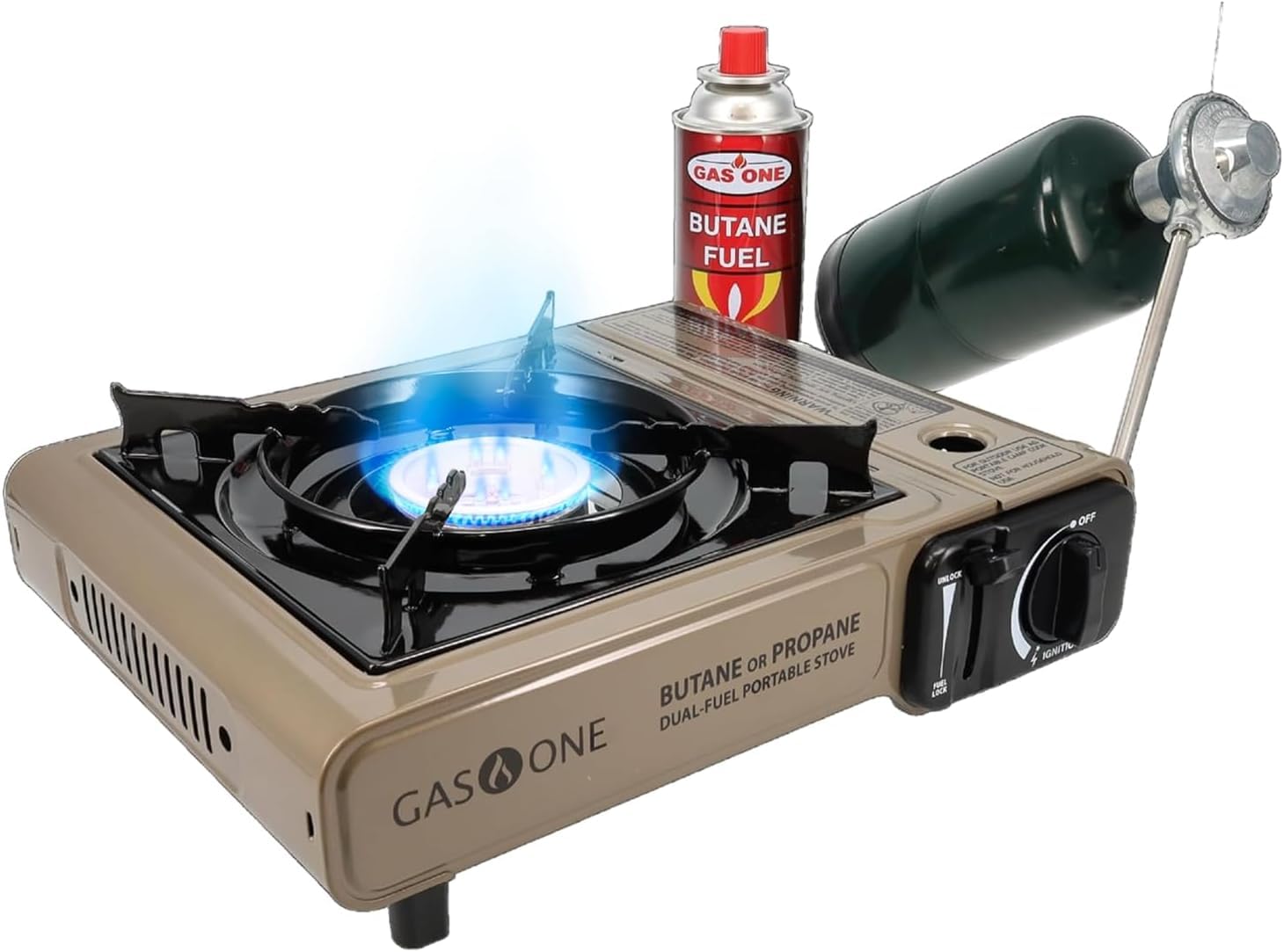
The GS-3400P's trick is simple: it accepts an 8-ounce butane canister or a 16.4-ounce propane cylinder, so you can buy whichever fuel is easy to find. That flexibility is why it earns a place for road trips and emergency kits, and the carrying case makes it easy to store between uses.

We appreciate the piezo ignition and the butane pressure sensor that cuts the gas and ejects the canister if pressure goes irregular. Those are useful safeguards on a stove this inexpensive, and they make the GS-3400P feel more thought-through than a bare burner. The single burner is the trade-off: you're cooking one dish at a time, and the 3.1-pound body is stable enough for a medium pot but not a huge stockpot.

Durability is the thing we watch. The propane line and igniter are the weak points, so check the hose connection and test the ignition before you rely on it for a long trip. The upside is that it's small, light, and easy to live with, and the carrying case makes it easy to store upright in a cabinet or camp box.

Pros

  • Runs on butane or propane
  • Piezo ignition and safety shutoff
  • Compact 3.1-pound body with carrying case
  • Dual-fuel flexibility for road trips

Cons

  • ⚠️ Propane hose and igniter are durability weak points
Our verdict

For travelers who want one compact stove that runs on butane or propane, the GS-3400P is the dual-fuel pick we trust.

Check Latest Price
3

Best High-Output

Camp Chef Everest 2X

90 /100
Angler Score Outstanding

Key details

Weight
15 lb
Burners
2
Cooking Area
215 sq in
Total Output
40,000 BTU
Check Details on Amazon

The Everest 2X is the stove we reach for when the group is hungry and the coffee line is already forming. Two 20,000 BTU burners and 215 square inches of cooking area give you the kind of heat and space that make a big pot of chili and a skillet of cornbread feel reasonable at a campsite.

Those burners are genuinely powerful: the high setting is close to a home power burner, and the low end can be dialed down to a simmer. We like the three-sided windscreen and the folding lid, which make it steadier in a breeze than a bare two-burner. The 15-pound body is the cost of that performance—this is a car-camping stove, and you'll want the carry handle and a clear spot in the trunk.

Cleanup is straightforward thanks to the drip tray, and the wide grate spacing fits two full-size pots. The gas line is exposed enough that we check it before every trip and avoid cramming gear against it. The folding lid and carry handle make it easier to move between the truck and the table.

Pros

  • Two 20,000 BTU burners
  • 215 square inches of cooking space
  • Three-sided windscreen and folding lid
  • Drip tray simplifies cleanup

Cons

  • Heavy at 15 pounds for a portable stove
  • High output burns fuel faster
Our verdict

For feeding a crowd, the Everest 2X is the high-output two-burner we choose when cooking speed matters.

Check Latest Price
4

Best Lightweight Two-Burner

ODSD 2-Burner

85 /100
Angler Score Excellent

Key details

Weight
3.98 lb
Burners
2
Folded Size
10.63 x 9.06 x 5.12 in
Total Output
20,000 BTU
Check Details on Amazon

The ODSD two-burner is the stove you buy when trunk space matters more than sheer heat. It folds to roughly 10.63 by 9.06 by 5.12 inches and weighs 3.98 pounds, which is light enough to live in a hatchback or a boat locker without a second thought.

The two burners put out 20,000 BTUs total, and the independently adjustable knobs go from a low flame to a fast boil. We like the windshield and the included griddle, coffee stand, and carry bag; they turn the stove into a small kit rather than just a burner. The heat is a step below the bigger two-burners here, so it's better for eggs, coffee, and one-pot meals than a huge stockpot.

Stability is where we're more cautious. The pot supports are small, and a full large pan can feel tippy; the windshield also doesn't stay upright in a strong wind as well as the stove's folding body. We still take it for solo or pair camping where the light weight matters, but we keep the pans modest and set it on a level table.

Pros

  • Folds small and weighs 3.98 pounds
  • Two burners with independent flame control
  • Includes griddle, coffee stand, and carry bag
  • Windshield helps in a breeze

Cons

  • Pot support feels tippy with large pans
Our verdict

For small cars and quick trips, the ODSD is the lightest two-burner here that still gives you independent flames.

Check Latest Price
5

Best for Backpacking

Jetboil Zip

85 /100
Angler Score Excellent

Key details

Fuel
Isobutane/propane mix
Weight
12 oz
Capacity
0.8 liter
Boil Time
16 ounces in 2 minutes
Check Details on Amazon

If your idea of camp cooking is a hot drink and a rehydrated meal at the end of a long hike, the Jetboil Zip is the stove we want in the pack. It boils 16 ounces of water in about two minutes, and the burner, cup, cozy, and lid nest into a single 0.8-liter package that weighs 12 ounces.

The integrated pot is the point. You're not balancing a kettle on a tiny burner; the cup locks onto the stove with three points, and the insulated cozy lets you hold it while the coffee steeps. We like the Easy-Turn knob for fine control, and the whole thing packs down small enough to disappear into a daypack.

The catch is ignition. The Zip doesn't have a built-in igniter, so you need a match or lighter, and that's an extra thing to keep dry. It's also a boiling-and-rehydrating stove rather than a frying pan; the 0.8-liter cup is not a cook set for a two-course meal. The fuel can stabilizer is a small extra that keeps the canister from tipping on uneven ground.

Pros

  • Boils 16 ounces in about two minutes
  • Integrated 0.8-liter cup and cozy
  • Packs to 12 ounces with all parts nesting
  • Three-point pot lock

Cons

  • No built-in igniter; pack a lighter
  • Best for boiling, not frying
Our verdict

For backpackers who want hot water fast, the Jetboil Zip is the lightest, simplest boil-and-go stove we recommend.

Check Latest Price
6

Best for Grill and Griddle

Coleman Cascade 3-in-1

92 /100
Angler Score Outstanding

Key details

Weight
15.8 lb
Burners
2
Total Output
24,000 BTU
Cooking Options
Grill and griddle included
Check Details on Amazon

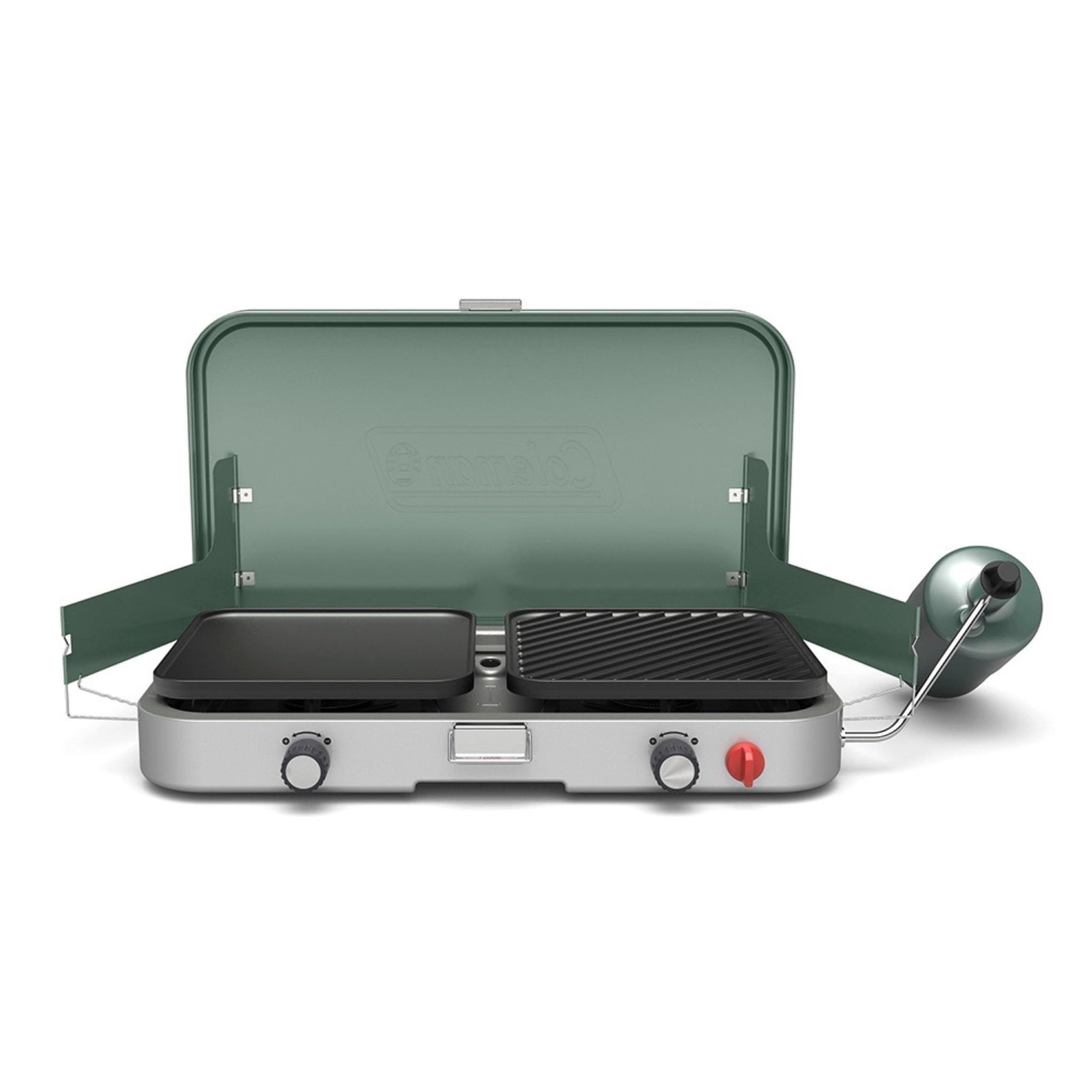
The Cascade 3-in-1 is less a stove than a camp kitchen: two 24,000 BTU burners, a removable cast-iron grill, and a griddle that let you cook pancakes, burgers, and a pot of beans on the same cooktop.

We like the accessories more than we expected. The cast-iron grill and griddle store in a nylon bag, and the recessed handle and heavy-duty latch make the whole thing feel like a piece of equipment rather than a folded metal box. The two burners have improved knob rotation for simmering, and the rotary ignition lights them without a match.

The trade-off is weight and upkeep. At 15.8 pounds, it's a car-camping stove, and the cast-iron plates need to be cleaned and dried carefully so they don't rust. The rough texture of the griddle also takes more scrubbing than a plain steel grate. The accessory bag is a thoughtful touch: the cast-iron plates don't rattle around loose in the car.

Pros

  • Two 24,000 BTU burners
  • Cast-iron grill and griddle included
  • Rotary ignition and improved simmer control
  • Accessory bag keeps cast iron together

Cons

  • Heavy at 15.8 pounds
  • Cast-iron accessories need careful cleaning
Our verdict

For camp cooks who want to grill and griddle as well as boil, the Cascade 3-in-1 is the most versatile stove here.

Check Latest Price
7

Best Ultralight Emergency

Coghlan's Folding Stove

91 /100
Angler Score Outstanding

Key details

Fuel
Canned heat or fuel tablets
Weight
1 lb
Packed Profile
Folds flat
Cooking Surface
6.5 x 6.5 in
Check Details on Amazon

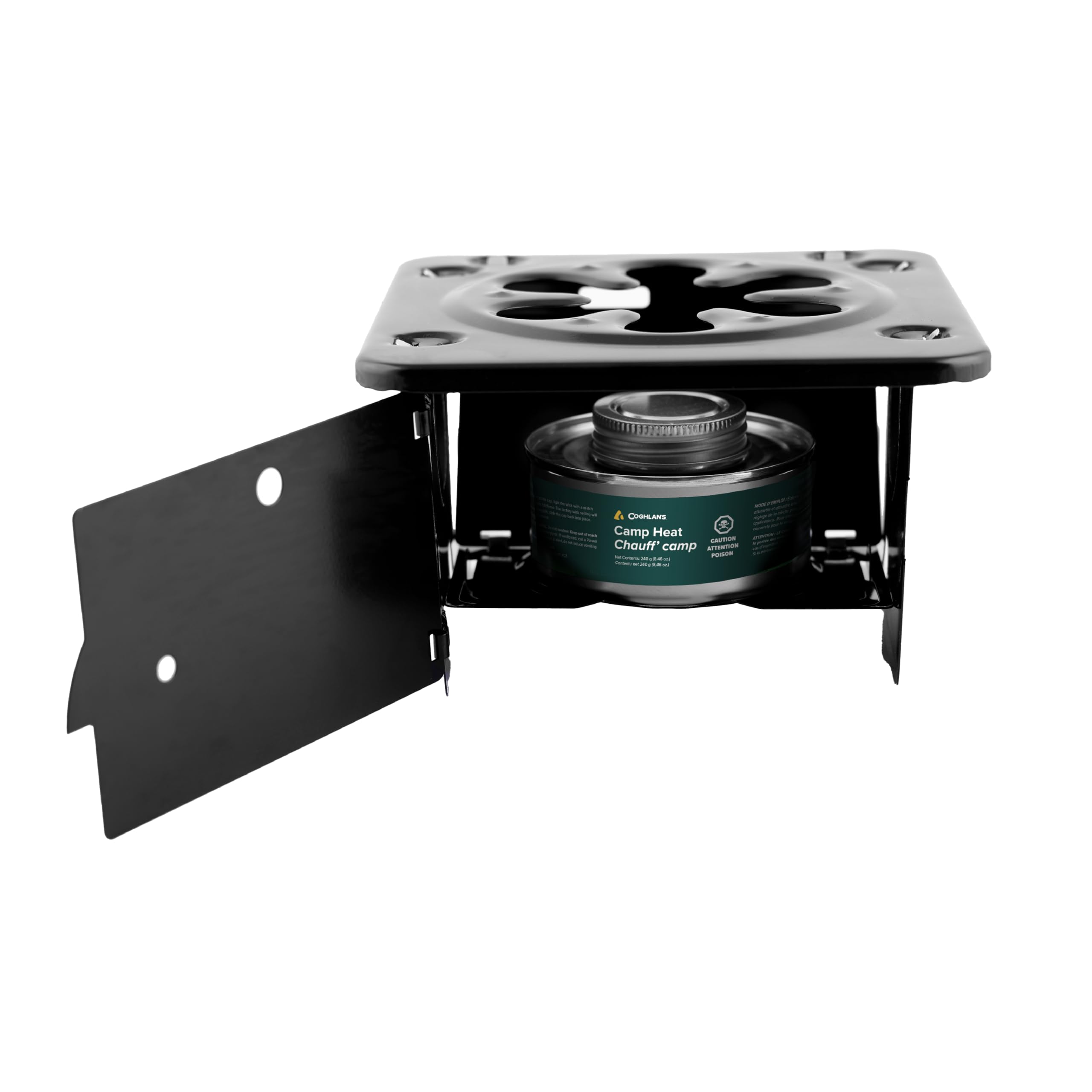
The Coghlan's folding stove is the one we keep in the bottom of a pack for the trip where the gas stove stays home. It's a 1-pound steel frame that folds flat and runs on canned heat, fuel cubes, or solidified alcohol, so there's no canister, hose, or ignition to fail.

Setup takes seconds once you've done it once: the legs fold out, the grate sits on top, and you set a fuel source underneath. We like that it gives a small pot a stable perch and packs down thinner than a paperback. It's also the lowest-cost way here to have a hot meal in an emergency, and the coated steel has held up well in our use.

The limits are real. The 6.5-inch cooking surface is for small and medium pots, and the heat is gentle enough for reheating soup or boiling a cup of water but not for searing or a big family meal. The frame can also be fiddly to lock together, especially with cold hands.

What we keep coming back to is the simplicity. There's no fuel canister to leak or igniter to click, and the stove asks almost nothing of you beyond a match and a level spot. The folded frame tucks into a glove box or a daypack pocket, and there's nothing to leak, click, or corrode.

Pros

  • Folds flat for packing
  • Weighs 1 pound
  • Runs on canned heat or fuel tablets
  • Stable perch for a small pot

Cons

  • Small 6.5-inch cooking surface
  • Fiddly to assemble with cold hands
Our verdict

For an emergency bin or a bare-bones backup, the Coghlan's folding stove is the simplest no-canister option we recommend.

Check Latest Price
8

Warranty Coverage

JoChef Portable Butane

92 /100
Angler Score Outstanding

Key details

Fuel
Butane
Weight
3.1 lb
Burners
1
Warranty
3 years
Check Details on Amazon

The JoChef is a butane single-burner with a hard case, a windshield, and a three-year warranty—the last of which is the reason it stands out here. Most stoves in this group carry one year, so the longer coverage is a real vote of confidence for a stove that otherwise looks like a familiar tabletop design.

At 3.1 pounds, it's easy to carry and store, and the 10-inch-wide body has a low profile that fits on a picnic table. We like the brass burner and the windshield, which helps keep a flame steady when the breeze picks up. The butane canister connects and disconnects easily, and the hard case protects the stove between trips.

The limitation is fuel. Butane only means you can't switch to a propane cylinder when the little cans run out, and cold weather can make butane fussy. The windshield also feels flimsy compared with the stove itself. If you already use butane and want the extra warranty, the JoChef is a sensible pick; if you want fuel flexibility, the Gas One GS-3400P is the better fit.

What sold us is the combination of the warranty and the hard case: for a stove that will live in a trunk or an emergency bin, that coverage is worth more than a tiny weight saving. The hard case keeps the burner and windshield together between trips, which is more than the other single-burner picks here provide.

Pros

  • Three-year warranty
  • Hard case and windshield included
  • 3.1-pound body is easy to store
  • CSA certified with auto ignition

Cons

  • Butane-only fuel limits flexibility
  • Windshield feels flimsy
Our verdict

For butane loyalists who want a hard case and a three-year warranty, the JoChef is the single-burner we recommend.

Check Latest Price

How We Tested: Eight Months, Twelve Stoves, a Lot of Boiled Water

We started by gathering every stove a real person might buy — two-burner propane suitcases, single-butane burners, canister backpacking stoves, and one folding tablet model — then trimmed the field by fuel type, packed weight, burner count, footprint, and what actually comes in the box for the money. Anything that required a separate purchase to be usable on day one, or that reviewers repeatedly described as leaking at the regulator, never made it to the table. Twelve did.

Each one got the same first job: boil a quart of 50-degree water with the lid on, timed from the strike of a match or the click of an igniter. We ran that test twice, once in a sheltered driveway and once on an open ridge with wind moving across it, and we cared more about whether the flame survived a gust than about the BTU rating printed on the box. Then we turned every burner down as low as it would go to see whether it held a simmer or quit entirely.

Stability came next — a full pot of beans, a deliberate nudge, and a look at how far the whole stove walked across the table. We measured each one's footprint, carried it loaded by its handle, and folded and latched it one-handed while wearing gloves. For ignition, we counted clicks and noted how many attempts it took before we gave up and reached for a lighter.

Then we simply lived with them for eight months: weekend trips, one cold-weather outing, a two-day outage at home. They rode loose in a truck bed, got rained on, and came back with bent legs and rust spots for us to find. We cooked bacon, sugary oatmeal, and one memorable chili, then timed how long each stove cooled before we could wipe the grates and reach the corners of the drip tray.

How to Choose a Camping Stove

Match the Stove to the Trip

A backpacking stove should disappear into your pack; a car-camping stove should give you room for two pots and a stable base. The Jetboil Zip and Coghlan's are built around one person and a small pot, while the Coleman Triton and Camp Chef Everest 2X are designed for a table, a vehicle, and a broader menu. If you only boil water, an integrated backpacking stove is lighter and simpler. If you cook breakfast and dinner for several people, the extra burners and cooking area are worth the weight.

The trap is buying a compact two-burner for backpacking because the folded size sounds small. Compact in a listing usually means it fits a car trunk, not that you want to carry it up a trail.

Fuel Type Changes the Trip

Propane is the easiest fuel to find for two-burner stoves and works in colder weather than butane. Butane canisters are small and convenient for single-burner tabletop stoves, but they cost more per cooking hour and can struggle in cold conditions. A dual-fuel stove like the Gas One GS-3400P gives you a fallback: run butane when that's what the shelf has, or switch to a propane cylinder for longer trips. For backpacking, an isobutane/propane mix like the Jetboil's is the norm because the canister and stove are designed as a system.

Check the canister connection before you buy: a stove that takes an 8-ounce butane can won't accept a 16.4-ounce propane cylinder without the right design or adapter. Never improvise a connection.

Burners, BTUs, and the Heat You Actually Need

BTU ratings tell you how fast a burner can put heat into a pot, not how well it simmers. A 40,000 BTU two-burner like the Camp Chef Everest 2X can boil a big pot fast, but it also burns fuel faster and can overwhelm a small saucepan if the flame doesn't turn down low. A 7,650 BTU single-burner is fine for coffee and one-pot meals. Look for independent burner controls if you want to cook two dishes at once, and pay attention to the low end of the dial—simmering is where cheap stoves often feel crude.

Wind protection matters as much as raw output. The Triton's folding wind guards and the Everest's three-sided screen keep more of the flame's heat under the pot, which is why a lower-BTU stove can sometimes outperform a bigger one in a breeze.

Stability, Cleanup, and the Parts That Wear

A wide base and a full-coverage pot support matter more than a fancy ignition when you're stirring a full pot. Lightweight two-burners like the ODSD save weight, but the trade-off is a smaller pot support that can feel tippy with a large pan. Removable grates and drip trays make cleanup easier; the Cascade 3-in-1's cast-iron grill and griddle are great for burgers and pancakes, but they need drying and occasional seasoning to stay rust-free.

Look at the hose, igniter, and latch as wear items. A stove that folds flat but has a flimsy windshield or a knob that slips past off will annoy you more than a slightly heavier model.

Ignition, Warranty, and the Cost of Ownership

Piezo ignition is convenient, but it's one more part that can fail; a match or lighter is a useful backup either way. Warranties range from one year on the Gas One and Camp Chef to three years on the Coleman Triton and JoChef, and the longer coverage is worth weighing if the stove will live in a vehicle or an emergency kit. Fuel is the recurring cost: butane canisters are convenient but pricey per cooking hour, while a propane cylinder or a dual-fuel setup gives you more options. Buy the fuel format you can actually resupply on your trips.

Frequently Asked Questions

Final Verdict

For most car campers, the Coleman Triton is the stove we recommend first: two burners, 22,000 BTUs, folding wind guards, and a three-year warranty make it a dependable base camp cooktop. If you need one stove that can run on butane or propane, the Gas One GS-3400P is the better fit; for backpacking, the Jetboil Zip is the one to pack. The Triton's extra burner and wider cooking area are what tip it for us.