Best Camping Water Containers of 2026

A full five-gallon jug weighs about 40 pounds, and it only has to tip over once in the back of a car to make a mess of a trip — water into the floor mats, into the sleeping bags, into the one towel that stayed dry. What a good camping water container actually fixes is the gap between your kitchen tap and a site with no spigot: it carries the water there, sits steady on a picnic table, and pours a cup without you having to deadlift the whole thing. The category splits into rigid jugs and collapsible bags, and which one suits you comes down to whether you're driving to a site or carrying everything in.

Over the past eight months my team and I have filled, hauled, dropped, and refilled 14 of these, from squat 2-gallon foldables to a 7-gallon rigid tank, and the spread is wider than the price tags suggest. Here's the thing a first-time buyer won't know: the gallon count on the label tells you almost nothing. Look at the opening and the cap — a wide mouth is easier to fill and scrub, but it's also the hardest thing to seal, which is why the containers that never leaked tended to be the ones with a plain screw cap and a gasket you can actually see. The ones worth your money are just below.

1

Best Overall

Reliance Aqua-Tainer 7 Gallon

95 /100
Angler Score Outstanding

Key details

Capacity
7 gallons
Material
Polyethylene (PE)
Dimensions
15.3"D x 11.3"W x 15.3"H
Dispensing
Hideaway spigot with reversible cap and screw-on vent
Check Details on Amazon

Seven gallons is the number that decides whether this jug suits you. At a drive-in site with two or three people it covers drinking, cooking, dishwater, and handwashing for a long weekend without a refill run. Solo, or parked a quarter mile past the gate, it is more water than one trip needs.

What earns it the top spot here is how well the shape matches the way camp water gets used. The molded contour grip gives you something to hold while the jug is heavy, the flat base sits still on gravel or a picnic table, and the spigot is low at the front so you can fill a bottle or a basin without tilting the body. The screw-on vent is the detail we ended up caring about most: air goes in as water comes out, so the stream stays steady instead of gulping and splashing down your wrist. It is the container in this set that most people can fill, set down, and forget about until dinner.

Sun is the thing to plan around. Prolonged direct exposure makes the polyethylene brittle, which is the pathway to the cracks that end these jugs early. Keep it under a tarp, a bed cover, or the shade of the vehicle between fills and it will take years of trips; park it on a sunny trailer lid between seasons and it will not.

Two smaller touches we appreciated: the spigot cap reverses to cover the nozzle in transit, so it does not arrive gritty, and the rectangular body stacks with another one in the garage when both are empty. Neither is a reason to buy. Both are reasons it stays in the truck.

Pros

  • Largest capacity in this set
  • Screw-on vent keeps the flow steady
  • Reversible spigot cap protects the nozzle
  • Stacks empty and sits flat

Cons

  • Heavy and awkward to lift when full
Our verdict

Our default for campsite water: seven gallons, a vented spigot, and a body that sits still wherever you set it down.
Check Latest Price
2

Best for Rugged Use

Scepter Military-Style 5 Gallon

93 /100
Angler Score Outstanding

Key details

Weight
4.5 lb
Capacity
5 gallons (20 liters)
Material
BPA-free high-density polyethylene
Dimensions
6.8"W x 18.75"H
Check Details on Amazon

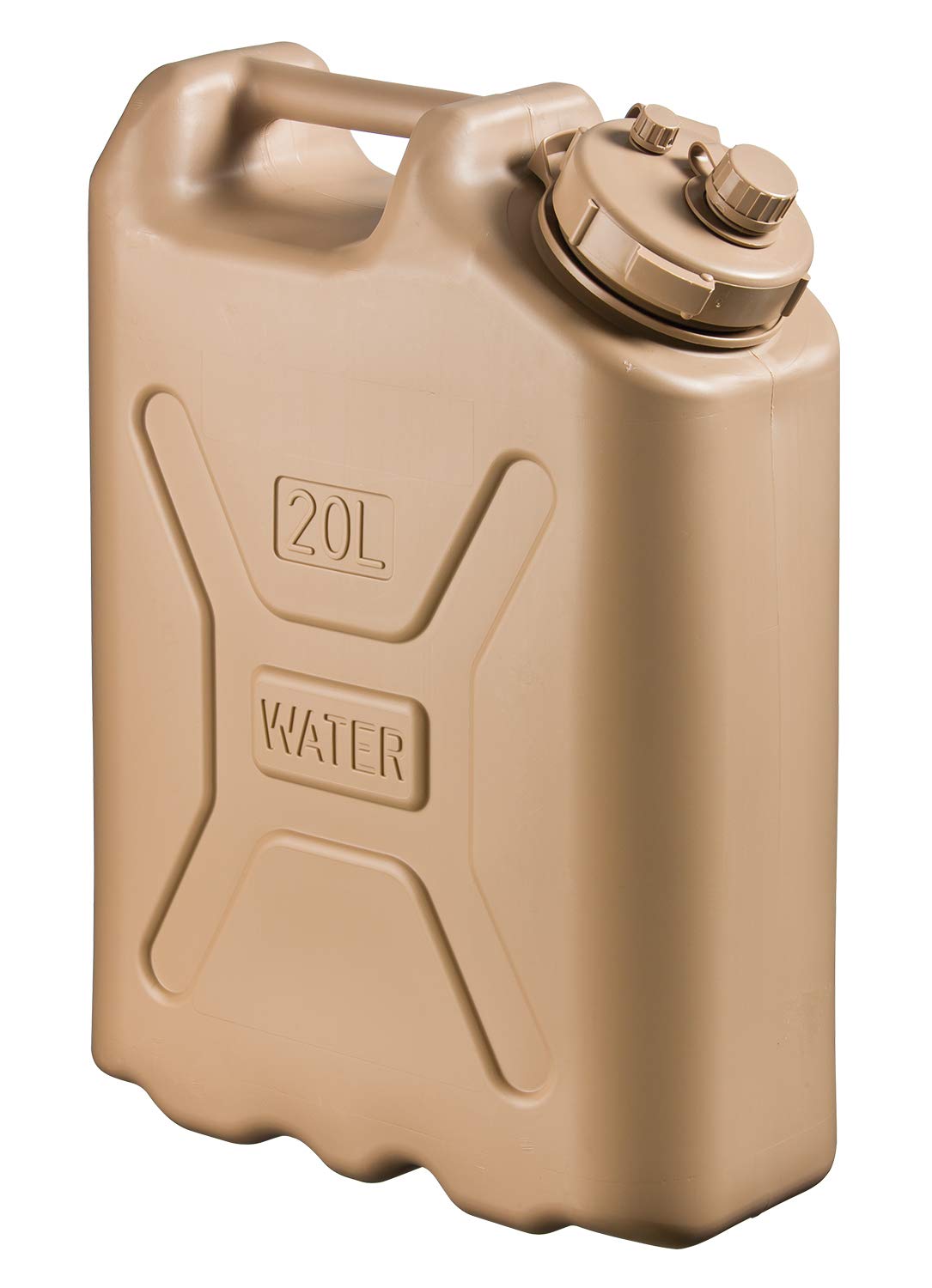
This is the most expensive jug in the group, and the money goes into the molding rather than the fittings. Walls this thick and a bottom seam this solid are what you notice first; set it down on rock or let it ride out a washboard road and the body shrugs it off. If you want one container that survives a decade of truck beds, this is the one we reach for, and that is the calculation the price asks you to make.

The shape does quiet work too. At 6.8 inches wide it slides behind a seat or between a cooler and a wheel well, the carry handle is molded into the body rather than bolted on, and 5 gallons is enough for two people over a couple of days. It is BPA-free high-density polyethylene, and the 4.5 pounds it weighs empty is the tax you pay for the wall thickness.

Loaded, it is a two-hand object, and that is the deal you make for the build: five gallons on board and a body that does not flex when you set it down hard. The handle is wide enough for a gloved hand, which matters more at a cold morning tap than it sounds. Nothing about it feels like it was designed to a price.

Pros

  • Built heavier than anything else here
  • Narrow enough to fit behind a seat
  • Molded-in handle with no bolted-on parts
  • BPA-free HDPE with a solid bottom seam

Cons

  • Cap O-ring must seat square or it seeps
  • Vent sits beside the spout, so filling takes aim
Our verdict

For a jug that lives in a truck bed and takes hits, nothing here is tougher, so long as you accept the premium and test the lid seal.

Check Latest Price
3

Best for Carrying to a Site

Digury 5 Gallon with Spigot

89 /100
Angler Score Excellent

Key details

Weight
2.25 lb
Capacity
5 gallons
Included
Adjustable shoulder strap, spigot, nylon brush
Dimensions
6"W x 14"H
Check Details on Amazon

The adjustable shoulder strap is why this one earns a place. A full 5-gallon jug is not something you carry far in one hand, and with the strap over a shoulder and the slim body against your hip, water can come from a tap a few hundred yards from the site instead of from the truck.

The filling end is just as sensible. A large cap with a small air hole beside it lets water go in fast and come out smooth, and the opening is wide enough to get a hand and the included nylon brush inside for a proper clean. At 6 inches wide it tucks behind a seat, and at 14 inches tall it sits low in a cargo area.

What we like unreservedly is the balance of the thing: just over a kilo empty, dual handles that spread the load when you do lift it, and a faucet that reaches past the edge of a picnic table so a bottle fills underneath rather than against the body. Set it level on a table edge and it does everything a camp jug needs to do.

Pros

  • Shoulder strap makes long carries manageable
  • Wide fill cap with an air hole
  • Slim 6-inch body tucks behind a seat
  • Brush and spout included

Cons

  • Spigot can drip steadily if it is not seated
  • Attachment fittings feel lightweight
Our verdict

If your water source is a walk from your tent, the strap and slim body make this the jug to carry, so long as the spigot is checked before a trip.

Check Latest Price
4

Best for Easy Cleaning

COOZMENT 3.2 Gallon

89 /100
Angler Score Excellent

Key details

Weight
1.9 lb
Capacity
3.2 gallons
Included
Spigot, sealing cap, cleaning brush
Fill Opening
4-inch mouth
Check Details on Amazon

A four-inch mouth is the whole argument for this jug. Camp containers get left in a hot car with an inch of water in the bottom, and the difference between a container you can scrub with a brush and one you can only rinse is the difference between a jug that lasts and one that smells like a pond by August. We prefer three gallons we can clean to five we cannot.

Size is the second half of the case. At 3.2 gallons it stays light enough for one person to move around camp full, and the two handles let you tip it forward without wrestling it. The spigot sits opposite the fill mouth, so you can put the faucet at the table edge with the body still supported, and the included brush reaches the corners.

The proportions help as well: 7.5 inches wide and 13.7 tall fits a back-seat footwell or a shelf in a camper van, and the flat base is stable enough to set on a bench without holding it. For a couple or a solo camper who wants drinking water that tastes like drinking water, this is the container we point to first.

Pros

  • Four-inch mouth takes a hand and a brush
  • Opposite-side spigot works at a table edge
  • Light enough to handle full
  • Cleaning brush included

Cons

  • Lid O-ring can fail to seat
Our verdict

The easiest jug here to keep genuinely clean, thanks to a four-inch mouth and a brush, at a size one person can handle full.

Check Latest Price
5

Best Collapsible with a Spigot

WaterStorageCube 5.3 Gal 2-Pack

89 /100
Angler Score Excellent

Key details

Spigot
Gasketless lid and spigot
Weight
5.2 ounces each
Capacity
5.3 gallons each
Pack Size
2 containers
Check Details on Amazon

Where a rigid jug owns a shelf in the garage, these two fold into a grocery bag. That is the trade in one sentence: you give up structure and you get storage that disappears when the trip is over.

Each holds 5.3 gallons and stands upright once filled, with a spigot low on the corner that reaches over the edge of a table. The lid and faucet are gasketless by design, so there is no O-ring to lose or replace, which is a small thing until you are the one hunting for a seal at dusk with a queue behind you.

The material is where the honesty comes in. Low-density polyethylene this thin creases, and creases are where pinholes start; keep the bags upright in transit, away from sharp edges in a truck bed, and expect the fold lines to soften after a couple of seasons. The two-pack is the insurance: one can fail and you still have water for the night.

Our view is that these are the best flat-packing option in this set and not a substitute for a rigid jug, so one of each is the combination we pack for a week away. Empty, both roll into the space of a paperback and go back in the camp tote with the plates.

Pros

  • Folds flat when empty
  • 5.3 gallons per bag with a corner spigot
  • Gasketless lid means no O-ring to lose
  • Two bags give you a spare

Cons

  • Rounds out and slumps as it empties
  • Hard to dry completely inside
Our verdict

The pair we pack when car space is tight: 5.3 gallons each, a working spigot, and a fold that takes up almost nothing.

Check Latest Price
6

All-In-One Kit

YOSN 5 Gallon

91 /100
Angler Score Outstanding

Key details

Weight
2.2 lb
Capacity
5 gallons
Included
Spigot, extension tube, brush, storage bag, 1.3-gallon collapsible bag
Dimensions
7"W x 12.6"H
Check Details on Amazon

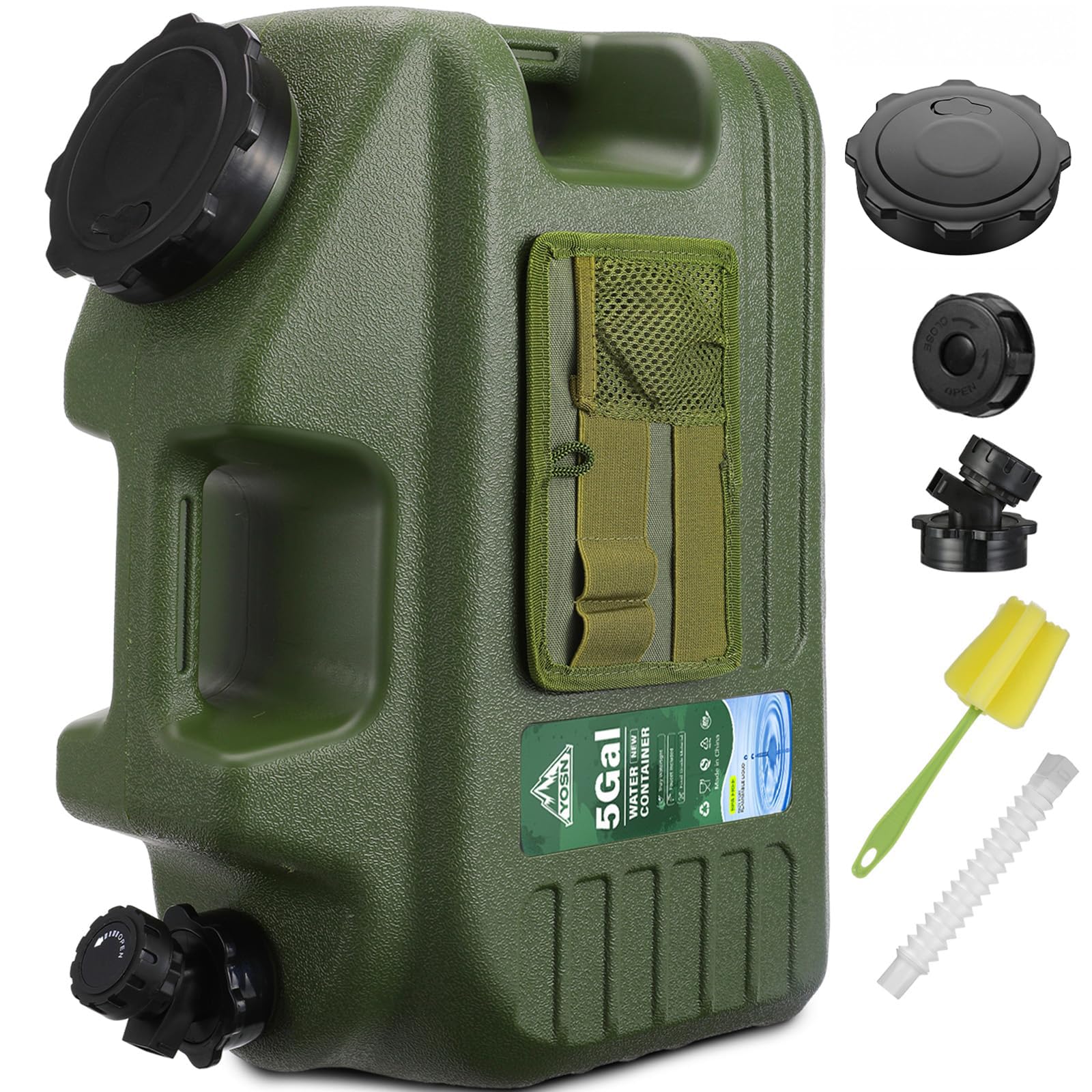
Open the box and there is more in it than with any other jug here: an adjustable spigot, an extension tube, a sponge brush, a stick-on storage bag, and a small 1.3-gallon collapsible bag for the walk to a standpipe.

The jug itself is a 5-gallon cylinder, 7 inches across and 12.6 tall, with dual handles and a wide mouth. At 2.2 pounds empty it is light to move around, and the wide mouth takes a hand and the included brush for a proper clean, which is the part that keeps a container in service for years.

What tips us toward recommending it is the spout. An adjustable faucet with an extension tube is a better setup for filling bottles and washing hands at ground level than a fixed tap, and the brush means the wide mouth stays useful rather than just large. We treat the accessories as a bonus rather than the reason to buy: the jug stands on its own as a light, easy-to-clean 5-gallon container, and the kit is what makes it a first-timer's buy.

Pros

  • Adjustable spout plus extension tube
  • Wide mouth and brush for cleaning
  • 2.2 pounds empty
  • Extra collapsible bag included

Cons

  • Round body rolls in a truck bed
  • Loose accessories are easy to lose
Our verdict

A light 5-gallon jug with the most useful set of extras here, and a sensible first container if you are starting from nothing.

Check Latest Price
7

Budget Day Trips

CoreMuse 2.1 Gal 2-Pack

87 /100
Angler Score Excellent

Key details

Capacity
2.1 gallons (8 liters) each
Openings
Separate inlet and outlet
Collapsed
Folds flat
Pack Size
2 containers
Check Details on Amazon

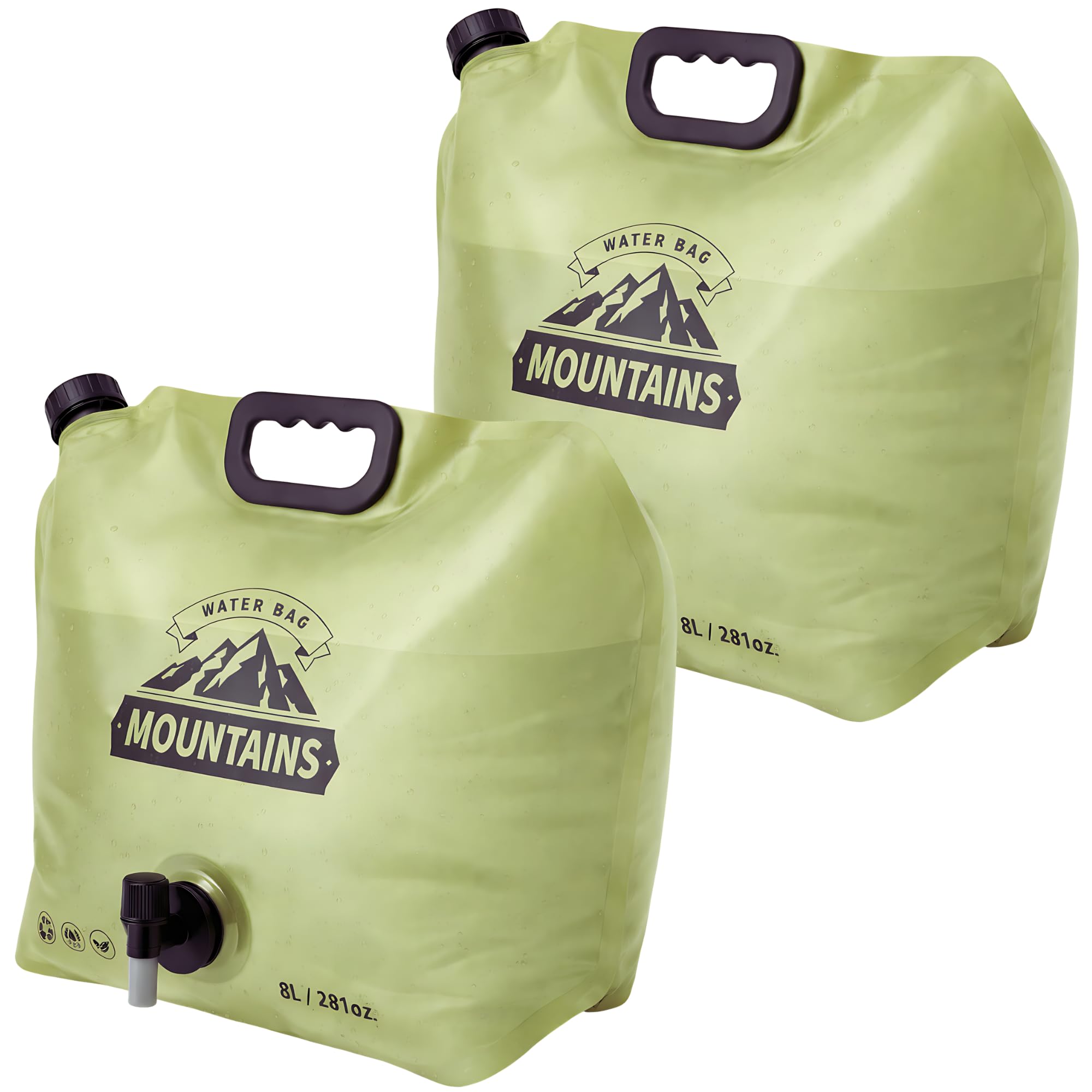
Two 2.1-gallon bags for less money than most of the single jugs in this guide is the headline. What you are buying is flexibility rather than capacity.

Small is the feature. Two gallons is roughly a day of drinking and cooking for one person, which makes these the pair to hand to a kid or leave at a second spot on the site instead of hauling one heavy container back and forth. The separated inlet and outlet are the detail we appreciate most: air goes in one opening while water comes out the other, so the flow does not stutter and you are not tilting the bag to chase the last of it.

They slump as they empty, so prop one against a cooler or hang it by the handle, and the wide fill opening takes a bottle brush without a fight. Folded, both take less room than a stack of plates, which is why ours live in the camp box year-round rather than on a shelf with the big jugs.

Pros

  • Two bags for the price of one jug
  • Separate inlet and outlet keep flow steady
  • Folds flat for year-round storage
  • Light enough for a kid to carry

Cons

  • Twist tap is stiff for small hands
  • Seams can develop pinhole leaks
Our verdict

The budget pair for short trips and small groups: two gallons each, a separate inlet and outlet, and a fold that disappears.

Check Latest Price
8

Cooler Ice Blocks

SUPANT 5L Collapsible 4-Pack

88 /100
Angler Score Excellent

Key details

Mouth
1.4-inch opening
Freezer
Freezer-safe
Capacity
5 liters (1.3 gallons) each
Pack Size
4 containers
Check Details on Amazon

Freeze them and they go into the cooler as blocks of ice that turn into drinking water as they melt. That is the trick these four 5-liter bags are built for, and it is why a set lives in our freezer between trips.

Each holds about 1.3 gallons, which is a day of drinking for one person or a handwash station for a small group. The 1.4-inch mouth is wide enough to fill from a tap without a funnel and wide enough for a bottle brush, the handle is molded into the bag rather than stitched on as a strap that can pull out, and the plastic is food-grade and BPA-free.

The clear body earns its keep too: you can see how much is left without lifting the bag, and a rinse and a shake gets most of the camp grime out. They are the containers in this set least likely to be fought over, because nobody has to be responsible for a heavy jug.

As a cooler and freezer system we think they are the smartest buy here; as your only water container they are not enough for a group. Folded, all four take up about the space of a hardback book, which is why they stay in our kit even when the big jug comes along.

Pros

  • Freezer-safe and cooler-ready
  • Wide mouth takes a bottle brush
  • Four bags pack into almost nothing
  • Clear plastic shows the water level

Cons

  • Seams weaken with repeated freezing
  • Won't stand up once partly empty
Our verdict

Buy them for the cooler and the freezer: four freezable 5-liter bags that double as ice blocks and backup water.

Check Latest Price

How We Filled, Hauled, and Dropped 14 Water Containers

We started with the containers that kept surfacing in camping forums, emergency-prep threads, and retail listings, then filtered that pool down using three practical questions: does it hold the capacity it advertises, can one person lift it when it's full, and is there a way to pour without tipping the entire jug. That left 14 containers — rigid 5- and 7-gallon jugs, 3-gallon stackables, and collapsible bags from 2 to 5 gallons — which have now been in rotation for eight months.

Every container was filled at my kitchen sink and then lived through weekend trips, one long dusty week of car camping, and a stretch in the garage between outings. At the sink, I timed how long a full fill took and checked whether the opening was wide enough to get a bottle brush inside. Full, each one was weighed and carried by its handle the roughly 100 yards from car to campsite, which is where handle shape and balance stopped being abstract — a few dug into my fingers before I'd crossed the parking lot.

Leaks got their own routine. I laid each full container on its side in a trunk for a two-hour drive, set it upside down on a picnic table overnight with a dry paper towel underneath, and opened and closed every spigot 30 times to see whether the seal came back or started weeping. For taste, water sat in each container in a hot car for a full day before I poured a glass, and the collapsible bags were folded and unfolded 20 times while I watched the seams and measured how small they packed into a duffel. The last round was plain clumsiness: each full container was shoved off a tailgate onto gravel, then checked for cracked lids, split handles, and hairline seams.

How to Choose a Camping Water Container

Match capacity to the walk, not the campsite

Camp water math is rough and forgiving: about a gallon per person per day for drinking and cooking, more if you are washing dishes. A 5-gallon jug is two people for two days, the 7-gallon Reliance covers a family over a long weekend, and a 3.2-gallon container is a solo or couple jug you can still move around camp full.

The trap is buying the biggest container because it holds the most per dollar. A full 7-gallon jug is heavy enough that it tends to stay where you first set it down, so if the tap or the truck is a walk from the tent, split the water across two smaller containers instead of hauling one big one back and forth.

Rigid or collapsible

Rigid jugs hold their shape, stack when empty, and survive being thrown in a truck bed, but they take up shelf space all year. Collapsible bags fold into nothing and suit a small car or a trip where water gets packed in from home. The trade is lifespan: a bag folds along the same creases every time, and that is where a pinhole starts.

If you go collapsible, buy a pair so one failure does not end the trip, and keep both upright in transit. A rigid jug plus a folding bag is the combination that covers most camping trips, which is exactly how we pack for a week away.

How the water gets out

A faucet low on the container beats pouring for anything more than a single bottle. Look for one positioned low and to the side, so a bottle fills underneath it while the jug stays supported on a table edge or a tailgate. A vented cap is the other half: air in, water out, and a stream that does not gulp and splash.

Adjustable spouts and extension tubes earn their place if you fill bottles at ground level, but every extra joint is one more spot to check for a drip before you leave.

The opening decides how long it lasts

Nobody puts mouth width on a shortlist, and it is the specification that keeps a container in service. A four-inch opening lets a hand and a brush reach the corners; a wide lid you can get a hand through does nearly as much. A narrow-neck jug gets rinsed and never scrubbed, and a season of that leaves a smell you cannot shift.

For drinking water, a food-grade body plus a proper wash before the first trip is all you need. A soak with a little vinegar or baking soda clears the new-plastic note that otherwise shows up in the first jug of the season.

Seals, transit, and where you set it down

Almost every leak in this category starts at a threaded joint: a lid O-ring that did not sit square, or a spigot knocked loose on a rough road. Fill a new container, tip it toward the lid, and look for a wet patch before you trust it in the truck. Carry collapsible bags upright in a bin rather than loose in a bed.

Placement matters too. A full 5-gallon jug set on a slope will find the low side of the table, and once one goes over, the container is empty and the tent floor is not.

Frequently Asked Questions

Final Verdict

The Reliance Aqua-Tainer is what we recommend to most people: 7 gallons, a vented spigot, and a body that stays where you put it, as long as it stays out of the sun. If your water has to survive a truck bed and a decade of trips, the Scepter is worth the extra money.

And if space in the car is the real constraint, the WaterStorageCube pair packs flat for very little. One rigid jug plus one collapsible bag is the combination that covers most trips, and it is what we would pack before any single container on this page.