Best Cast Nets of 2026

A cast net is pure physics: weights around the rim drag the mesh down and out, and a hand line at your wrist snaps it shut before the bait knows what happened. Whether you get a full flat circle or a sad wet bundle at your feet depends on how the mesh is cut, how much lead is on the rim, and whether the hand line sits where your fingers expect it. Get it right and a dozen baitfish are in the bucket in two throws; get it wrong and you're untangling in the shallows while the school moves on.

I spent years throwing a hand-me-down that opened maybe half the time, so I notice the difference fast. We've thrown 12 nets over the past seven months, from 3-foot starters to wide 10-foot models, judging ease of use, durability, weight distribution, and how reliably each one opened flat on an average throw. One thing the tackle shop won't mention: match the weight to your arm before you match the mesh to your quarry — the picks below are the ones we'd actually carry.

1

Best Overall

Drasry Gray Sinker Cast Net

87 /100
Angler Score Excellent

Key details

Radius
5 ft
Hand Line
32 ft
Mesh Size
3/8 inch
Sinker Weight
1 lb per foot
Check Details on Amazon

A cast net's sink line is the argument for one net over another, and this Drasry carries a full pound of sinker for every foot of radius — the number usually reserved for nets that cost noticeably more. That, plus a five-foot radius and 3/8-inch mesh, is why it's the net we recommend to most people first. The weighting gets the net down before bait moves; the mesh covers everything from shrimp to finger mullet.

The weights are plastic-coated gray sinkers rather than bare lead, and we ended up liking that more than we expected. Coated weights don't rust, so a net that lives on a boat doesn't leave a line of orange stains across a white deck after a wet week. The trade is bulk — coated sinkers are fatter than lead, and the coiled net sits chunky in its bag. Thirty-two feet of floating braided handline is more than a boat angler needs and about right off a pier or bridge.

New out of the bag, the monofilament is stiff enough that early throws can come up short of a full pancake. A couple of soaks in fresh water and a few dozen lawn throws loosened ours up. Keep it off oyster bars and shell bottom — at 0.3 mm the netting isn't the heaviest here, and a torn net leaks bait on every throw. For flats, dock lights, and sandy banks, that's an easy trade to accept.

Pros

  • Full pound of sinker per radius foot
  • Coated weights resist rust and staining
  • 32-foot floating handline for piers
  • Repair kit and net bag included

Cons

  • 0.3 mm mesh needs care on shell bottom
Our verdict

For flats, docks, and boat decks, this is the net we point most anglers to: fast sinking, rust-resistant weights, and a handline long enough to reach the fish.

Check Latest Price
2

Best for Easy Throwing

Fitec RS750 Super Spreader

88 /100
Angler Score Excellent

Key details

Radius
5 ft
Hand Line
20 ft
Mesh Size
3/8 inch
Sinker Weight
3/4 lb per foot
Check Details on Amazon

Against our top pick, the RS750 gives up a quarter pound of sinker per foot and a dozen feet of handline. What it keeps is a bullseye-cut net built around a triple-tied 80-pound braille line, on a five-foot radius with 3/8-inch mesh, and a spread that fans out with less effort than five feet of radius usually suggests.

That spread is why it's here. Three-quarters of a pound per foot is light for a net this size, and light is what you want when you're making thirty throws before the tide turns: it comes back to hand easily and doesn't wear your shoulder out. In the shallows it fished with anything in the set, holding bait in the top foot of water while the net settled around them. The high-floating handline keeps the rope on the surface instead of wrapping a piling, and the wrist cuff and throwing aid in the box shorten the learning curve.

Depth is where it gives ground. A light line takes longer to reach bottom, and in current the bait has time to slide out from under the rim before it seals. If most of your netting happens over eight or ten feet of moving water, put your money into weight instead; over a flat, off a beach, or around dock lights, this is the easier net to live with.

Pros

  • Bullseye cut opens wide with little effort
  • Light enough for a full morning of throws
  • Floating handline stays off structure
  • Wrist cuff and throwing aid included

Cons

  • 20-foot handline is short for high piers
Our verdict

The net we hand a friend who is still learning the throw: light, forgiving to spread, and happiest in shallow water.

Check Latest Price
3

Best for Kayaks

Betts Old Salt 4 ft

87 /100
Angler Score Excellent

Key details

Radius
4 ft
Included
Utility box
Mesh Size
3/8 inch
Sinker Weight
1 lb per foot
Check Details on Amazon

Four feet of radius is what fits when your casting platform is a kayak seat, a low pier, or a bank crowded with mangroves. The Old Salt is that net: short enough to swing while sitting down, with a full pound of lead per foot of radius to get it down in a hurry.

We like the weighting most. Small nets on light lines tend to parachute, letting bait slip out from under the rim; this one drops and seals, which is the entire job. It opens flat with a modest push, handles shrimp and finger mullet without gilling them, and comes back with less load on the retrieve than a five- or six-footer, which matters on the twentieth throw of a morning. The utility box is genuinely useful for keeping a wet net off a deck, and the instructions are worth reading before your first throw rather than after. It's the small net we keep coming back to when the boat is crowded or the wind is up.

Pros

  • Throws from a seated kayak position
  • Full pound of lead per radius foot
  • Opens flat with a modest push
  • Utility box keeps it off a wet deck

Cons

  • Netting tears with hard use around structure
Our verdict

For kayak seats, low piers, and tight banks, this is the four-foot net we trust to open flat and sink fast in a short throw.

Check Latest Price
4

Best for Deep Water

BASSDASH Cast Net

86 /100
Angler Score Excellent

Key details

Radius
6 ft
Hand Line
32.8 ft
Mesh Size
3/8 inch
Sinker Weight
1 lb per foot
Check Details on Amazon

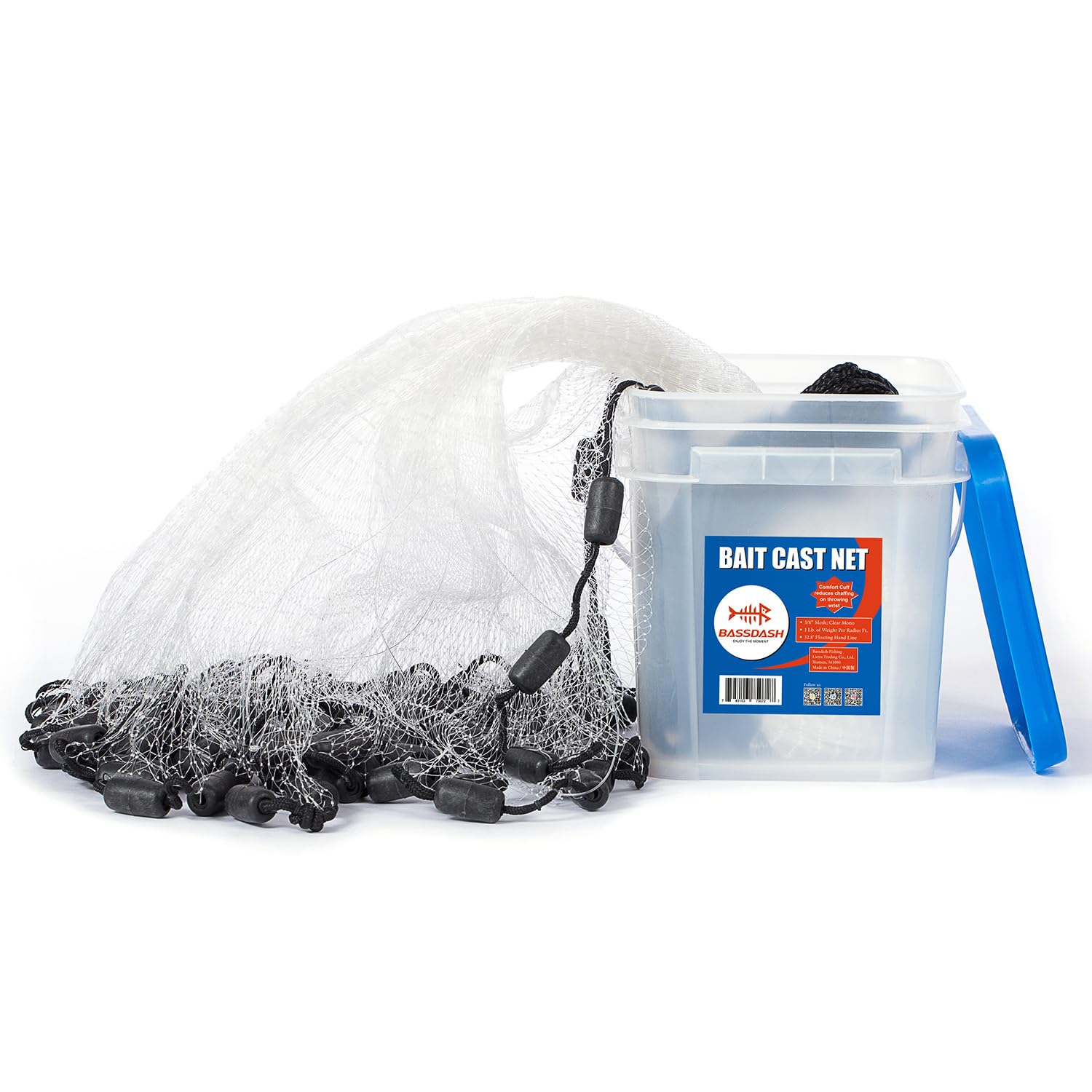
A 316 stainless swivel, an ABS horn, and a padded comfort cuff don't catch bait, but they decide whether a net still works after a season of salt. BASSDASH fits all three, then hangs six panels of 3/8-inch copolymer monofilament off them on a one-pound-per-foot sinker line.

The six-panel cut is the interesting part. Panels spread the load evenly around the horn, so the net opens into a round pancake instead of a lopsided one, and a full pound per radius foot gets it down quickly enough for schooling bait. The 3/8 mesh holds bait from about three inches up, and the padded cuff does real work on repeated casts — it takes the chafe off the throwing wrist instead of letting the line bite in. Thirty-two feet of floating handline is the other reason it's on the list: it gives you the reach to work a jetty or the deep side of a channel without moving the boat.

This is our pick when bait is holding deep or off the end of a jetty. It's also the most work to throw repeatedly — six feet of radius at a pound per foot is a real load by the hundredth cast — so it suits an angler making fewer, bigger throws over one picking bait all afternoon.

Pros

  • Six-panel cut opens into a round pancake
  • Full pound per foot sinks fast
  • 316 stainless swivel and ABS horn
  • 32.8-foot floating handline

Cons

  • Flimsy utility bucket
Our verdict

Our choice for deep water and jetty work: a fast sink, a round spread, and hardware that shrugs off salt.

Check Latest Price
5

Best for Beginners

Calamus Baitfish Cast Net

80 /100
Angler Score Excellent

Key details

Radius
3 ft
Mesh Size
3/8 inch
Included Gear
Bait net, bucket, repair kit
Sinker Weight
0.71-0.82 lb per foot
Check Details on Amazon

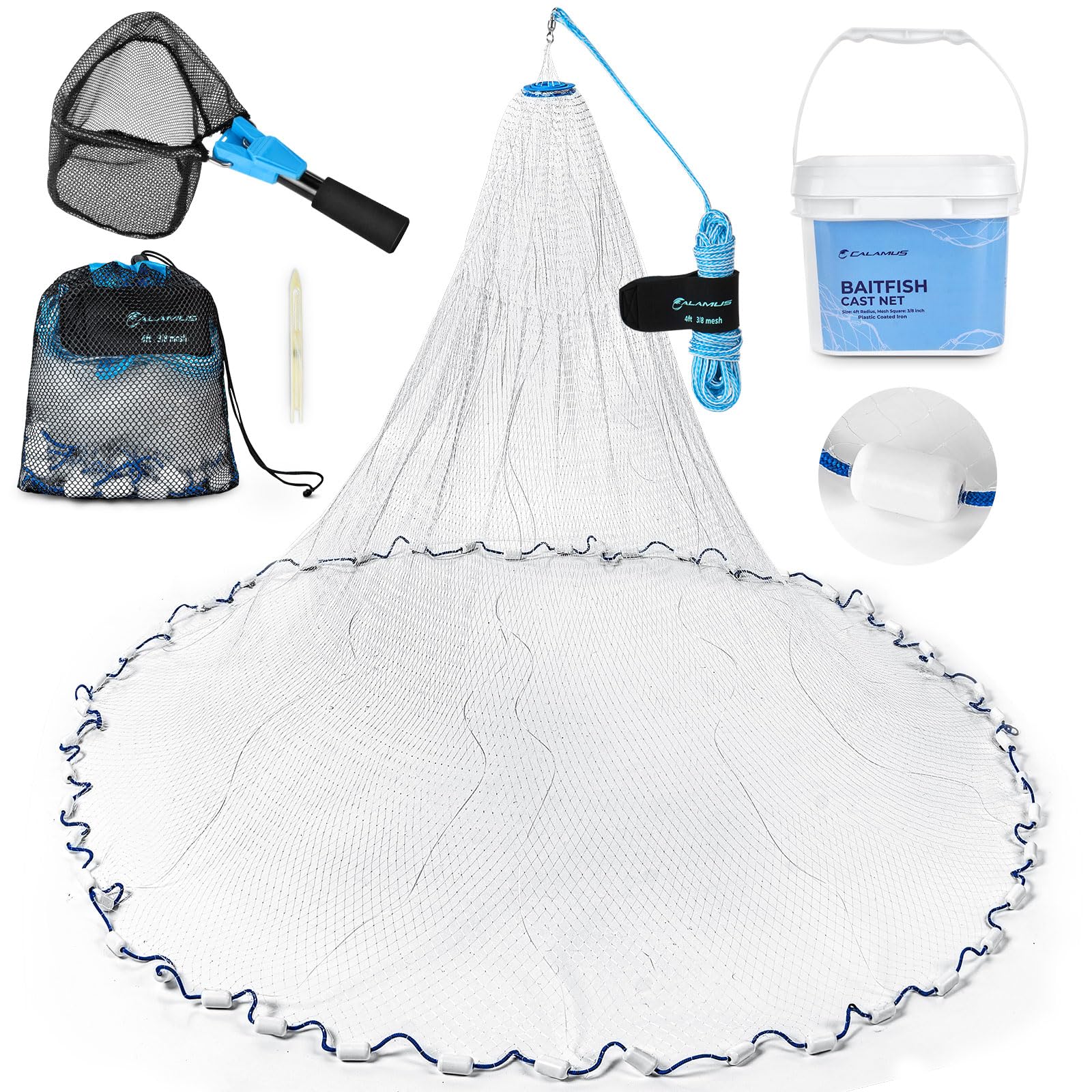
Open the Calamus box and you get more than a net: a foldable bait net that clips to a belt, a mesh carry bag, a repair kit with spare line, and a bucket. For a first cast net, that's most of what you otherwise buy one piece at a time after your first mistake.

The horn is the detail worth pointing out. It's sectioned into six holes instead of the usual two or three, which spreads the braille lines further apart and cuts down on the wraps and knots that make new throwers quit. The 0.012-inch monofilament is thin and light, and the three-foot radius opens on a gentle throw — exactly what a beginner needs to see a pancake form before bad habits set in. The little dip net is the sleeper item; scooping bait out of the bucket without chasing it around is worth more than it sounds.

As a first net it earns its place on that kit and on a forgiving throw. It's also a sensible thing to keep in the truck after a bigger net takes over, because three feet of radius is still the easiest size to throw off a dock at dusk. Don't expect it to do the work of a five-foot net in open water; it's a small-water tool, and it's honest about that.

Pros

  • Six-hole horn cuts tangles
  • Bait net, bag, bucket, repair kit included
  • Forgiving throw for beginners
  • One-year warranty

Cons

  • Light sinker line sinks slowly in current
  • Thin mono tears on snags
Our verdict

A starter net that arrives as a complete kit with a throw that forgives beginners, best kept to calm, shallow water.

Check Latest Price
6

Best Large Net

Betts 7PM Old Salt 7 ft

88 /100
Angler Score Excellent

Key details

Radius
7 ft
Mesh Size
3/8 inch
Listed Weight
3 lb
Check Details on Amazon

A seven-foot net announces itself on the first throw. The 7-foot Old Salt opens wide enough that you feel the swing in your shoulders, and from a boat deck with clear water around you, that width is the point: one spread covers a school a four-foot net needs three passes to work.

The panel construction is why it opens so easily for its size. The netting is limp rather than springy, so it folds out instead of fighting you, and it separates small bait like scaled sardines and thread herring without gilling them. The 3/8-inch mesh is the right compromise for bait from about three inches up.

Handling is where a net this size asks for something back. Seven feet of radius and a monofilament body is a lot to haul, and by the end of a long session the throw goes before the net does. It rewards an unhurried, practiced motion and punishes a rushed one — if you're still learning to open a pancake, start at four feet and come back to this.

For an angler throwing from a deck with room to swing, who wants one haul to fill the livewell, this is the best big net in the set: the highest-rated one here, and the one that compromised least on spread. From a bank or a kayak it's more net than you can manage.

Pros

  • Opens wide for its size
  • Catches small bait like sardines and herring
  • Throws easily for a seven-footer
  • Strong value at the top of the range

Cons

  • Flimsy storage box
Our verdict

Buy it if you throw from a boat deck and want one big spread; a seven-foot net rewards a practiced arm and punishes a tired one.

Check Latest Price
7

Kids and Beginners

BasicGear 3 ft Cast Net

86 /100
Angler Score Excellent

Key details

Radius
3 ft
Included
Repair kit and utility box
Mesh Size
3/8 inch
Sinker Weight
0.75 lb per foot
Check Details on Amazon

Three feet of radius is the smallest net on this list, and for plenty of buyers that's the reason to pick it: light enough for a nine-year-old to throw, short enough to work over a dock rail, and cheap enough to treat as a learner's net.

What you get is a 3/8-inch net on a 0.75-pound-per-foot zinc-iron line, a neoprene wrist strap that doesn't chew at your arm, a repair kit, and a hard utility box that beats the bags most nets ship in.

The horn is the detail that decides whether it suits you. It's generous, which is fine for chubs and menhaden but lets the smallest bait swim straight out; if silversides are the target, look for a 1/4-inch mesh instead. The neoprene cuff, meanwhile, is the kind of small thing we noticed on a long morning — it spreads the load across the wrist instead of biting into it.

As a first net or a kid's net, it's hard to argue with: it opens, it catches, and the box keeps it tidy in a garage between trips. Plan on stepping up to a four- or five-footer within a season or two — that's not a knock, it's just what happens once you can throw.

Pros

  • Smallest, lightest net in this set
  • Neoprene wrist strap and repair kit
  • Manageable for kids learning
  • Hard utility box for storage

Cons

  • Zinc-iron sinkers can rust
  • Netting tears with hard use
Our verdict

The net we hand a kid or a curious first-timer: small, light, and inexpensive enough that a bad throw costs nothing but a re-rig.

Check Latest Price
8

Lead-Weight Casting

Best Fisher's Core Pro

85 /100
Angler Score Excellent

Key details

Radius
6 ft
Warranty
1 year
Mesh Size
3/8 inch
Sinker Weight
1 lb per foot
Check Details on Amazon

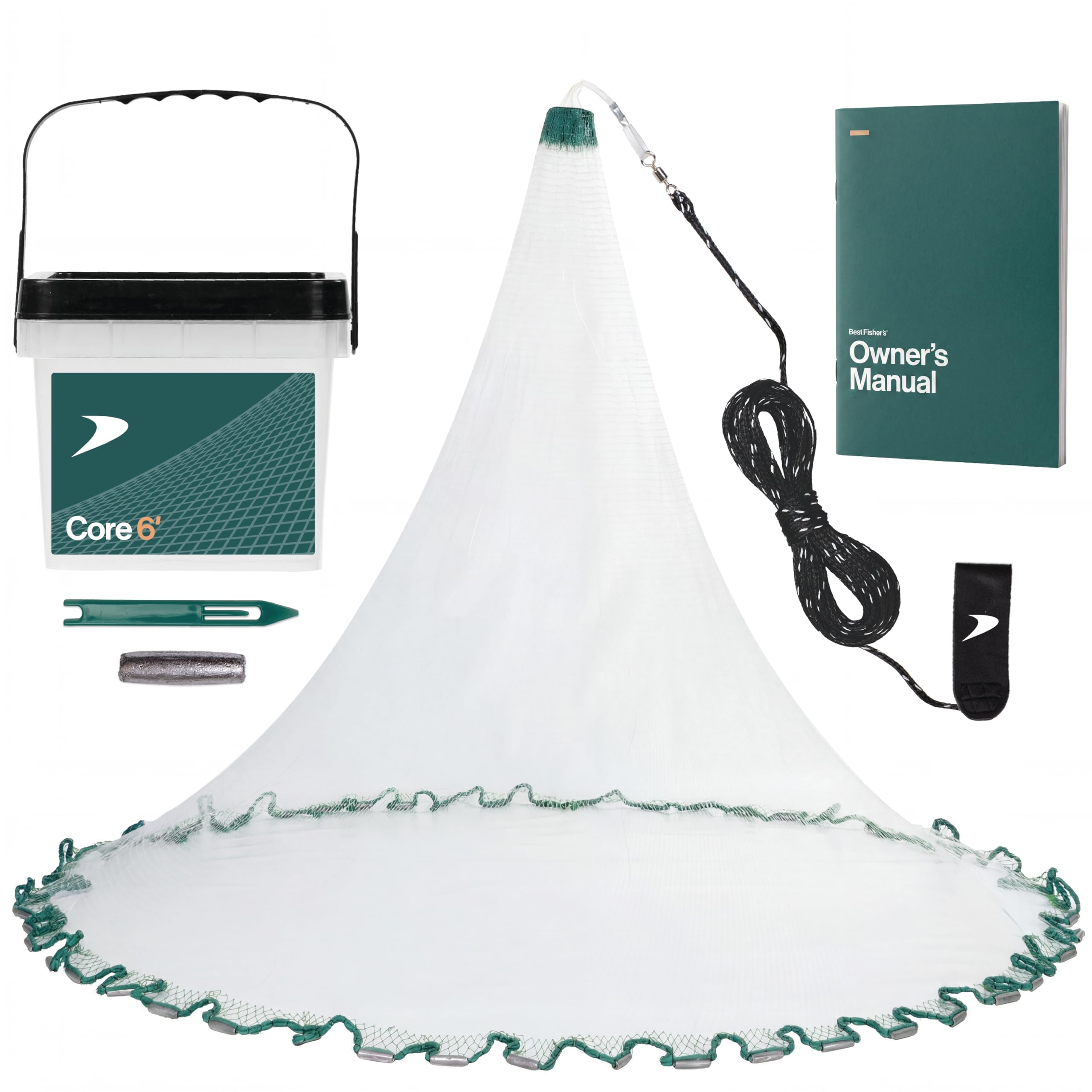
The one-year, no-questions replacement is the first thing worth knowing about this net. It sits on top of a six-foot, 3/8-inch net on a full pound of real lead per radius foot, with double selvage reinforcement around the horn and along the lead line — the two places a cast net usually fails first, which is a sensible place to add material.

Two details to check against your own habits. The hand loop is small, so big hands will discover that on the water rather than in the driveway — try it over your wrist before the trip. What it does well is sink: real lead is denser than the coated and zinc-iron lines here, so six feet of net drops fast and seals on the bottom, and the 3/8 mesh holds everything from shrimp up to finger mullet. The bucket, repair kit, and written instructions round out a package for someone who wants lead weighting and a warranty standing behind it.

Pros

  • One-year no-questions replacement
  • Full pound of real lead per foot
  • Double selvage at horn and lead line
  • Bucket and repair kit included

Cons

  • Horn can pull away from the netting
  • Runs longer than the listed six feet
Our verdict

For anglers who want genuine lead weighting and a warranty behind the failure points, this is the safest six-foot buy.

Check Latest Price

How We Tested These Cast Nets

We started with roughly 30 nets and narrowed the field on the things that change an actual session: available mesh sizes, radius options, stated weight per foot, and hardware that looked like it could survive salt. That left 12 nets, which we threw for seven months on sandy flats at low tide, off a dock, from the deck of a skiff, and in a few muddy creeks where a torn net is a real possibility.

For the first week we did the boring part on a grass field: ten throws per net, per person, counting how many opened into a full circle rather than a folded cone. My teammate who had never thrown a cast net learned on all 12, which is how we separated nets that forgive a clumsy release from ones that demand a perfect one. We weighed each net on a kitchen scale, noted whether the lead line was tapered toward the horn or evenly loaded, and kept track of which shoulder got tired first after 50 throws.

In the water we counted bait per throw, watched how quickly each net sank, and checked whether small bait slipped back through the mesh before we could haul it in. After every trip we hosed the nets down, dried them, and looked for pulled seams, a cracked horn, or stretch where the hand line attaches; two nets got dragged on purpose over oyster shell and riprap to see how the mesh held. We also wrote down what came in the box — bucket or utility box, repair kit, spare swivel — because a net that arrives ready to fish is worth more than a slightly cheaper one that doesn't.

How to Choose a Cast Net

Match the mesh to the bait, not to the fish

3/8 inch is the working default because it holds most inshore bait — shrimp, finger mullet, menhaden, chubs, small sardines — while still letting water pass so the net drops quickly. Drop to 1/4 inch only when the bait itself is tiny, like silversides or whitebait.

The trap is assuming finer mesh is better mesh. A 1/4-inch net carries far more netting for the same radius, so it sinks slower, loads up with grass, and takes more work to clear. If you can't name the bait you're chasing in advance, buy 3/8 and learn on it.

Weight per foot sets your sink rate and your fatigue

Sinker weight is quoted per radius foot, and it is the number that decides whether bait swims out from under the rim. Three-quarters of a pound per foot is light, easy to throw, and fine over shallow flats and calm water; a full pound drops faster and seals better in current.

Remember that weight and radius multiply. A six-foot net on a one-pound line carries about six pounds of sinker before you count the mesh, and every throw costs you that. Choose the heaviest line you need for the water you fish, not the heaviest you can buy.

Pick a radius you can throw all morning

Radius is not diameter: a four-foot net opens a circle roughly eight feet across, and a six-foot net doubles that spread while adding a lot of weight to every retrieve. Beginners, kayakers, and anyone fishing tight banks are better served at three to four feet; a boat deck with clear water around it can carry five or six.

The other half of the decision is where you're standing. A big net needs room to swing, so a seven-footer that pancakes beautifully from a bow is dead weight on a crowded dock.

Horn, swivel, braille line, and handline

The horn is where the braille lines gather, and a sectioned horn — six holes rather than two or three — keeps those lines apart and cuts tangles. The swivel below it should be stainless, because a seized swivel twists the handline into coils that ruin the next throw.

Handline length is the cheapest thing to get wrong. Twenty feet is fine from a boat; piers and bridges want thirty or more, and a floating line stays on the surface instead of snagging structure. Look at the braille line too: reinforced attachment at the horn and lead line is what stops a net from opening into a bag with no bottom.

Frequently Asked Questions

Final Verdict

If we were buying one cast net for the water most of us fish, it would be the Drasry with the gray sinkers: a full pound per foot of rust-resistant weight, 32 feet of handline, and a 3/8 mesh that covers the bait you'll actually chase. It sinks fast enough for a jetty and stays manageable over a flat.

Two situations change that answer. Fishing from a kayak or a crowded bank, drop to the four-foot Betts Old Salt, which gets a full pound per foot down in a throw you can make sitting. Throwing from a boat deck with room to swing, the seven-foot Betts is the big-haul net — provided your arm is already good for it.