
Best Fishing Fighting Belts of 2026

A fighting belt should disappear the moment a fish takes off—not dig into your waist, spin under load, or leave you bracing the rod against your hip. The right one spreads pressure across your body, keeps the rod butt planted, and lets you fish hard without feeling like the setup might go over the side. Over eight months, my team and I ran 12 belts through offshore runs, inshore flats, and party-boat trips; fit and stability matter as much as padding.

What separated them was rarely the plush pad. A belt that felt fine at the dock could shift on a hard run, and quality came down to stitching, hardware, and padding that didn't crush; value meant the extras earned their place on the water. Functionality came down to how the rod holder seated and released under load; practicality to putting the belt on over rain gear with cold hands. Comfort and fishing suitability showed up during long fights, while fit, size, and stability decided whether a belt stayed put—and the picks below are the ones that did.

1

Best Overall

PELLOR Padded Fighting Belt

85 /100
Angler Score Excellent

Key details

Body
ABS with padded backing
Closure
Adjustable safety buckle
Rod Fit
1.5 in
Rod Holder
360° rotary slot
Check Details on Amazon

The rod holder on the PELLOR turns a full 360 degrees, and that is what put it at the top of this group. When a fish changes direction under the boat you can swing the cup to follow the pull instead of twisting the plate around your hips, so the rod stays where you want it and your shoulders do less of the arguing. In a long fight, that is the whole game.

The rest of the belt supports the same idea. A padded backing sits between the ABS plate and your stomach, the strap closes with an adjustable safety buckle, and the holder is listed at 1.5 inches, which is enough cup for the thick conventional butts we fish offshore. Rods seated firmly and stayed seated, and the belt is comfortable enough to leave on between bites, which counts for a lot after six hours at the rail.

Where it gives ground is in the fittings. There is a rotary slot and no pin, so a butt cut with a groove, the kind that locks onto a gimbal, sits in the cup without locking. On a stand-up rod with a plain butt that costs you nothing; if every rod you own has a grooved butt, the SANLIKE is the better call.

The hardware is listed as seawater-corrosion resistant, and a rinse and a hang after each trip keeps the buckle working smoothly instead of crusting up by August. Buy this one if you want a single belt that covers offshore weekends and inshore afternoons without you having to think about it again.

Pros

  • 360-degree holder steers the rod mid-fight
  • Padded backing keeps the plate off your stomach
  • Cup fits thick conventional rod butts
  • Adjustable buckle strap rated for salt water

Cons

  • No locking pin for grooved rod butts
  • Fixed cup leaves slim rod butts sitting loose
Our verdict

The belt we point most offshore anglers to: a rotating holder that keeps the rod under control and a padded plate that keeps the pressure off your stomach.

Check Latest Price
2

Best for Mixed Rod Butts

SANLIKE Aluminum Fighting Belt

87 /100
Angler Score Excellent

Key details

Body
EVA pad and aluminum alloy
Weight
16 oz
Belt Length
140 cm / 55.1 in max
Rod Butt Fit
Grooved pin or round head
Check Details on Amazon

Two fittings sit inside the SANLIKE's cup: a stainless pin for rod butts cut with a groove, and a rotary slot for round ones. On a boat with a mixed rod locker that is the difference between a belt that works and a belt that works on some rods. We swapped it between a grooved conventional butt and a plain one and neither wobbled in the holder.

The aluminum body is what you feel first. This is a rigid plate rather than a molded plastic one, and the EVA pad on the back is impact resistant enough that a big fish's pull lands on the pad instead of your ribs. At 16 ounces it carries more weight on the hips than the compact belts here, and the wide base is the reason: it spreads the load across the abdomen instead of concentrating it in one sore spot. We would call it the belt for someone who would rather carry a little more and feel a lot less.

Buckle creep is the thing to watch. The strap closes with a plastic snap buckle that can work itself looser during a long fight, so snug it before the first run and check it again when you change baits. That is a habit, not a dealbreaker, and it is the trade for a belt that extends to a 55-inch waist and still cinches down for the rest of us.

Pros

  • Steel pin and rotary slot cover both butt styles
  • Rigid aluminum body with an impact-resistant pad
  • Strap extends to a 55-inch waist
  • Wide base spreads pressure on the abdomen

Cons

  • Insert pin's screw can work loose with use
Our verdict

Buy it if your rod locker mixes grooved and round butts: the steel pin and the rotary slot take both, and the aluminum body takes a beating.

Check Latest Price
3

Best Premium

PlayAction B100 Fighting Belt

87 /100
Angler Score Excellent

Key details

Model
B100
Sizing
Single size
Belt Style
Snap-on
Check Details on Amazon

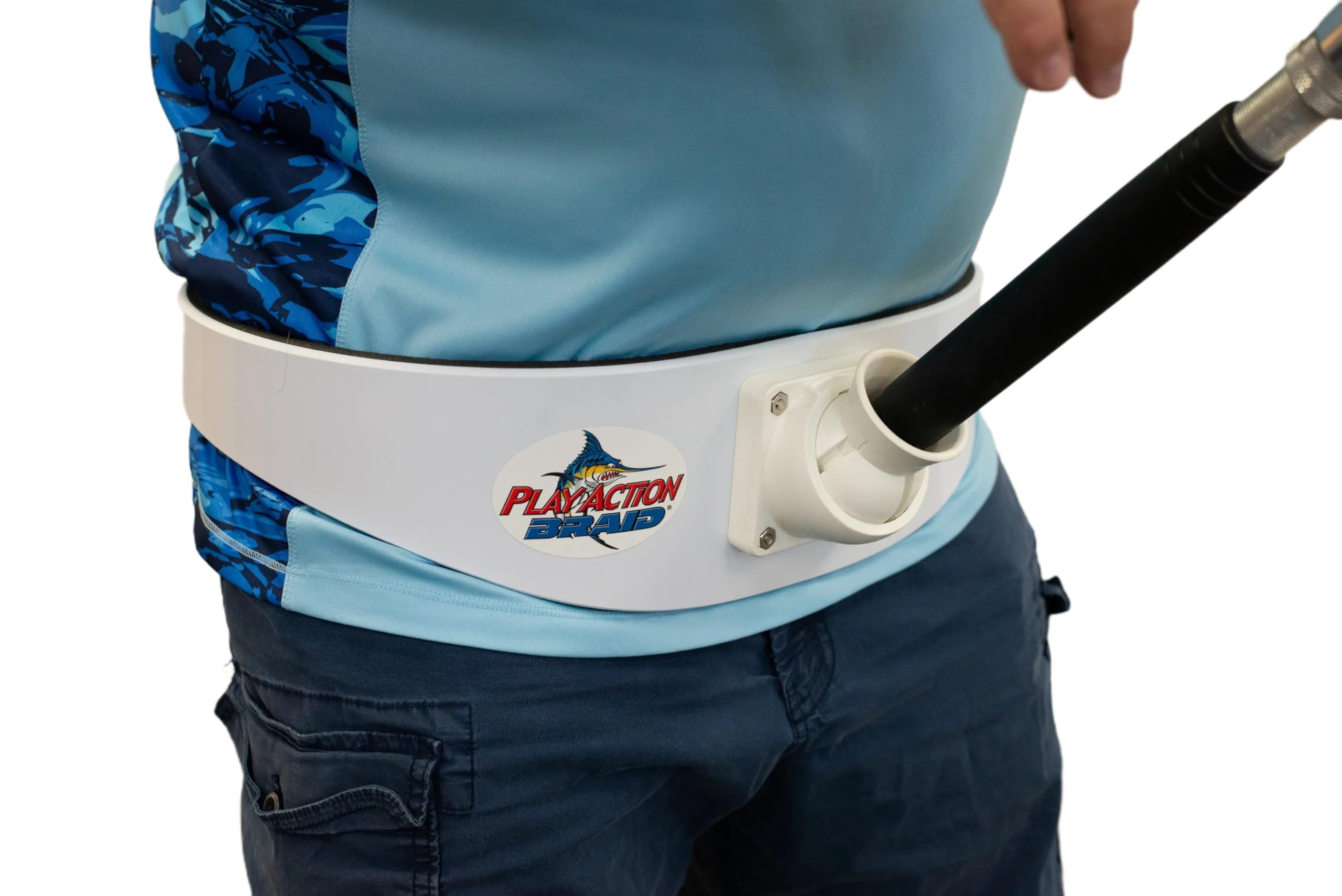
This is the most expensive belt in the guide, and the extra goes into a snap-on closure that takes one motion to fit. No threading a long strap through a buckle while a fish is taking line: snap it below the hips, drop the rod butt into the cup, and you are fishing. On a boat where gear gets handed around, that speed is the feature you are paying for.

It is also the best-finished belt here. The plate is solid, the strap is heavy, and it carries the highest rating in this group. Seating it low, below the hips, is the right instinct too, because that is where you want the butt when you are leaning back against a fish; the load goes into your legs and the plate rather than your stomach.

The catch is sizing. It ships in one size, and that size runs small, so a big frame, or a waist measured over bibs and a jacket, may not get the secure fit the design deserves. There is also no size printed on the listing to check before you order, which is a strange omission on a belt at this price. If it fits, it is the belt we hand to someone who fishes heavy tackle a few times a year and wants charter-boat hardware without charter-boat luck.

Pros

  • Snap-on closure fits in one motion
  • Heaviest-duty build in this group
  • Sits below the hips to spare the stomach

Cons

  • Ships in one size that runs small
  • No size stated on the listing
Our verdict

A premium snap-on belt that fits in one motion and feels like boat-supplied gear, provided the single size suits your waist.

Check Latest Price
4

Best Budget

Ogrmar Fighting Belt

87 /100
Angler Score Excellent

Key details

Waist
Adjustable strap
Design
Belly-top plate
Rod Holder
Single cup
Check Details on Amazon

Ogrmar built this one for the fish most of us actually catch, and it is honest about that. The belly plate takes a standard rod butt, the strap adjusts wide, and the padding sits where the load lands. Point it at a giant bluefin and it runs out of belt; point it at the fish on a half-day trip and it does everything a fighting belt is supposed to do.

For that middle ground it is the best value in this group. The plate is well made, the load goes into your hips and legs instead of your forearms, and the whole thing stays put once it is snugged down. It is also the belt here most likely to get handed to a kid or a guest, and that is the right instinct: the strap adjusts wide, the plate is forgiving, and nobody worries about it getting knocked around on deck.

Comfort is where it surprised us for the money. A long day with a plate against your stomach is the difference between fishing the afternoon and watching it, and this one does not leave the bruise a bare rod butt does. There is strap to spare around a 42-inch waist, which is not something you can say for every budget belt.

What it will not do is grow with your fishing. As your trips move toward heavier tackle, the belt you want moves with them, and that is when the SANLIKE or the PELLOR starts earning its price. Until then, this is the belt that quietly does the job on most boats.

Pros

  • Well-made plate at a budget price
  • Adjusts wide enough for a big waist
  • Comfortable enough for a full day
  • Simple enough to hand to a kid or guest

Cons

  • Cup runs small for heavy ocean rod butts
Our verdict

The best value here for school tuna, mahi, and bottom fishing: well made, comfortable, and honest about the fish it cannot handle.

Check Latest Price
5

Best for Occasional Trips

KUFA TS-A4 Fighting Belt

82 /100
Angler Score Excellent

Key details

Weight
1.15 lb
Cushion
EVA, 12.5 x 7 in
Rod Holder
360 degrees
Check Details on Amazon

The cushion on the KUFA measures 12.5 by 7 inches, which makes it the largest soft surface in this group, and your stomach notices the difference on the third fish. Instead of one hot spot where the rod butt digs in, the load spreads across the whole plate. That is the entire case for buying it, and at the lowest price here it is a good one.

The holder turns a full 360 degrees, so the rod can rotate as you fight, and the strap closes with hook-and-loop rather than a buckle. That has a practical upside: it goes on fast, loosens with one cold hand, and there is strap left over on a large frame instead of strap stretched to its limit. For a boat bag or a rental house, that generosity is worth more than refinement.

Hook-and-loop is quick but it grabs where it grabs, so fine-tuning takes a couple of tries rather than a slide, and you want the strap flat before you lean into anything. None of that matters on the occasional trip, which is exactly where this belt belongs: buy it as the boat-bag spare, the guest belt, or the one that travels to a rental and comes home with sand in it.

Pros

  • Widest EVA cushion in this group
  • 360-degree holder keeps the rod stable
  • Lowest price of the belts we recommend
  • Strap range suits a large frame

Cons

  • Wide plate is a lot of belt on a small frame
Our verdict

Our pick for the occasional blue-water trip: the widest cushion here, a strap that fits big frames, and the lowest price in this group.

Check Latest Price
6

Packing Light

Daiwa 15800-005 Rod Belt

84 /100
Angler Score Excellent

Key details

Model
15800-005
Weight
7.94 oz
Dimensions
7.44 x 6.02 x 2.48 in
Check Details on Amazon

At 7.4 by 6 by 2.5 inches and just under eight ounces, the Daiwa is the belt that disappears into a tackle bag. That matters more than it sounds. A belt you own but leave at home because it is a brick is not a belt at all, and this one slides into the side pocket next to the pliers.

It is a compact plate rather than a broad one, so you trade surface against the stomach for that packed size. If bruising is the thing you are trying to fix, the KUFA's 12.5-inch pad gives you far more coverage; if you want something that is always aboard and never in the way, this is the easier belt to live with.

The build is where the Daiwa earns its money. It is a well-made piece, and the holder grips a rod butt better than a plain flat plate does, which is the difference between the rod staying put and the butt skating across the plate mid-fight. It is the belt that ends up in the bag and gets forgotten until somebody on the boat needs one, and that is precisely the job it is good for.

Pros

  • Smallest packed size in this group
  • Under eight ounces on the hips
  • Holder grips the butt better than a flat plate

Cons

  • Small plate covers less of the stomach
Our verdict

Worth it if the belt has to live in a tackle bag: the smallest, lightest design here from a name already on your rods.

Check Latest Price
7

Light Tackle

ASOCEA Fighting Waist Belt

88 /100
Angler Score Excellent

Key details

Waist
Adjustable strap
Belt Type
Waist fighting belt
Rod Holder
Single cup
Check Details on Amazon

The ASOCEA is the belt that folds into a side pocket and does not mind being there. It is light, the plate is smaller than the offshore belts here, and it takes up about as much room as a pair of gloves, which is why it is the one that actually travels instead of staying in the garage.

For the money it does the basic job. The rod butt sits in the holder instead of against your ribs, the strap adjusts, and on a half-day boat it is all the belt most people need. Nothing about it feels premium, but the build holds up and the price means you can buy one for the boat bag and one for the car.

The catch is the cup. It is small, which is fine for thinner butts and light tackle; put a fat offshore butt in it and the rod can rock or slip instead of seating. The strap runs long for a slim waist too, so it has to be taken up a fair way before the plate stays where you put it.

Buy it as the travel belt, the guest belt, or the spare that lives in the car, and it will earn its keep. Buy it as your only belt for heavy blue-water fishing and you will be shopping again by the second trip. For light tackle, kids, and the odd offshore outing, the value is hard to argue with.

Pros

  • Packs down to almost nothing
  • Cheap enough to buy as a spare
  • Takes the rod butt off your ribs

Cons

  • Small cup for fat rod butts
  • Strap runs long on slim waists
Our verdict

The cheapest way to get a rod butt off your ribs, best as a travel, guest, or light-tackle belt rather than your only offshore rig.

Check Latest Price

How We Tested Fishing Fighting Belts

We started by gathering every fighting belt we could find that was actually sold for offshore or stand-up fishing, then narrowed the shortlist by waist-size range, rod-holder design, padding, hardware, and price. That left 12 belts, which we used over eight months on offshore runs, inshore flats, and a handful of party-boat trips. We rotated them among anglers of different builds and had each person note where the belt sat, whether it shifted during a fight, and how it felt after a full day.

On the water, we focused on actions rather than specs: we buckled each belt over light layers and bulky rain gear, leaned into the rod holder during drag pulls, and watched for rotation, ride-up, or digging at the waist and ribs. We checked how quickly the rod butt seated and released, whether the holder stayed angled under load, and if buckles or straps crept after repeated adjustments. Comfort was judged during long fights and long waits—did the padding stay supportive, or turn sweaty and slippery? Stability meant the whole belt stayed put when a fish made a hard side-on run, and fit meant it worked across the size range without cinching down in the wrong place.

After each trip we inspected stitching, webbing, foam, and metal parts for fraying, crushing, or corrosion, and compared that wear against what each belt asked us to spend. Practicality got judged with cold, wet hands—could we get the belt on and off without help, and was it easy to stow? A belt scored well only if it was comfortable across a full day, stable under pressure, and genuinely suited to the fishing we do, not just feature-heavy at the dock.

How to Choose a Fishing Fighting Belt

Start With the Rod Butt, Not the Waist

It is tempting to shop these belts by strap length, and that is the wrong end of the problem. The measurement that decides whether a belt works is the inside of the cup against the butt of your heaviest rod. A 55-inch strap tells you how large a waist the belt wraps and nothing about whether a fat conventional butt will seat. Measure the bottom couple of inches of your biggest rod and compare it with the listed holder size; the PELLOR's 1.5-inch cup is a workable reference for offshore conventionals.

Pin, Rotary Slot, or a Plain Cup

Three holder styles turn up here. A plain cup grips whatever you drop into it. A 360-degree slot lets the rod rotate so you can angle the butt toward the pull without moving your feet. A stainless gimbal pin engages a butt cut with a matching groove and locks the rod's orientation. If your rods have grooved butts, a pin is worth having, and the SANLIKE is the belt here that offers both pin and slot. If everything you own has a plain butt, the pin is dead weight and a rotating cup is the more useful feature.

Padding, Plate Size, and the Bruise You Are Avoiding

A fighting belt exists to move load out of a two-inch rod butt and into a wide plate. The wider that plate, the less it feels like a knuckle in the stomach: the KUFA's 12.5-inch EVA cushion and the PELLOR's padded backing both make the point, while the compact Daiwa trades some of that surface for packability. Soft padding helps, but surface area tends to do more work than thickness, so look at the plate before you fall for a plush cover.

Buckles, Straps, and Staying Where You Put It

Every belt here adjusts, but the closure is where they differ. A snap buckle is fast to close and sits flat; hook-and-loop is quicker to loosen with cold hands but grabs where it grabs. Whichever you choose, fit it below the hips, over the layers you actually fish in, with the rod already in the holder, then lean back hard and watch whether the plate moves. The PlayAction's low ride is the shape to copy. If the belt creeps after the first run, tighten it before the next fish, not during one.

Frequently Asked Questions

Final Verdict

The PELLOR is the belt most offshore anglers should buy. The 360-degree holder keeps the rod pointed where the fish is pulling, the padded backing keeps the plate off your stomach, and the cup takes the thick butts conventional rods have. If your quiver mixes grooved and round butts, the SANLIKE covers both with a pin and a slot.

And if you want charter-grade hardware, the PlayAction is worth the stretch, provided the single size fits you. Try it on with the rod in the cup before the trip rather than on the deck.