Best Fishing Gaffs of 2026

The first good fish I lost at the boat didn't beat me on drag or a knot — it beat me because the net was four inches too small for what was thrashing beside the hull. A gaff fixes that in one motion: a sharp hook, a stiff shaft, and a handle you can hold onto when your hands are wet and the deck is moving. It's also the piece of gear most anglers buy last and think about least, which is exactly why so many of them bend under a fish, slip out of your grip, or show up dull right out of the package.

Over the past seven months my team and I have fished 12 gaffs hard — off piers, party boat rails, kayaks, and a couple of rough offshore mornings — across fiberglass, aluminum, and carbon shafts ranging from a short boat gaff to a six-and-a-half-foot big-game stick. What separates a good one isn't glamour. It's whether the point bites on the first swing, whether the shaft stays stiff when a fish surges, and whether the grip holds once it's coated in slime and sunscreen. Length matters as much as build quality, since a gaff that's too short for your freeboard is useless no matter how good the steel is, and the picks below cover that whole range.

1

Best Overall

Fiblink Fiberglass Gaff

85 /100
Angler Score Excellent

Key details

Hook
4-inch stainless
Handle
Non-slip grip with hook keeper
Shaft Length
5 ft
Shaft Material
Fiberglass
Check Details on Amazon

Five feet of fiberglass and a four-inch hook is the pairing that fits the widest range of boats, and that is why this is the gaff we recommend first. Standing at the gunwale of a center console, you have enough shaft to reach the water without leaning out, and enough hook to hold a fish that decides to roll on the way up.

The grip is the part we kept noticing. It stays usable with wet hands, and there is a keeper on the shaft that stops the gaff sliding overboard when you set it down between fish — a small thing until the day it saves you a gaff. Fiberglass gives the shaft some give under load, which we prefer to the dead stiffness of a thin aluminum pole, and the whole thing runs heavier than an aluminum gaff of the same length without ever feeling clumsy in one hand.

Four inches of hook is more than you need for schoolie bass, and the fixed five-foot shaft is genuinely awkward on a kayak or in a packed truck bed. This is a boat gaff, and that is the trade. The one-year warranty covers a shaft that takes real pressure, and for most anglers fishing from a deck, this is the right compromise.

Pros

  • Five-foot reach clears most gunwales
  • Four-inch stainless hook holds a rolling fish
  • Grip stays usable when hands are wet
  • Hook keeper keeps the gaff aboard

Cons

  • Fixed five-foot shaft is clumsy on a kayak
Our verdict

For most boats this is the gaff we point people to: five feet of fiberglass and a four-inch hook that reaches the water and holds a decent fish.

Check Latest Price
2

Best for Offshore Reach

Sea Striker Aluminum Gaff

88 /100
Angler Score Excellent

Key details

Hook
3-inch stainless, knife edge
Weight
1.9 lb
Shaft Length
6 ft
Shaft Material
Anodized aluminum
Check Details on Amazon

Picture the fish still a rod's length away from the rail on a boat with real freeboard, and you have the case for six feet of gaff. The anodized aluminum shaft gets you out there without hanging your chest over the water, and at 1.9 pounds it swings one-handed when the fish makes its last run.

The hook is three inches of stainless with a knife edge — a point that cuts in rather than punches, which we like on hard-mouthed fish. What sold us is the metal spring guard over the point. A rubber cap is fine until it disappears; the spring stays attached to the hook and covers the tip every time you rack the gaff.

What you give up is room. Six feet of shaft needs somewhere to live in a cockpit, and short-stroking a gaff this long is how points get bent and fish come off. From a low skiff or a kayak it is more tool than you can use well; from a deck looking down at the water, it is the reach that earns its keep.

Pros

  • Six-foot reach from a high deck
  • Knife-edge point bites hard mouths
  • Light for its length at 1.9 pounds
  • Spring guard stays on the hook

Cons

  • Long shaft needs swing room
Our verdict

The offshore pick: six feet of anodized aluminum and a knife-edge point for the fish you cannot quite reach from the rail.

Check Latest Price
3

Best Premium

AFTCO Gaff Hook

89 /100
Angler Score Excellent

Key details

Finish
Gold
Handle
Non-slip grips
Shaft Length
4 ft
Shaft Material
Aluminum
Check Details on Amazon

This sits at the premium end of the gaffs here, and it is the one we hand to someone who gaffs often and wants the tool to outlast the boat. Four feet of aluminum, non-slip grips, and a maker that has been in big-game fishing for more than 50 years.

Four feet is a good working length: long enough to reach past the wash, short enough to control with one hand while the other holds the leader. The grips are the slightly soft, high-friction kind that stay put when everything on deck is wet, and the gold anodizing has come through salt air without the chalky look bare aluminum picks up.

The catch is the money and the fixed shaft. You are paying premium for four feet that will not telescope into a locker, which is fine on a sportfisher with a rod rack and less fine in a garage. For an angler who gaffs a few fish a season this is more than the job needs; for someone doing it every offshore weekend, it is the one that feels like a tool rather than an accessory.

Pros

  • Non-slip grips hold up wet
  • Four feet balances reach and control
  • Big-game pedigree behind the build

Cons

  • Premium price for a fixed shaft
Our verdict

An heirloom-grade big-game gaff: four feet of aluminum, non-slip grips, and the build we trust when the fish is worth the trip.

Check Latest Price
4

Best Lightweight

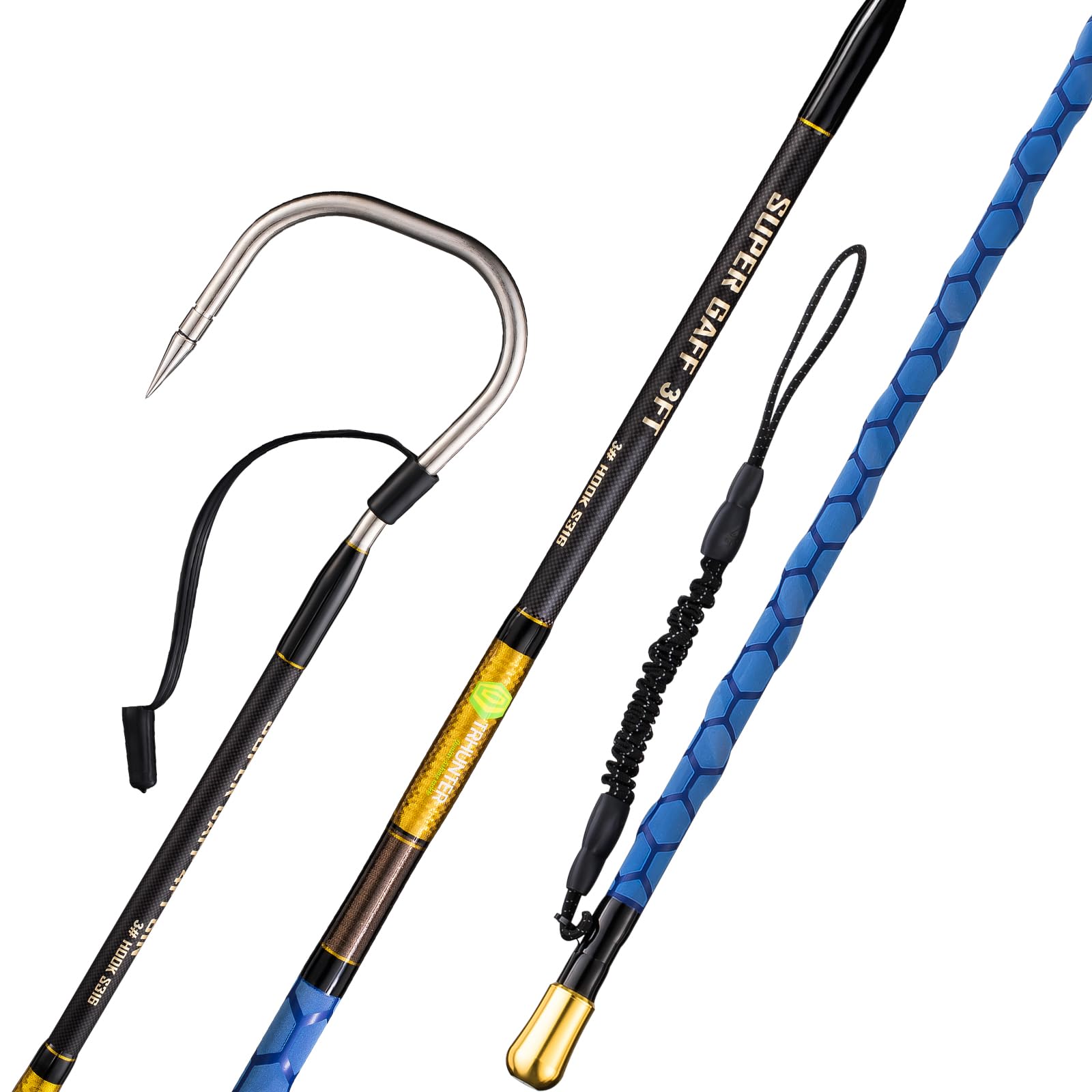
TRHUNTER Carbon Fiber Gaff

90 /100
Angler Score Outstanding

Key details

Hook
3-inch S316 stainless
Warranty
1 year
Shaft Length
3 ft
Shaft Material
Carbon fiber
Check Details on Amazon

Carbon fiber does not make this a featherweight — it feels solid in the hand, and the shaft has almost no flex. We count that as a strength: when you are sinking a hook into a green fish, the gaff goes where you point it instead of whipping.

The hook is S316 stainless, the marine grade we want on anything that lives in a damp locker, and it is a three-inch point with a solid bite. The handle is shaped rather than round, so it seats in your palm without you looking at it, and there is a one-year warranty behind the shaft.

Three feet is the honest limitation: from a kayak seat or a low skiff it is plenty, and from the deck of a big boat it is not, because reaching with a short gaff puts you off balance at exactly the wrong moment. Judge it as a close-quarters tool and it is one of the better-made gaffs in this set.

Pros

  • Stiff shaft points where you aim
  • S316 stainless hook resists corrosion
  • Shaped handle seats in the palm
  • One-year warranty

Cons

  • Feels heavier in hand than carbon implies
Our verdict

Stiff, compact, and built for close control: this is the carbon gaff we take when the boat sits low to the water.

Check Latest Price
5

Best for Kayaks

FISHAPPY Fiberglass Gaff

83 /100
Angler Score Excellent

Key details

Hook
4-inch stainless
Weight
1.5 lb
Shaft Length
3 ft
Shaft Material
Solid fiberglass
Check Details on Amazon

Same four-inch hook as our top pick, on a shaft two feet shorter. That is the trade FISHAPPY makes, and it is the right one if you fish from a kayak, a canoe, or a tiller skiff where the fish comes aboard within arm's reach anyway.

We like the proportions. A big hook on a short handle gives real holding power without a long lever fighting you when a fish surges under the hull, and the solid fiberglass shaft — not a hollow tube — feels substantial enough to lean on. The shaped grip fills the hand, and the same design comes in 4-foot-8 and 7-foot lengths if you move up to a bigger boat later.

What it will not do is reach. From a high deck you are leaning out with a short gaff, which is the position that loses fish and, occasionally, footing. Buy it for a low seat and close water, and buy a longer gaff the day you trade the kayak for a console.

Pros

  • Big hook on a controllable short shaft
  • Solid fiberglass shaft feels substantial
  • Shaped handle for close control

Cons

  • Three feet of reach suits close work only
Our verdict

The kayak answer: a four-inch hook on a solid three-foot shaft, sized for fish you land right beside the hull.

Check Latest Price
6

Light-Duty Freshwater

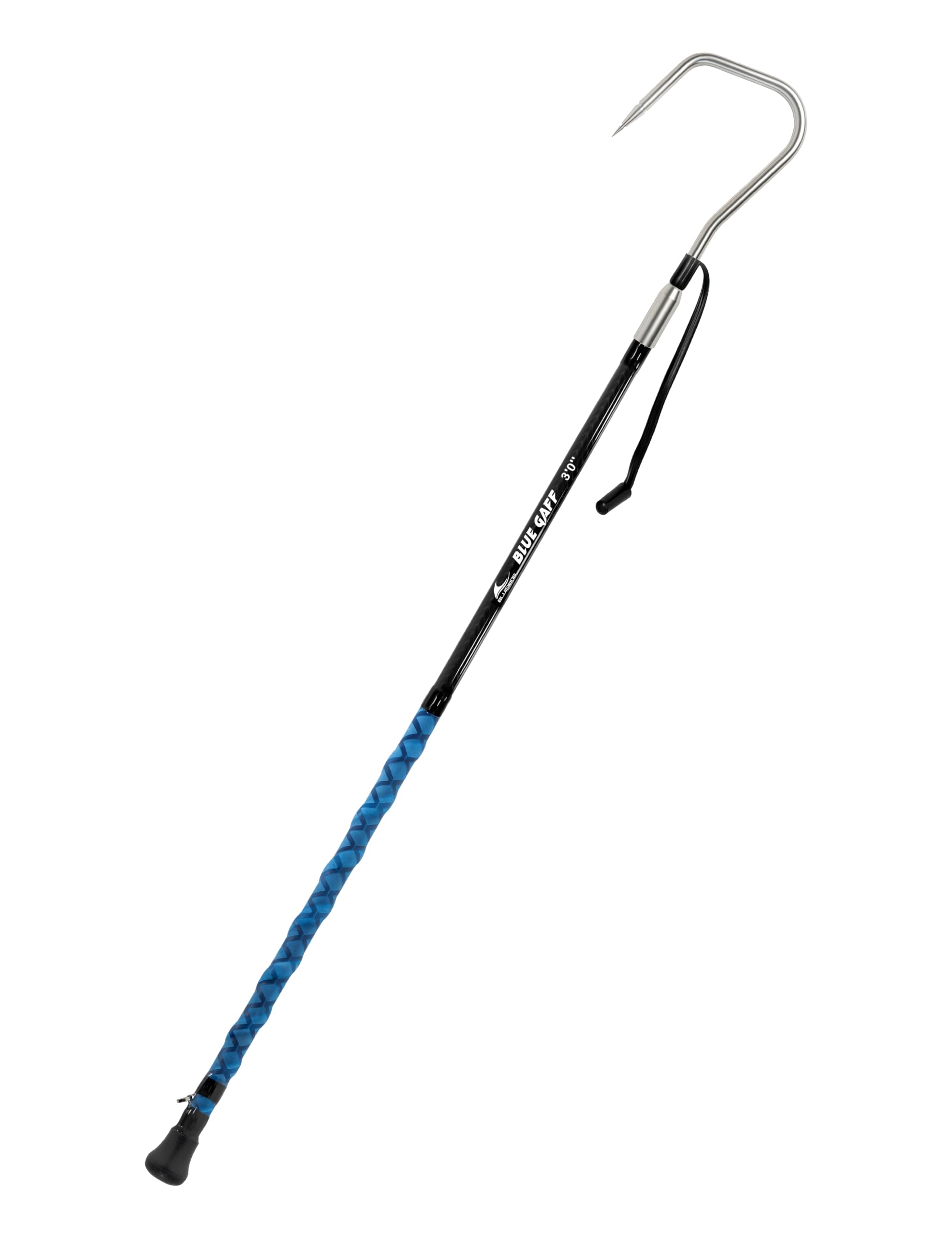
BLUEWING Fiberglass Gaff

87 /100
Angler Score Excellent

Key details

Hook
2-inch stainless
Shaft Length
3 ft
Shaft Material
Fiberglass
Check Details on Amazon

The version here is the three-foot shaft with a two-inch hook, and that pairing tells you most of what this gaff is for. Two inches is a small-fish point: right for school fish, bait, and pier work, wrong for anything with serious girth.

Fiberglass is the sensible choice at the budget end, and BLUEWING uses it well. The shaft flexes under load instead of passing every jolt into your wrist, and the stainless hook arrives with a workable point.

If you like the feel, the same gaff comes in five- and six-foot versions with three- and four-inch hooks, so the family scales up when your fishing does. What does not change is the flex: this is a shaft that bends, which is forgiving on a small fish and less so on a heavy one.

The two-inch hook is the real limit. It will skate off the shoulder of a big fish, and no amount of technique fixes that. Buy it as a spare, a dock gaff, or a first gaff for a kid, and leave the offshore work to something with more point and more shaft.

Pros

  • Fiberglass flex softens the load
  • Stainless hook with a workable point
  • Same design available in longer lengths

Cons

  • Two-inch hook is small for big fish
Our verdict

A light-duty fiberglass gaff at the budget end of this set — good for school fish and docks, not for big shoulders.

Check Latest Price
7

Packable Backup

SANLIKE Telescopic Gaff

89 /100
Angler Score Excellent

Key details

Hook
Stainless steel
Weight
8.8 oz
Folded Length
17.32 in
Extended Length
47.24 in
Check Details on Amazon

Folded down this is a 17-inch package weighing under nine ounces — small enough to live in a kayak hatch or behind the seat of a truck until you need it. Extended, it is 47 inches of aluminum with a stainless hook on the end.

The removable hook is the feature we appreciated most. Unscrew it and the sharp end goes in a tackle box instead of waving around the deck of a paddleboard. The twist locks hold when you snug them, and the rubber grip gives you something to hold with wet, cold hands.

Where it stops is big fish. The shaft is thin aluminum and the joints are the weak point once a heavy fish rolls; load it hard and you can feel the sections give. Snug the locks before every use and keep this one for school fish, bait, and ice duty. As a stowed backup for a kayak or an SUP we are glad to have it aboard; as the only gaff on a boat chasing big fish, it is not enough.

Pros

  • Folds to 17 inches for stowage
  • Removable hook is safer to pack
  • Under nine ounces in hand

Cons

  • Telescoping shaft gives under heavy fish
Our verdict

A packable backup: 17 inches folded, 47 extended, and light enough to keep in a kayak hatch for the fish you did not plan on.

Check Latest Price

How We Tested Fishing Gaffs, From Dock to Deck

We started by pulling every gaff we could find that listed an actual hook material and an actual length, then cut anything that said only "stainless steel" without naming the alloy, anything whose hook guard looked like it would pop off the first time it caught a cleat, and anything so short it was really a spear. That left 12 gaffs in fiberglass, aluminum, and carbon, fixed and telescoping, spanning roughly two feet to six and a half.

Seven months of testing happened where gaffs actually live: a tidal creek dock float, the rail of a party boat in a chop, a kayak where every inch of packed length counts, and two offshore trips with a deck that never stopped moving. To judge sharpness, we set each point against a scrap of two-by-four and leaned in until it bit, noting how much pressure it took and whether it left a clean divot or skidded across the grain. We hung a weighted bucket from each hook to watch how far the shaft flexed and whether the grip shifted in a wet hand, then repeated the hold test with our palms coated in sunscreen and bait residue.

For durability and appearance, every gaff came home and got rinsed, dried, and left in a rod holder for a week before we checked the hook weld, the ferrule, and the finish for rust and scratches down to bare metal. We weighed each one on a kitchen scale and carried it all day to see whether "lightweight" was real or just a spec sheet claim, measured packed length against a rod locker, and worked the telescoping joints until we could say whether they locked up tight or wobbled under load. Value came down to one question: does the price buy better hook steel and a stiffer shaft, or just a nicer-looking handle?

How to Choose a Fishing Gaff

Start With Reach, Not Hook Size

A gaff has to get your hand to the fish without you hanging over the rail. Sit or stand where you actually fish and measure from your hip to the waterline, then add about two feet for the angle of the swing. That number is your minimum shaft length. Three feet suits kayaks, canoes, and low skiffs where the fish comes alongside your knee; five to six feet is what you want from a deck with real freeboard, where the water is a long way down and leaning out is how people go in.

The trap is buying a short, packable gaff for a tall boat because it stores easily. It ends up in the rod locker while you borrow someone else's, and a borrowed gaff is never the one you have practiced with.

Match the Hook to the Fish

Hook size scales with the fish, not with the handle. Two-inch points are for school fish, bait, and pier work; three inches covers striped bass, bluefish, and most inshore duty; four inches is the offshore size for tuna, mahi, and anything with shoulders. Point style matters too: a knife edge slices in and holds on a hard mouth, while a triangular or spear point punches through softer ones.

Buyers routinely match the hook to the shaft when they should match it to the fish. A two-inch point on a six-foot shaft reaches a tuna and then skates off it. Decide the fish first, then pick the shaft that puts that hook in the water.

Pick a Shaft Material You Can Live With

Fiberglass is the forgiving choice. It flexes under load, shrugs off knocks, and costs less than the alternatives, but it is heavier and the give costs you some precision. Aluminum is light and stiff, which makes a long gaff manageable in one hand; thin-wall aluminum can dent if you lever a fish over the gunwale instead of lifting. Carbon fiber is the stiffest and lightest of the three and the most expensive, and it tends to fail suddenly rather than bend.

Solid versus hollow matters as much as the material name. A solid fiberglass shaft on a short gaff feels dead in the hand in the good way — no rattle, no flex. A telescoping aluminum pole saves space and gives up stiffness at the joints.

Grips, Guards, and Keeping It Aboard

Wet hands are the normal condition, so a shaped, high-friction grip earns its place. Look for a hook guard that stays attached to the gaff — a metal spring cover beats a rubber cap that vanishes the first week — and check that the guard actually covers the point, because on telescoping models the cap often stops short of the tip. A keeper loop or lanyard on the shaft means the gaff comes back if it goes over the side.

Telescoping gaffs trade stiffness for stowage. They suit kayaks, paddleboards, and travel, and they are the wrong tool for leaning hard on a heavy fish. Snug the locks every time you extend one.

Frequently Asked Questions

Final Verdict

Our default for most boats is the Fiblink: five feet of fiberglass, a four-inch hook, and a grip that works with wet hands, sitting in the middle of the price range. If you fish from a deck with real freeboard, or the fish habitually hangs a rod's length away, the extra foot of the Sea Striker is worth the step up.

Kayak and skiff anglers should go the other way. The FISHAPPY puts the same four-inch hook on a solid three-foot shaft that keeps the fight close to the hull instead of at the end of a lever. Match the gaff to where you stand and the fish takes care of the rest.