Best Fishing Hook Removers of 2026

The worst part of a good day on the water isn't the one that got away — it's a treble hook buried past the barb in your thumb while the fish thrashes and your pliers slide off wet steel. I've watched grown anglers go pale at that exact moment. A real hook remover does one job: it grabs the hook instead of the fish and backs it out along the same path it went in, so nothing tears on the way. Plenty of tools sold as dehookers are just pliers with a confident name, and you only find that out when a hook is set deep.

Most people buy their first one after a bad afternoon, which is how my tackle bag got so cluttered. My team and I have spent the past four months putting 15 hook removers through bass, catfish, and saltwater trips, and the keepers share a few things: jaw tips that actually meet, a handle that stays put one-handed when it's slick, and steel that doesn't pit after a rinse on the ride home. Compact beats long, too — the tool in your pocket gets used, the one in the bottom of the box doesn't. Below are the ones that never came back out of the bag.

1

Best Overall

Booms Fishing R2 Hook Remover

91 /100
Angler Score Outstanding

Key details

Material
Anodized aluminum, plastic handle
Operation
Squeeze-out jaws, one-handed
Overall Length
10 inches
Check Details on Amazon

The moment that decides whether a hook remover is any good is the one where the fish is in the net, the hook is past the bend, and you have a single hand free. The Booms R2 is built for that moment: squeeze the handle, the jaws close on the hook, and you push down the line and twist. At 10 inches it keeps your fingers well back from the teeth without turning into something you need a rod rack to store.

That balance is why this is the one we recommend first and the one that lives in our boat bag. It handles the hooks that cause the most trouble, the ones swallowed past the lip, because the jaws grab the bend and back the hook out the way it went in. Compared with the 5-inch forceps here it reaches hooks you can't see; compared with the 13.6-inch CRAZY SHARK it disappears into a side pocket.

What it isn't is indestructible. The plastic handle is joined to the aluminum shaft, and that joint is where a hard pull on a big treble can crack it. Play a fish out before you reach for the tool and you never stress it that way; try to lever a 4/0 treble out of a thrashing pike and you're asking for trouble. Bass, trout, panfish, and inshore schoolies are its proper territory.

One detail the listing doesn't settle: the wrist strap in the product photos may not come in the box, so tie on your own lanyard before the first trip. A remover over the side is a remover gone, and this one is light enough to disappear fast.

Pros

  • One-hand squeeze keeps your other hand on the fish
  • Jaws reach hooks swallowed past the lip
  • 10 inches stows where a long dehooker won't
  • Budget price for a full-size tool

Cons

  • Plastic handle joint can crack under a hard pull
Our verdict

If you want one hook remover in the boat bag, we recommend this one: the 10-inch reach and one-hand squeeze handle everything from bluegill to schoolie stripers.

Check Latest Price
2

Best for Long Reach

CRAZY SHARK 13.6-Inch Hook Remover

91 /100
Angler Score Outstanding

Key details

Weight
6.08 oz
Material
Aviation-grade aluminum tube, stainless hook
Overall Length
13.6 inches
Check Details on Amazon

Thirteen and a half inches of aluminum tube is the whole argument. That length puts your hand a long way from a fish's teeth, which is exactly what you want when a pike or a bluefish is thrashing in the net with a treble still in it. You can also unhook a fish over the side without lifting it, which is better for the fish and cleaner for the deck.

The working end is a stainless hook on a trigger: set it, squeeze, and the hook backs out. The first fish or two take a couple of tries while you learn to pull rather than yank, and then it's quick.

We reach for this one when the fish has teeth and the hook has gone deep. The reach is the reason, and the trade is storage: at 14 inches overall and just over 6 ounces, it lives in the boat rather than a vest pocket.

The lower plastic handle is the piece to watch. Drop it on rocks, or use it to lever a stubborn hook, and that's what gives. Treat it as a reach tool instead of a pry bar and the aluminum tube will outlast plenty of fish.

Pros

  • 13.6-inch reach keeps hands clear of teeth
  • Trigger action backs hooks out with one squeeze
  • Lets you release fish over the side
  • Aluminum tube and stainless hook resist salt

Cons

  • Lower plastic handle is the weak point
  • Too long for a small tackle box
Our verdict

We keep this one for pike and other toothy fish, where the extra three inches of reach matters more than a compact frame.

Check Latest Price
3

Best for Big Saltwater Fish

Booms Fishing R08 Dehooker

89 /100
Angler Score Excellent

Key details

Handle
Non-slip T-handle
Weight
4.16 oz
Material
Austenitic stainless steel
Overall Length
10 inches
Check Details on Amazon

Most hook removers grab. This one pries. The tip carries two curves, so you can catch a bend and push the hook back out the way it came, or hook it and pull, whichever angle the fish gives you. The T-handle means you can put your palm behind that push instead of squeezing with your fingertips.

That's why it's our pick for big saltwater fish: sharks, big snapper, anything with a mouthful of teeth and a hook set deep. Austenitic stainless is the right material for the job, and at 4.16 ounces it hangs on a lanyard all day without you noticing. The push action also keeps your hand above the fish rather than inside its mouth.

It has a learning curve, and it's steeper than the squeeze-style tools. Pushing a hook out is counterintuitive the first time, and someone handed one as a gift may look at it and shrug. Ten minutes of practice on a bait fish sorts that out.

The other limit is size. It's built for medium and large fish, and the tip is too blunt to be delicate with a size 8 hook. For panfish and trout, the forceps in this guide are the better tool.

Pros

  • Dual-curve tip pushes or pulls a hook free
  • T-handle gives you palm pressure
  • Austenitic stainless holds up in saltwater
  • Light enough to hang on a lanyard all day

Cons

  • Tip is too blunt for small hooks
Our verdict

For sharks, big snapper, and any fish you'd rather not touch, we trust the push-pull tip and the T-handle grip.

Check Latest Price
4

Best for Small Hooks

SURGICAL ONLINE Forceps Set

91 /100
Angler Score Outstanding

Key details

Lock
Three-position ratchet
Length
5 inches
Pieces
2, curved and straight
Material
Stainless steel
Check Details on Amazon

Five inches of stainless steel looks like a letdown next to a 13-inch dehooker until you watch someone try to get a size 10 hook out of a bluegill with a long tool. These forceps are for that job: pinch the barb, back the hook out, hold it steady while you tie the next knot. On small hooks they're the pair we reach for first.

You get two tools, one straight and one curved, both with serrated jaws and a three-position ratchet that locks them shut on a hook so your other hand stays free. That lock is the reason to buy these over tweezers or a cheap clamp, because it turns the forceps into a third hand.

Check them when they arrive. The jaw tips should meet flush, so hold them up to a light and look for a gap, and the ratchet should click and hold in all three positions. Some pairs come out of the package with tips that don't line up, and a forceps that won't close is no use at all, so send that pair back. Size is the other thing: five inches won't reach a swallowed hook in a bass, and the handles are fiddly with cold, wet fingers.

Where they shine is the small stuff: panfish, trout, bait, and any hook you can actually see. If you fish fine wire and small mouths, this two-pack covers the vest and the tackle box for less than most single tools here.

Pros

  • Two forceps, straight and curved, in one pack
  • Ratchet lock frees a hand for the hook
  • Serrated jaws grip fine wire and small hooks
  • Budget price for two tools

Cons

  • 5-inch reach won't get to swallowed hooks
  • Small handles are fiddly with cold, wet fingers
Our verdict

Buy these for small hooks and fine wire; we think the two-pack is the best value here for panfish and trout.

Check Latest Price
5

Best Budget

Cracrab 11.5-Inch Hook Remover

89 /100
Angler Score Excellent

Key details

Included
Coiled lanyard
Material
Stainless steel
Warranty
6 months
Overall Length
11.5 inches
Check Details on Amazon

A lanyard sounds like a throwaway detail until the first time you fumble a dehooker over open water. The Cracrab is the one tool in this group that ships with a coiled one, and that says something about how it's meant to be used: clipped to you, wet, one-handed.

The rest is conventional in the best way. Eleven and a half inches of stainless steel, a spring-loaded handle that opens the serrated jaws when you let go, and a squeeze that grabs a hook and holds it. The jaws sit level rather than angled, which makes it easy to see what you're grabbing on a fish lying in the net.

The serrations that make it grip so well have a downside: they can hold a hook tighter than you want when you're trying to shake it off into the box, and you end up working the hook free with your other hand. There's also a six-month manufacturer warranty, which is more coverage than most of the tools here carry.

For the money, this is the best value in the group: full-size stainless jaws, a spring handle, and a lanyard that keeps it off the lakebed. If you want one tool for the boat bag and you don't want to think hard about the purchase, start here. The top pick's squeeze design is a touch quicker to master, but the gap is small.

Pros

  • Ships with a coiled lanyard
  • Spring-loaded jaws open with one hand
  • 11.5-inch stainless body reaches deep hooks
  • Six-month manufacturer warranty

Cons

  • Serrated jaws can hold a hook too well
Our verdict

The cheapest full-size remover here, and it still brings spring-loaded jaws, a level grip, and a lanyard.

Check Latest Price
6

Best Premium

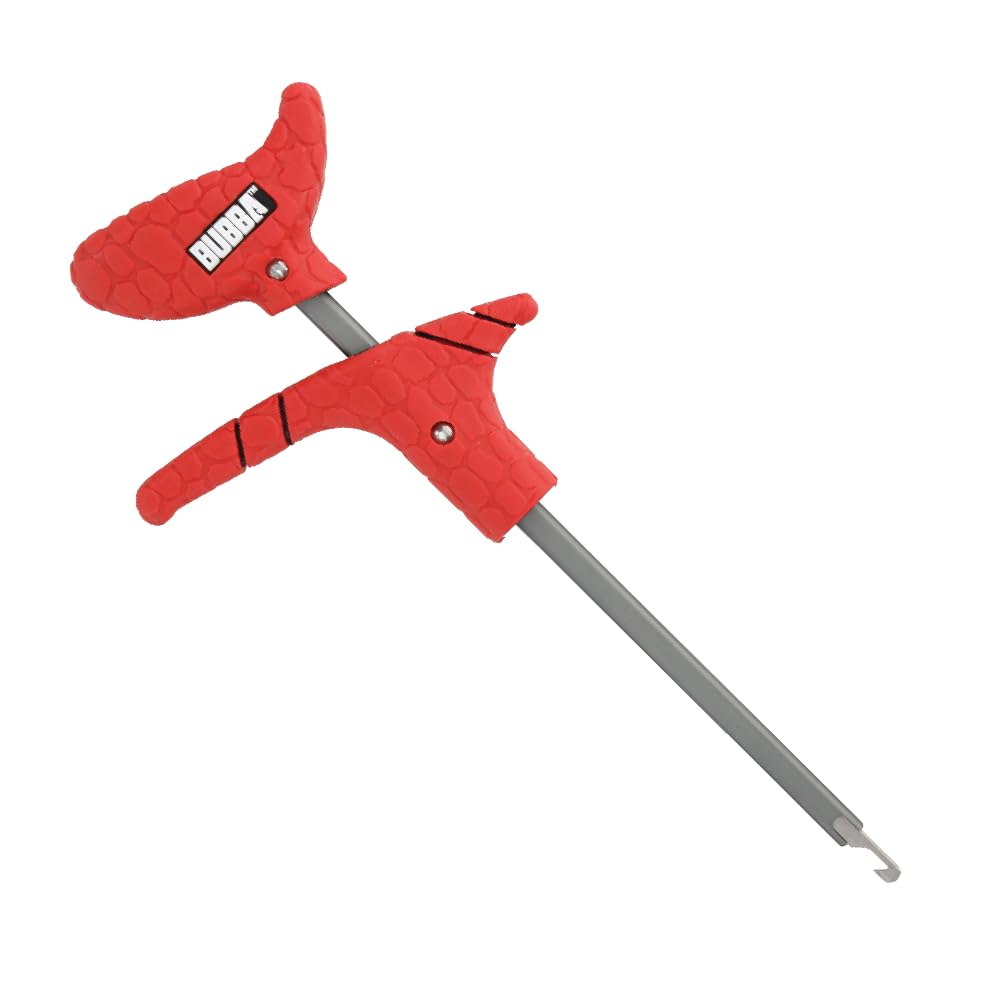
BUBBA Hook Extractor

91 /100
Angler Score Outstanding

Key details

Weight
2.08 oz
Material
Forged stainless steel
Warranty
Limited lifetime
Overall Length
8 inches
Check Details on Amazon

This is the most expensive tool on the page, and it earns that in two ways: forged stainless with a limited lifetime warranty, and an 8-inch overall length that goes where the long dehookers can't. On a kayak, that matters, because a 13-inch tube is one more thing to tangle in a paddle leash.

The spring-loaded T-handle works one-handed. Brace the handle in your palm, squeeze, and the extractor jaws close on the hook; at 2.08 ounces it disappears into a PFD pocket. The slim profile is the quiet advantage, because it gets into the corner of a mouth where a bulkier tool blocks your view.

The trade is reach. Eight inches is plenty for a bass or a redfish, and it's half the length of the long dehookers here, so on a big toothy fish you're giving up the distance that keeps your knuckles intact. There's no lanyard in the box either, which at this price is a small irritation; add one before the first trip.

What you're buying is the last remover you plan to buy, backed by a warranty that outlasts the salt. If you fish from a kayak or a small boat and you're tired of replacing plastic handles, this is the upgrade.

Pros

  • Fits a PFD pocket at 8 inches and 2.08 ounces
  • Forged stainless steel with a limited lifetime warranty
  • Spring-loaded T-handle works one-handed
  • Slim profile reaches tight spots in a mouth

Cons

  • Half the reach of the long dehookers here
Our verdict

We reach for this one on a kayak, where an 8-inch frame and a lifetime warranty beat extra reach.

Check Latest Price
7

Boat Spares

Sumind Hook Remover 2-Pack

90 /100
Angler Score Outstanding

Key details

Pieces
2
Material
Stainless steel
Operation
Spring-loaded handle
Overall Length
11.5 inches
Check Details on Amazon

Two identical 11.5-inch removers in one pack sounds like a strange idea until you've left your only dehooker in the truck. The second one is the point: one for the boat, one for the tackle box, one for whoever keeps borrowing yours.

The tool itself is a spring-loaded grabber with serrated jaws and a one-handed squeeze. The jaws meet squarely and the spring opens the handles on release, so grabbing a hook and letting go takes one motion. Nothing clever here, just a spring, a pair of jaws, and a body the listing calls stainless steel, which is what you want in a tool you're using in the dark.

The steel is where we're careful: some rust anyway despite the stainless label, and pairs have failed at the jaw on the first big fish. As spares that live in a boat box and get rinsed after saltwater, they're excellent value. The spring is light enough that small hands can work it, which is why the second tool usually ends up with whoever's fishing beside you.

Pros

  • Two 11.5-inch removers in one pack
  • Spring handle opens and closes one-handed
  • Jaws grip a hook without slipping
  • Budget price for a spare in every bag

Cons

  • Steel can rust despite the stainless claim
  • Jaw strength varies between pairs
Our verdict

Two capable 11.5-inch removers for about the price of one, best kept as spares in the boat and the truck.

Check Latest Price
8

Big Toothy Fish

Region Fishing Heavy Duty Dehooker

91 /100
Angler Score Outstanding

Key details

Shaft
Corrosion-resistant stainless steel
Handle
Solid anodized aluminum
Overall Length
10 inches
Check Details on Amazon

Heavy duty is a claim every listing makes. Here it's at least structurally different: one solid piece of anodized aluminum for the handle, and a stainless shaft that stays stiff when you lean on it.

At 10 inches it sits in the same useful middle as our top pick, long enough to keep your hand off a catfish spine and short enough to stow along a gunwale. The hardware reads the same way: nothing to adjust, nothing that spins in your grip, no rattle when you shake it.

The catch is that we know less about it. It comes from a smaller brand with a shorter track record than the Booms tools, and what we've seen of it is uniformly good, sturdy and straight and well finished, without the history that tells you how one holds up after five seasons of salt. What we can say is that the parts that fail on cheaper tools, the handle joint and the jaw rivets, aren't where our concern sits with this one.

So this is the pick for a boat that sees big fish and saltwater, and the one to choose if you've already broken a plastic-handled remover. It isn't the value leader, since the budget picks here cost less, but it's built like it expects to be used hard.

Pros

  • Solid anodized aluminum handle that won't spin
  • Stiff stainless shaft made for big toothy fish
  • 10 inches balances reach and stowage

Cons

  • Costs more than the budget picks without extra features
Our verdict

We treat this as the heavy-duty choice: a solid anodized handle and a stiff stainless shaft with no plastic joint to fail.

Check Latest Price

How We Tested 15 Hook Removers, On the Water and at the Bench

We started by pulling every hook remover we could find with a real customer base behind it — squeeze-out designs, T-handle extractors, forceps-style tools, and the long stainless models — then cut anything with plastic jaws, vague steel, or reviews that mentioned tips splaying on the first fish. That left 15 tools, spanning roughly the whole range of sizes and handle styles you'd find shopping.

Testing ran four months, from cold spring bass in muddy shallows through summer saltwater. Each tool rode in a vest pocket, a boat bag, or a kayak crate and got used the way you'd actually use it: one-handed, sometimes in low light, with wet hands and occasionally gloves.

Back at the bench, we buried barbed hooks in a leather glove and a scrap of denim and timed how long each tool took to clear them, watching whether the jaw tips met cleanly or slid past each other. Forceps with locking mechanisms were opened and closed a few dozen times to see if the lock held or drifted loose. We gripped every handle with slime-coated hands to check whether the tool twisted, and carried the smallest ones in a shirt pocket for full days to see how often we actually reached for them.

Durability got its own treatment: each tool was dunked in salt water, left sitting, rinsed, and checked for pitting, and a few were dropped on a dock on purpose to see what bent or sprang. Value came down to what survived all of that — a plain tool that still clears a deep hook beats a fancy one that doesn't.

How to Choose a Fishing Hook Remover

Match the Tool to the Hook

Jaw-style removers squeeze a hook and back it out, push-pull dehookers use a curved tip to lever or push, and forceps lock onto a hook and hold it while you work. None of them is universal. A 13.6-inch dehooker's tip is too blunt for a size 10 hook, and five-inch forceps will never reach a hook swallowed past a bass's throat.

Start with the hooks you actually tie on. Fine wire, small eyes, and panfish mouths point to forceps. Big singles and trebles on bass, pike, and saltwater fish call for a jaw tool or a push-pull dehooker with a tip wide enough to catch a 4/0 bend. Buy for the fishing you do most, not the trip you take once a year.

Reach Versus Storage

Length is a trade you make once. Ten to eleven and a half inches is the useful middle: enough distance from teeth and spines, short enough to drop into a tackle box or a boat compartment. Anything past 13 inches buys real standoff from a thrashing fish and costs you stowage, because it lives in a rod rack, not a vest.

Think about where the tool sits between fish. If it's going in a PFD pocket or a small box, an 8-inch frame like the BUBBA's is the one that actually gets carried. If it hangs on a boat lanyard all day, extra length costs you nothing.

One Hand Free

You will almost always be holding something else. Spring-loaded jaws open when you release the handle, so squeeze-and-release is the entire motion. A ratchet lock on forceps does the opposite job: it holds the hook so both hands are free to tie or pinch a barb. A T-handle lets you push with your palm, which is stronger and steadier than fingertip pressure.

Test the spring before you trust it. It should open the jaws fully under a wet thumb and close without grit. A tool that needs two hands to open is a tool you'll leave in the box.

The Parts That Fail

Failures cluster in two places: the joint where a plastic or two-piece handle meets the shaft, and the rivet that holds the jaws. A hard pull on a big treble is what breaks them, so play fish out before you reach for the tool and don't use it as a pry bar. Stainless and anodized aluminum survive saltwater far better than painted steel, but even those want a freshwater rinse and a dry before they go back in the box.

Check a new tool before the first trip. The spring should snap the jaws open, the handles shouldn't rattle, and the joint shouldn't flex when you squeeze. Send back anything that does.

Frequently Asked Questions

Final Verdict

Start with the Booms Fishing R2. It has the best balance of reach, one-hand control, and price in this group, and it handles everything from a bluegill to a schoolie without asking you to learn a technique first.

If your fishing means big toothy fish in salt water, the Booms R08's push-pull tip is the better tool. From a kayak, the BUBBA's 8-inch frame earns its premium. And if small hooks are your whole world, the forceps two-pack is the smarter buy.