Best Fishing Marker Buoys of 2026

The worst thing a fishing marker buoy can do is drift. You drop it over a brush pile, turn around to re-rig, and look up to find it forty yards downwind of anything worth catching. A buoy doesn't need to be complicated — it needs enough ballast to sit deep, a hole that grips the line where you set it, and a color you can pick out against chop and glare. Get those right and it quietly saves you a spot and a pile of sonar time; get them wrong and it just gives you a false sense of where the fish are.

I've marked plenty of spots I never actually fished, so I've gotten picky about what earns space in the boat bag. Over the past four months we've had 16 buoys in the water, from egg-sized floats to big crab-trap markers, and the differences show up fast. The detail first-time buyers overlook is hole spacing: too wide and the buoy creeps up your anchor line, too narrow and you can't thread it with cold, wet hands. The picks below are the ones that held.

1

Best Overall

Lindy Marker Buoy Set

89 /100
Angler Score Excellent

Key details

Ballast
Internal
Line Length
60 ft
Body Material
High-impact styrene
Markers Per Pack
4
Check Details on Amazon

Open the box and you get four complete markers: a hot-orange barbell body, a weight, and 60 feet of rot-proof cord for each one, plus a rack that keeps the set together. Nothing to rig and nothing else to buy, and there are enough markers to tag a brush pile, a ledge, and a rock pile in a single morning.

Internal ballast is the part that earns its keep. Weight inside the body rather than hanging below it keeps the marker planted when the wind picks up and the surface starts moving. High-impact styrene means you can toss them into a rod locker loose instead of nesting them in a bag, and the rot-proof cord matters more than it sounds when the markers live in a damp compartment between trips.

For most freshwater and inshore fishing, this is the set we hand people first. Sixty feet of line covers the structure most of us fish, four markers let you run a whole milk run rather than one spot, and the price means losing one over the side is an inconvenience instead of a decision. It is the best value among the ready-to-fish sets on this list, and the simplest of them to live with.

Wind them back loosely. Reeled tight, the cord can pinch against itself on the winder and cost you a few minutes untangling on the water. Past that, there is not much to say about a marker this straightforward: you tie it on, you drop it, and it sits where you put it.

Pros

  • Four complete markers in one box
  • Internal ballast resists drift in wind
  • Rot-proof cord survives wet storage

Cons

  • Barbell body is bulkier than photos suggest
Our verdict

For marking structure in 60 feet or less, we reach for this set first: four complete markers with cord and weight in the box, and the best value of the ready-to-fish sets here.

Check Latest Price
2

Best for Deep Water

RITE-HITE Marker Buoy

92 /100
Angler Score Outstanding

Key details

Weight
6.5 oz, lead-free
Coating
UV-resistant
Line Length
75 ft
Markers Per Pack
2
Check Details on Amazon

Seventy-five feet of nylon and a 6.5-ounce weight is a different job from the shallow sets. That is the depth where you are tagging a hump on a main-lake point or a piece of structure in current, and where a light weight means the buoy never quite gets over the spot you are trying to remember.

This is the pair we trust when the wind moves the boat faster than a light marker can fall. The nickel-plated steel weight drops quickly, and the flat body stops paying out line once it lands, so the buoy settles instead of sailing off the mark. It is also the strongest-reviewed complete marker here, and the weight contains no lead, which some anglers care about.

Two things to do before the first drop. Check the knot at the weight and at the buoy, because the line is thin and a loose knot is how people lose a weight on the first throw. And treat the snap-together design as tidy storage rather than a lock; the halves hold for packing, not for gripping a rope. The UV coating, meanwhile, is a genuine advantage for a marker that spends the season on a deck.

Pros

  • 75 feet of line reaches deep structure
  • 6.5-ounce lead-free weight drops fast
  • Flat body stops paying out line

Cons

  • Only two markers per pack, at a premium price
Our verdict

Our pick for deep water: 75 feet of line and a 6.5-ounce weight that drops fast and holds over structure when the wind is pushing the boat.

Check Latest Price
3

Best for Crab Pots and Traps

JEZERO Deep Water Float

91 /100
Angler Score Outstanding

Key details

Material
Closed-cell foam
Float Size
5 x 11 in
Hole Diameter
1 in
Floats Per Pack
2
Check Details on Amazon

Five inches by eleven is a lot of closed-cell foam, and that is the point. These floats carry pot lines, trap lines, and mooring lines that would pull a small plastic float under, and the rated maximum is 8.8 ounces of hanging weight. If your job is marking pots rather than a bass ledge, start here.

The center hole is listed at an inch, and it is the spec to check rather than trust. The bore is not always uniform from float to float, and a rope that slides through one can bind in the next. Test-fit your actual line before the season, and if it is tight, a rat-tail file opens the hole without hurting the foam; a two-minute job that saves an afternoon on the water.

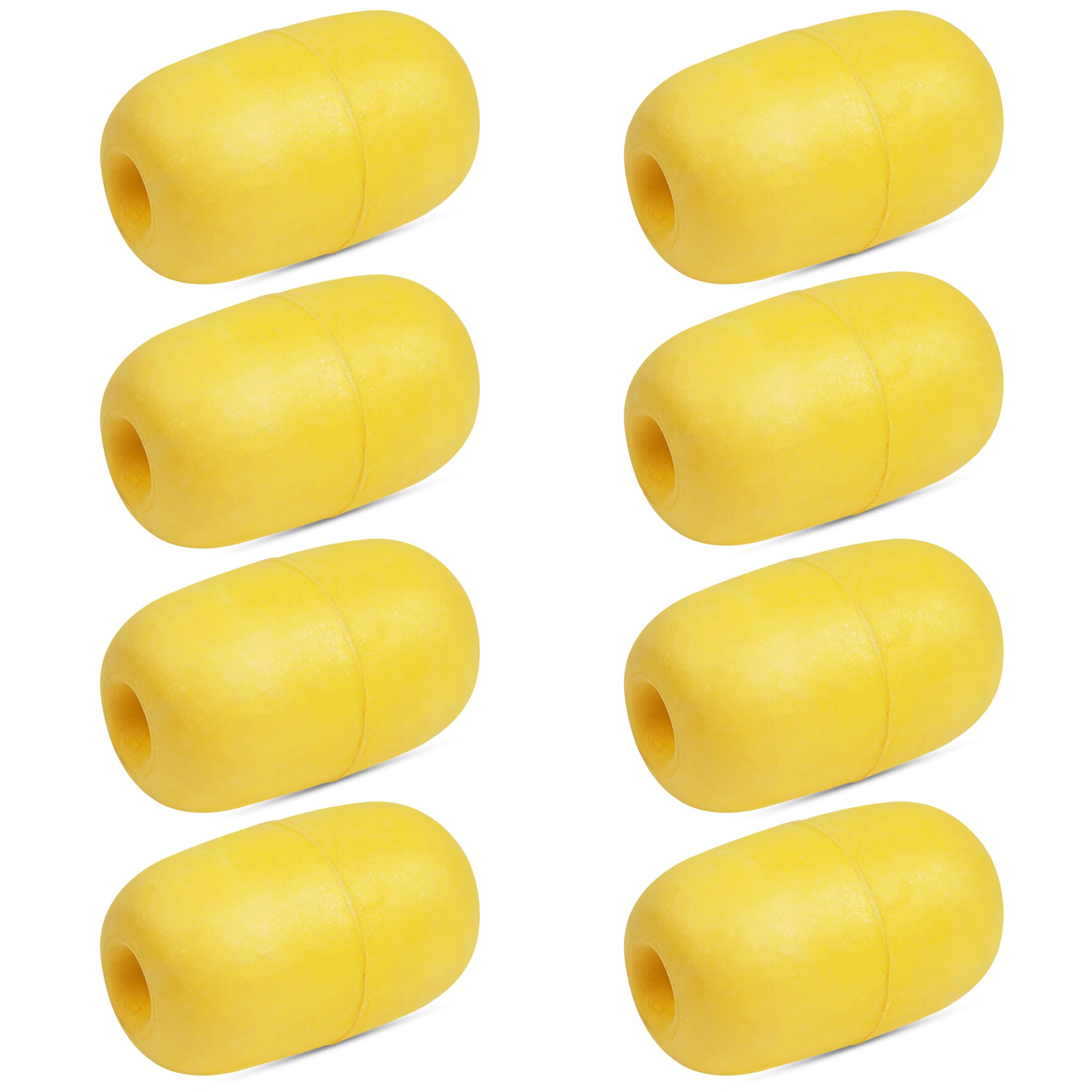
Yellow reads well against dark water, and in flat light it is easier to pick out than a white or pale float. The 5 x 11 body is big enough to spot from the helm, which is the whole reason to accept a float this bulky in the boat in the first place.

For trap and pot marking, this is the float we trust most in this group. It has been used as a kayak outrigger, a crab pot marker, and a mooring float, and it stays on top with a line hanging off it, which is the entire job. Just do not buy it for a rope it will not fit.

Pros

  • Large foam body holds pot lines up
  • Bright yellow reads on dark water
  • Closed-cell foam will not waterlog

Cons

  • Surface color can arrive dull, hurting visibility
Our verdict

If you are marking crab pots or a trot line, this is the float we trust: a big foam body that stays up with a loaded line hanging off it.

Check Latest Price
4

Best for Thick Rope

Shaddock 5x11 Trap Float

88 /100
Angler Score Excellent

Key details

Material
EVA closed-cell foam
Float Size
5 x 11 in
Hole Diameter
1.06 in
Floats Per Pack
2
Check Details on Amazon

A 1.06-inch center hole is the widest on this list, and for some setups that is the only number that matters. Pot line, spliced eyes, doubled rope, anything that has to slide through without being coaxed: a bore this size takes it where a three-quarter-inch float will fight you all season.

The body is EVA closed-cell foam, five inches by eleven, so it floats a serious line without soaking up water, and it comes two to a pack. The foam is dense rather than spongy, and that density is the difference between a float that lasts several seasons and one that crumbles at the edge after a summer of sun.

For crabbers tired of working rope through a tight hole, this is the pick. The bore size and the foam density are the reason to choose it over the other two-packs here, and two floats cover a pair of pots. Inspect them when they arrive, since foam shipped loose in a bag is worth a look before the season rather than after.

Pros

  • 1.06-inch bore takes the thickest rope
  • Dense EVA foam resists waterlogging
  • Sized for crab and shrimp pots

Cons

  • Priciest per float among the two-packs here
Our verdict

For thick pot line and spliced eyes, the widest bore here is the reason to buy it, provided you are ready for the premium price.

Check Latest Price
5

Best Bulk Set

Vertintong Deep Water Floats

86 /100
Angler Score Excellent

Key details

Material
Closed-cell foam
Float Size
2.75 x 5.1 in
Hole Diameter
0.78 in
Floats Per Pack
12
Check Details on Amazon

Twelve floats in one bag is the argument. At 2.75 by 5.1 inches with a 0.78-inch hole, they thread onto trot lines, net edges, and dock lines in bulk, and the closed-cell foam is dense enough to hold a line up rather than just ride the surface. If you rig a long line or you lose floats regularly, buying a dozen at once is the sensible way to do it.

Color is the weak point. Red and yellow are the right idea for visibility, but they can arrive dimmer than the listing photos suggest, and on a gray day a dull float is a float you hunt for. Check a couple in good light before you commit the whole bag to a line; the ones with strong color are as easy to spot as anything here.

Pros

  • Twelve floats per bag
  • Dense foam holds a line up
  • Fits trot lines and net edges

Cons

  • Small bodies suit light line rather than pot lines
Our verdict

Twelve floats in one bag make this the practical buy if you rig long lines or you are simply hard on floats and lose them.

Check Latest Price
6

High-Visibility Mooring

KUFA 5x11 Foam Float

0 /100
Angler Score Fair

Key details

Color
Red and white
Material
Closed-cell foam
Float Size
5 x 11 in
Floats Per Pack
2
Check Details on Amazon

Red and white is a classic for a reason. The white body catches light while the red band gives your eye something to lock onto, and on a mooring or a trot line that combination reads farther than a solid dark float, especially in sun.

The body is five inches by eleven of closed-cell foam, the same footprint as the other big floats here, and durability is where it holds up best. The foam takes sun and salt without chalking out, and the same body gets used for crab pots, kayak outriggers, and ski moorings.

The molding is where it slips. The line hole is not always perfectly round and can run large, so a thin rope may need a stop knot or a washer to hold the float in place, and a snug PVC fit is optimistic. Check the bore against your rope before you commit it to a pot line.

For a mooring buoy or a trot line marker, this is the one we pick when visibility and toughness matter more than crisp molding. Measure the bore, expect some variation between floats, and it does the job it is sold to do.

Pros

  • Two-tone red and white stays visible
  • Durable closed-cell foam body
  • Handles mooring and trot line duty

Cons

  • Can arrive dented, misshapen, or faded
Our verdict

A tough, bright foam float for mooring and trot lines, as long as you can live with a loose hole and some variation in the molding.

Check Latest Price
7

Dock and Trail Lines

Tlence Oval Water Floats

83 /100
Angler Score Excellent

Key details

Material
High-density PVC
Float Size
5.5 x 3.5 in
Hole Diameter
About 1 in
Floats Per Pack
8
Check Details on Amazon

Hard PVC is the difference here. Where most of the picks on this list are foam, these eight ovals are molded plastic with a smooth bore, so they do not absorb water, do not compress when a line pulls hard, and slide along a rope instead of gripping it. For a dock line, a trail marker, or a line you adjust often, that is a better feel than foam, and the red-painted sides give you contrast on a white body.

The hole runs from about five-eighths of an inch to roughly an inch, so measure the rope before you order a bag. Eight to a pack covers a long line or a season of dock work, and the oval shape sits flat against a hull or a piling instead of rolling under it. These are working floats rather than markers, with no cord or weight in the bag, so plan on rigging them with your own line and a weight.

Pros

  • Hard PVC will not absorb water or compress
  • Eight floats cover a full line

Cons

  • Less flotation than the 5 x 11 foam bodies
Our verdict

For dock lines and net edges where foam would soak or compress, the hard PVC shell is worth the trade in flotation.

Check Latest Price
8

Lightweight Rigging

AGOOL EVA Marker Floats

87 /100
Angler Score Excellent

Key details

Material
EVA foam
Float Size
2.76 x 4.33 in
Hole Diameter
0.8 in
Floats Per Pack
8
Check Details on Amazon

At about an ounce apiece, these are the lightest floats here, and that is not a knock. A float that weighs next to nothing does not drag a fine line down or sag a net edge, and the EVA foam is soft enough that it will not scuff a hull or chip when it gets kicked around a deck.

Eight to a bag in a bright yellow, with a 0.8-inch hole that fits most rope and line, these are the ones we put on a net or a trot line where weight is the enemy. They hold their shape instead of soaking up water and going soft, and for light-duty marking from a kayak or a small boat that is exactly the right spec.

The warranty runs three months, which tells you how the maker thinks of them: a consumable rather than an heirloom. That is fair for what they are, and a bag of eight means there is always a spare when one goes over the side.

Pros

  • Light enough for fine line and net edges
  • Soft EVA will not scuff a hull

Cons

  • Small body suits light line, not heavy pot lines
Our verdict

Light, soft, and buoyant, these are the floats for fine line and net edges rather than heavy pot lines in current.

Check Latest Price

How We Tested Fishing Marker Buoys

We built the shortlist from spec sheets rather than reviews, because a buoy's numbers tell you most of what matters: hole diameter, cord length, listed weight, and whether the body is molded in one piece or joined at a seam. Anything with a hole narrower than a quarter inch got cut — it won't take real anchor line — and anything without a stated weight went too, since internal ballast is the difference between a marker and a kite. That left 16 buoys.

Those 16 buoys spent four months on the water with us: dropped over rock piles on weekend trips, tethered to a kayak in a tidal creek while we pulled crab traps, and floating off a pond dock through a run of windy afternoons. Back at the bench, we weighed each one dry on a kitchen scale and again after an hour of soaking, which exposed the ones quietly taking on water.

In the water we pushed each buoy under and let go, watching whether it surfaced fast and sat upright or rolled onto its side in chop. We threaded 3/16-inch rope through every hole to see whether it slid freely or bit down, then tossed them into the wind and timed the drift over five minutes. A few trailed behind a kayak at trolling speed so we could see whether the cord paid out clean or knotted in the bag.

Durability and storage got the boring tests: a month in a sun-baked deck bucket to see if the color chalked or the seams split, then a season rattling in a tackle box and a milk crate to check whether the cord came back tangled or ready to throw. We weighed every buoy against what it actually did on the water rather than what the packaging promised, and the picks below are the ones still riding high.

How to Choose a Fishing Marker Buoy

A Marker System or a Float You Rig Yourself

The products here split cleanly in two. A marker system arrives with line, weight, and a buoy ready to drop, and that's what you want for a spot you plan to return to, because you can deploy it one-handed while the boat is still settling. The Lindy and the RITE-HITE are the two systems here. A bare float is a component: it threads onto a pot line, a trot line, or a dock line you already own, and it marks nothing by itself.

So a float in a bag is not a marker yet. Price the line and the weight into that decision before you compare bags of foam. Whatever you buy, check the knot at the weight and tie the line off to the buoy before the first drop; those are the two failures that cost people a marker on day one.

Line Length and the Depth You Fish

The line has to be longer than the water is deep. You drop upwind of the mark, the boat keeps drifting while the weight falls, and the buoy needs enough scope to settle over the spot rather than under the hull. Sixty feet covers most inland structure and shallow coastal rock; 75 feet is the right call when 40-plus feet or steady current is normal for you.

Past that, no marker line is long enough. A GPS waypoint becomes the real tool and the buoy is a visual backup for the drift. If you fish both shallow and deep, the deep-water set still marks shallow water fine; the reverse is not true.

Hole Size and Rope Diameter

Center holes on these floats run from 0.78 inch to 1.06 inch, and that hole decides whether a float works with your gear. A one-inch hole does not mean one-inch rope slides through easily. You want clearance, especially for a spliced eye, a doubled line, or a knot. Holes also vary float to float inside the same bag, so test-fit your actual line before the season starts.

Too tight, and a rat-tail file opens the bore in a couple of minutes. Too loose, and a stop knot or a washer above the float keeps it where you put it. If thick pot line is the job, start with the widest bore here rather than fighting a small hole all season.

Float Size, Buoyancy, and Visibility

Body size tells you what a float can carry. The 5 x 11-inch foam bodies hold pot lines, mooring lines, and trap lines. The 2.75-inch floats are for net edges, trot lines, and light work where the float is a flag rather than a load-bearing part. Foam is forgiving, cheap, and can go chalky in sun; hard PVC does not absorb water or compress under a hard-pulling line.

On color, orange and yellow read best against dark water, two-tone red and white holds up in bright sun, and any float that lives on deck benefits from a UV coating. Add a strip of reflective tape if you're ever retrieving at dawn or after dark. Buy for the light you actually fish in, not the light in the listing photo.

Frequently Asked Questions

Final Verdict

Buy the Lindy set unless you fish deep. Four markers with cord and weight in the box, internal ballast that resists drift, and a cost per ready-to-fish marker that makes losing one a shrug — that covers the way most of us fish structure.

If your spots sit in 40-plus feet or in current, step up to the RITE-HITE. The 75-foot line and 6.5-ounce weight settle faster and hold better, and two markers are enough when the spot itself is the point.