Best Fishing Pliers of 2026

The worst time to find out your pliers are junk is with a treble hook buried past the barb and a fish thrashing in your hand. I've been there with a rusty needlenose: the jaws slipped, the cutter crushed 30-pound braid instead of slicing it, and a thirty-second release turned into five minutes. Good fishing pliers fix all of that at once — they hold a hook where you can actually reach it, cut clean, and stay on your vest instead of somewhere at the bottom of a bag. My team and I have fished 12 pairs over the past eight months, and price didn't predict much.

What separates them usually isn't the frame; aluminum bodies all feel light and look handsome. The jaws and the cutter do the real work, and that's where cheaper tools quietly cut corners. Nobody mentions the lanyard until it matters, either — it's the difference between a tool you keep and one on the lakebed. We weighed cutting, ergonomics, versatility, and saltwater manners, and the picks below are the ones that earned a permanent spot on the boat.

1

Best Overall

KastKing Cutthroat 7-Inch

93 /100
Angler Score Outstanding

Key details

Cutters
Tungsten carbide, side-mounted
Included
Molded sheath and lanyard
Jaw Material
420 stainless steel
Overall Length
7.2 inches
Check Details on Amazon

Tungsten carbide side cutters are the first thing we check on a fishing plier, because a cutter that frays braid costs you a re-tie every time you trim a tag end. The Cutthroat's blades sit on the side of the jaws where you can actually see what you are cutting, and they go through braid in one squeeze rather than a saw. That single detail decides more fishing days than anything else on this page.

The rest of the tool is built to be run with one hand. The jaws are spring-loaded and the grip profile is thin, so the pliers open themselves as soon as you relax your fist and sit naturally in a palm that is already holding a fish. The textured rubber helped us keep hold with slime on our hands, and the orange body is easy to spot when it lands on the deck. Serrated jaws grab a hook shank, the crimping slots close a split shot, and a small hooked nose opens split rings.

The detail we liked most is easy to miss: the jaws do not quite touch when the pliers are closed, so you can clamp a hook by the bend without flattening it, which matters when the hook is coming out of a fish you intend to release. What you accept in return is upkeep. The 420 stainless is coated rather than rustproof, and saltwater is where that coating earns its keep or does not; a freshwater rinse and a full dry after every trip is what keeps this pair working. Do that and you have a braid-ready tool with a belt-clipping sheath and a lanyard, priced in the middle of this group.

Pros

  • Tungsten carbide cutters cut braid cleanly
  • Spring-loaded jaws open one-handed
  • Sheath, belt clip, and lanyard included
  • Crimping slots and split-ring nose add rigging uses

Cons

No notable drawbacks to flag.

Our verdict

We think most anglers should start here: carbide cutters that handle braid and spring-loaded jaws you can work with one hand.

Check Latest Price
2

Best Locking Design

TRUSCEND Lockable Pliers

92 /100
Angler Score Outstanding

Key details

Lock
Sliding safety lock
Weight
4.9 oz
Cutters
Tungsten carbide
Body Material
Teflon-coated aluminum
Check Details on Amazon

A locking plier sounds like a small feature until a spring-loaded pair pops open inside a vest and puts a jaw through the pocket lining. The TRUSCEND's sliding lock is the best of the ones we handled: it moves with a thumb, holds the jaws shut in the sheath, and releases into a self-opening tool you can run with one hand, which is what you want when the other hand is holding a fish.

The handle is the other reason it is on this list. It is cast aluminum with a Teflon coating and shaped like a pistol grip, which puts the squeeze closer to the strongest part of your hand and gave us more control on a hook buried past the bend of a treble. At 4.9 ounces it hangs from a lanyard without dragging your belt sideways, and the tungsten carbide blades go through braid and heavy mono without complaint.

Two things to know before you commit. The pivot is the wear point, and pieces coming apart at the joint is the failure to watch for, so grip a hook with the jaws rather than levering it out of a throat. The holster's belt clip also works loose; run the lanyard to a belt loop and the clip stops mattering.

Pros

  • Sliding lock keeps the jaws shut in a sheath
  • Self-opening jaws work one-handed
  • Pistol-grip handle gives extra control
  • Tungsten carbide blades handle braid and mono

Cons

  • Priciest plier in this set
Our verdict

If your pliers live in a vest pocket or a kayak crate, the sliding lock and self-opening jaws make this the pair we trust to stay shut until we need it.

Check Latest Price
3

Best for Saltwater

FLISSA 8-Inch Pliers

91 /100
Angler Score Outstanding

Key details

Length
8 inches
Cutters
Tungsten carbide
Included
Belt sheath and coiled lanyard
Jaw Material
Titanium 6Al-4V
Check Details on Amazon

Eight inches of plier is a lot of tool until a fish has swallowed a hook past the bend and you need to get behind it without putting your knuckles near the teeth. The extra length is why the FLISSA is here: the jaws reach where a 6 1/2-inch pair simply cannot, and the hooked nose gives you a lever for opening split rings without hunting for a second tool.

The build is the part we rate most highly. The jaw is titanium 6Al-4V, the body is anodized aluminum, and the blades are tungsten carbide, so the jaw and body are not the parts you will find corroding after a week of tidal fishing. On braid the blades leave a clean end rather than the fuzzy one you get from a chewed cut, and the safety lock keeps the jaws closed in the sheath between fish.

It is also the easiest of these to use with cold, wet hands: the handles are broad and the lock tab is big enough to find by feel. What you trade is size. Eight inches takes up real room in a vest pocket, and on a kayak it is more tool than you need for small fish. If your fishing is saltwater and your hooks run deep, that is a trade worth making every time.

Pros

  • Titanium jaw and anodized body resist salt
  • Eight-inch reach for deep-set hooks
  • Tungsten carbide blades leave a clean braid cut
  • Hooked nose opens split rings

Cons

  • Long body takes up vest or pocket space
Our verdict

For saltwater and big fish, this is our pick: titanium jaws, an anodized body, and eight inches of reach that gets behind a deep hook.

Check Latest Price
4

Best for Fly Anglers

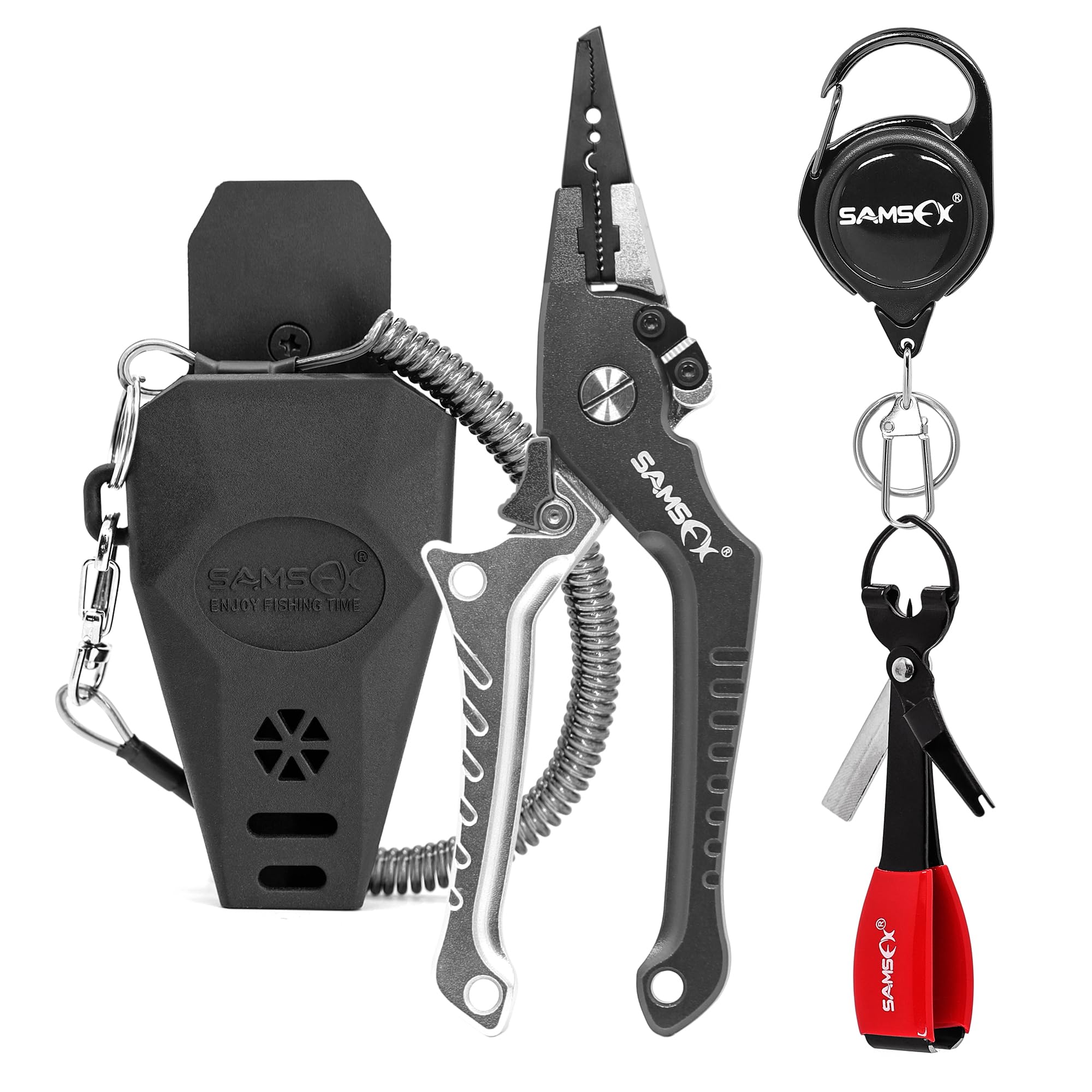
SAMSFX Aluminum Pliers

92 /100
Angler Score Outstanding

Key details

Lock
Manual thumb switch
Cutters
Replaceable tungsten carbide
Included
Sheath, steel-wire lanyard, knot tool
Body Material
Anodized aluminum
Check Details on Amazon

Most pliers in this guide are spring-loaded. The SAMSFX is not, and that is the whole idea: a thumb switch lets you open and close the jaws freely, park them at any width, and lock them shut, with no spring to fatigue and nothing snapping at your fingers while you thread a knot. We found the switch easy to work one-handed, and it is the reason this pair suits fly anglers and anyone who ties leaders on the water.

The cutter is replaceable, which no other plier here offers: when the tungsten carbide blade dulls you swap it instead of retiring the tool. The package adds a knot-tying tool and a steel-wire coiled lanyard with a molded sheath, and the anodized aluminum body keeps the weight down. Serrated jaws and the hooked nose cover hook removal and split rings.

Where it gives ground is the sheath. The pliers can slide free of it, so use the coiled lanyard rather than trusting the holster alone. Buy this one for the lock and the replaceable blade, and keep a spare cutter on hand if you trim braid every trip.

Pros

  • Thumb lock replaces a spring entirely
  • Replaceable tungsten carbide cutter
  • Knot tool and steel-wire lanyard included
  • Anodized aluminum body resists corrosion

Cons

  • Cutters vary from pair to pair on braid
Our verdict

The pair we reach for when we are tying knots rather than unhooking monsters: a thumb lock instead of a spring, and a cutter you can replace when it dulls.

Check Latest Price
5

Best Budget

Rapala Fisherman's Pliers

90 /100
Angler Score Outstanding

Key details

Handle
Co-molded grips
Length
6 1/2 inches
Material
Nickel-plated carbon steel
Check Details on Amazon

The Rapala is the cheapest pair here, and the savings come out of the cutter. As a hook remover it is hard to fault: nickel-plated carbon steel, co-molded grips, and a slim 6 1/2-inch body that slides into a bluegill's mouth without a fight. Mono and fluorocarbon it cuts cleanly, and the grips stay comfortable through a long afternoon of unhooking fish.

Braid is where it stops. The blades skate and fray instead of slicing, which on a bass lake is most of the day, so plan on carrying a small braid cutter alongside it. If you already do, this is a lot of hook-removing tool for the least money in this group, and the slim profile is easier on small fish than the broad-jawed pliers most of us default to.

Pros

  • Comfortable co-molded grips
  • Slim 6 1/2-inch body reaches small mouths
  • Cuts mono and fluorocarbon cleanly
  • Lowest price in this group

Cons

  • No sheath or lanyard included
Our verdict

A plain, honest hook remover for mono and fluorocarbon, and the pair we hand a kid or keep in the boat box as long as braid is not on the menu.

Check Latest Price
6

Split-Ring Swaps

Booms Fishing X1

92 /100
Angler Score Outstanding

Key details

Jaws
Stainless steel
Handle
Aluminum with inset spring
Included
Coiled lanyard and sheath
Split Ring
Hooked jaw tip
Check Details on Amazon

Changing a treble on a crankbait without a split-ring tool is a thumbnail-losing job. The X1 puts a small upturned hook at the jaw tip for exactly that, and it works: you catch the ring, spread it, roll the new hook on, and get back to casting. For lure tuners, that one detail is worth more than the cutter.

The aluminum handle hides its spring inside rather than running it along the outside of the pivot, which keeps the mechanism clear of line and grit, and the jaws open on their own between squeezes. The braid cutters are set into the handle, the stainless jaws are serrated, and the package includes a coiled lanyard and a sheath. It rides light enough on a vest that you forget it is there until a hook needs moving.

What keeps it out of the runner-up group is the money: it costs about what the SAMSFX and the Cutthroat do, and both of those bring something this one does not. Fish freshwater, swap trebles often, and want a genuine split-ring nose on a light pair, and it still earns its spot in the box.

Pros

  • Hooked jaw tip opens split rings
  • Inset spring stays clear of line
  • Aluminum body keeps it light
  • Coiled lanyard and sheath included

Cons

  • Smooth aluminum handle gets slick when wet
  • Cutter and spring are the wear points
Our verdict

A light aluminum pair with a proper split-ring nose, worth it if you swap trebles more often than you unhook big fish.

Check Latest Price
7

Small Hooks, Trout

Pristis UTA II

92 /100
Angler Score Outstanding

Key details

Lock
Return spring with safety lock
Weight
4.8 oz
Jaw Opening
1.3 inches
Jaw Material
2CR13 stainless, Teflon coated
Check Details on Amazon

If the Cutthroat is the all-rounder, the UTA II is the small-hook specialist. The jaw opening is listed at 1.3 inches and the nose is narrow, so it slides into a trout's mouth or works a size-10 hook without the jaws crowding each other, and the hooked tip still handles split rings when you need to change a lure.

The build is unusual for the money: a 2CR13 stainless jaw with a Teflon coating, an aluminum handle, and a return spring paired with a safety lock, so it opens on its own and still stays shut in the sheath. At 4.8 ounces it hangs from a vest all day without notice, and the lanyard is a PVC-sheathed steel wire rather than the elastic cord most of these use.

In the hand it feels the most compact of the group despite its length. The handle is slim, the spring is light, and the lock tab falls under your thumb without a look, which is the sort of thing you notice at dusk with a fish flopping in the net.

Our reservation is leverage, not fit. This is a light plier with a narrow jaw, and prying a deep hook instead of gripping the shank is how jaws like these twist. Use it for what it is built for, meaning small hooks, light line, and fish you can lift with one hand, and it is a pleasure. Hand it to someone winching a hook out of a big fish's throat and you are asking for a bent jaw.

Pros

  • Narrow nose reaches small hooks
  • Spring plus safety lock stays shut
  • 4.8 ounces hangs light on a vest
  • Steel-wire lanyard and sheath included

Cons

  • Light build and narrow jaw suit small hooks only
Our verdict

For trout, panfish, and small hooks, this narrow-jawed, featherweight pair gets into places the bigger pliers cannot, just do not ask it to boss a big fish.

Check Latest Price

How We Tested Fishing Pliers On and Off the Water

We started with a field of roughly 40 pairs and narrowed it by what the tool is actually made of: jaw material, cutter type, coating, whether a sheath and lanyard came in the box, and how each size lined up with the fishing it was built for. Price counted, but only as a value question — we wanted to see what the extra money bought. Twelve made the final cut, and each one spent eight months rotating between my boat bag, my vest, and the open tray on the deck.

On the water, the work looked like this: cutting 20- and 50-pound braid, monofilament, and fluorocarbon, and counting how many clean cuts we got before the blades started fraying line instead of shearing it. We unhooked lipped bass, opened split rings to swap trebles, and tightened knots with the built-in knot tools — first bare-handed, then with cold, wet, gloved hands. Grip got judged on how the handles felt after a hundred casts, and size on whether a pair actually disappeared into a pocket or hung off a belt all day without snagging.

Durability we tested rudely. Every pair got dunked in saltwater, left wet in a closed tray overnight, and dropped on gravel and bare aluminum deck; after that we checked the hinge for play, watched for rust blooming at the pivot and along the jaw, and noted whether the coating flaked. Lanyards got the hard tug test and, in two cases, the overboard test. The survivors are still in the rotation, and we'll update as they wear.

How to Choose Fishing Pliers

Match the Cutter to Your Line

Braid is the reason carbide exists on fishing pliers. A plain shear pinches and frays the strands, and a frayed end means a re-tie you did not plan for; tungsten carbide blades, as on the KastKing, TRUSCEND, FLISSA, and SAMSFX here, slice cleanly and hold an edge longer. Fish mono or fluorocarbon almost exclusively and a cheaper plier is genuinely fine.

The trap is the word cutter on the package. It can mean a wire cutter or a hook-holding notch rather than a braid blade, so look for carbide in the specification before you commit. A replacement blade, like the SAMSFX one, is worth paying a little more for if you trim braid every trip.

Reach and Nose Shape: Six Inches or Eight

Six and a half inches is a pocket plier; eight inches is a hook extractor. The longer the jaw, the further back you can reach behind a hook swallowed past the bend, which is why the FLISSA's length earns its place. The opposite matters too: a narrow nose with a 1.3-inch opening, like the Pristis, gets into a small fish's mouth where a broad jaw only crowds.

Seven inches is the compromise most anglers settle on, and it is where our top pick sits. One caution: in a kayak or float tube, a long plier becomes a handling problem in a small cockpit. Match the reach to the boat you fish from, not to the biggest fish you have seen.

Saltwater Is a Materials Question

Nothing in this group is rustproof. Coated 420 stainless and plated carbon steel both rely on a finish that saltwater will eventually work around, while an anodized aluminum body with a titanium jaw puts less steel in the salt path to begin with. That is the argument for the FLISSA if most of your fishing is tidal.

Whatever you carry, rinse it in fresh water at the end of the day, dry it fully, and never stow it wet in a closed box. A coating is protection, not immunity, and the pivot is the first place you will see the difference.

Springs, Locks, and One-Handed Use

A spring is what lets you open and close the jaws with one hand while the other holds the fish, and most pairs here have one. What separates them is the lock: without it, a spring-loaded plier sits open in your bag and puts a jaw through whatever it touches. A sliding lock or a manual thumb switch holds the jaws shut until you release them.

The trade-off with a manual switch, like the SAMSFX, is that you squeeze to open rather than letting the spring do the work. Some anglers prefer that control; anyone re-rigging in cold weather will miss the assist.

Sheaths and Tethers

The sheath is the accessory; the tether is what keeps the tool. Molded holsters with belt clips are standard, but clips work loose and pockets do not grip, so a coiled lanyard clipped to a belt loop or a vest D-ring is the reliable answer. The Rapala is the one pair here with neither, so add a tether if you fish from a boat.

Before a trip, put the sheath on the waistband or vest you actually wear and shake it. If the pliers move, trust the lanyard and not the clip.

Frequently Asked Questions

Final Verdict

If you are buying one pair, buy the KastKing Cutthroat. The carbide cutters handle braid, the spring-loaded jaws work one-handed, and the sheath and lanyard mean it fishes out of the box. At the middle of this group's prices, nothing else here covers as many trips as well.

Two requirements change the answer. Fish mostly saltwater and want the fewest rust-prone parts, and the FLISSA's titanium jaw, anodized body, and eight inches of reach make more sense. Fish from a kayak or wade with a vest, and the TRUSCEND's sliding lock is what keeps a plier shut until you need it.