Best Fly Fishing Waist Packs of 2026

I fished out of a vest for years, mostly because that's what the guide on my first float trip handed me. Then came a July afternoon standing waist-deep in a tailwater, reaching for a fly box that required unclipping three things and soaking a sleeve in the process. A waist pack rides above the waterline and keeps what you actually use within one hand's reach, and I haven't gone back. What it fixes is simple: less digging, less dunking, and gear that stays put when you wade out to your belt.

The catch is that a bad one rides up your ribs, sags the moment you cinch it down, or lets the river in through a zipper that looked sealed in the product photos. My team and I have spent seven months with 12 waist packs — loading each for a full day, wading with them, and hauling them back up the bank — and the real differences come down to how a bag sits on your hips when it's full and how its seams behave when they're wet. The ones worth carrying are below.

1

Best Overall

Allen Eagle River Lumbar Pack

89 /100
Angler Score Excellent

Key details

Net Carry
Padded sleeve
Front Panel
Zip-down workstation
Bottle Pockets
2 at the waist
Fly Box Capacity
6 boxes
Check Details on Amazon

The front panel of the Eagle River unzips and folds down into a flat shelf, and that shelf is why it is our top pick. Six fly boxes go into the main compartment, the panel drops, and you have a work surface at hip height for knots, tippet changes, and digging out the one box you actually want. We stopped balancing boxes on a knee early on and never went back.

What we appreciate most is how much of a vest this replaces without putting anything on your shoulders. Two bottle pockets ride at the waist, dividers inside keep the boxes from sliding into a pile, and a padded sleeve behind the main bag takes a landing net that would otherwise swing from a D-ring all afternoon. On a hot day that is a real difference: nothing against your back, nothing across your chest, casting arm clear.

The bag is not waterproof, so steady rain will eventually work through the main zip. We keep fly boxes in a quart bag inside, which costs nothing and settles the question; anything that rusts gets the same treatment.

The gray-and-lime version is louder than most fly-fishing gear, and that is an advantage the day you set it down on a gravel bar and walk fifty yards upstream.

Pros

  • Six fly boxes in the main compartment
  • Zip-down panel doubles as a work surface
  • Two bottle pockets at the waist
  • Padded sleeve keeps a net out of the way

Cons

  • Seam stitching can give out under heavy loads
Our verdict

This is the one we recommend to most fly anglers: room for six boxes, a fold-down work surface, bottle pockets, and a net sleeve, all carried on the hips instead of the shoulders.

Check Latest Price
2

Best Modular System

fishpond Switchback Belt System 2.0

83 /100
Angler Score Excellent

Key details

Included
Belt, 2L pack, shoulder strap
Net Slot
Built into belt
Waist Fit
33 to 64 inches
Pack Volume
2L
Check Details on Amazon

The priciest pack here is also the least bag-like. The Switchback is a system: a wide thermoformed wader belt with a net slot molded into it, a 2-liter pack that slides along a rail on that belt, and a shoulder strap that keeps the whole thing from sagging when it is loaded. Slide the pack round to your back while you cast, pull it to your front to change flies, and the belt and net stay exactly where you put them. Of everything in this group, it is the design we keep thinking about afterwards.

Fit is where the money goes. The belt adjusts from 33 to 64 inches, enough to sit over a wader shell and a rain jacket, and the ambidextrous layout gives left- and right-handed anglers the same access. Hypalon tabs on the shoulder pad hold pliers and nippers, and the Velcro patch is there for a fly patch or for drying out a sodden dry fly.

Two liters does not go far: a couple of boxes, tippet, a leader wallet, and that is the lot. For the angler who already carries volume somewhere else and wants the net, the tools, and a few boxes moving with them through fast water, that is a deliberate choice rather than a shortcoming. The hand-wash instruction tells you what kind of gear this is, the sort you maintain rather than the sort you abuse.

Pros

  • Pack slides on the belt without moving the net
  • Belt fits 33 to 64 inches over waders
  • Net slot and tool tabs built into the system

Cons

  • Water resistant rather than waterproof
Our verdict

We reach for this one when the plan is to wade far and fish light: belt and net stay put while the pack slides to your hands, and 2 liters holds a day of essentials, not a full box collection.

Check Latest Price
3

Best for Wet Wading

Xelfly Waterproof Waist Bag

88 /100
Angler Score Excellent

Key details

Rod Holder
Integrated
Compartments
5
Waist Straps
Padded, adjustable
Water Resistance
Waterproof
Check Details on Amazon

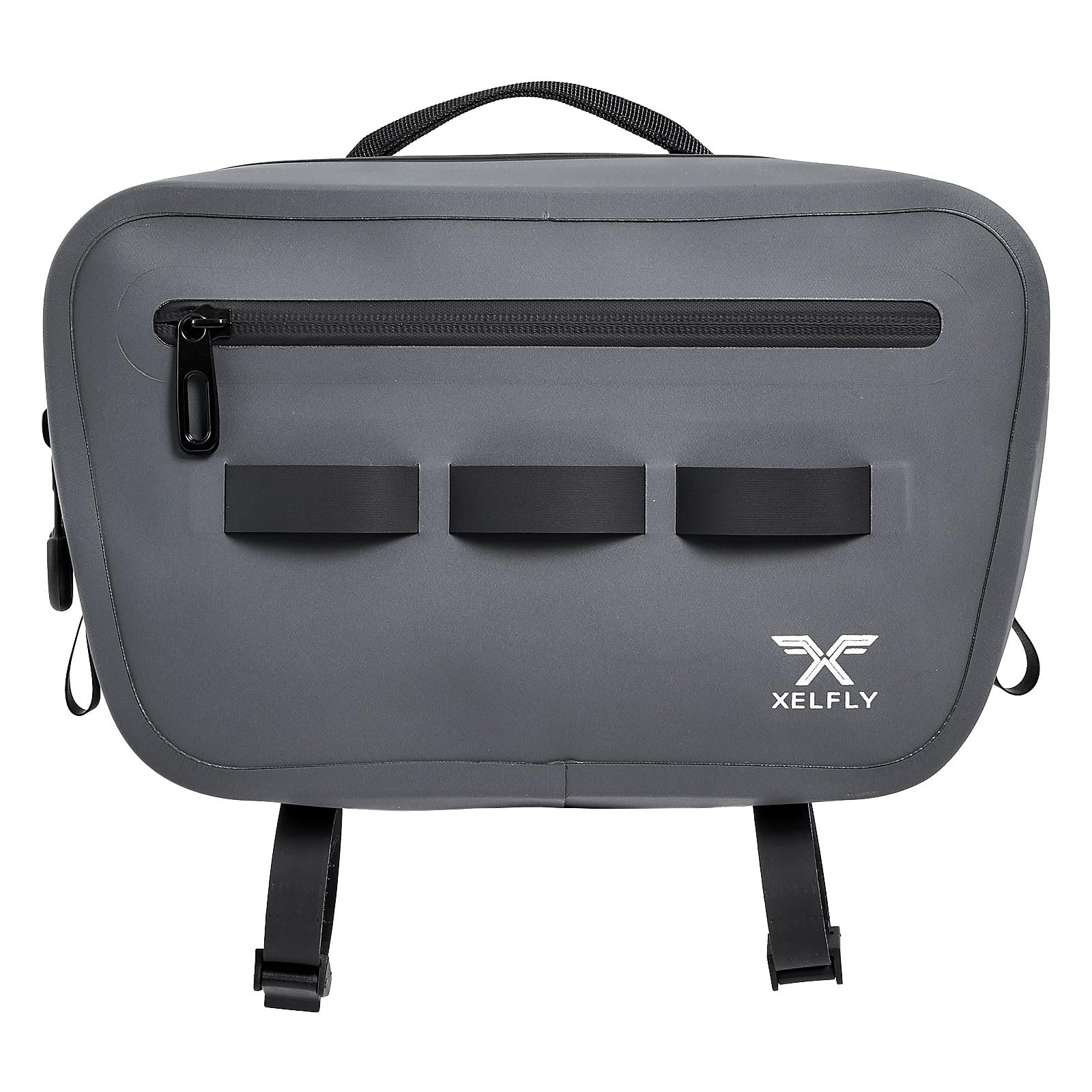
Every waist pack is fine until the water comes over the top of it: a slipped boot in a tailout, a crossing deeper than it looked, two hours of rain with no bank to stand on. The Xelfly is the one here built for that moment, with a waterproof shell, a sealed submersible zip, and a top handle you can grab one-handed when you are already waist deep.

Five compartments take a few fly boxes plus a spare spool without the bag going barrel-shaped, and the outside is set up for the rest of it: a rod holder, a pliers holster, and loops for anything on a leash. The padded waist straps are what we noticed at the end of a long day. They sit flat instead of digging into the hip bone.

Where it earns its keep is the day the water wins a round. Nothing inside needs drying out afterwards, and that is a piece of mind no fabric treatment alone buys you. It is also the least expensive route to genuine waterproofing in this group, which is why it is the one we take for wet wading rather than as a spare.

Pros

  • Waterproof shell with a sealed submersible zip
  • Holds a few fly boxes and a spare spool
  • Padded waist straps stay flat all day
  • Pliers holster and rod holder built in

Cons

  • Sealed zip takes two hands and practice
Our verdict

This is the pack we take when a crossing might go wrong: a sealed waterproof shell, room for a few fly boxes plus a spare spool, and padding that keeps it steady in current.

Check Latest Price
4

Budget All-Rounder

KastKing BaitSpace Waist Bag

85 /100
Angler Score Excellent

Key details

Item Weight
2.03 lb
Compartments
12
Included Box
3600 utility box
Water Resistance
Water resistant
Check Details on Amazon

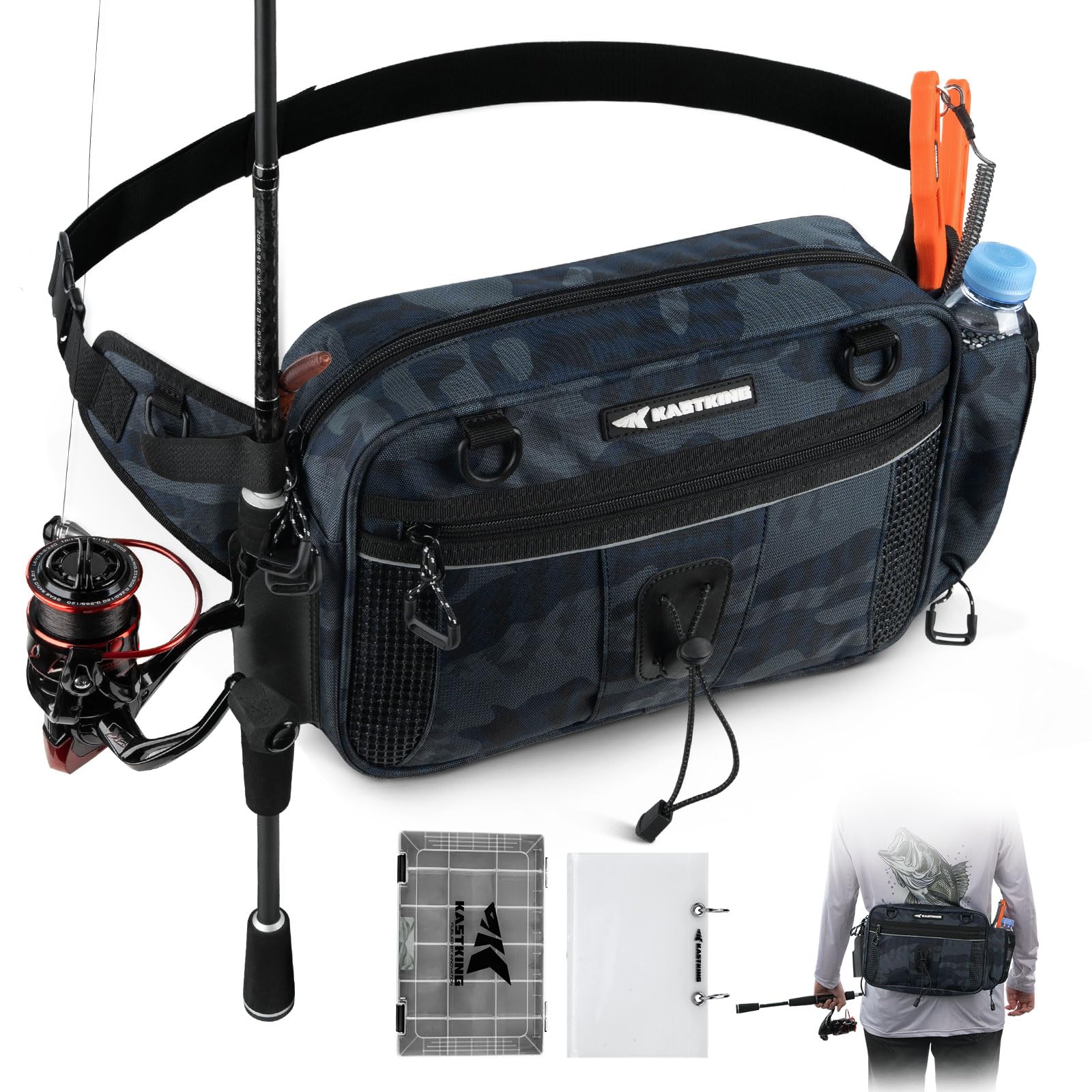
A 3600-size utility box comes in the bag, and that tells you who KastKing built this for. Twelve compartments wrap around it, with tool pockets and gear sleeves up front and zip bags inside for soft plastics, laid out so you can put a hand on one specific lure without unpacking the lot. As a first fishing waist pack, it is the one we hand people with the least hesitation.

Bulk is the catch. Empty, the bag runs about two pounds, and loaded it is a big object to have around your middle in current. Worn high and cinched over the wader belt it settles down; worn low on the hips it swings. If you wade deep or cast all day, that is the thing to weigh before you buy.

One check before a trip: run the main zip open and shut with the bag empty, because the binder rings inside sit close to the track and can catch. It is also the most useful of these off the river, for pond hopping, a kayak, or a boat bag, because a rod holder earns its place when nobody is counting grams.

Pros

  • 3600 utility box comes with the bag
  • Twelve compartments keep gear sorted
  • Useful away from the river too

Cons

  • Splash-resistant only, not submersible
Our verdict

We hand this to new anglers first: a 3600 box comes in the bag, twelve compartments keep lures and tools apart, and the coated shell handles spray without complaint.

Check Latest Price
5

Short Sessions

THKFISH Fishing Waist Pack

85 /100
Angler Score Excellent

Key details

Weight
0.68 lb
Pockets
5
Capacity
3 quarts
Main Compartment
11.8"L x 4.7"W x 3.5"H
Check Details on Amazon

At 0.68 pounds empty, this is the pack you notice least: five pockets, a 3-quart main compartment measuring 11.8 by 4.7 by 3.5 inches, and a MOLLE panel across the front. Light, plain, and enough for a couple of small fly boxes, tippet, a phone, and keys.

It is a small pack by design, and it is worth buying it as one. If your day involves six boxes and a lunch, the Eagle River is the bag; if it is an evening rise with a box of dries and a spool of 5X, this carries it and nothing else. What we like is that THKFISH did not add pockets it cannot fill, and the five it has are all reachable with the pack on.

The pliers loop takes hemostats and small nippers rather than full-size pliers, and the lanyard loop beside it is the better anchor for a leash. Both are the kind of detail you only appreciate after a season of fishing out of the same bag.

Pros

  • 0.68 pounds empty, the lightest here
  • Five pockets, all reachable while worn
  • 3-quart main compartment for light trips

Cons

  • Splash-resistant, despite the waterproof label
Our verdict

Our lightest option and the right call for a short evening session: five pockets, a 3-quart main compartment, and almost nothing on your hips after an hour.

Check Latest Price

How We Tested Fly Fishing Waist Packs

To build the shortlist, I read specs and customer reviews for about 40 waist packs, then narrowed by belt width, claimed fly-box capacity, and price. I ruled out anything that only worked as a chest pack with a waist strap bolted on, and I kept a mix of fly-tackle specialists and general fishing brands so we weren't comparing one style of bag to itself. Twelve made the cut.

Each pack went through the same seven months of use, starting with a full-day loadout: fly boxes, tippet spools, nippers, floatant, a bottle, and a light rain shell. I cinched each one on and walked a quarter mile of bank trail to see whether it stayed put, then waded to my waist and reached for a fly box without looking. Packs that swung around, dug into a hip, or forced me to unclip a strap to get at a box got marked down for fit and functionality, however much they held.

Storage was measured by what actually fit — I counted fly boxes per pocket, checked whether a bottle stayed upright in its sleeve, and noted whether tippet spools migrated between compartments. For water resistance, I hosed each pack for two minutes, left one in steady rain on a dock, and dunked another in the shallows, then opened it up and checked whether the boxes inside were damp. Durability came from the wear points — strap stitching, buckle teeth, zipper pulls, and the fabric where the belt meets the bag — checked after every trip, and value got weighed at the end, since a pack costing twice as much should show it in the hardware. Seven months on, the packs still in rotation are the ones I stopped noticing.

How to Choose a Fly Fishing Waist Pack

Size the Pack to Your Box Stack

Fly boxes, not pocket counts, are the dimension that decides this purchase. Lay out what you carry and measure the stack: a couple of small boxes and a tippet spool live happily in a 2-liter pack or a 3-quart main compartment, while a full day with six boxes needs something closer to the Eagle River's main bag.

Compartment numbers mislead here. A twelve-compartment bag is laid out for lures and soft plastics rather than flat fly boxes, and a wide box can be too wide for a pocket that sounds generous. Check the internal dimensions of the main compartment against your biggest box before you commit.

Fit, Bulk, and Staying Put in Current

Most waist packs adjust widely enough to sit over waders and a rain jacket; the fishpond's belt runs from 33 to 64 inches, and the others use webbing straps with a buckle. What separates them is bulk. A pack loaded with six boxes and two bottles becomes a weight on your middle, and the higher it sits the less it swings when you are standing in current, so cinch it down over the wader belt instead of letting it ride on your hips.

If you wade deep or fish long sessions, save weight where you can. The THKFISH is under a pound empty, and that is the pack you notice least by the end of the day.

Water Resistance Is Mostly About the Zip

A water-resistant fabric with a standard coil zip keeps out spray and not much else, and the difference matters because wet fly boxes rust. Truly waterproof packs pair a coated shell, polyester with a TPU backing or PVC-coated oxford, with a sealed zip, which is what the Xelfly uses.

Read past the word waterproof on the label and look at the closure, because that is the part that fails first. Sealed zips are slower and usually want two hands. Whichever pack you choose, keep the boxes themselves in a quart bag: it costs nothing and makes the fabric argument moot.

Getting to Your Gear Without Taking It Off

Access is where the fly-specific designs separate from the general fishing bags. A zip-down front panel turns the pack into a small bench at hip height, which is the Eagle River's trick, and a sliding rail lets the belt stay put while the pack travels from your back to your hands, which is the fishpond's.

Tool loops, Hypalon tabs, and D-rings matter more than they sound: pliers on a leash, nippers on a retractor, and everything within reach while you are standing in the river. Load your own tools into the layout before you trust it on the water.

Frequently Asked Questions

Final Verdict

The Allen Company Eagle River is the pack we recommend to most fly anglers: six boxes, a fold-down work surface, bottle pockets, and a padded net sleeve, with nothing on your shoulders. Spend up for the fishpond Switchback if your day is a net, a couple of boxes, and a lot of moving water; the belt and slide rail are worth the premium.

And for crossings that might go deep, the Xelfly's waterproof shell and sealed zip are the ones we trust.