Best Fly Tying Hooks of 2026

The take comes, you lift the rod, the fish is on — and then it isn't. Nine times out of ten the weak link wasn't your tippet or your drift, it was the hook: a point that rolled over on the strike, a bend that opened under load, or wire so soft it straightened on the first snag. A good hook is the cheapest insurance in fly fishing, and it's also the piece of tackle most of us grab without a second thought, which is exactly why the gap between a great pack and a mediocre one matters more than the price tag suggests.

I've tied on everything from 450-count budget boxes to competition barbless jigs, and my team has now spent four months putting 16 packs through the vise and the water. Here's the thing nobody tells a new tyer: the size number on the label is a rough suggestion, not a standard — a 12 from one maker can fish like a 14 from another, so gap width and wire gauge tell you far more than the number does. What follows are the packs I'll be restocking.

1

Best Overall

XFISHMAN Fly Tying Hook Assortment

89 /100
Angler Score Excellent

Key details

Wire
2X heavy
Count
240 (30 per compartment)
Sizes
10 to 16
Hook Styles
Dry, wet nymph, curved Czech
Check Details on Amazon

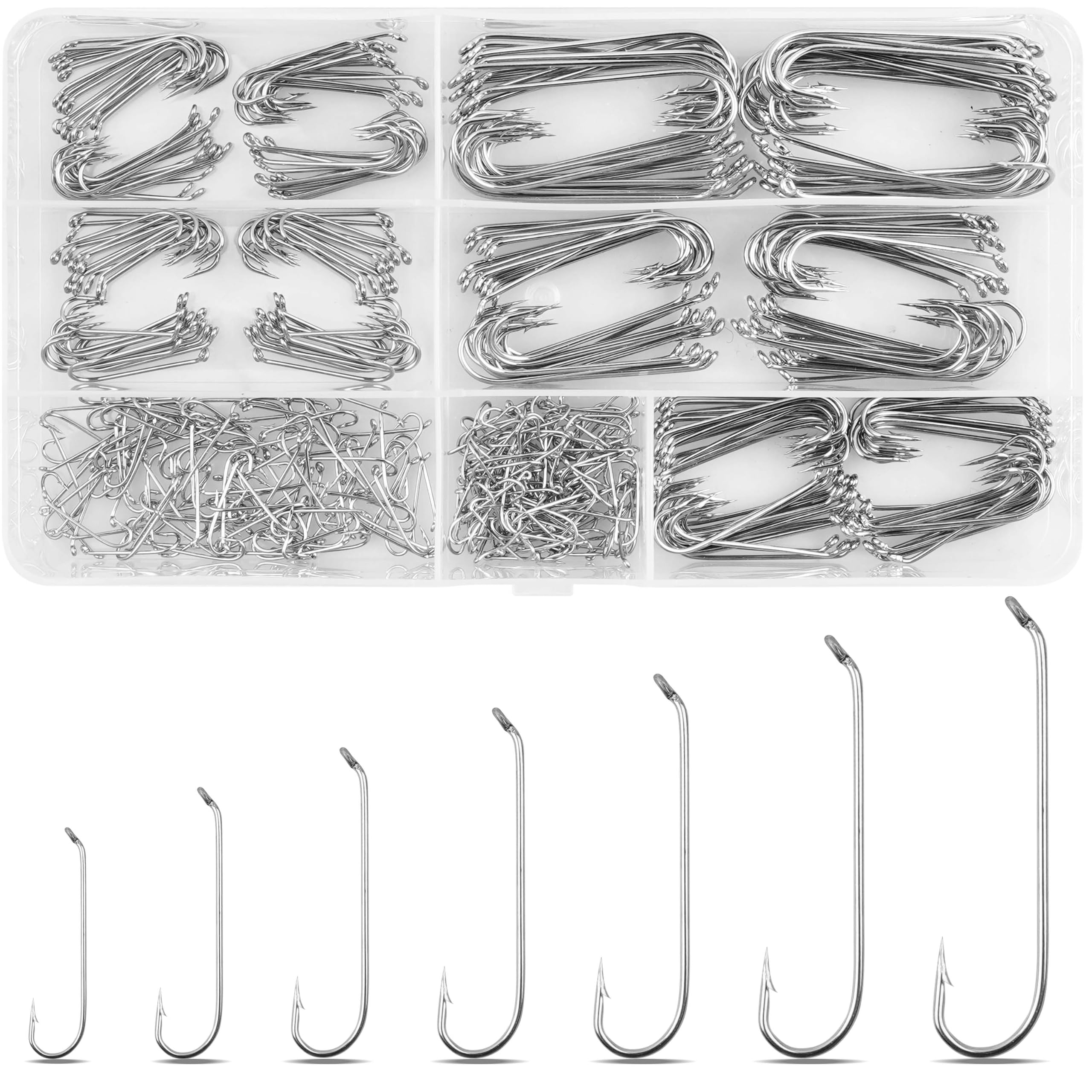
The pallet sold us more than the hooks inside it. Eight compartments with a magnetic floor and foam dividers hold 240 hooks, 30 to a cell, in sizes 10 through 16 and in both dry and wet nymph patterns. The magnets stop a bumped box from becoming a hundred-hook pickup job on the tying bench floor.

As a first box of hooks, this is the one we point people to before they know what they like tying. The size range covers what most trout flies are tied on, the wire is listed at 2X heavy, and the points come chemically sharpened with a low barb that flattens easily for catch-and-release water. The cells refill, too, so a 25-pack of whatever you burn through tops up the box instead of adding another loose bag to the drawer.

Two things to know before you order. The sizes run on the large side of their labels, so a #14 here fishes closer to a #12, which is worth planning around if you tie small parachutes and comparaduns. And the wire will snap if you lean on it. These are trout hooks, and a fish that has to be horsed out of cover is a job for the Gamakatsu in this guide.

Pros

  • Magnetic eight-cell pallet keeps hooks sorted
  • 240 hooks across dry and wet nymph patterns
  • Chemically sharpened points with a crushable barb

Cons

  • Wire can snap under hard hook-setting pressure
Our verdict

The box we point new tiers to first: 240 hooks in the trout sizes, sorted in a magnetic pallet that keeps them on the bench.

Check Latest Price
2

Best for Streamers

Gamakatsu B10S Stinger

91 /100
Angler Score Outstanding

Key details

Size
6
Count
25
Point
Needle point, NS black
Hook Style
Stinger and articulated streamer
Check Details on Amazon

A stinger's job is to trail off the back of an articulated streamer, where a fish that nips the tail actually gets hooked, and the wide gap on this size 6 is why we reach for it. Gap is what turns a short strike into a fish in the net. A narrow hook buried in the tail of a six-inch fly is decoration.

The rest is Gamakatsu doing what Gamakatsu does. The points are sticky straight out of the pack, the tempering gives wire that is strong without being brittle, and the NS black finish holds up to a season of teeth and rocks. Tying on them is uneventful: clean eye, consistent gap, no surprises halfway through a fly.

Twenty-five hooks to a pack is plenty for a season of streamer tying, and it keeps a lifetime supply of one size out of your drawer. This is the hook we tie when the fly matters, the one going to the far bank under the log.

Pros

  • Wide gap improves short-strike hookups on streamers
  • Sticky sharp points straight out of the pack
  • Tempered wire is strong without being brittle

Cons

  • Costs more per hook than the bulk packs here
  • One size per pack
Our verdict

For articulated streamers and any fly that needs a trailing hook, this is the one we tie on: sharp, wide-gapped and strong enough to lean on.

Check Latest Price
3

Best Budget Dry Fly Hook

SF Ultra Sharp Dry Fly Hooks

89 /100
Angler Score Excellent

Key details

Size
16
Count
100
Finish
Black nickel
Hook Style
Dry fly, wide gap
Check Details on Amazon

Most of us tie more size 16 dries than anything else, so it makes sense to buy them the way you buy tippet: in a box, without ceremony. This is a hundred hooks in a single size, in a case the size of a matchbook, and it costs less than one premium 25-pack of streamer hooks.

The shape is what makes it more than cheap. The gap is wide for a #16, which keeps the point clear when you crowd the bend with hackle and dubbing, and the micro barb is small enough to flatten with a squeeze of forceps when you're fishing barbless water. Black nickel over high carbon steel is the right finish for a box that lives in a vest and gets damp.

We've been happy with the points, which arrive honed and ready to fish. One caution at the vise: crush the micro barb gently. A hard squeeze can snap the tip off a hook this small, and then you're tying on a hook with half a point.

Pros

  • Wide gap keeps the point clear on small dries
  • Micro barb flattens easily for barbless water
  • Cheap enough to treat as a tying staple

Cons

  • Single size per box
  • Fine wire can bend under a heavy fish
Our verdict

A hundred #16 dries with a wide gap and a crushable barb, cheap enough that you tie without counting hooks.

Check Latest Price
4

Best Scud and Pupa Hook

Umpqua U202 Scud Pupa

90 /100
Angler Score Outstanding

Key details

Size
18
Count
50
Hook Style
Curved scud and pupa
Wire And Length
1X strong, 1X short
Check Details on Amazon

A scud or a caddis pupa wants a short, curved shank so the body sits compact and the point stays clear of the shell back. Tie the same pattern on a standard nymph hook and it comes out long and leggy. That's the case for the U202: 1X short, 1X strong, curved, bronze, with a spear point, in a size 18 that covers most of the sowbugs and pupae we actually fish.

The wire is hard and holds its curve when a fish twists, which is what you want from a hook this small. It also doesn't appreciate careless vise pressure. We set these gently rather than cranking the jaws down, and that habit has kept our box intact. Fifty to a pack is a sensible quantity for a hook that serves one style of fly.

Pros

  • 1X short curved shank keeps scud bodies compact
  • Holds its curve under a twisting fish
  • Bronze finish and spear point suit small nymphs

Cons

  • Only size 18 in this listing
Our verdict

If your box is full of scuds and pupae, this is the hook that makes them sit right: one size, one job, done properly.

Check Latest Price
5

Best Jig Hook

Fulling Mill Force Jig Barbless

90 /100
Angler Score Outstanding

Key details

Eye
50 degree
Size
14
Count
50
Hook Style
Barbless jig nymph
Check Details on Amazon

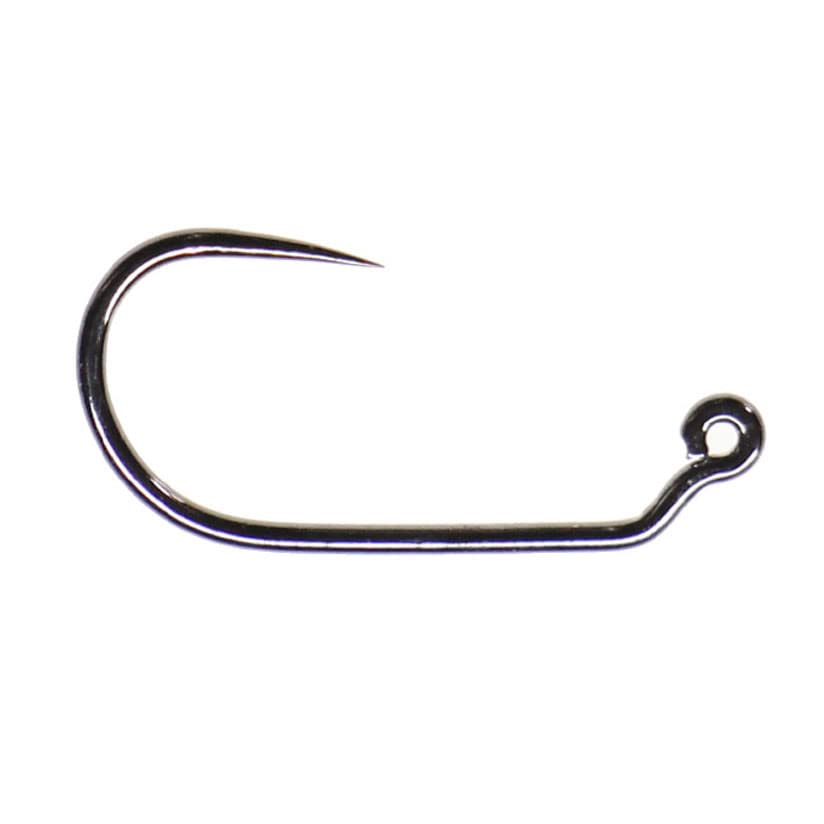
The 50-degree jig eye is the whole point. Thread a beadhead on and the fly rides point-up through the drift, so the hook sits above the fly instead of dragging along the bottom behind it. Fewer snags, and a point that's already in position when a fish takes.

We reach for this one whenever we're tying jig-style nymphs for a tight-line rig. The 2X heavy wire carries a tungsten bead without folding, the barbless claw point angles in slightly to keep a corner working once a fish turns, and the black nickel finish survives a wet fly box. Fifty to a pack, in size 14 here, covers the small jig nymphs most of us fish.

It's a specialist's purchase and priced like one. The per-hook cost only makes sense if jig nymphs are a real part of your fishing rather than an experiment, and for a dry-fly box the money goes further on the SF hundred-pack.

Pros

  • 50-degree jig eye makes the fly ride point-up
  • Claw point holds fish without a barb
  • 2X heavy wire stands up to hard-fished nymphs

Cons

  • Only size 14 in this listing
Our verdict

The jig hook we tie when the fly has to ride point-up: a proper 50-degree eye, heavy wire and a claw point that holds without a barb.

Check Latest Price
6

Best Barbless Value

Eupheng Barbless Competition Pack

85 /100
Angler Score Excellent

Key details

Point
Barbless
Sizes
10 to 18 by style
Finish
Black nickel
Hook Style
Barbless dry, wet, nymph, pupa, jig
Check Details on Amazon

Barbless gives up a little holding power and hands back a lot: quicker releases, less damage, and legal use where the rules require it. This pack is the least expensive way into barbless here, with black nickel plating, chemically sharpened points, and a line that covers dry, wet, nymph, pupa and jig-style straight points.

Style is the thing to sort out before you buy, because the option you choose is what arrives and the sizes and patterns vary across the line. Pick by the fly on your vise: a down-eye fine wire for dries, a heavier wire for wets, an up-eye reversed bend for pupae, a straight jig point for jig nymphs on a small stream rod.

What we liked in use was the points, cut clean and sharp enough to go in with barely a push, which matters on a light rod and a short line. The finish holds up in fresh water and the occasional brackish trip. It's not a premium hook, and at this price you're buying a season of working flies rather than a lifetime box, which is the right trade for competition-style fishing where you change flies every twenty minutes.

Pros

  • Least expensive way to fish barbless here
  • Sharp points go in with little pressure
  • Covers dry, wet, nymph, pupa and jig styles

Cons

  • Barbless only, with no barbed option
Our verdict

Our pick for barbless water and catch-and-release fishing: clean, sharp points at the lowest barbless price in this guide.

Check Latest Price
7

Saltwater Big Game

Gamakatsu SL12S Big Game

91 /100
Angler Score Outstanding

Key details

Size
6/0
Count
6
Finish
Tin
Hook Style
Big game wide gap
Check Details on Amazon

Six hooks to a pack is the first thing you notice, and for what these are, it's the right number. This is a 6/0 big-game hook for tarpon, giant trevally and big saltwater baitfish, and you tie a handful of those before a trip, not a hundred.

The wide gap is what you're paying for. A bulky baitfish body with a thick collar of hackle will swallow a narrow hook right up to the shank, while a wide gap keeps the point out where a fish can find it and set it. The tin finish is the saltwater concession, and it's the reason these don't come out of the box spotted.

Gamakatsu's wire is the other half of the story. This is a hook built to be leaned on with a heavy tippet and a locked drag, and that isn't a job you hand to a bulk-box trout hook.

So the arithmetic is different from everything else on this list. You don't need many, the ones you tie are the flies you're betting a trip on, and a hook that gives up a point on a tarpon has cost you more than the whole pack. We keep them in the salt wallet and nowhere else.

Pros

  • Wide gap clears bulky saltwater baitfish bodies
  • Built for heavy tippet and locked drags
  • Tin finish suits saltwater use

Cons

  • Only size 6/0 in this listing
  • Premium price per hook
Our verdict

Tie these on the saltwater flies you only get a few shots at: a wide-gap 6/0 built to hold a big fish on a locked drag.

Check Latest Price
8

Panfish and Bluegill

AGOOL Aberdeen Hook Kit

84 /100
Angler Score Excellent

Key details

Count
450
Sizes
2 to 16, seven sizes
Material
High carbon steel
Hook Style
Aberdeen long shank
Check Details on Amazon

The counts give away what this kit is for: 100 hooks apiece in #14 and #16 against 50 in each of the five bigger sizes. Nobody weights an assortment that way by accident. It's built for panfish and bluegill boxes, where small hooks get chewed up and replaced all summer and the big ones sit in the compartment unused.

Aberdeen is the shape to understand. The long shank makes baiting easier and keeps a deeply taken hook out where you can reach it, which is why the pattern gets used for catch-and-release panfishing. The trade is light wire: this is a bluegill, crappie and small-trout kit, not a bass-in-the-weeds kit.

You get 450 hooks for less than some of the single-size premium packs here, sharpened points with a micro barb, and a case that keeps seven sizes apart instead of one bag of mixed hooks and a bad evening.

Call it a volume buy. The points arrive sharpened and the micro barb holds, and it's the cheapest per-hook option in this guide. We treat it as the kit we restock from, not the hooks we tie our best flies on.

Pros

  • 450 hooks across seven sizes for very little
  • Long shank makes hook removal easier
  • More hooks in the #14 and #16 sizes replaced most

Cons

  • No #12 in the seven-size run
Our verdict

The bulk buy for a panfish box: 450 long-shank hooks in the sizes that get chewed up, at the lowest cost per hook here.

Check Latest Price

How We Tested the Best Fly Tying Hooks

We started by gathering every hook pack we could find that covered the sizes a trout and panfish tyer actually fishes, roughly 8 down to 18, in barbed and barbless, standard shank and jig. Packs were compared by price per hook rather than price per box, since a 240-count bargain isn't a bargain if a third of them bend on the first fish. That filtering left us with 16 packs, which we tied with and fished over four months.

Out of the box, we drew each point lightly across a thumbnail — a sharp hook bites and holds, a dull one skates — and checked hooks at intervals through every bulk pack for rolled points, off-center barbs, and eyes that hadn't closed cleanly at the factory. Calipers came out for shank length, gap width, and wire diameter, and we compared those numbers against what the label promised.

On the water we fished them the way anyone does: drifting nymphs through riffles, stripping streamers along the banks, and deliberately snagging logs and rocks to see where a hook bends and whether it springs back. Back at the vise we tied the same patterns repeatedly on each hook, noting whether the wire cut thread, whether the eye sat straight, and whether it survived being clamped and re-clamped in the jaws. Hooks that bent on a snag went into a separate bin for a pull test, where we loaded each one until it deformed and recorded the point at which it gave.

Durability got the least glamorous test of all: a few hooks from every pack spent three weeks in a damp box at the bottom of a vest, and we checked for rust and for points that had gone soft. We also filled and shook every included box, upside down and sideways, to see whether the compartments and magnetic strips actually held hooks in place or dumped them loose into the lid.

How to Choose Fly Tying Hooks

Match the hook to the pattern

Every fly-tying hook is a shape built for a job. Dries want fine wire, a wide gap and a down eye so the fly sits low in the surface film. Beadhead nymphs want standard or 2X-long wire that gets down. Scuds and pupae want a curved, 1X-short shank so the body stays compact. Articulated streamers want a heavy stinger with a wide gap trailing at the back, and jig nymphs want a 50-degree eye so the fly rides point-up.

Buy for the flies you actually tie and add styles as the box grows. The trap is a pack labeled for fly tying that is really a bait-hook shape underneath: it will hold thread and dubbing, but it won't sit, sink or hook the way the pattern was designed to.

Wire weight is a fishing decision

Fine wire floats better, sinks slower and is easier on small fish. Heavy wire sinks faster, turns over bulky flies and survives a hard fight. The 2X-heavy stingers and jig hooks here are built for pressure; the SF dry-fly hooks are deliberately fine.

Think about the fish rather than the fly. A fat trout on a size 16 dry is fine on light wire; the same fish in a fast chute is not. A 2X-heavy label tells you the hook is meant to be leaned on, so buy it for the flies you fish deep and dirty and keep the fine wire for the ones that have to float.

Size labels are a suggestion

Hook sizes aren't standardized between makers, and the budget import packs here tend to run large for their labels. Do a five-minute check before you tie a dozen flies: set one hook beside a brand you trust, match them at the bend, and compare the gap and the shank length. If yours run big, order a size down.

It's also worth checking a kit's size run against your own box before you commit. When an assortment skips a size you tie constantly, plan on buying that size separately rather than letting the kit dictate what you tie.

Barbs, points and release water

Barbed, micro-barbed and barbless are three different tools. A full barb holds best but is slower to remove and harder on fish; a micro barb is nearly as good and crushes flat with forceps, which is why it turns up on the SF dries and most of the trout-range packs here. Barbless is fastest for release and required on a lot of catch-and-release and competition water.

Crush gently. A hard squeeze on fine wire can snap the point clean off. If you fish both kinds of water, keep one barbless box and one barbed box and stop mixing them.

How many to buy, and how to store them

Buy your staples by the hundred and your specialties by the 25. A hundred size 16 dries costs less per hook than four 25-packs and never leaves you short halfway through an evening; a 25-pack of stingers is several seasons of articulated streamers for most people.

Storage matters more than it sounds. A compartment box with a magnetic floor keeps a couple hundred hooks sorted and off the carpet, while loose bags migrate to the bottom of a pack and open themselves. Write the size on the lid of anything that arrives in a plain bag.

Frequently Asked Questions

Final Verdict

If you're buying one box, make it the XFISHMAN 240-hook set. It covers the trout sizes most flies are tied on, the magnetic pallet keeps them sorted through a whole evening at the bench, and refilling it with a 25-pack of whatever you burn through costs almost nothing.

Once your tying narrows to a pattern, buy the specialist: the Gamakatsu B10S if your box is full of articulated streamers, Fulling Mill's jig hook if you fish point-up, the Umpqua U202 if scuds and pupae are your thing. One good all-round box, then hooks chosen for the flies you actually tie.