
Best Fly Tying Tool Organizers of 2026

A good tying session has a rhythm to it, and that rhythm dies the moment your scissors vanish under a pile of saddle hackle. That's the whole job of a tool organizer: bobbins, bodkins, hair stackers, and thread where your hands already expect them, plus a vise that doesn't skate across the desk while you bear down on a tight wrap. I tied out of a coffee mug for years before I admitted how much of every evening I was spending on the hunt for a whip finisher. A caddy fixes less than you'd think and more than you'd expect — fewer interruptions, fewer lost tools, and a bench you can set up without renegotiating where everything lives.

The catches show up fast. Holes drilled for one spool size won't hold another upright, foam goes soft after a season of being stabbed, and a stem-mounted caddy can foul the rotation on a rotary vise. We've spent five months with 14 organizers loaded up, mounted, and packed around, and the gap between them came down to fit and finish rather than features. Check your spool diameters and your vise stem before you buy anything — most shoppers skip both. The ones that held up to all of it are below.

1

Best Overall

Aventik Foam Tool Caddy Combo

92 /100
Angler Score Outstanding

Key details

Weight
265 g (9.5 oz)
Material
Non-skid foam
Mounting
Vise stem and bench
Tool Slots
36
Check Details on Amazon

Two pieces arrive in the bag: a soft foam bench caddy with 36 slots, and a smaller high-density foam holder that slides onto the vise stem. That combination is why this is our top pick. Most organizers make you choose between the bench and the vise, and this kit covers both for less than several single-piece caddies in this group.

The bench block is the piece we use most. It's 8 inches square and 2 inches tall, and the foam is dense and non-skid, so it stays where you set it down instead of skating across the bench when you pull a bobbin out one-handed. Thirty-six slots cover a full set of tying tools with room left over, and the holes run in several sizes so scissors, a whip finisher, and hackle pliers all stand upright rather than leaning on each other.

The stem holder handles the tools you want closest. It's a foam ring with its own holes, held on by O-rings, and the kit includes both 5 mm and 8 mm inner-diameter rings, which covers the common vise posts. Check yours before ordering: the rings do the fitting, so an oversized post is the one thing that will stop this half of the kit working.

What you give up is protection. There's no lid and no water resistance, so dust settles into the empty holes and a tipped bottle of cement will find the foam. On a bench that lives in a cabinet, that's nothing; in a garage, plan on blowing the dust out now and then.

Pros

  • Two organizers in one kit
  • 36 slots in several hole sizes
  • Dense non-skid foam that stays put
  • O-rings fit common vise stem sizes

Cons

  • No lid, and the foam is not water resistant
  • No spool posts or lidded parts boxes
Our verdict

The one we point most people to: a bench caddy and a vise-mounted holder in the same bag, with enough slots for a full tool set and foam heavy enough to stay put.
Check Latest Price
2

Best Vise-Mounted

Aventik CNC Aluminum Tool Caddy

90 /100
Angler Score Outstanding

Key details

Length
5.2 in (13 cm)
Material
T6 aluminum, Type II anodized
Hole Sizes
9, 4.5, and 2.5 mm
Vise Stem Fit
8 to 10 mm
Check Details on Amazon

Nine grams is the whole story. This is a 5.2-inch bar of CNC-machined T6 aluminum, anodized in one of five colors, and it adds so little to the vise that you forget it's clipped on until you reach for a scissor and it's already under your hand.

The hole layout is what makes it useful rather than decorative: five 9 mm openings for bobbins and scissors, four at 4.5 mm for hackle pliers and threaders, and four at 2.5 mm for bodkins and hooks. Thirteen holes in a line across the front of your work beats a scatter of slots around the bench, and the bar fits vise stems from 8 to 10 mm, which covers most standard posts. It also carries a two-year manufacturer warranty, rare enough in this category to be worth noting.

What we missed while using it is storage. A bar this narrow has nowhere for thread spools or a cement bottle, so it's a companion to a bench caddy rather than a replacement for one. Mount it low on the stem the first time: on a vise with a rotary handle, a bar sitting high can crowd your knuckles when you spin the head.

Pros

  • Weighs 9 grams on the vise
  • 13 holes across three diameters
  • Fits 8 to 10 mm vise stems
  • CNC-machined, anodized T6 aluminum

Cons

  • No storage for spools or cement bottles
Our verdict

If your tools live on the vise, buy this one: it's the lightest and best-machined stem caddy here, and it puts thirteen tools in a line you can reach without looking.

Check Latest Price
3

Best Pivoting Tool Bar

Kingfisher Stem-Mounted Tool Bar

84 /100
Angler Score Excellent

Key details

Length
6 in
Weight
2 oz
Material
Aluminum
Mounting
Slip-over vise stem
Check Details on Amazon

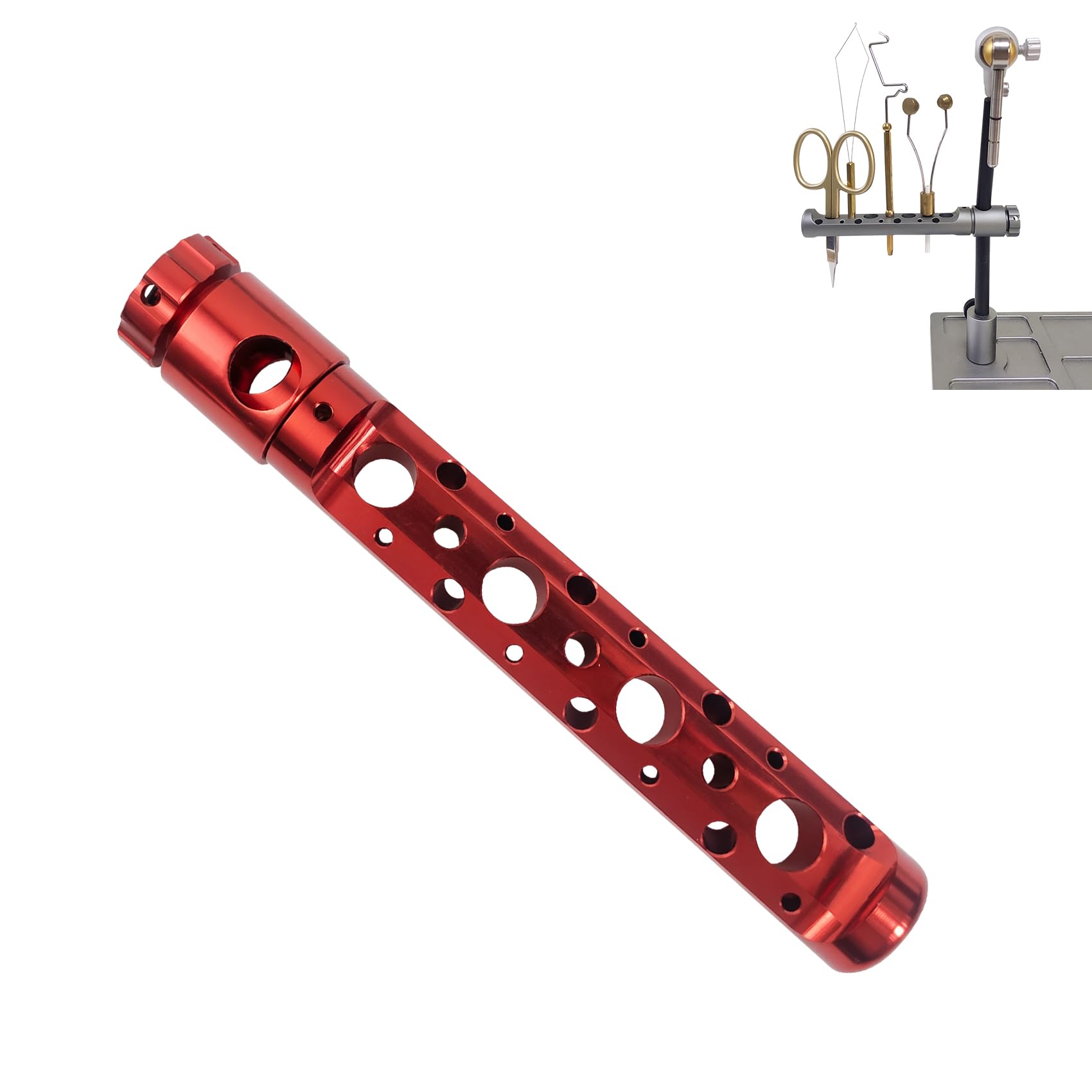
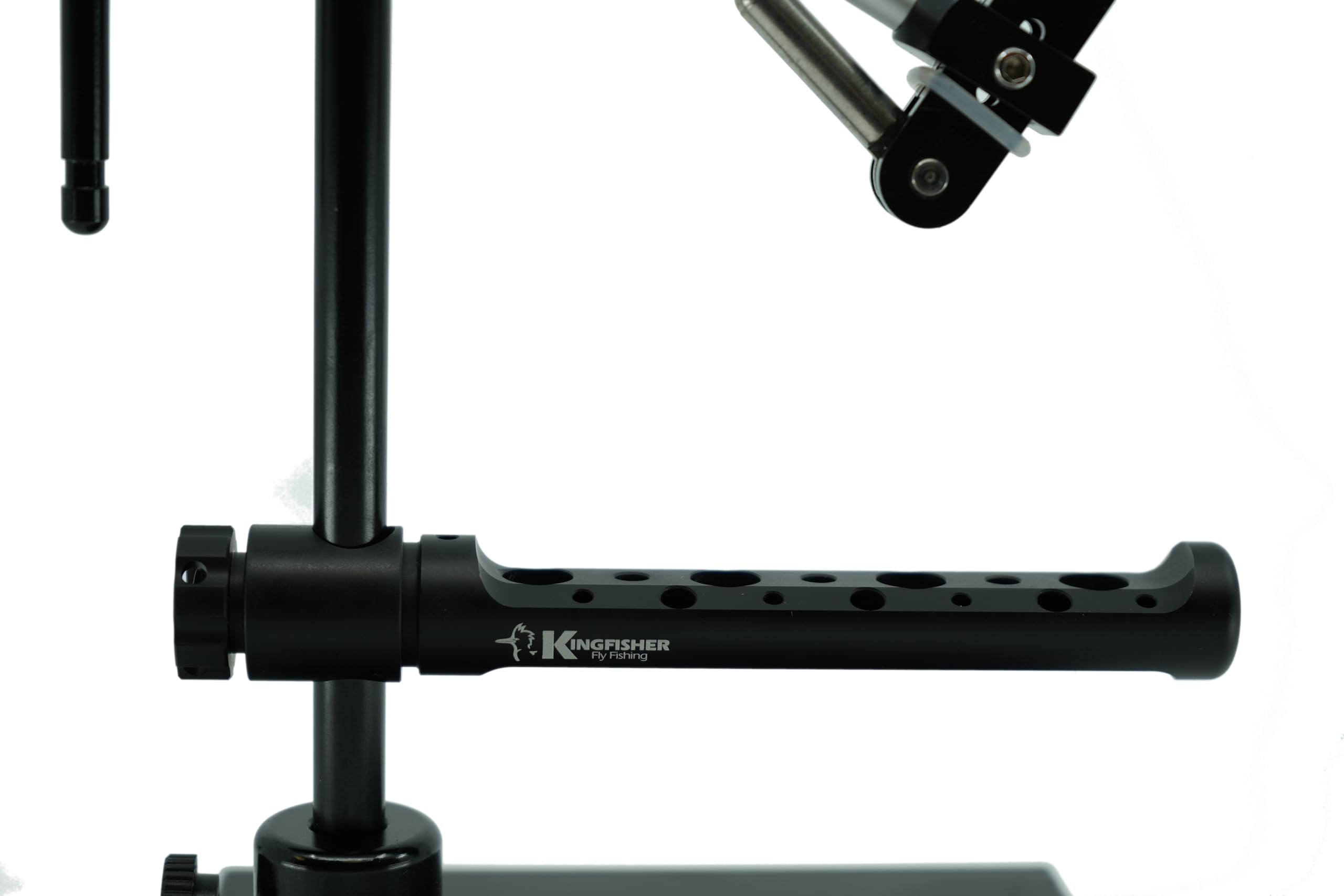
There's a precondition worth stating plainly: this bar only works if your vise has a stem to slip it over. Given that, it offers the widest reach here — six inches of aluminum that pivots on the post, so you can swing the tools you aren't using out of the way and pull them back when the pattern calls for them.

The layout favors what you grab constantly: four large holes for scissors, bobbins, and a whip finisher, plus a run of smaller ones for threaders, bodkins, and hooks. Two ounces of aluminum won't drag a light vise forward across the bench, and the matte black we tried blends into a black vise base; there's a red version if you like your tools easy to spot from across the room.

Two things to know before ordering. The bar slips onto 10 mm and 3/8-inch posts, the two sizes most bench vises use, so measure yours if it's unusual, and a thin wrap of padding under the bar keeps the finish from marking. And what ships is the bar alone — the tools and vise in the product photos are there to show it in use.

Pros

  • Six-inch bar with four large holes
  • Pivots on the stem to clear your hands
  • Two ounces won't tip a light vise

Cons

  • Stem-mounted only, with no bottle or spool storage
  • Sold as the bar alone, without tools
Our verdict

Worth it if you want more reach across the vise than a compact caddy gives and you already have somewhere to put your thread.

Check Latest Price
4

Best for Thread Storage

LURELINK Fly Tying Tool Caddy

87 /100
Angler Score Excellent

Key details

Weight
10.9 oz
Mini Boxes
10
Tool Holder
EVA foam grooves
Thread Capacity
20 spools on 10 posts
Check Details on Amazon

Ten wooden posts, two spools each, standing where you can read every color without lifting anything out. If your tying has outgrown a drawer of loose spools, this is the organizer built around that problem rather than around tools alone.

The tool side is simpler but well handled: an EVA foam groove holds bobbins, scissors, and a whip finisher upright without letting them knock together, and ten small clear boxes take hooks, beads, and cones. The boxes are what we rate highest here. Small parts are the things that actually go missing off a tying bench, and having them visible in one tray beats a compartmented box at the back of a drawer.

It's plastic, and there's no lid, so this is a station organizer rather than a travel case — set it at the back of the bench and leave it there. Twenty spools also assumes standard spool diameters; a run of oversized spools will fill the posts faster than the count suggests.

Pros

  • Twenty spools on ten posts, all visible
  • Ten clear boxes corral hooks and beads
  • Foam grooves hold tools upright
  • Light enough to shift around the bench

Cons

  • No lid; hooks and thread sit open
  • Plastic body rather than wood or aluminum
Our verdict

For a tyer with more thread than bench space, this is the practical buy: twenty spools in sight and ten boxes for the small parts that disappear.

Check Latest Price
5

Best Heavy-Duty Foam

Renzetti Soft Foam Tool Caddy

90 /100
Angler Score Outstanding

Key details

Color
Orange
Model
RZ310
Material
Soft foam
Compartments
1
Check Details on Amazon

This is the most expensive organizer in our roundup, and the money goes into one thing: a thick, heavy foam block that refuses to slide. Set it down and it stays through a whole session of pulling bobbins in and out.

We like the density. It's substantial enough to stay upright when you lean a pair of scissors into it, and the single-block format means cement bottles, a bobbin, and pliers all sit within one reach instead of spread across the bench. The orange is a genuine convenience on a surface covered in feathers and tinsel — you find it without looking.

Hole sizing is where it gets fussy. A fat-handled bobbin and a slim bodkin don't want the same socket, and some of the openings run narrow or shallow for the tool you had in mind, so it's a block to buy after you've looked hard at what you actually use rather than before.

Pros

  • Dense foam that will not slide or topple
  • One block for cement bottles and hand tools
  • Bright orange is easy to find

Cons

  • No compartments, boxes, or spool posts
Our verdict

Buy it if your tying shares a table with everything else — the dense foam stays put, takes cement bottles along with your tools, and comes in a color you can't lose.

Check Latest Price
6

Benches on Show

Creative Angler Wooden Organizer

87 /100
Angler Score Excellent

Key details

Material
Bamboo wood
Openings
33
Dimensions
9.06 x 7.09 x 2.24 in
Check Details on Amazon

Bamboo rather than plastic, and it shows. This is the caddy in our group you can leave out on the side table when the tying bench doubles as a living-room surface — 33 openings in a nine-by-seven-inch footprint take bobbins, scissors, whip finishers, and glue bottles, and the whole thing stands just over two inches tall.

What we noticed first was how little it interferes with the room: no bright orange, no molded tray, just a wooden block doing the job. It's light enough to move from shelf to table in one hand, which matters when your tying space has to be cleared for dinner.

Bamboo is the trade-off. It isn't a surface to leave cement or a wet bottle sitting on, so wipe drips rather than letting them cure into the grain. There's no lid either, which makes this a bench piece rather than something you toss in a pack.

Pros

  • 33 openings in a compact footprint
  • Bamboo looks good enough to leave out
  • Light enough to carry table to table
  • Low profile at just over two inches

Cons

  • No lid, and bare wood needs prompt wiping
Our verdict

Pick this one when the tying bench is also a living-room table: 33 openings in bamboo that reads as furniture rather than tackle.

Check Latest Price
7

Permanent Bench

Raprance Wooden Tool Caddy

83 /100
Angler Score Excellent

Key details

Weight
2.6 lb
Assembly
Required
Material
Wood
Openings
33
Check Details on Amazon

It ships flat and goes together with a screwdriver before you can tie anything on it — worth knowing if this is a gift, or if you expect to be at the vise the evening it lands. What you get for that bit of assembly is the roomiest wooden caddy here: 33 openings across a nine-by-seven-and-a-half-inch top.

At 2.6 pounds it's also the heaviest, and that's the point. Heavy wood doesn't creep when you push a bobbin home or lean on the edge to thread a hook, and the 2.4-inch body is deep enough for bottles that would stand proud of a shallow tray. We found the size most useful for a tyer who keeps a full spread out — dubbing, cement, three pairs of scissors — rather than a compact kit.

The weight also decides where it lives. At 2.6 pounds this is a bench fixture, not something you carry to a club night, so it suits a permanent corner and not a table that gets cleared after every session.

Pros

  • 33 openings across a wide wooden top
  • 2.6 pounds stays planted on the bench
  • Deep body holds taller cement bottles
  • One-year manufacturer warranty

Cons

  • Not water resistant; cement marks the wood
Our verdict

The pick for a permanent tying bench: 33 openings in heavy wood that stays exactly where you set it, as long as you don't need to carry it anywhere.

Check Latest Price

How We Tested: Five Months at the Tying Bench

We started with more than 40 organizers — foam pads, machined stem mounts, wooden desktop racks — and cut anything that mounted only to one proprietary vise, anything with no stated post diameter, and anything whose slot count assumed a tool collection nobody actually owns. That left 14, spread across the price range. Each one came out of the box, got measured at the mounting point, and was compared against the tools already on my bench before it earned a spot.

Testing happened where tying actually happens: a basement bench on weeknights, a folding table in the garage, and the open tailgate of a truck before a morning float. Every stem-style caddy went onto both a lightweight rotary vise and a heavier standard one, then through a full rotation to see whether the arm clipped the caddy or blocked the handle. We loaded each holder with spools already in rotation, counted how many seated upright and how many sat cocked in oversized holes, and pulled bobbins and scissors in and out mid-wrap to see whether the holes kept their grip. Bench-top caddies got leaned on as if bearing down on a tight wrap, and we watched for slide.

Portability got tested honestly: each organizer went into a gear bag next to reels and waders, rode in the truck, and came back out to be checked for spilled spools and bent posts. We also counted usable slots against what each one cost, because a 20-post rack with six holes too narrow for standard thread is worse value than a plain eight-hole block. Cleanup mattered too — dubbing wax and head cement wipe off anodized aluminum and sealed wood, but they sink into open-cell foam and never quite leave.

How to Choose a Fly Tying Tool Organizer

Vise-Mounted Bars vs. Bench Caddies

A bar that slips over the vise stem puts four to thirteen tools in the same field of view as the hook and keeps the bench clear, which is the job the Aventik aluminum bar and the Kingfisher tool bar do. A block on the bench holds what a bar can't: cement bottles, spools, hackle, the loose stuff that accumulates mid-pattern. Many tyers end up with both, which is why the two-piece Aventik kit is our default.

Buying one? Count the tools you touch during a single fly. More than four, and you want the block; two or three, and the bar on the vise is enough.

Holes: Sizes Before Count

Thirty-three openings sounds like more storage than thirteen until a fat-handled bobbin won't seat in a small hole. Look at the spread of diameters rather than the total: bobbins and scissors want something around 9 mm, hackle pliers and threaders about half that, bodkins smaller again. Depth matters just as much, because a shallow socket lets a long tool lean out into your sleeve while you're whipping a finish.

A caddy with thirteen well-chosen holes beats one with thirty that mostly fit nothing. That's why a machined bar with three diameters can hold more usable tools than its opening count suggests.

Thread and Small Parts Need Their Own Home

A caddy that holds tools but not thread sends you back to the drawer mid-fly. Ten posts carrying twenty spools, as on the LURELINK, lets you read colors without lifting anything out, and small clear boxes do the same for hooks, beads, and cones.

If you tie several patterns a week across a range of colors, thread storage is the feature you'll use every session. If two spools cover your whole rotation, it's bench space spent on nothing, and a plain foam or wooden block serves you better.

Material, Weight, and Staying Put

Foam grips and stays quiet, and it takes stains. Wood is heavier and wipes clean but marks if it stays wet. Anodized aluminum shrugs off a wipe and weighs close to nothing. Weight cuts both ways: 2.6 pounds of wood stays exactly where you set it and is the last thing you'd pack, while a 9-gram bar disappears into a bag.

Decide which of those lives is yours. A permanent bench with the vise bolted down rewards the heavy block; a table cleared for dinner rewards the bar. "Lightweight" in a listing usually means easy to shift around the bench, not necessarily easy to travel with.

Frequently Asked Questions

Final Verdict

Start with the Aventik foam combo. It's the only organizer here that covers both jobs in one purchase, the bench block is heavy enough to stay where you set it down, and the stem holder puts the tools you want closest within reach without asking you to choose a mounting style.

If your bench is small or you tie away from home, the CNC aluminum bar does the vise half of that job in nine grams. And if you want one dense block that holds cement bottles alongside your tools, the Renzetti is worth the extra money.