
Best Hiking Leggings of 2026

The leggings that feel best in a yoga studio are rarely the ones you want three miles up a rocky climb. Thin, buttery fabric rolls at the waist under a pack belt, and a seam that never bothered you indoors can rub raw once it's damp with sweat. What a hiker actually needs is a pair that stays put — waistband flat, phone pocket landing above the hip belt, fabric thick enough that granite doesn't feel like sandpaper — while still feeling soft against skin.

I've hiked in everything from cheap mystery-fabric pairs to technical tights, and the differences almost always come down to details rather than price — where the pocket sits, whether the seams are flat, how the fabric behaves after ten washes. Over six months, my team and I put 14 pairs through day hikes, scrambles, and a lot of laundry, and one thing became clear early: a thigh pocket only counts if it rides above your hip belt instead of under it. The picks below are the ones that held.

1

Best Overall

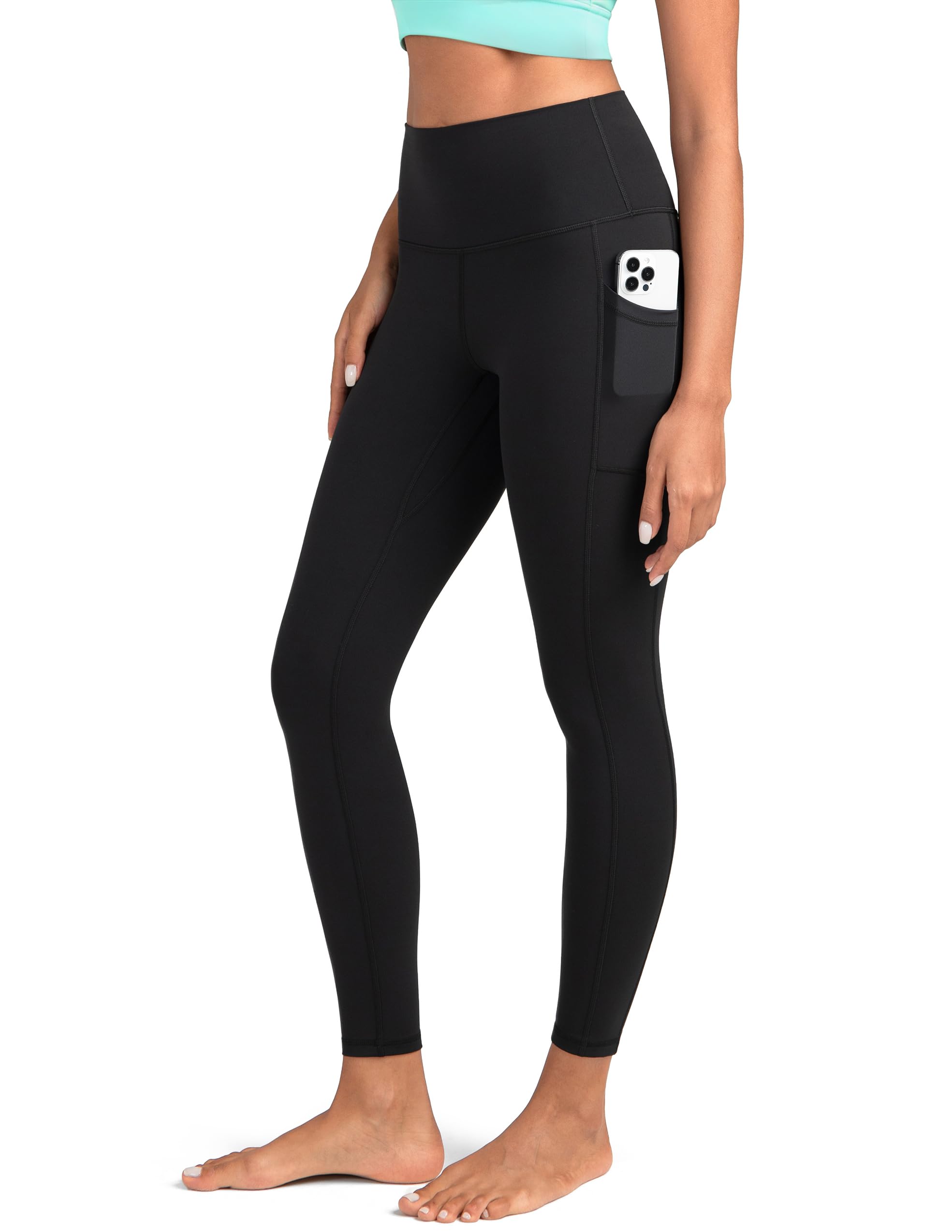
Ewedoos Yoga Pants with Pockets

93 /100
Angler Score Outstanding

Key details

Waist
High-rise, tummy control
Fabric
Thick, opaque knit
Pockets
Two leg plus one waistband
Check Details on Amazon

Three pockets is what decided this one for us. Two run down the legs, a small one sits in the waistband for a key or a gel, and that means the phone and the car key stop competing for the same slot. On a real trail it's the difference between a hip belt stuffed with a pouch and a pack you put on and forget about.

The knit behind those pockets is thick without feeling like a wetsuit: brushed and soft on the inside, smooth outside, with enough body to hold its shape through a day of walking rather than relaxing at the knee by lunchtime. Bending to lace a boot is the moment that separates a trail legging from a gym one, and this fabric stays solid through it.

The waistband is where high-rise leggings usually lose us. It creeps down under a hip belt, and you spend the descent hitching it back up. This one sits flat and stays there, and the tummy control is firm without the corset feeling — comfortable at hour six, not just hour one.

So these are our three-season pick: a spring traverse, a summer climb, most of October. When the forecast turns properly cold, move to a fleece-lined pair below; when you want more squeeze and a longer leg, the IUGA pair is the next step up.

Pros

  • Three pockets, two of them on the legs
  • Thick knit stays opaque when bending
  • Waistband holds without rolling down
  • Lowest price tier in this set

Cons

  • Runs small; size up if between
Our verdict

For most hikers these are the pair to buy: two leg pockets, a thick knit that stays opaque when you crouch, and a waistband that holds under a pack.

Check Latest Price
2

Best Compression

IUGA Tummy Control Leggings

93 /100
Angler Score Outstanding

Key details

Rise
High-rise
Pockets
Side leg pockets
Compression
High
Check Details on Amazon

If our top pick is the all-rounder, this is the one with more grip. The knit is thicker and more compressive, so it holds the leg through a long descent instead of letting the knee bag out, and it stays where you put it at the waist. Anyone who has finished a rocky downhill in a legging that has gone loose and slithery will feel the difference on the first mile.

The design is plain and effective: high-rise, a pocket on each leg, and a fabric opaque enough that crouching to adjust a boot cuff isn't a calculation. We rate the opacity alongside the best here, and the compression is real rather than a word on the listing — this is the pair we hand someone who tells us their leggings always feel slack by the second hour.

Length is the catch. These are cut long, which is ideal if you're tall or you like a hem that sits down over a boot, and a nuisance if you're not, since shorter hikers will be turning the cuff. Compare the inseam against a pair you already like rather than trusting the size chart on its own.

Pros

  • More compression than our top pick
  • Fully opaque, even when bending
  • A pocket on each leg
  • Well made for the money

Cons

  • Cut long for shorter hikers
Our verdict

A firmer, more compressive legging with a longer leg — the pick for hikers who want support on long descents and have the height to fill it.

Check Latest Price
3

Best 7/8 Length

Colorfulkoala 7/8 Leggings

91 /100
Angler Score Outstanding

Key details

Rise
High-rise
Length
7/8
Pockets
Side leg pockets
Check Details on Amazon

Seven-eighths length is a small specification with an outsized effect. The hem lands just above the ankle, so there's nothing pooling into a boot and nothing to hitch up when you step over a root — and on a shorter frame it reads as a full-length legging without a trip to a tailor.

The fabric is soft in the way people mean when they say buttery: brushed, smooth and pleasant against bare skin on a warm climb. It's also the thinnest knit among our three-season picks, so treat coverage as the thing to check before you commit. Go for a dark color, and resist sizing down to chase more compression, because you'll get sheerness instead.

We keep these for summer day hikes and for travel, where the side pockets take a phone and the softness earns its keep on a long drive to the trailhead. Sizing is the wrinkle: the fit runs small, so go up if you're between, and expect that 7/8 hem to sit well above the ankle on a tall frame.

Pros

  • 7/8 hem clears boots without pooling
  • Side pockets sized for a phone
  • Buttery soft against the skin

Cons

  • Runs small; order up if between
  • Can pill at the thigh over time
Our verdict

The 7/8 length solves ankle bunching for shorter hikers and the side pockets hold a phone, so long as you order up a size.

Check Latest Price
4

Best for Easy Trails

CRZ YOGA Butterluxe 25"

93 /100
Angler Score Outstanding

Key details

Rise
High-rise
Inseam
25 inches
Pockets
None on this style
Check Details on Amazon

Butterluxe is the softest fabric in this roundup, and it isn't close. There's a cool, almost weightless feel to it that makes a synthetic legging feel like something you pack for a flight, and the 25-inch inseam lands at the ankle on an average frame with no bunching and no cuff to roll.

We like these for the hikes that are really walks: a rail trail, a fire road, a short climb with a view at the top. High-rise, no roll at the waist, and a smooth finish that looks tidy in town afterward. It's the pair we reach for when the day is more about being outside than about covering ground, and it flatters in a way that most trail gear doesn't bother with.

The gap is pockets. This 25-inch style doesn't carry the hip pockets some CRZ leggings have, so a phone rides in a pack or a belt pouch. For a two-hour walk that's nothing; over a full day it changes how the hike feels. If pockets are the priority, the Colorfulkoala pair handles that ground.

Pros

  • Softest fabric in this roundup
  • High-rise waistband that doesn't roll
  • Neat enough to wear after the trail

Cons

  • Thin knit can snag on brush and rock
Our verdict

Soft enough to sleep in and tidy enough for the drive home, this is a mild-weather, low-abrasion legging rather than a rough-trail one.

Check Latest Price
5

Best for Cold Weather

IUGA Fleece Lined Leggings

93 /100
Angler Score Outstanding

Key details

Waist
Wide waistband
Lining
Fleece
Pockets
Two thigh plus two hidden
Check Details on Amazon

The first genuinely cold morning of the season is when a fleece lining earns its keep, and this is the pair we reach for. The warmth is there before your legs are, and because the fleece is light rather than ski-pant thick, you never feel like you're wearing two garments at once.

Storage is where this one wins the cold-weather group. Two deep thigh pockets take a phone and a key and lie flat enough to vanish under the fabric, and there are two hidden waistband pockets on top of that. Nothing else lined here gives you that much usable carrying space, and the wide waistband sits comfortably under a hip belt.

Be clear about the trade: the fleece softens the compression, so this isn't a tummy-control legging the way the unlined IUGA pair is. What you get instead is something you can wear all day in the cold without wanting to peel it off at lunch, which is the better bargain on a winter hike.

Pros

  • Two thigh pockets plus two hidden
  • Light fleece warms without bulk
  • Wide waistband comfortable under a pack

Cons

  • Sizing runs small; check hip measurement
Our verdict

Our cold-weather choice: a wide waistband, two thigh pockets and a light fleece lining that makes a freezing start feel ordinary.

Check Latest Price
6

Best for Layering

baleaf Fleece Lined Thermal Tights

91 /100
Angler Score Outstanding

Key details

Rise
High-rise with tummy control
Lining
Fleece
Pockets
Side pockets
Check Details on Amazon

The fleece inside these is thin, closer to a brushed jersey than the fluffy lining of a heavy winter tight. That's the point rather than a shortfall: they slide under shell pants without adding a bulge at the knee, and they don't bunch when you're stepping high over roots or kicking a boot into a snowbank.

Worn alone they handle a windy, raw day better than their weight suggests, because the fabric blocks wind in a way a plain knit doesn't. Worn under a shell they're the layer we take for a winter climb where you're moving hard and making your own heat — the one situation where a thick fleece becomes a liability rather than a comfort.

For high-output winter days we reach for these first. They cost more than the other lined pair here, and what that buys is a tidier layer: thinner, smoother, less likely to bunch under a shell. If what you want is warmth for standing around in camp rather than for climbing, a heavier fleece is the better tool.

Pros

  • Thin fleece layers under shell pants
  • Blocks wind better than its weight suggests
  • Soft inside and out

Cons

  • Shallow pockets won't hold a large phone
  • Runs small with a waistband that can slide
Our verdict

A thin fleece that layers under shell pants without bulk — the pair for high-output winter days when a heavy lining would cook you.

Check Latest Price
7

Best Thick Fabric

CHRLEISURE Leggings with Pockets

93 /100
Angler Score Outstanding

Key details

Waist
High-waisted
Fabric
Thick, winter-weight knit
Pockets
Hidden waistband pocket
Check Details on Amazon

This is the most expensive pair in our roundup, and the money goes into fabric weight. The knit is the thickest unlined one here — enough that a cold morning doesn't cut straight through it, and solid enough that nothing shows when you bend to adjust a strap or tighten a boot.

It's also the smoothest of the group: a slick, faintly sheened surface that reads more like a going-out legging than a trail one, with a hidden pocket in the waistband for a key or a card. And there's no logo anywhere on it. That last detail matters more than it sounds on a multi-day trip, where a brand stamped across the thigh gets old by day two.

The cost of that weight is a narrow window. These are a cool-weather legging; in July they feel like too much, and on a hard climb in October you may find yourself rolling the waistband down to vent. Buy them for the shoulder season you actually hike in, not the one you imagine.

Where they earn their place is the six weeks either side of winter, when a fleece-lined pair is overkill and a thin knit isn't enough. Nothing else here fills that gap as comfortably. If your season runs colder than that, go fleece; if you hike in real heat, go thinner.

Pros

  • Thickest unlined knit in this set
  • Smooth, no-logo finish
  • Hidden waistband pocket

Cons

  • Runs large; order down if between
  • Short leg for taller hikers
Our verdict

The thickest unlined fabric here, for hikers who run cold in shoulder season but overheat the moment a fleece lining goes on.

Check Latest Price
8

Cold Weather, Lighter

Heathyoga Fleece Lined Leggings

94 /100
Angler Score Outstanding

Key details

Fabric
Smooth outside, brushed inside
Lining
Fleece
Pockets
Side pockets, phone-sized
Check Details on Amazon

A side pocket is only worth having if the phone stays in it, and that's the detail that stood out here. The side pockets are cut deep enough for a large phone, and it stays put through bending, climbing and the general fidgeting of a long day out.

The lining is the light kind, enough to take the edge off a frosty start without turning a climb into a sauna, and the fabric is soft on both faces — smooth outside, brushed in. By the first switchback you've forgotten you're wearing a lined legging at all, which is not something we can say about every pair here.

Against the IUGA fleece pair, these are lighter and less compressive, with softer pocket placement; against the baleaf pair they're warmer for standing around and easier to wear on their own. That puts them in the middle of the cold-weather group rather than at the front of it.

The middle of this group still means a good legging. If you run warm, hike hard and want a lining you notice only on the cold bits, this is the cold-weather pair to buy — and if you want maximum warmth for a slow, freezing day, the IUGA pair delivers more of it.

Pros

  • Side pockets deep enough for a large phone
  • Warm without a bulky lining
  • Waistband stays up without digging in

Cons

  • Sizing divides; some find them small
Our verdict

A warm, soft fleece-lined pair with side pockets deep enough to trust a phone to, for hikers who want warmth without a bulky lining.

Check Latest Price

How We Found the Leggings That Hold Up on the Trail

We started with a research pile of more than 60 pairs, then cut it down by reading fabric content and seam construction, checking the size range each brand actually offers, and looking at where the pockets sit. Fleece-lined and unlined versions were considered separately, since they solve different problems. Fourteen pairs made the final list, from budget finds to technical tights, and every one of them came on at least four hikes with us: a steep, sweaty climb, a cold morning start, a long flat approach with a 20-pound pack, and a rocky scramble where we sat, knelt, and slid on granite on purpose.

Fit was the first thing to separate them. We ordered the size each chart recommended and noted whether the waistband gaped at the back or dug in at the front, then logged any spot that started to rub on a long descent. For thickness, we stretched each pair in front of a window to check for show-through, then watched for overheating on the uphill. Length mattered more than expected — the 7/8 pairs that landed above the boot collar stayed put, while a couple of full-length pairs bunched at the ankle.

Pockets got loaded with a phone and keys and tested on a downhill jog, since a pocket that swings is worse than no pocket at all. We washed every pair at least ten times over the six months and checked for pilling between the thighs, seam separation, and fading. Softness we judged by hand and against bare skin on the first wear and again a month in; warmth we judged by whether the fleece-lined pairs kept us comfortable at a cold trailhead without turning into a sauna on the climb.

How to Choose Hiking Leggings

Start With What Shows When You Bend

Try them on, then crouch in front of a mirror in daylight. That is the test that matters, and it is not the same as how thick the fabric feels in your hand — a knit that passes in a dim fitting room can go sheer in direct sun on a climb. Dark colors hide more than light ones, and sizing down for extra compression is the fastest way to fail the test.

We weight opacity above almost everything else here, because every other quality is a preference while this one is a problem you can't solve once you're two miles out.

Match the Pockets to How You Hike

A waistband slot holds a key, a gel or a folded bill. A phone needs a leg pocket with real depth, or a home in your pack. Two leg pockets, as on the Ewedoos pair, let you split a phone and a snack and reach either without unbuckling anything — which is the whole reason hikers care about pockets in the first place.

Think about your hands, too. If you walk with poles, a thigh pocket sits under your natural swing, so check that whatever is in it doesn't knock against your wrist every stride.

Waistbands and Hip Belts

Most of us carry a pack whose hip belt lands exactly where a high-rise waistband sits, and that is where leggings fail: the belt drags the fabric down with every stride until you're hitching it up on the descent. A wide, flat waistband with firm elastic holds far better than a narrow gathered one.

Test it at home. Load your pack, wear it around the house for ten minutes, and see whether the waistband is still where you put it. That ten minutes tells you more than any size chart.

Length: Full, 7/8, or Capri

Full length covers the ankle against brush, ticks and sun, and suits most three-season hiking. A 7/8 hem clears a boot without pooling fabric and is the better cut for shorter frames. Capri leaves the ankle and lower calf bare, which is fine on a warm rail trail and a poor choice in tall grass.

Pick the length for the terrain and the season rather than the look. A hem that bunches inside a boot will have rubbed a raw line by mile five, and no amount of soft fabric fixes that.

Fleece Lining and the Cold

A fleece lining buys warmth and costs versatility: wonderful on a frosty start, unpleasant on a climb that gets you sweating. A thin lining, like the baleaf pair, layers under a shell and vents better than a thick one, while an unlined heavyweight knit like the CHRLEISURE pair covers shoulder season with no fleece at all.

If you hike year-round, plan on two pairs rather than one compromise. A single legging that claims both jobs will be too hot in September and not warm enough in January.

Frequently Asked Questions

Final Verdict

For three-season hiking, the Ewedoos pair is the one to buy: two leg pockets plus a waistband slot, a knit thick enough to stay opaque when you crouch, and a waistband that stays where you put it under a pack. Size up if you're between, and it will handle most of the hiking you actually do.

When the forecast turns properly cold, the IUGA fleece-lined pair does the same job with a lining and better storage. And if the leggings are a layer under shell pants rather than the outer one, the baleaf pair is the smarter buy — thinner, smoother, and built to disappear under something else.