Best Ice Augers of 2026

Two feet of ice is a lot of ice when the only thing you brought is a hand auger. I learned that the hard way on a February morning with three friends waiting on me to punch holes, and it's the reason I started paying attention to what actually separates a good auger from a frustrating one. The tool does one job — cut a clean hole fast and keep doing it — but the version you pick, whether gas, purpose-built electric, or a cordless drill attachment, decides how the rest of your morning goes. What a good one buys you is simple: more holes, less sweat, and nobody standing around watching you crank.

Over the past two ice seasons, my team and I have drilled with nine augers across all three power types, from four inches of first ice to well over two feet of midwinter buildup. The pattern that emerged honestly surprised me: blade sharpness and the pitch of the flighting matter more than raw motor specs. A dull auger on a big motor cuts slower and wears you out faster than a sharp one on a modest powerhead. What follows are the ones we'd haul out to our own spots.

1

Best Overall

Eskimo E40 Electric Auger

92 /100
Angler Score Outstanding

Key details

Power
40V 4.0Ah lithium battery
Weight
19.3 lb
Warranty
5-year unit, 3-year battery
Cutting Diameter
10 inches
Check Details on Amazon

A 10-inch hole is the whole argument. Every other battery auger here stops at 8 inches, and those two inches are what give a pike or a lake trout room to turn and come up headfirst instead of planing off under the edge of the hole. The E40 delivers that at 19.3 pounds, which is light enough that the powerhead stops being the thing you think about on the walk out.

The 40V, 4-amp-hour pack is built for cold-weather work, and the variable-speed trigger is the detail we got the most use from. Dial the flighting back inside a wheelhouse and the shavings stay in the hole instead of spraying across the floor and into your boots — a small thing that turns into a big one by the fourth hole.

Where it gives ground is weight. At 19.3 pounds it's the heaviest of the three battery augers here, a few pounds up on the Alpha Plus and the Lite-Flite, and on a long walk to a distant flat that's a real argument for an 8-inch auger. It's also a 40-inch one-piece unit, so it rides across a sled rather than inside a pack. Eskimo backs it with five years on the auger and three on the battery, the longest coverage of the electrics in this group.

Pros

  • Drills a 10-inch hole on battery power
  • Light for a 10-inch unit at 19.3 pounds
  • Variable-speed trigger keeps shavings out of the shelter
  • Five-year auger warranty, three on the battery

Cons

  • Two-hour recharge on the 2-amp charger
Our verdict

We take the E40 because it drills a 10-inch hole without a gas engine on your back, and at 19.3 pounds it's still easy to haul.

Check Latest Price
2

Best Lightweight Electric

ION Alpha Plus 8-Inch

84 /100
Angler Score Excellent

Key details

Power
40V 4.0Ah Gen 3 lithium
Weight
15.9 lb
Cutting Diameter
8 inches
Drilling Per Charge
Up to 2,000 inches (ION rating)
Check Details on Amazon

On paper this is the wrong buy: it costs more than our top pick, cuts two inches less hole, and carries a shorter warranty. Then you lift it. At 15.9 pounds the Alpha Plus is the lightest of the battery augers here and more than three pounds lighter than the Eskimo E40 — a difference you notice on the third move of the morning rather than the first.

So the trade we take is hole size for weight, and for hole-hopping it's the right one. A line of holes across a flat, a move, another line: that's this auger's day, and the turbo cutting system is designed for the second pass through openings that have skimmed over. On refrozen ice it drops in and bites instead of shimmying around the old hole, which is the part that usually sends you looking for a chisel.

ION rates it at up to 2,000 inches of 8-inch ice per charge on the Gen 3 pack and quotes an average cutting speed of 3.4 inches per second from its own test holes. Those are the manufacturer's numbers, so plan a day around one battery plus a spare rather than around the box. The three-year warranty is the one place this auger leaves something on the table — Eskimo gives five.

Pros

  • Lightest battery auger here at 15.9 pounds
  • Turbo cutting system for re-drilling old holes
  • Rated for up to 2,000 inches per charge

Cons

  • Three-year warranty against five on the Eskimo
Our verdict

For anglers who cover ground, the Alpha Plus earns its money: at 15.9 pounds it's the lightest battery auger here, and you feel it by mid-morning.

Check Latest Price
3

Best Gas Auger

Eskimo Quantum S33Q8

91 /100
Angler Score Outstanding

Key details

Engine
33cc 2-cycle Viper
Weight
25 lb
Warranty
5-year limited
Cutting Diameter
8 inches
Check Details on Amazon

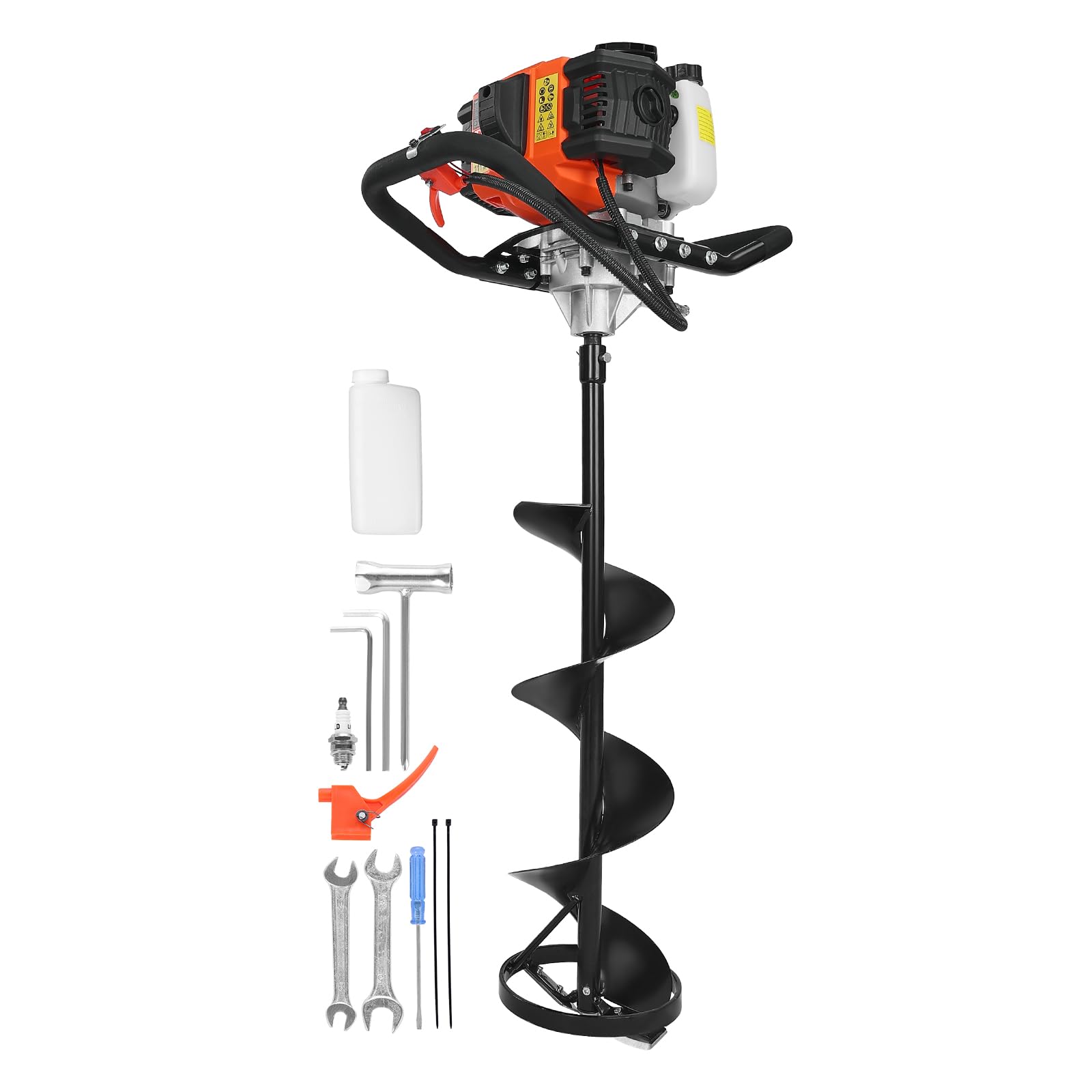
A gas auger is judged on one morning: the one where it's well below freezing, the ice is thick, and everybody stands around waiting. The Quantum's 33cc Viper has been a first-or-second-pull engine for us in exactly that weather, and that's why it's the gas pick here. No charge the night before, no spare battery in the truck, no watching a bar drop.

The cutting end is sorted too. Stainless blades hold an edge in dirty ice better than plain steel, the stainless centering point keeps the auger stable on uneven ice, and the Quantum's centering ring is made for dropping back into a hole you drilled yesterday. The all-metal transmission tells you the same thing the rest of the machine does: plain, heavy, and built to take a knock.

What you accept is everything that comes with a two-stroke. You mix fuel, you smell exhaust, and you hear it, which rules out a closed wheelhouse on a still morning and leaves that job to the E40. Twenty-five pounds is the honest figure before you add fuel, and this is the second-heaviest unit here after the VEVOR. Five years of limited warranty covers the rest.

Pros

  • Reliable cold starts without a charger
  • Stainless blades and a centering ring for old holes
  • All-metal transmission
  • Five-year limited warranty

Cons

  • Two-stroke fuel mixing, exhaust, and noise
  • 25 pounds before you add fuel
Our verdict

The gas auger we recommend: the 33cc Viper starts in real cold, cuts an 8-inch hole, and never asks you to think about a charger.

Check Latest Price
4

Best Value Electric

StrikeMaster Lite-Flite 24V

86 /100
Angler Score Excellent

Key details

Power
24V lithium
Pieces
3
Weight
14.3 lb
Cutting Diameter
8 inches
Check Details on Amazon

Of the battery augers here, the Lite-Flite leaves the most room in the budget for a spare battery, and at 14.3 pounds it's the lightest complete electric in the group. That's the pitch in one line: a real 8-inch auger you can carry in one hand and still afford to power properly.

Twenty-four volts turns an 8-inch flighting without drama. There's no sense of the motor running out of gear halfway down, the flighting clears the hole, and the three-piece shaft breaks down short enough to strap to a pack or lay in a truck bed — the one-piece units here can't do that. Reassembly at the lake takes a minute, and the joint is the part to keep clean and seated.

So this is the electric for someone who walks out and drills a dozen holes rather than fifty, or the second auger for a group where somebody always forgets a battery. What it keeps is an 8-inch hole, a short pack, and a weight you won't complain about on the walk back.

Pros

  • Lightest complete electric here at 14.3 pounds
  • Cuts an 8-inch hole without strain
  • Three-piece shaft packs down short
  • Least expensive battery auger in this group

Cons

  • 24V system rather than the 40V the premium electrics run
Our verdict

The smart-money electric: 14.3 pounds, an 8-inch hole, and enough left over for the spare battery a walk-out day wants.

Check Latest Price
5

Best Drill-Powered

K-Drill Auger 7.5-Inch

91 /100
Angler Score Outstanding

Key details

Weight
7.39 lb
Drill Fit
1/2-inch chuck
Rated Ice Depth
Up to 36 inches
Cutting Diameter
7.5 inches
Check Details on Amazon

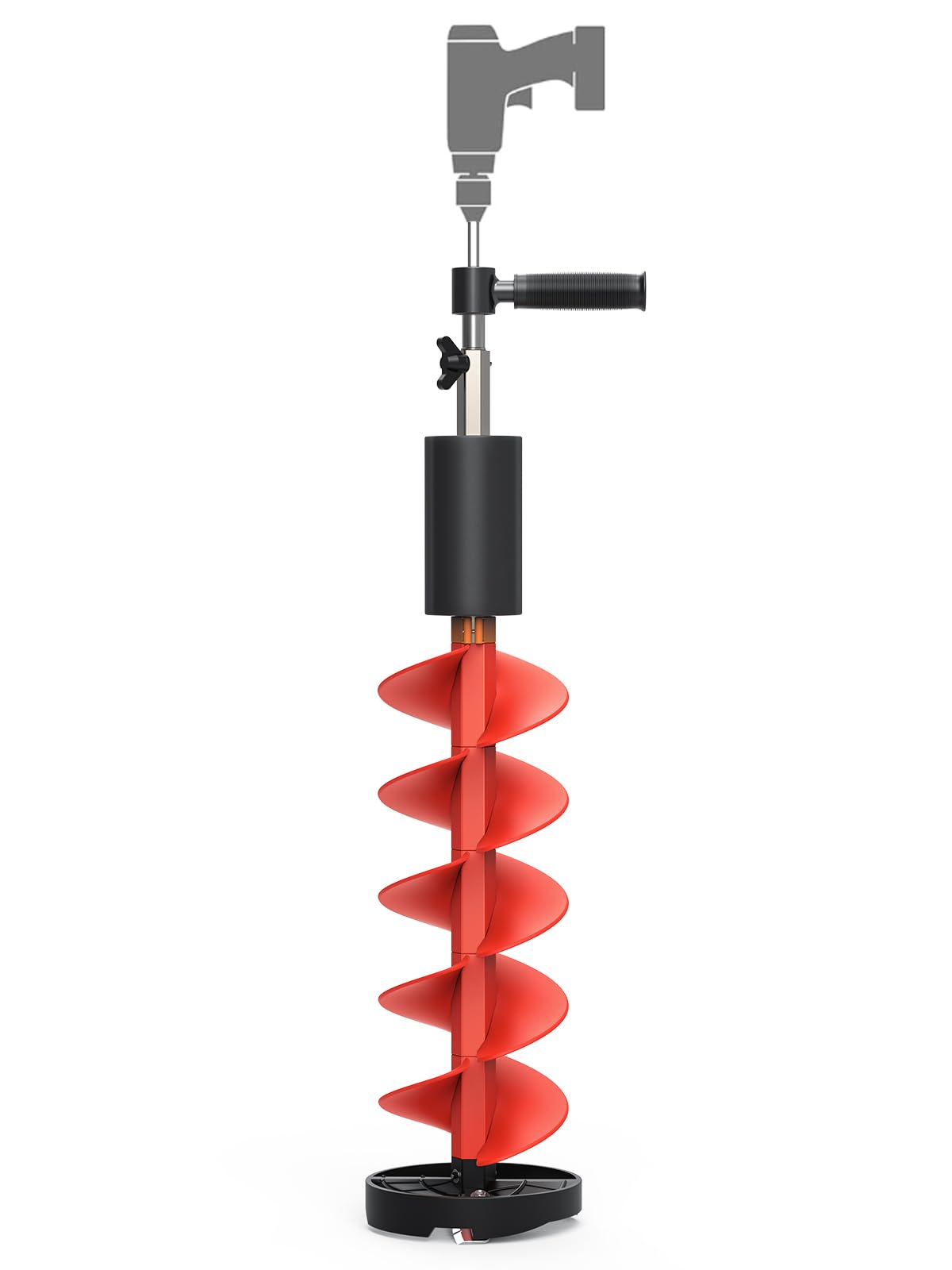
Augers go down holes. It happens at the worst moment — a chuck that wasn't quite tight, a glove on the trigger — and it ends the day for everyone but a magnet and a lot of patience. The K-Drill is built to float if it comes off your drill, and that single design decision is worth more on a cold morning than any number on this page.

The rest of it is a drill attachment done properly. An aluminum shaft with composite flighting keeps it at 7.39 pounds, the shank fits a standard 1/2-inch chuck, and the tool-steel blades are rated for ice up to 36 inches thick. The cut is seven and a half inches — half an inch under the 8-inch picks, and a little easier on the drill because of it.

Everything runs through the drill in your hand. With a big brushless hammer drill this is the lightest way to cut holes: no powerhead, no fuel, no second battery system to buy and charge. With a compact drill it's a disappointment — the flighting loads up, the motor heats, and you're the one apologizing to it. We treat the drill as part of the purchase.

That's why this is the drill-powered auger we point people to. Seven and a half inches is the right hole for walleye and panfish, the floating shaft hedges the one mistake that ruins a trip, and at 7.39 pounds it disappears into a sled that's already full. Buy it if you already carry a drill you trust; if the drill is the thing you were hoping to buy later, start with a purpose-built electric.

Pros

  • Floats if it comes off the drill
  • 7.39 pounds with no powerhead to haul
  • Fits standard 1/2-inch chucks
  • Rated to 36 inches of ice

Cons

  • Only as good as the drill turning it
Our verdict

The drill-powered auger we point people to: 7.39 pounds, a floating shaft, and an 8-inch hole from a drill you already own.

Check Latest Price
6

Best Hand Auger

Strike Master Mora Hand Auger

0 /100
Angler Score Fair

Key details

Shaft
Two-piece
Handle
Adjustable
Cutting Diameter
6 inches
Check Details on Amazon

Six inches of hole sounds like a compromise until you're the one turning the handle. The Mora is the auger for early ice, a farm pond, a backup behind the truck seat, and anyone who wants to leave the battery and the fuel can at home. It breaks into two pieces that fit in a trunk, the handle adjusts for height, and the powder-blue finish makes it easy to find when it's leaning against a snowbank.

For a hand auger it cuts faster than it has any right to. The blades arrive sharp and the 6-inch flighting takes less muscle per turn than the 8-inch units here, so a foot of ice is a job rather than a workout — and it's the auger we hand to a kid who wants to drill their own hole.

The handle is the part to watch. The bolt that clamps it is fiddly to adjust, and it's what takes the load when the blades catch and the auger stops, so check it and the locking pin before your first trip, then check the pin again after you break through; a lost pin ends the outing. Looked after that way, this is a tool that keeps earning its place in the truck.

Pros

  • Two-piece shaft fits in a car trunk
  • Sharp 6-inch flighting cuts with less effort
  • No battery, fuel, or charging to manage

Cons

  • Six-inch hole is tight for pike and lake trout
Our verdict

For early ice, a pond, or a backup behind the seat, the Mora is the hand auger we recommend: two pieces, sharp blades, nothing to charge.

Check Latest Price
7

Occasional Gas Use

VEVOR 52cc Gas Auger

80 /100
Angler Score Excellent

Key details

Engine
52cc 2-stroke, 40:1 mix
Weight
26.2 lb
Auger Speed
240 RPM
Cutting Diameter
8 inches
Check Details on Amazon

This is the cheapest way into a gas powerhead in this group, and it isn't a toy: a 52cc two-stroke, an 8-inch flighting, and 240 RPM at the auger. It ships in pieces — flighting, handle, bolts, wrenches — and goes together in a few minutes on the tailgate.

The engine runs a 40:1 mix and it does the job in real cold. Where it wants a light touch is the cut: let the flighting pull and it eats ice steadily; lean on it because you're in a hurry and it bogs and keeps running, which is the more irritating version of a stall. Two hands, no rush, and it behaves.

The fasteners are the budget part. Blade screws are worth checking before every trip, and the pull handle is the first thing we check. None of that changes the arithmetic for an angler who drills a handful of holes a month and wants gas without premium money.

Pros

  • Least expensive gas powerhead here
  • 52cc engine turning an 8-inch flighting
  • Goes together quickly out of the box

Cons

  • Bogs down if you lean on the cut
  • Heaviest unit here at 26.2 pounds
Our verdict

The cheapest route to gas power here, and a sensible one if you drill a handful of holes a month and let the auger set the pace.

Check Latest Price
8

Cheap 8-Inch Cut

Eyoyo 8-Inch Nylon Auger Bit

86 /100
Angler Score Excellent

Key details

Length
30 inches
Included
Blade cover and spare blade set
Cutting Diameter
8 inches
Drill Requirement
1/2-inch chuck, 80-120Nm
Check Details on Amazon

A spare set of blades and a blade cover come in the box, which is the kind of detail that decides a season. Blades are the consumable that ends trips — nick them on sand or a rock in shallow water and the auger stops cutting and starts polishing — so an 8-inch bit that ships with a second set is worth a look on that alone.

The bit itself is nylon flighting on a metal stem, 8 inches across and 30 inches long, and it's light enough to carry in one hand with a drill in the other. It fits a 1/2-inch chuck, and the centering point keeps it from skating when you start a hole.

Everything depends on the drill behind it. Eyoyo asks for 80 to 120 newton-meters of torque, an 18-to-21-volt pack, and a 1/2-inch chuck, and that is a serious drill — a compact 18V won't hold the flighting once it loads. Put a brushless drill with real torque behind this bit and it cuts fast and clean, and the blades hold their edge in clean ice.

For someone who already carries a big drill, this is the least expensive route to an 8-inch hole here, and the spare blades are what make it cheap to keep cutting. If the drill in your bag is a compact, put the money toward a purpose-built electric instead — this bit will only show you what your drill can't do.

Pros

  • Ships with spare blades and a blade cover
  • Light nylon flighting, easy to carry
  • 8-inch hole from a drill you already own
  • Centering point starts holes cleanly

Cons

  • Wants a 1/2-inch drill with 80-120Nm of torque
Our verdict

If a serious drill already lives in your truck, this is the least expensive 8-inch hole here, and the spare blades keep it cutting.

Check Latest Price

How We Tested Ice Augers on First Ice and Last Ice

We started with about 30 augers sold by brands anglers actually run, then filtered by power type, cutting diameter, listed weight, and price, plus the thing people forget until February: whether replacement blades are easy to find. Nine made the trip.

Testing ran across two ice seasons and three very different surfaces — a shallow bay in December with four inches of clear ice, a basin that grew past two feet by midwinter, and slush and refrozen crud in March. A typical session meant 20 to 30 holes, moving between spots to set tip-ups, and we counted every one.

Every powerhead went on a kitchen scale before it went into the sled, and we carried each one from the truck to the ice one-handed to see how the listed weight actually felt by the time we got there. We timed each auger through a measured 12 inches of ice and noted whether the motor bogged near breakthrough or threw slush back at our boots. Battery machines drilled until the pack quit in 10-degree weather, and we left a spare overnight in an unheated sled to see how it recovered. Drill attachments ran on the same two brushless cordless drills so the comparison stayed fair, and we paid attention to how hard they pulled and whether the chuck slipped. We also marked whether an auger tracked straight or walked off line, and how it kicked when the blade broke through.

Some things only show up with use: whether composite housings flexed, whether bolts loosened, and how blades held an edge after a few hundred holes. Value here is really blade availability plus battery life — an inexpensive auger with unobtainable blades gets expensive fast.

How to Choose an Ice Auger

Start With the Power Source

Four power sources, four different days. Gas runs all day without a charge but costs you fuel mixing, exhaust, noise, and a machine that wants maintaining. A battery auger starts with a trigger, runs quiet enough for a wheelhouse, and stops when the pack is done. A drill-powered bit is the lightest and cheapest way in — if you already own a serious drill. A hand auger is silent and simple and fine for a foot of early ice.

Our rule of thumb: if you're drilling a line of holes and moving all morning, a powerhead earns its keep. If you drill a handful of holes a few times a season, the Mora does the job without a charger or a fuel can.

Match the Hole to the Fish

There's a reason 8 inches became the standard: it lands walleye, panfish, and most of what else comes through, and it's the size powerheads are built around. Go to 10 inches if pike, lake trout, or big baits are the point — that's the Eskimo E40's argument — and accept the extra ice you cut, scoop, and haul out of every hole. Go to 6 or 7.5 inches when the auger is hand-cranked or the drill is modest, because a smaller hole takes less out of both.

The Drill Is Half the Auger

Drill-powered bits live or die on torque rather than voltage. A bit like the Eyoyo wants 80 to 120 newton-meters through a 1/2-inch chuck, which means a brushless hammer drill in its low gear, not the compact you keep in the kitchen drawer. Hang a bit on a drill that can't turn it and you'll cook the drill instead of the ice.

Check two numbers before you buy: chuck size, where 1/2 inch is the standard for these bits, and your drill's torque rating. If your drill doesn't clear the bit's requirement, the money goes further on a purpose-built electric.

Weight Is a Distance Question

A pound matters in proportion to how far you carry it. If the truck sits beside the hole, 26 pounds of gas auger is nobody's problem. If you walk a mile onto a flat, the gap between a 7-pound drill bit and a 19-pound powerhead is the difference between a good day and a long one. Check packed length too: one-piece units ride across a sled, while two- and three-piece shafts go in a trunk or a pack.

Treat Blades as a Consumable

Every auger here cuts well with sharp blades and stops cutting with dull ones, so budget for blades the way you budget for line. Sand, gravel, and the refrozen slush around an old hole are what take the edge off. Keep the guard on between holes and never set the auger down on its cutting head. Stainless blades tolerate dirty ice better than plain steel, and a spare set in the sled costs less than a lost day.

Frequently Asked Questions

Final Verdict

If you want one auger that handles panfish, walleye, and pike, the Eskimo E40 is the one we point you to: a 10-inch hole, 19.3 pounds, and a battery instead of a fuel can. Anglers who cover a lot of ice should look hard at the ION Alpha Plus, which trades two inches of hole for more than three pounds less weight on every move.

And if a big brushless drill already lives in your truck, the K-Drill turns it into an auger for a fraction of the money — provided the drill is genuinely up to it.