Best Ice Fishing Safety Picks of 2026

Price and brand tell you very little up front. What matters is whether the picks work in the four seconds after you go through: two handled spikes on a cord around your neck, whose whole job is to bite the lip of the hole so you can haul yourself out. I've carried a set on every first-ice walk I've taken, and after a winter spent with 14 of them — retractable models, fixed-spike designs, ones with whistles and protective covers — I can tell you the good ones share a quality that has nothing to do with how they look on the pegboard.

The thing first-time buyers miss is that you'll be opening these with thick gloves on, one hand at a time, while adrenaline plays havoc with your fine motor skills. Sharpness decides whether the points bite; fit — sheath, cord length, how they sit over a float coat — decides whether they're reachable. Durability is what keeps them working after a season of slush, grit, and being sat on in a shelter. The picks below are the ones I'd wear.

1

Best Overall

Frabill Retractable Ice Picks

93 /100
Angler Score Outstanding

Key details

Weight
7.2 oz
Carry Style
Worn on jacket
Cord Length
72 inches
Point Guards
Retractable
Check Details on Amazon

A pair of ice picks only helps if it is already on you when the ice gives way, and the Frabill pair is built around that idea. You hold one handle in each hand, put on your jacket, and the picks sit at the base of your sleeves, connected by a cord that stretches to 72 inches. There is no pouch to open and no neck lanyard to untangle from a collar first.

That sleeve placement is why this is our top pick. The picks stay within reach without swinging across your chest, and the retractable guards cover the points until you press them against the ice. In an emergency, the tool should feel obvious rather than fiddly, and this one rewards a simple grip-and-press motion. We also appreciate the yellow handles, which stand out against dark gear and the bottom of a sled.

The fit is the detail to check before you commit. Sleeve-mounted picks depend on your jacket cuffs and how many layers you wear; on a loose cuff, the cord can ride up or sit less securely than you expect. Try them on over the layers you actually fish in, and make sure both handles sit where your hands naturally fall. If you switch jackets often, a neck lanyard is easier to live with.

For a straightforward design, that is a small compromise. The Frabill pair gives you the essentials without asking you to learn a new routine: gloves on, sleeves checked, picks in place.

Pros

  • Worn at the sleeve for immediate access
  • Retractable guards cover the points
  • 72-inch cord keeps both picks connected
  • Simple two-handle design is easy to use

Cons

No notable drawbacks to flag.

Our verdict

We recommend the Frabill pair as the default for most ice anglers: it rides on your sleeves, stays covered until needed, and keeps both picks on a 72-inch cord.

Check Latest Price
2

Best Long-Lanyard Kit

Huntury Retractable Ice Safety Picks

89 /100
Angler Score Excellent

Key details

Included
Safety whistle
Carry Style
Neck lanyard
Point Guards
Retractable covers
Lanyard Length
11.5 feet
Check Details on Amazon

The first thing we noticed about the Huntury kit is how much lanyard you get: 11.5 feet, far more than the 72-inch cord on the Frabill pair. That extra length is the reason we like it as a neck-carried option—it gives you slack to move without unclipping, and the included whistle adds a way to signal for help. The retractable covers work on the same press-and-grip principle, hiding the points until you drive them into the ice.

The kit is built for wearing, not packing. It hangs around your neck for quick access, and the covers keep the very hard, sharp points away from your hands and clothing while you walk. Compared with the sleeve-mounted Frabill, that puts the picks higher and more visible, and it makes the Huntury easier to move from one jacket to another. On a layered-up day, that is a real convenience.

The whistle is the detail that gives this kit its own lane. If you fish with a group, travel on uneven ice, or want a way to signal when shouting into the wind is not enough, having it attached to the same lanyard saves you from improvising. The 0.22 kg weight is noticeable next to the lightest pair here, but it is not burdensome for a walk out to a hole. This is the version we point to when reach and signaling matter more than a low-profile sleeve fit.

Pros

  • 11.5-foot lanyard adds reach
  • Includes a safety whistle
  • Retractable covers protect the points
  • Neck carry keeps picks accessible

Cons

  • Long lanyard can tangle if it is not coiled
Our verdict

The Huntury kit is our runner-up for anglers who want more reach and a built-in whistle; the 11.5-foot lanyard and retractable covers make it a capable neck-carried backup.

Check Latest Price
3

Best Lightweight Pair

HT Polar Ice Safety Picks

85 /100
Angler Score Excellent

Key details

Color
Orange
Weight
4.8 oz
Carry Style
Lanyard
Picks Per Set
2
Check Details on Amazon

At 4.8 ounces for the pair, the HT Polar picks are the lightest set we recommend here. You get two picks on an attached lanyard, molded handles, and orange color that is easy to find against ice and dark clothing. The design is deliberately plain: two picks on a lanyard, with molded handles and orange color.

That low weight is the reason we keep it in the mix. If you walk a long way or pull a loaded sled, an extra ounce around your neck matters, and this pair disappears under a collar more readily than the heavier Rapala spikes. It is a simple set to leave on all day, which is exactly what a backup pair should be.

The HT is the pair we think of as a second set: one for your jacket, one for the sled, or a spare for a friend who forgot theirs. It does not aim to solve every carry preference; it aims to be light, visible, and ready.

Pros

  • Lightest pair here at 4.8 ounces
  • Orange handles are easy to spot
  • Simple two-pick lanyard setup

Cons

  • Simpler build with fewer features than covered picks
Our verdict

We like the HT Polar pair for a barely-there carry: at 4.8 ounces it is the lightest set here, with orange handles and a lanyard that keeps the basics close.

Check Latest Price
4

Best Simple Neck Carry

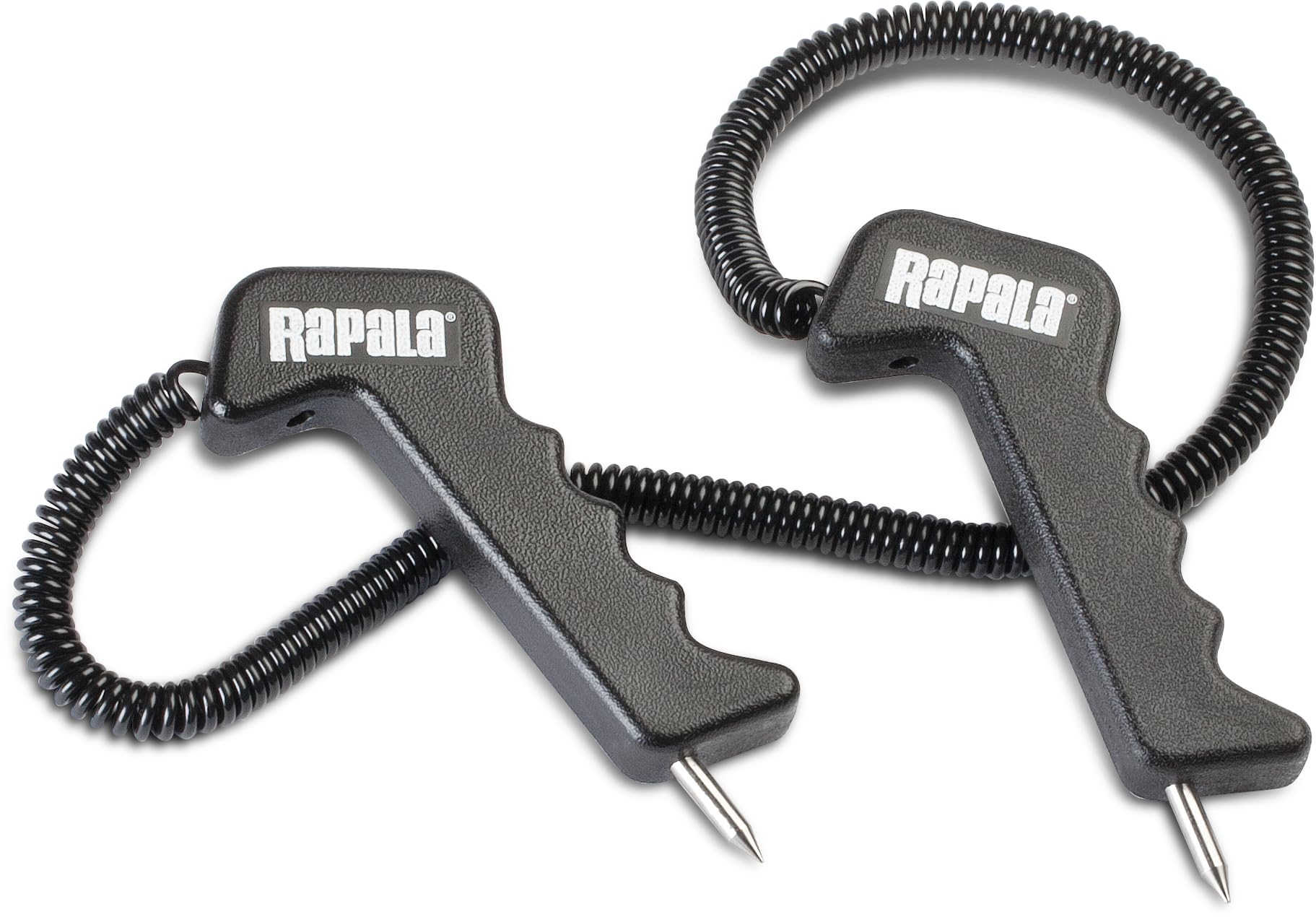
Rapala Ice Safety Spikes

88 /100
Angler Score Excellent

Key details

Weight
9.6 oz
Spike Type
Sharp spikes
Carry Style
Neck lanyard
Check Details on Amazon

The Rapala ice safety spikes are a neck-lanyard pair with sharp points and a simple hang. The set goes around your neck, so the spikes sit in front of you rather than in a pocket or at the bottom of a sled.

What we like is the directness. You pull the lanyard over your head, and the spikes are already in reach; there is no sleeve to check or separate case to open. The points are sharp, and that is the main job—when you are in the water, you need something that will bite the ice on the first or second try.

That simplicity makes the Rapala a good fit for an angler who wants the same routine every trip: lanyard over the head, spikes in front, no extra steps. It is not the most feature-rich pair in this group, but it is easy to understand and easy to keep close. We see it as the straightforward neck-carry choice.

Pros

  • Sharp spikes bite into ice
  • Neck lanyard keeps picks in front
  • Simple routine with no sleeve mount

Cons

  • Heavy 9.6-ounce neck carry
Our verdict

The Rapala spikes are the simple neck-lanyard pick: sharp points and an easy hang, though the set is heavier than our other lanyard options.

Check Latest Price
5

High-Visibility Backup

Tlswshsy Retractable Ice Awls

82 /100
Angler Score Excellent

Key details

Color
Bright yellow
Weight
6 oz
Buoyancy
Floats
Material
Stainless steel
Check Details on Amazon

The Tlswshsy awls are the pair in this group built to be found. The shells are bright yellow, they weigh 0.17 kg, and the plastic body is designed to float if it ends up in the water. That is a different priority from the sleeve-mounted Frabill or the long-lanyard Huntury, and it is useful if your gear tends to get dropped, borrowed, or buried in a sled.

The picks themselves are stainless steel, and they come with a separate protective case rather than a retractable cover. You take the picks out, grip the handles, and dig in. We like the simplicity for a spare set, and the case keeps the points covered when the awls are stored.

For ice fishing, we see this as a second pair rather than the one you rely on first. Keep it in the sled, in a jacket pocket, or with a buddy who needs a loaner, and check that the case stays put in transit. The bright color is the feature that makes it easy to keep accounted for, and the floating body is a sensible backup if a pick goes over the edge.

Pros

  • Bright yellow shells are easy to spot
  • Floating body helps recover dropped gear
  • Stainless steel points
  • Light 0.17 kg carry

Cons

  • Separate case adds a deployment step
Our verdict

The Tlswshsy awls are our high-visibility spare: bright yellow shells float, and the stainless points give you a second set to stash in a sled or loan out.

Check Latest Price

How We Tested 14 Ice Picks Over One Winter

We started with more than 60 sets sold as ice picks, ice awls, or self-rescue spikes and cut anything that failed on paper: spikes too short to punch past slush, cords that read short for an average parka, sheaths that stayed put on friction alone, retractable designs with no lock. That left 14 sets across the price range, from plain two-spike kits to models with whistles, covers, and long lanyards.

Testing ran through one full winter, roughly four months, beginning on first ice in December. We wore each set the way it actually gets worn — riding over a float coat, tucked under a bib strap, hanging at the chest — on walk-outs, while sitting on a bucket in a shelter, and during driveway drills with mittens on, timing how long it took to pull both picks free and set them one-handed. On a shallow pond with a safety line, we practiced self-rescue and noted whether the points bit on the first strike or skated across the surface.

Between trips we rinsed and dried each set, then looked for rust, grit gumming up the retractable mechanism, and sheaths that had stretched loose. We dropped them point-first onto ice, sat on them, and checked whether the covers stayed on in a pocket. Value came down to what a set added beyond two sharp spikes that come out when you pull.

How to Choose Ice Safety Picks

Sleeve Mount vs. Neck Lanyard

Sleeve-mounted picks sit at the base of each cuff and stay out of the way until you need them; the Frabill pair works this way. A neck lanyard is easier to move between jackets and puts both picks in front of you, as on the HT, Huntury, and Rapala sets. Neither is universally better. Choose sleeve carry if you wear the same fishing coat and want a low-profile fit; choose a neck lanyard if you layer up, share gear, or want to see the picks at a glance.

Whatever you choose, check that both hands can reach the handles without unzipping a jacket or opening a pack. A pair buried in a sled is not rescue gear in any practical sense.

Guards, Points, and Fast Deployment

Retractable guards cover the spikes until you press them into the ice, which keeps the points from snagging on clothing and keeps your hands safer in transit. The Frabill and Huntury pairs use this system; the Tlswshsy pair uses a separate protective case instead. A cover only helps if it comes off or retracts in one motion while you are wearing gloves.

Practice with the picks on land before you go out: press each point against a firm surface, watch the guard retract, and make sure the handle gives you a secure grip. Sharp points matter, but so does getting them exposed quickly.

Tethers, Clips, and Secure Storage

A tether keeps the pair together and gives you something to hold while you pull. The Frabill cord stretches to 72 inches; the Huntury lanyard runs 11.5 feet. More length is not automatically better, since long line can tangle or swing, and a short cord can feel restrictive when you are layered up.

Check the connection point as carefully as the spike: the two picks should stay together in storage and separate without a fight when you need them. If a pair comes apart on its own or the covers release in your bag, it is not ready gear.

Visibility, Flotation, and Weight

Bright handles are easier to find in a sled or on snow, and a floating design can save a dropped pick from sinking. The Tlswshsy awls pair bright yellow shells with a floating body; the HT pair uses orange handles without adding much weight. Weight matters when the picks hang around your neck all day: the HT set weighs 4.8 ounces, while the Rapala set weighs 9.6 ounces.

Flotation is a useful backup, not a substitute for a tether. Pick the lightest pair you will actually keep on your body, then add visibility if you fish around holes, slush, or open water.

Durability and a Simple Pre-Season Check

These tools live in a jacket pocket or sled for months, so inspect them before the season rather than after a failure. Open the guards, look for bent or dull points, and flex the cord or lanyard to check for cracks or worn stitching. Store picks dry, and replace any pair with a damaged cover, a sticky closure, or a tether that no longer holds.

A cheap pair that is checked and ready is better than a premium pair left tangled at the bottom of a bucket. Put the picks in the same outer-layer pocket every trip so the routine stays automatic.

Frequently Asked Questions

Final Verdict

Start with the Frabill Retractable Ice Picks. They put the pair at your sleeves, cover the points until you press them into the ice, and keep both picks on a 72-inch cord—simple, quick, and easy to keep on your body all day. That is the combination we want in a rescue tool.

If you prefer a neck lanyard with more reach and a built-in whistle, choose the Huntury kit; it gives up some compactness for a longer tether and an extra way to signal. For the lightest possible carry, the HT Polar pair is the spare that disappears around your neck.