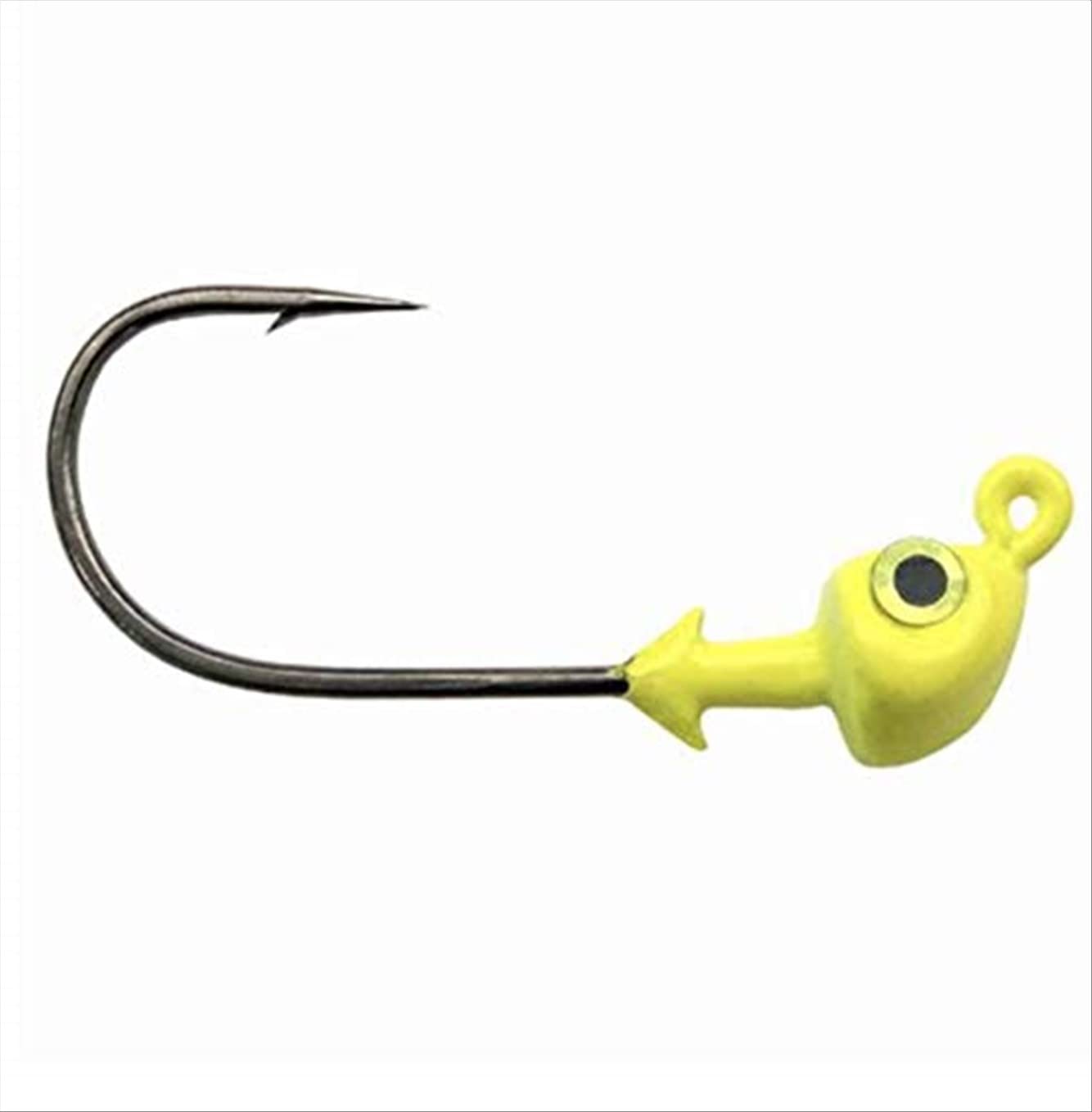
Best Jig Heads of 2026

The fish rolled at the surface, shook once, and the swimbait came back without it — hook point folded over from the rocks I'd dragged through ten casts earlier. That's the trouble with jig heads: the cheapest piece of the rig decides whether the fish you find actually gets landed. A good one starts sharp, stays sharp after a morning of bottom contact, keeps its paint, and sits on the bottom the way its shape promises. Swap the right one onto the same plastic and it fishes deeper, hooks cleaner, and makes it through more than a trip or two.

I've tied them on since I was a kid fishing minnows off a dock, so I came in with opinions. Over the past four months, my team and I fished 16 different jig heads — ball, mushroom, and swimbait styles — and the gaps between them showed up fast. One thing a first-timer won't hear at the tackle counter: weight changes a bait's fall more than brand ever will, and a hook gap too narrow for your plastic costs you fish. Everything below is what survived.

1

Best Overall

Temorah Ball Head Jig Heads

89 /100
Angler Score Excellent

Key details

Hook
High-carbon steel, matched to weight
Colors
10 solid and two-tone
Weights
1/32 oz to 1 oz
Heads Per Pack
50
Check Details on Amazon

The eyelets are the first thing we check on a painted jig head, because a head full of paint means picking at it with a hook point in bad light. These arrive clean, with the paint stopping where it should. Fifty heads to a box, in weights from 1/32 ounce up to 1 ounce, each one paired with a hook that suits its size, a #6 on the smallest and a 5/0 on the ounce, plus ten color options across solid and two-tone finishes. That combination of open eyes, matched hooks, and a box you can fish all season from is why this is the jig head we tell most people to buy first.

The ball head is the least fussy shape there is. It sinks fast, it casts straight, and it takes a grub, a tube, or a paddletail without argument. The hooks are high-carbon steel and sharp enough to grab a thumbnail, and the barb on the shank holds a plastic where you set it. We especially like that the size pairing saves guesswork: a 1/32-ounce head comes with a hook small enough for a crappie plastic instead of the oversized hook you find on cheap ultralight heads.

Fished slow over gravel and around docks, it does what a ball head should: it stays in contact with the bottom, comes back with the bait still on, and casts flat into wind for its weight. The wire is general-purpose rather than heavy, which is the honest boundary of this box. Around docks, over shell, and in open water it is fine; dragging a creature bait through thick grass and winching a bass out of it is a job for a heavier hook.

Pros

  • Eyelets come clear of paint
  • Hook size matched to each head weight
  • 1/32 oz to 1 oz covers panfish through bass
  • Ten color options in a 50-count box

Cons

  • Paint chips on rock and dock pilings
Our verdict

Open eyelets, hooks matched to every weight from 1/32 ounce to 1 ounce, and fifty heads in ten colors make this the box that covers panfish through bass.

Check Latest Price
2

Best Premium Swimbait Head

Berkley Fusion19 Swimbait Jighead

91 /100
Angler Score Outstanding

Key details

Hook
3/0 forged, needle point
Weight
1/4 oz
Bait Keeper
Conical collar with wire lock
Heads Per Pack
3
Check Details on Amazon

Three heads in a pack looks like a poor deal next to a fifty-count box, right up until you roll the hook between your fingers. This is a forged hook with a needle point, and the difference shows up in a hookset: the point goes in with a nudge instead of a swing. The 40-degree bend puts the pull point where Berkley wants it, which we noticed most when a fish shook its head at the boat and stayed on.

Then there is the keeper, a conical collar with a wire that locks a swimbait down the shank. Paddle tails that slide on other heads stay put here, and the head tracks straight on a slow retrieve instead of rolling. If you fish swimbaits seriously enough to care about one more fish a trip, this is the head we point you to, because the hook and the keeper are the two places that difference shows up.

It is a swimbait head rather than an everything head. The collar and wire lock are built around a swimbait body, and a 3/0 hook is more gap than a two-inch crappie tube needs. Rig a paddletail or a hollow belly and it makes sense immediately; make it your only box of jig heads and you will want a ball head beside it.

Pros

  • Needle point penetrates on a light set
  • Wire-lock collar holds swimbaits in place
  • Forged hook adds lateral strength

Cons

  • Only three heads per pack
Our verdict

If you fish swimbaits and want the best hook in this group, this is it: a forged needle point and a wire keeper that keeps a paddletail straight.

Check Latest Price
3

Best Value Swimbait Head

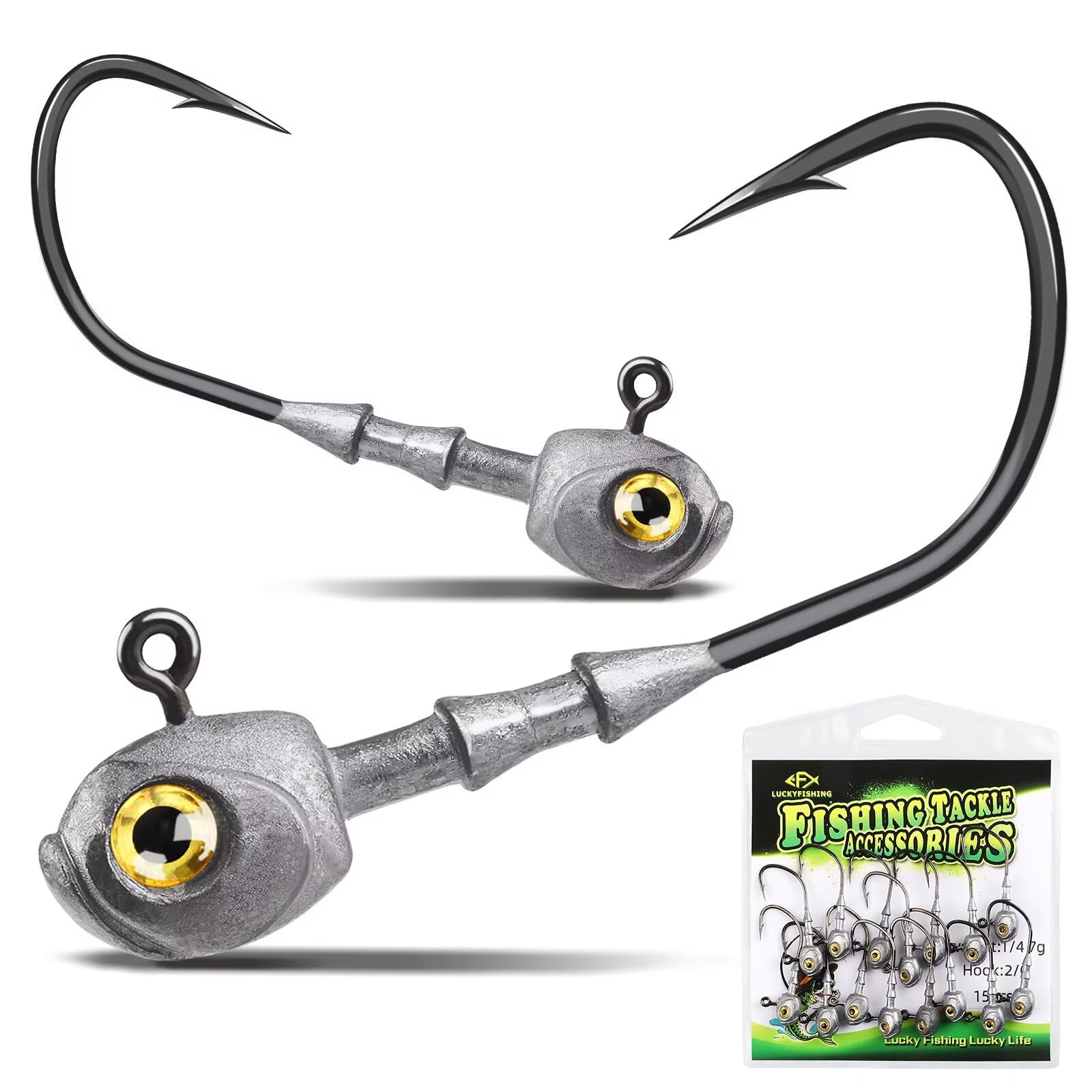
LUCKYFISHING Swimbait Jig Head

88 /100
Angler Score Excellent

Key details

Hook
1/0, 3X high-carbon steel
Weight
1/8 oz
Bait Keeper
Double collar
Heads Per Pack
15
Check Details on Amazon

A double collar is the kind of detail you notice the third time a paddletail slides down the shank on a long cast. On this head, two rows of ridges grip a soft plastic hard enough that we stopped checking the bait between casts, and for less per head than the premium swimbaits here it is the value pick of the group.

The hook is the other half of the argument. It is 3X high-carbon steel with a bend designed to drive the point home with less effort, and what we can tell you is that the wire is heavier than the bulk ball heads in this set and it held its shape around rock where a lighter head tends to open up. Sharp out of the pack too, with no work needed on a stone.

The 3D eyes and sculpted gills do something in stained water, and the head runs true behind a paddletail at a slow roll. What you give up is choice inside a pack: one weight, one hook size, fifteen heads, so covering three depths means buying three packs. That is a fair trade for a head this solid, and it is the reason it shares box space with a premium swimbait head rather than replacing it.

Pros

  • Double collar grips soft plastics
  • Heavier wire that holds its shape
  • Sharp out of the pack
  • Fifteen heads per pack

Cons

  • One weight and hook size per pack
Our verdict

A double collar and a heavy-gauge hook make this the swimbait head we hand people who want real performance without premium swimbait money.

Check Latest Price
4

Best for Ned Rigs

Reaction Tackle Mushroom Jig Heads

89 /100
Angler Score Excellent

Key details

Weights
1/16 to 1/4 oz
Head Style
Mushroom stand-up
Hook Options
Standard or EWG
Heads Per Pack
25
Check Details on Amazon

A Ned rig lives or dies on what the bait does after it hits bottom, and a mushroom head is the shape that makes the answer a standing bait. The flat cap here props a TRD or a stick bait up off the bottom with the tail raised, and it stayed upright on the sloping rock we worked it over, which is more than a ball head dragged through the same spot manages.

Twenty-five to a pack across four finesse weights, with a standard or an EWG hook, is the flexibility we want from a Ned box. The standard hook suits a slim stick bait, the EWG gives you the gap for a thicker craw or creature, and having both means you rig for the cover in front of you instead of the cover you planned for. The hook is sharp and strong enough that we stopped thinking about it.

The one thing to sort before you fish is the keeper. A Z-Man ElaZtech bait is stretchy enough that the barb does not bite deep, and it slides back down the shank after a few casts; a drop of superglue at the collar fixes it, which plenty of Ned fishermen do anyway. Keep this head for slow work and it earns its place in the box.

Pros

  • Stands baits up off the bottom
  • Four finesse weights, standard or EWG hook
  • Sharp, durable hook

Cons

No notable drawbacks to flag.

Our verdict

For Ned rigs on the bottom, this mushroom head stands a bait up, offers four finesse weights, and comes twenty-five to a pack.

Check Latest Price
5

Best Sickle Hook for Panfish

Temorah Sickle Jig Heads

90 /100
Angler Score Outstanding

Key details

Hook
Sickle bend
Colors
Assorted
Weight
1/8 oz
Heads Per Pack
50
Check Details on Amazon

Sickle hooks are a panfish trick more bass fishermen should know. The point curves back toward the shank, so a fish that turns and shakes has less room to work it loose, and on crappie and bluegill, where the bite is a tap and the mouth is paper, that geometry is the difference between a hookset and a look at an empty bait.

The rest of the head is sorted. Fifty to a pack in assorted colors, the eyes come clean of paint so you are not picking at them on the water, and the finish held up over a couple of outings without the chipping we have come to expect from painted bulk heads. The 1/8-ounce weight is a sensible finesse compromise: heavy enough to cast on light line, light enough to work slowly over brush.

We keep a pack of these in the panfish box and reach for one ahead of a round-bend head when fish are short-striking; the hookup rate on bluegill is what sold us. It is a finesse head rather than a cover head, so treat it as the panfish half of your jig box and it earns its space.

Pros

  • Sickle bend keeps fish from turning off
  • Eyes come clear of paint
  • Fifty heads per pack

Cons

  • Stiff wire resists bending out of a snag
  • Fixed at 1/8 ounce in the 50-pack
Our verdict

A sickle bend that holds panfish and paint-free eyes make this the finesse head we tie on when fish are short-striking.

Check Latest Price
6

Best for Crappie

Strike King Mr. Crappie Jig Heads

90 /100
Angler Score Outstanding

Key details

Hook
Thin-wire Eagle Claw
Weight
1/16 oz
Heads Per Pack
25
Check Details on Amazon

A 1/16-ounce head with a thin wire hook is built for a specific kind of fishing: shooting docks, dipping brush, and working a tiny plastic where a bass lure will not fit. The wire here is deliberately fine, and that is a feature. When it hangs a limb, a steady pull straightens the hook and gets your jig back, which is the whole economics of crappie fishing.

Strike King builds it around an Eagle Claw needle point that stays sharp, with a barb on the shank that holds a small plastic tail or a live minnow without a fight. One thing we did not expect to care about: the head gives a strong return on forward-facing sonar, so you can watch the jig work instead of guessing at it. If you fish a screen, that alone is worth knowing.

For crappie, this is the head we hand a beginner and fish ourselves. The point finds the corner of a paper mouth, the shank barb keeps a small tail where it belongs, and on a light rod with light line it does exactly what a crappie jig is supposed to do. The 25-count pack means you are not hoarding them.

Pros

  • Thin wire straightens out of brush
  • Sharp needle point keeps crappie pinned
  • Strong return on forward-facing sonar

Cons

  • Thin wire will not survive bass or saltwater duty
  • One weight and color per pack
Our verdict

Crappie fishermen should start here: thin wire, a sharp needle point, and a head that shows up clearly on forward-facing sonar.

Check Latest Price
7

Best for Inshore Saltwater

Strike King Saltwater Flats Jig Head

91 /100
Angler Score Outstanding

Key details

Hook
Black nickel, chemically sharpened
Weight
1/4 oz
Bait Keeper
Molded barbs
Heads Per Pack
3
Check Details on Amazon

Bait keeper barbs look like a small thing until you have cast a soft plastic a hundred times and watched it bunch up at the hook eye. The barbs on this Strike King head sit behind the collar and hold a plastic, including the stretchy Z-Man baits that shrug off most keepers, right where you rigged it cast after cast.

The rest of the build is what you want in the salt. The hook is black nickel and chemically sharpened, it stayed sharp through a morning of casts, and the point is the kind that finds purchase in a boney mouth. The 3D eyes and chip-resistant finish are the details that make it read as a baitfish rather than a lump of lead.

The line tie sits at the nose of the head, which is the arrangement that works when you are dragging through sparse grass rather than fouling in it. It fishes as well with a plastic as with a live shrimp or minnow threaded on the shank, and 1/4 ounce is the flats weight for shallow water with a little chop on it.

Inshore, over grass and shell, this is the flats head we tie on first. It handles the trout, redfish, and flounder presentations a 1/4-ounce head was made for, it keeps the bait where you put it, and it stands up to teeth and shell instead of coming back bare. Whether that is worth it depends on how you fish; on a flat, with a push pole and a plan, it is.

Pros

  • Barbs hold soft plastics and live bait
  • Chemically sharpened black nickel hook
  • Chip-resistant finish and 3D eyes

Cons

  • Only three heads per pack
Our verdict

For inshore flats, this head holds soft plastics and live bait on molded barbs, with a chemically sharpened black nickel hook that stays sharp.

Check Latest Price
8

Assorted Weights

OJYDOIIIY Fish Eye Jig Heads

87 /100
Angler Score Excellent

Key details

Hook
High-carbon steel, spear point
Weights
1/8 to 3/8 oz
Heads Per Pack
12
Weight And Hook
Separate pieces
Check Details on Amazon

Twelve heads in four weights, three each of 1/8, 3/16, 1/4, and 3/8 ounce, is a sampler box, and we mean that as a compliment. If you have never been sure whether your water wants a slow fall or a fast one, this answers the question in an afternoon instead of in three separate orders.

The design is unusual: the weight and the hook are separate pieces, so the bait moves independently of the head. On a paddletail that showed up as more kick at slow speed, and the 3D eyes give a fish something to aim at in dirty water. Rigging is straightforward, a spear point high-carbon hook with no fiddling at the collar.

The head shape comes through grass better than a plain ball head, which is what the anti-snag claim is about, and the hook is sharp enough to need no work out of the box. Between the four weights you can fish the same plastic at three depths in a morning, and that is the real argument for a kit like this.

For someone filling a swimbait box from scratch, this is where we start, because it tells you which weight your water wants while giving you a better hook than a sampler has any right to. Once you know, buy that weight in a heavier single-size pack and keep this one for experimenting.

Pros

  • Four weights in one box
  • Separate head and hook free the bait
  • Sharp spear point hook

Cons

  • Hook can separate from the head under load
  • Glued-on eyes come off after a few fish
Our verdict

Buy it to find your weight: four sizes in one box, sharp hooks, and a separate head that lets a paddletail swim.

Check Latest Price

How We Tested Jig Heads on the Dock, the Rocks, and in Current

We started with roughly 40 jig heads that come up again and again in angler forums and tackle-shop conversations, then trimmed by weight offerings, hook gauge, pack size, and price per head. That left 16 heads, which we fished over four months — early mornings off a lighted dock, afternoons dragging along rock banks, and a couple of windy days on a flat where the boat wouldn't hold.

Sharpness was the first cut. I touched each hook point to my thumbnail at a slight angle and dragged it; a point that skated instead of biting got set aside, and any head that rolled a point during a hookset was retired on the spot. Paint durability got the dock-piling treatment — a dozen casts bounced off wood and concrete, then a close look for chips and bare lead. We also weighed every head on a kitchen scale against its labeled weight, since a pack of heads running light fishes a completely different depth than the number on the package suggests.

For size and stability, we matched each head to the plastics it was built for, watching whether the collar held the bait without tearing the nose and whether the hook gap cleared the body on the retrieve. Stand-up and mushroom styles went across the bottom in moving water to see if they held upright or tipped over at the first bit of current. At the end of four months we counted how many heads per pack were still fishable, which is what value came down to far more than the price on the tag.

How to Choose Jig Heads

Weight First, Then the Hook

Ounce ratings tell you how fast a head falls and how far it casts, not how big it is. A 1/32-ounce head is genuinely tiny, right for a crappie plastic and useless behind a five-inch swimbait, and it comes on a #6 hook. Heavier heads carry bigger hooks: our top pick runs from 1/32 ounce on a #6 up to 1 ounce on a 5/0. Pick the weight your depth and wind call for, then check that the hook gap is wide enough to clear the body of the plastic you are threading on. Too narrow and you miss fish; too wide and the bait tears off the collar.

Match the Head Shape to the Presentation

Ball heads do everything adequately and sink fast, which is why they are the default in most boxes. A mushroom or Ned head has a flat cap that stands a bait up off the bottom, better for finicky fish and slow presentations and worse for covering water. Swimbait heads carry a collar or wire keeper to lock a paddletail straight, and a few run the weight and hook as separate pieces for more bait action. If you fish one style most of the time, buy for it and let an all-rounder cover the rest.

Hook Wire Is a Trade, Not a Ranking

Thin wire penetrates on a light set and straightens when it snags, which is exactly what a crappie fisherman wants in brush. Heavy wire holds big fish and will not open on a hookset, and it costs you jigs in cover. Chemically sharpened needle points are standard on the better heads here and hold an edge longer than a stamped point; a forged hook adds lateral strength. Decide which failure you can live with, a straightened hook or a lost fish, and buy for that water rather than for the strongest hook on the shelf.

Eyelets, Keepers, and Paint

Two details separate a head you will fish from one you will fight. The eyelet has to be clear of paint, or you will be picking at it with a hook point in the dark. And a keeper, whether a barb, a collar, a wire lock, or a double row of ridges, is what stops a plastic sliding down the shank after every cast. We put far more stock in those two than in the finish. Paint is the least important of the three: a chipped head still catches fish, so do not pay extra for a finish you are going to bounce off rock.

How Big a Pack to Buy

Jig heads disappear into snags, not into fish, so the count matters more than it does with hard baits. A fifty-count box lets you fish carelessly and try colors you would not otherwise buy; a three-count card makes you careful with every cast. Neither is wrong. If you are still learning a lake, buy the bulk box and do not think about it again. If you know the two weights you throw and want the best hook in them, the small card is the better buy.

Frequently Asked Questions

Final Verdict

Start with the Temorah ball heads. Fifty heads, every weight from 1/32 ounce to 1 ounce, hooks matched to each one, and eyelets that come open: that is the box covering panfish through bass without a second trip to the tackle shop.

From there it is about your water. The Berkley Fusion19 if swimbaits are the program and you want the best hook in this group, or the Reaction Tackle mushroom heads if you are dragging a Ned rig along the bottom.