Best Marine Battery Switches for Boats of 2026

You don't think about a marine battery switch until the morning the engine won't crank and you want to switch over to the house bank without wrestling a cable off a terminal. Every switch on the shelf promises the same three things: waterproof, heavy duty, 300 amps. They photograph almost identically, and the difference between one that survives a decade and one that seizes solid in two seasons is hidden inside the housing. What a good switch buys you is unglamorous and essential: every circuit on the boat dead in one twist, and the certainty it will still turn in year five.

I've had a bargain selector freeze halfway between positions with weather coming in, which is why I'm fussy about these now. Over the past six months we installed and lived with 14 switches, from plain on/off disconnects to four-position selectors, and one thing holds across all of them: amp ratings are advertised loosely, with continuous and momentary numbers used interchangeably. Measure your cutout and hole spacing before you drill. The ones worth the money are below.

1

Best Overall

Blue Sea e-Series Selector

93 /100
Angler Score Outstanding

Key details

Switch Type
4-position selector (1, 2, 1+2, off)
System Voltage
32V DC
Continuous Rating
325A
Marine Protection
UL listed, ignition protected, IP66
Check Details on Amazon

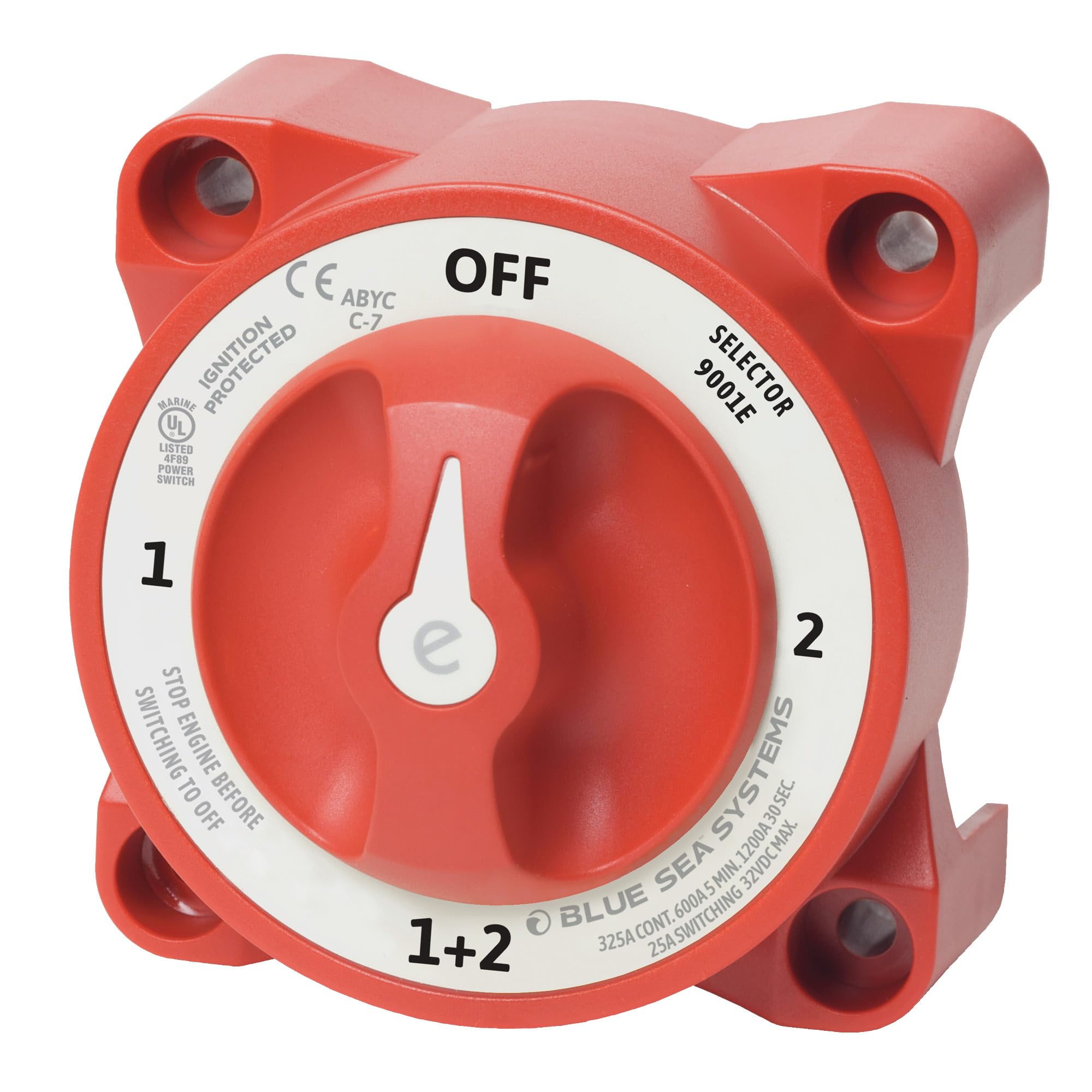
Two battery banks and one charging system is the point where a simple kill switch stops being enough. You need to start on bank 1, run the house load on bank 2, and have a way to combine both if one is low. The Blue Sea Systems e-Series Selector is the switch we keep coming back to for that job: four positions, 325A continuous, and a compact body that mounts on a surface or the back of a panel.

What earns it the top spot is the combination. It is UL listed and ignition protected, so it can live in the engine room of a gasoline boat, and the IP66 housing stands up to the damp air and spray that find their way into a battery compartment. The tinned copper studs are long enough to stack more than one cable, and the raised tactile markings let you find 1, 2, both, or off without a light. We liked the firm detents; the switch tells you where it is without feeling stiff.

The switch does not include mounting hardware, so plan on four screws before installation. It is also larger than the mini selectors in this group; if your panel cutout is tight, measure the body and leave room for cable bends. Those are the trade-offs, and they are easy to absorb on a boat with a real battery panel. The 7/8-inch studs accept multiple cable lugs, which matters when a charger lead and a main feed land on the same post.

Pros

  • Four-position selector for two banks
  • 325A continuous rating
  • UL listed and ignition protected
  • IP66 housing and tactile detents

Cons

  • No mounting hardware included
Our verdict

For a two-bank boat, we make the Blue Sea e-Series Selector the default: 325A continuous, UL listed and ignition protected, IP66 sealed, and four positions that click into place with real confidence.

Check Latest Price
2

Best Budget On/Off

Nilight 90015A

95 /100
Angler Score Outstanding

Key details

Switch Type
On/Off
Ingress Rating
IP66
System Voltage
12–48V DC
Continuous Rating
275A at 12V DC
Check Details on Amazon

The Nilight 90015A is the budget answer for a simple job: one battery bank, one master disconnect, and no need to choose between banks. Its 275A continuous rating at 12V DC, 455A intermittent rating, and 1250A momentary rating cover a typical outboard or trailer load, and the 12–48V compatibility lets it serve in more than one system. The IP66 housing and rear terminal cover are the details that make it feel more marine-ready than the price suggests.

What we noticed first is how little space it takes up. The body is compact enough to fit beside a battery box, and the four side plates give you room to route heavier cable without fighting the housing. The rotary knob has a solid, definite stop at each position, so you can tell on from off by feel. The two-year warranty is also a useful cushion on a part that lives in a damp compartment.

This is an On/Off switch, not a selector, so it cannot separate two banks or combine them for an emergency start. The ratings are also quoted at 12V DC; if you run a 24V or 48V system, check the load against the switch's rating rather than assuming the same current. For one bank and a straightforward disconnect, those limits are easy to live with. The rear cover is the detail we appreciate most: it keeps a dropped wrench or a loose cable end away from the studs.

Pros

  • 275A continuous at 12V DC
  • IP66 housing with rear terminal cover
  • Compact body and two-year warranty

Cons

  • Mounting screws are not reliable; use your own
  • No dual-battery selection
Our verdict

We point single-bank boats to the Nilight 90015A: a sealed, compact master disconnect with a 275A continuous rating at 12V and a two-year warranty.

Check Latest Price
3

Best Heavy-Duty Single Circuit

Blue Sea e-Series On/Off

94 /100
Angler Score Outstanding

Key details

Switch Type
On/Off
System Voltage
48V DC
Continuous Rating
350A
Marine Protection
IP66, limited lifetime warranty
Check Details on Amazon

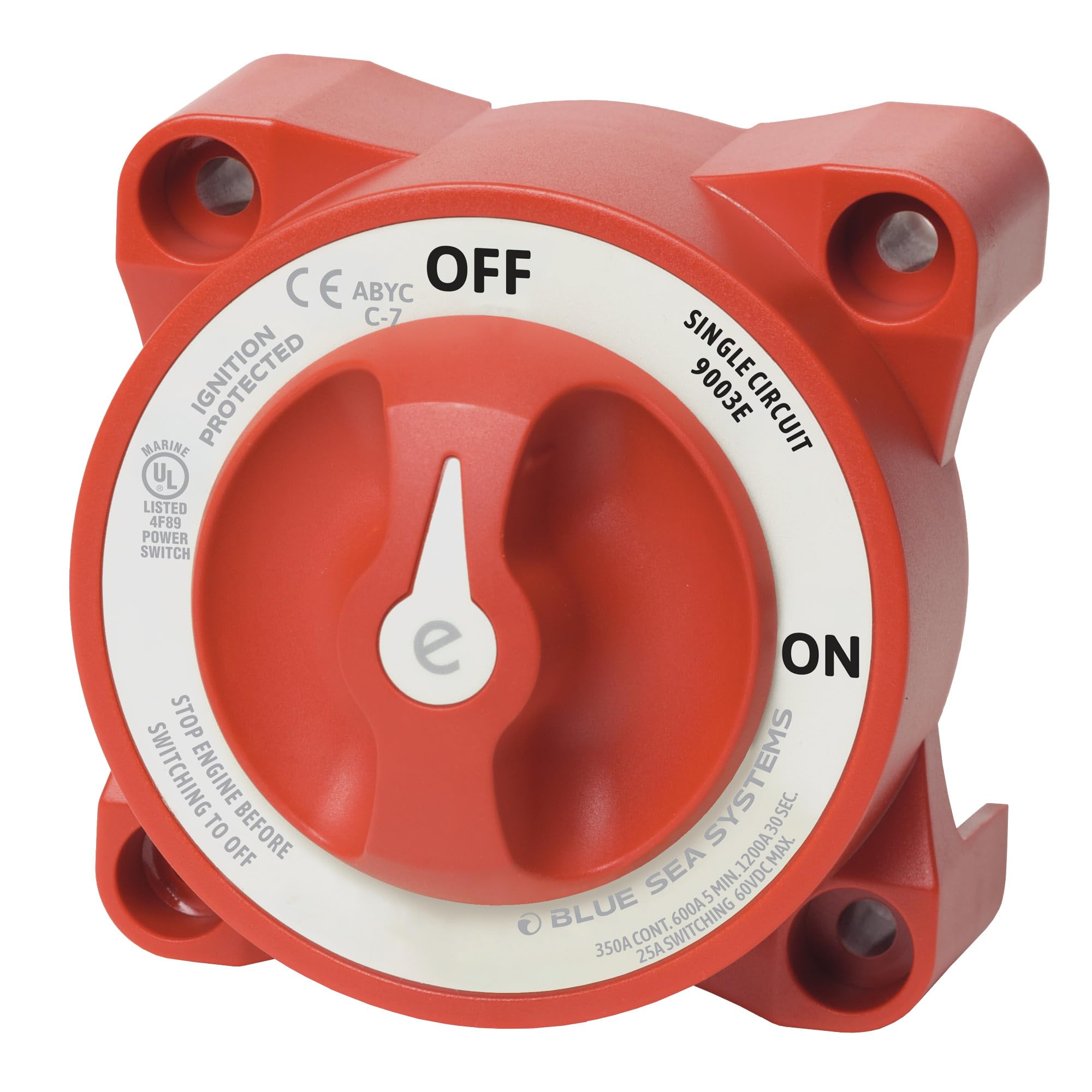
The e-Series On/Off is the switch we choose when one bank needs a heavier disconnect than a budget kill switch can provide. Its 350A continuous rating is the highest in this group, and the 48V DC rating puts it in the right place for a modern 48V house bank or a heavy inverter circuit. The body is compact for that much capacity, with surface or rear-panel mounting and tin-plated copper studs.

We appreciate the textured knob and face more than we expected. In a dark battery locker, you can find the switch and tell on from off by feel, which is not true of every smooth plastic knob here. The IP66 housing and limited lifetime warranty add to the case for a permanent installation. It turns with a firm, positive action rather than a vague sweep.

It is a single-circuit switch, so it will not select between two banks or combine them for starting. It is also larger than the mini On/Off switches, so check the depth behind your panel before you commit. Those are the boundaries, not surprises. For a winch, inverter, or 48V bank that needs one clean disconnect, the extra capacity is worth the space.

Pros

  • 350A continuous rating
  • 48V DC compatibility
  • IP66 housing and limited lifetime warranty
  • Textured knob for low-light use

Cons

  • Single circuit only—no bank combining
Our verdict

If your single bank carries a windlass, inverter, or 48V load, we trust this disconnect: 350A continuous and a sealed housing with a lifetime warranty.

Check Latest Price
4

Best Budget Selector

SEAFLO SFCBS-300-402

84 /100
Angler Score Excellent

Key details

Switch Type
4-position selector (off, 1, 2, 1+2)
System Voltage
12/24/48V DC
Continuous Rating
300A
Ignition Protection
ABYC, UL 1500, SAE J1171
Check Details on Amazon

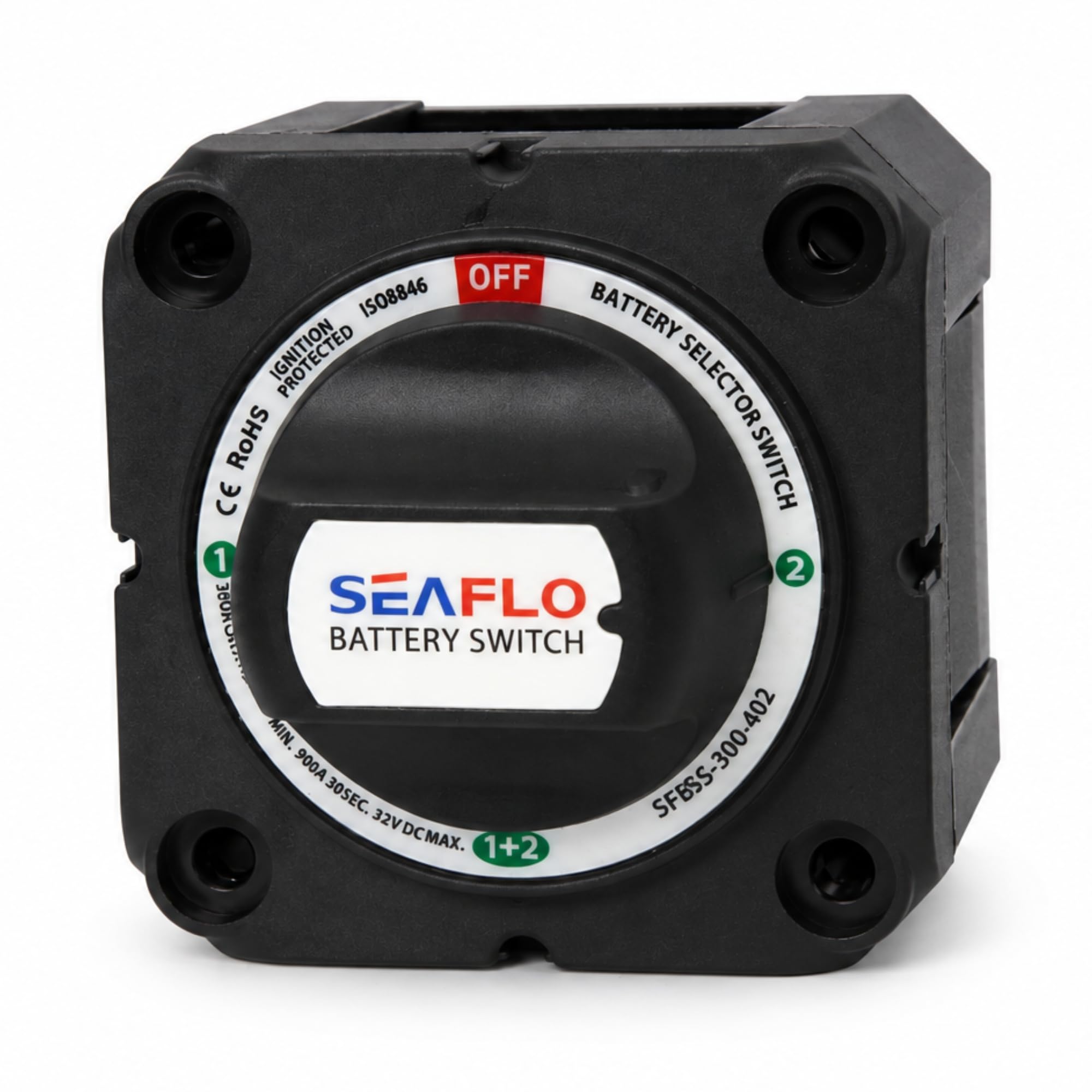
SEAFLO lists the SFCBS-300-402 against ABYC, UL 1500, and SAE J1171 ignition protection, which is unusual detail at this end of the selector market. It is a four-position switch—off, 1, 2, and 1+2—with a 300A continuous rating, a 500A five-minute intermittent rating, and a 900A 30-second cranking rating. The studs are tinned copper, and the one-piece terminal design is meant to resist vibration.

We like it for a two-bank boat where the switch will live in a protected battery compartment and the budget does not stretch to the Blue Sea. The 300A continuous figure is enough for a typical outboard and house load, and the 900A burst gives you a margin for starting. The detents are positive, and the four positions are labeled clearly enough to use by feel. It is not as refined as the top pick, but it covers the safety basics.

The housing feels a little less substantial than the Blue Sea, but the electrical specs are the reason it earns a spot. If you need a selector for a 48V system, the voltage rating is there. Size the cables and the continuous load, not the cranking burst. The one-piece studs are the detail that matters on a small boat: they give you a solid landing for a lug without a separate washer stack to lose over the side.

Pros

  • ABYC, UL 1500, and SAE J1171 protection
  • 300A continuous and 900A cranking burst
  • Four-position selector with tinned copper studs

Cons

No notable drawbacks to flag.

Our verdict

We send budget-minded two-bank boats here: ABYC, UL 1500, and SAE J1171 ignition protection, 300A continuous, and four clear positions.

Check Latest Price
5

Wet Mounting Spots

RVMARINEPAT 4-Position

83 /100
Angler Score Excellent

Key details

Switch Type
4-position selector (1, both, 2, off)
Ingress Rating
IP68
System Voltage
12–48V DC
Continuous Rating
300A
Check Details on Amazon

IP68 is the headline: this is the only four-position selector in the group that claims a fully sealed housing. That matters on a center console or a boat with a hatch that collects spray, where a switch with an open back can corrode or short. The rest of the package is familiar: a 1-both-2-off layout, a 300A continuous rating, 12–48V DC compatibility, and tinned copper studs. It mounts on the surface, front panel, or rear panel.

The make-before-break contact design is the other feature we pay attention to. It lets you move between battery 1 and battery 2 without dropping power to electronics, which is useful when a chartplotter or radio is running. The 3/8-inch terminals are a common size, and the switch has a positive, rotary feel.

We choose it for an exposed cockpit locker or a saltwater boat where the switch gets sprayed. It is not our first pick for a protected panel; the Blue Sea's certification and warranty package is stronger. Where water is the main risk, the IP68 rating is worth the trade. That sealing is the detail that decides it.

Pros

  • IP68 sealed housing
  • 300A continuous rating
  • Four-position make-before-break selector

Cons

  • ABS housing feels less substantial than the top pick
Our verdict

For a switch that lives where spray reaches it, we point to the IP68 housing and 300A rating of this four-position selector.

Check Latest Price
6

Simple Single-Bank

RVMARINEPAT On/Off

91 /100
Angler Score Outstanding

Key details

Switch Type
On/Off
Ingress Rating
IP54
System Voltage
12–48V DC
Continuous Rating
300A
Check Details on Amazon

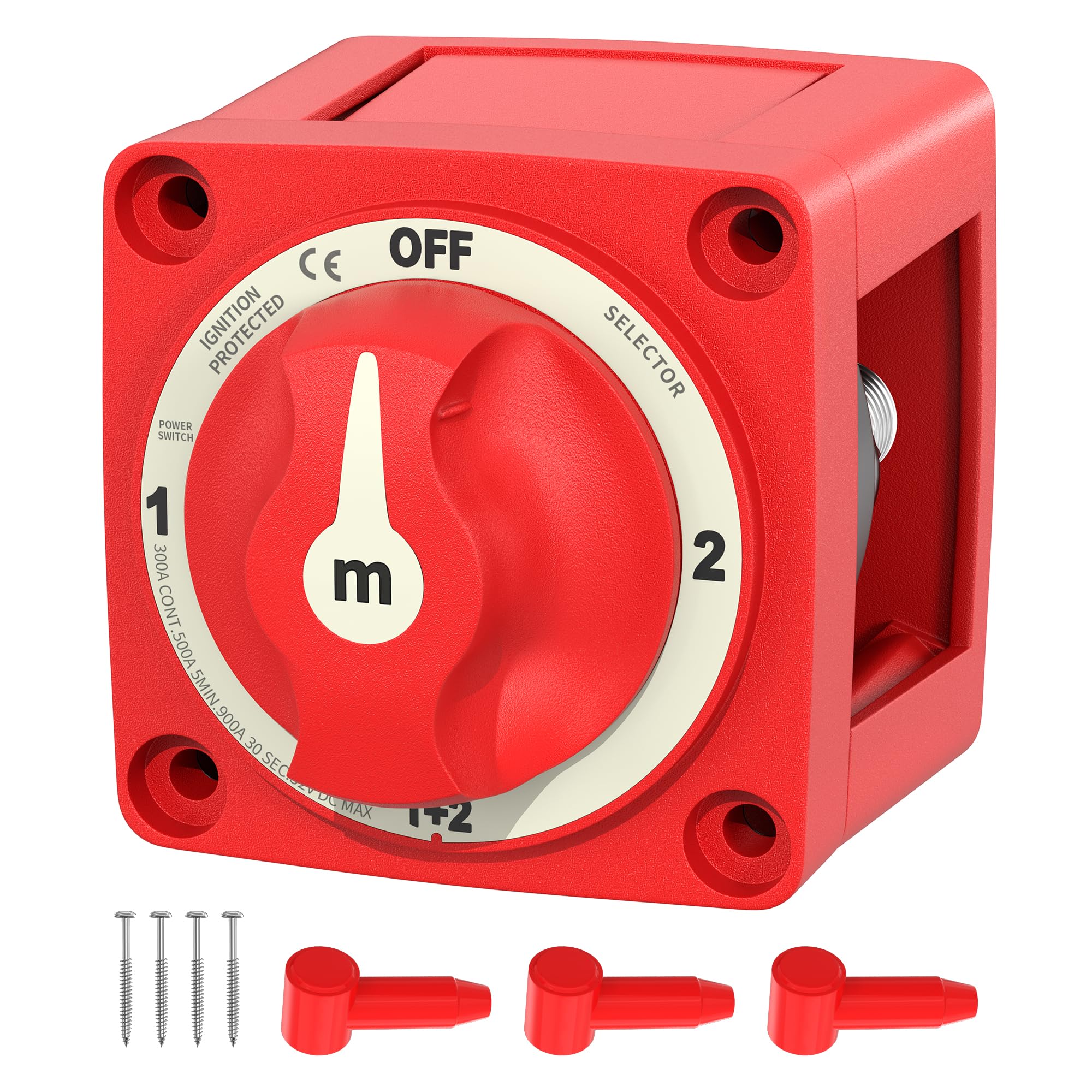
The RVMARINEPAT On/Off comes with mounting screws, which sounds like a small thing until you are standing in a battery compartment with a switch in one hand and no fastener that fits. That detail makes it easier to finish the job in one pass. The switch itself is a two-position On/Off with a 300A continuous rating, 12–48V DC compatibility, and tinned copper studs. It is built for a single circuit, not for choosing between two banks.

Ignition protection is the other reason it earns a place. If the switch lives in the engine room of a gasoline boat, that rating matters more than a slightly higher current number. The rotary knob has a clear stop at on and off, and the housing is compact enough to fit beside a battery box. The terminal studs are tinned copper, which is the right choice for a boat that lives near salt water.

This is the one we point to for a single-bank boat that wants a clean install without a trip to the hardware bin. If the mounting spot stays dry and the load stays under 300A continuous, it is a straightforward, well-equipped disconnect. The included screws are the detail that makes it easy to live with.

Pros

  • 300A continuous rating
  • Ignition protected for gasoline engine rooms
  • Mounting screws included

Cons

  • IP54 is splash-resistant, not sealed for wet wells
Our verdict

We like this for a single-bank install that needs mounting screws in the box and ignition protection, with IP54 as the wet-location boundary.

Check Latest Price

How We Tested: Six Months of Salt, Load, and Wet Gloves

We started with every switch we could find rated for at least 250 amps continuous, then filtered by footprint, terminal stud size, and whether the maker published a real wiring diagram instead of a cartoon. That left 14 units, spanning simple on/off disconnects and four-position selectors, and we bought each one at retail so nothing arrived pre-favored.

Each switch went onto a bench board before it went near a boat: two batteries feeding a 2,000-watt inverter and a winch, so we could throw the selector under genuine load rather than clicking an unpowered knob. We turned each one with wet, greasy gloves on to see whether the detents were crisp enough to find position 2 without looking, and we felt the studs and housing for heat after a hard pull. Then we re-torqued the terminal nuts to see whether anything had crept.

Installation came next, on a 21-foot center console kept on a saltwater mooring and a trailerable skiff that gets dunked at the ramp most weekends. Calipers came out for cutout diameter and mounting hole spacing, since being an eighth of an inch off means drilling fresh holes in a console. We noted whether stainless fasteners were in the box and whether the studs were long enough for a 2-gauge lug, a lock washer, and a nut that fully engages.

Over six months we rinsed the panels weekly and opened them up twice to look for green crust on the contacts and pitting on the selector. A multimeter on the bilge circuit told us whether off really killed the draw, and a pull-to-start load told us whether a switch could carry what it claimed. What separated the good ones was rarely the headline rating: it was tinned contacts, a gasket that actually sealed, and hardware we didn't have to replace. The expensive switches that skipped those didn't stay on our boats.

How to Choose a Marine Battery Switch

Start with the switch type

An On/Off switch does one job: it isolates a single battery bank. That is all a small boat with one starting battery needs, and a compact model like the Nilight 90015A is easier to fit than a full selector. A four-position selector adds 1, 2, 1+2, and off, so you can run the house load on one bank and keep the other in reserve. The combine position is the emergency start. We prefer a selector with make-before-break contacts for a two-bank boat, because moving between 1 and 2 does not drop power to electronics.

Match the continuous rating to the load

Continuous rating is the number to size for, not the big cranking burst. A windlass, inverter, or bow thruster can pull more than a basic outboard, and the switch has to carry that load for minutes, not seconds. The Blue Sea e-Series On/Off is the highest continuous rating in this group at 350A, which is why it suits a heavy single-bank circuit. Check the voltage too: a switch rated for 48V is the right choice for a 48V bank, and a 12V rating is not a guarantee at 48V.

Look at sealing and ignition protection together

Ingress protection and ignition protection solve different problems. An IP66 or IP68 housing keeps spray and dust out; ignition protection matters if the switch lives in the engine room of a gasoline boat, where a spark could ignite fuel vapor. The SEAFLO selector is the budget pick that states ABYC, UL 1500, and SAE J1171 ignition protection. The RVMARINEPAT four-position goes further on sealing with an IP68 claim. We do not treat those ratings as interchangeable: a sealed switch in a gasoline engine room still needs the ignition-protected label.

Measure the footprint and plan the hardware

Switches that look similar in photos can differ by an inch in body depth and terminal spacing, and that matters when the cables have to bend inside a shallow panel. The Blue Sea e-Series models are compact but still need clearance behind the panel; the RVMARINEPAT On/Off includes mounting screws, which saves a hardware run. Check the body depth and terminal access before you drill. We treat mounting hardware as part of the purchase, not an afterthought: a switch that arrives without screws is not a bargain if you have to make a second trip.

Frequently Asked Questions

Final Verdict

Buy the Blue Sea e-Series Selector if you have two battery banks and want one switch that can start, charge, and combine them without guesswork. Its 325A continuous rating, ignition protection, and sealed housing make it the safest default in this group. If you run a single bank and want to spend less, the Nilight 90015A is the simple disconnect we recommend; for a 48V single-bank system with a heavy inverter or windlass, choose the Blue Sea e-Series On/Off and its 350A continuous rating.