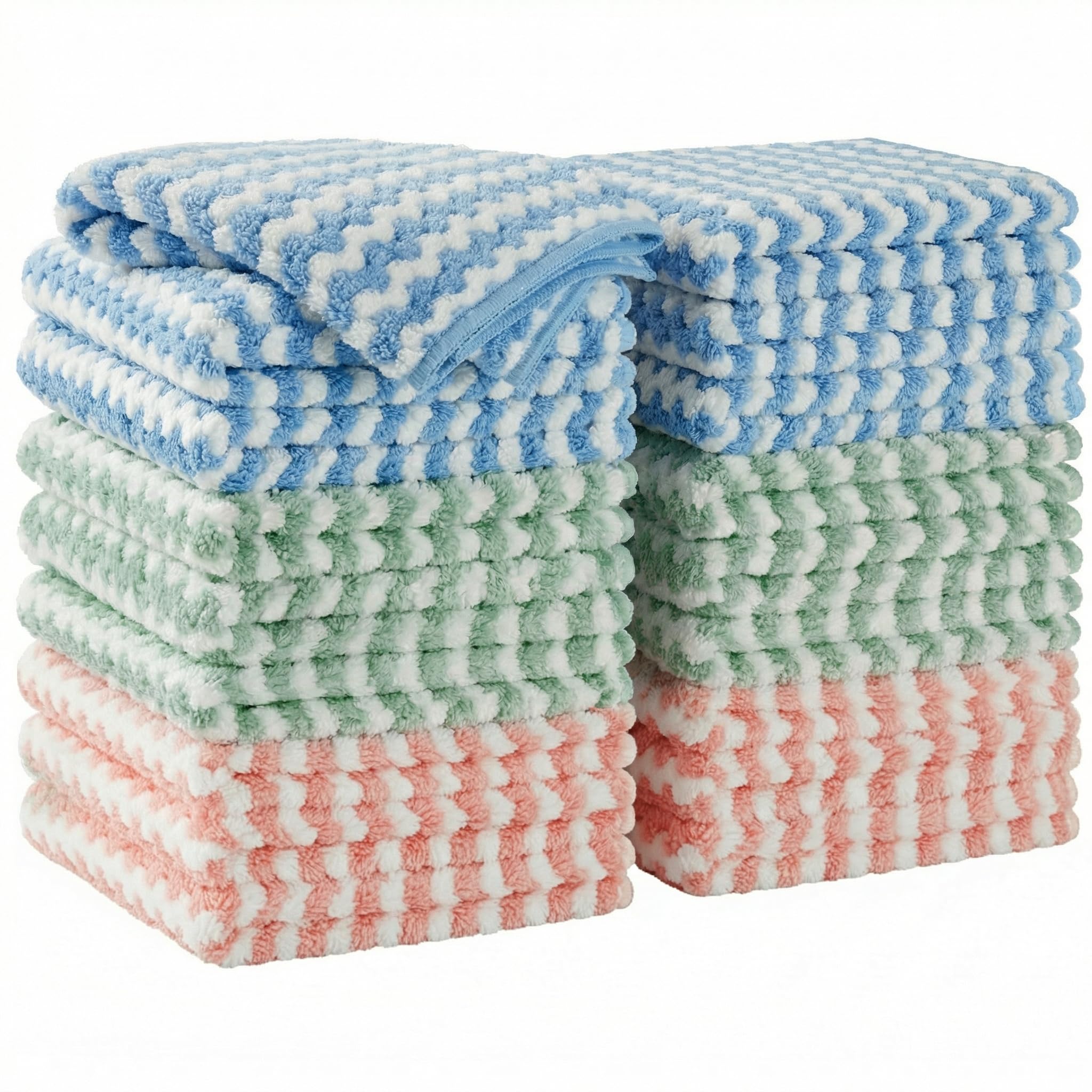
Best Microfiber Towels of 2026

Microfiber works because each strand is split into wedge-shaped filaments that grab dust, grease, and water instead of pushing them around, which is why a good cloth can clean a mirror with water alone. The trouble is that the label covers everything from a thin, scratchy square that skates across glass to a plush towel that drinks up a spilled mug, often at the same price. What separates them is whether the cloth lifts grime, rinses clean, survives the laundry, and dries a window without leaving lint behind.

I keep one in the kitchen drawer, one in the car, and one under the bathroom sink, and I've learned the hard way that the wrong cloth just moves the mess around. Over the past five months my team and I put 14 packs through greasy stovetops, fogged mirrors, dusty dashboards, and repeated hot washes. Something worth knowing before you buy: thickness and weave matter more than pack size — a plush, high-GSM cloth soaks up spills beautifully but smears glass, while a thinner waffle weave is what gets windows streak-free. The picks below are the ones that held up.

1

Best Overall

MR.SIGA Microfiber Cleaning Cloths 12-Pack

95 /100
Angler Score Outstanding

Key details

Material
85% polyester, 15% nylon
Cloth Size
12.6 x 12.6 in
Pack Count
12
Edge Finish
Reinforced stitched edges
Check Details on Amazon

Size is the first thing that separates a cloth you reach for from one you avoid, and 12.6 inches square is the middle ground this whole guide keeps coming back to. It's wide enough to wipe a counter in a single pass and small enough to wring out one-handed over the sink. Twelve of them arrive in the pack, so there's a dry one in the drawer while the rest wait for laundry day.

What put this set at the top for us was how little effort the wiping took. Water on a countertop disappears in one swipe, the cloth comes up without the heavy, sodden feel of cotton, and a dry one buffs a mirror clear with no lint and no streaks. The 85/15 polyester-nylon blend and the reinforced stitched edges have held up through repeated washing here: no curled borders, no fraying at the corners.

The colors do more work than you'd expect. We keep blue for glass and yellow for the bathroom, so the cloth that scrubbed a toilet never lands on a countertop where food goes. Once that system is in place, going back to a roll of paper towels for everyday spills feels like a step backward.

One boundary worth naming: a 12.6-inch square is not the cloth for drying a whole car. You'll go through three of them and wish for one big one, which is a job for the 16-inch picks below. For everything inside the house, this is where we start.

Pros

  • Absorbs a spill in one pass, no lint
  • 12.6-inch square wipes and wrings one-handed
  • Reinforced edges survive repeat washing
  • Colors make room-by-room coding easy

Cons

  • Not plush enough for buffing wax
Our verdict

We recommend this 12-pack first because the 12.6-inch square handles kitchen, bath, and glass work equally well, and the cloths come out of the wash ready for more.

Check Latest Price
2

Best Bulk Buy

Amazon Basics Microfiber Cloths 36-Pack

95 /100
Angler Score Outstanding

Key details

Colors
Blue, white, yellow
Cloth Size
16 x 12 in
Pack Count
36
Stated Absorbency
8x its weight
Check Details on Amazon

The arithmetic is the pitch: 36 cloths at a per-cloth cost near the bottom of this group, which changes how you use them. We kept a stack in the garage for road grime, bike chains, and boat hardware and stopped treating a rag as something to conserve. If one comes back truly filthy, retiring it costs you almost nothing.

They measure 16 by 12 inches, so there's more cloth under your hand than the 12-inch squares that dominate this list — quicker across a workbench, a hull, or a car hood. Ours have soaked up spills, wiped screens without scratching anything, and gone back into the wash without complaint.

The whites in the pack are noticeably thinner than the blues and yellows, which is worth knowing before you assign colors to jobs. We gave the whites to dusting and kept the colored ones for anything wet. It's the pack we hand someone setting up a first garage shelf.

Pros

  • 36 cloths at a low per-cloth cost
  • 16 by 12 inches covers ground fast
  • Soft enough for screens and trim

Cons

  • Too thin for paint and heavy detailing
Our verdict

We keep a stack of these for messy jobs we don't want to think about: 36 cloths, thin but effective, and the easiest way to stop rationing rags.

Check Latest Price
3

Best for Car Paint

Chemical Guys Workhorse 3-Pack

95 /100
Angler Score Outstanding

Key details

Pile
Plush high-pile
Color
Black
Cloth Size
16 x 16 in
Pack Count
3
Check Details on Amazon

Most inexpensive microfiber has a flat, slightly grabby face that drags across paint and pushes dust around rather than lifting it. These don't. The pile is deep enough that the cloth glides, and you notice the difference on the first panel you wipe.

Sixteen inches square, soft, and thirsty: ours took up quick detailer and water without leaving a haze and came out of the wash as soft as they went in. Slightly damp is how we like them best — the pile picks residue up rather than smearing it, which is the whole trick with polish and wax.

Where these earn their keep is the surfaces you'd otherwise hesitate over: clear coat, piano-black interior trim, paint protection film, tinted glass. A cheap cloth leaves a haze on that stuff. Three to a pack is the catch, and it's real, because we're reaching for a fourth before laundry day.

Pros

  • Plush pile lifts wax instead of smearing
  • Leaves no swirl marks on paint
  • Washes clean and stays soft

Cons

  • Black hides how loaded the cloth is
  • Only three per pack
Our verdict

Buy these if the surfaces you care about are painted: the plush 16-inch square is the one we trust for wax, quick detailer, and interior trim.

Check Latest Price
4

Best for Glass

Puomue Glass Cleaning Cloths 6-Pack

93 /100
Angler Score Outstanding

Key details

Color
Blue
Cloth Size
16 x 16 in
Pack Count
6
Fabric Weight
320 GSM
Check Details on Amazon

Density is the number to look at with a glass cloth, and this set lists 320 GSM, the heaviest in this group by a clear margin. You feel it the moment you unfold one: a flat-faced square that doesn't bunch or skid when you push it across a window.

In use, one damp pass and one dry buff is the whole method. Windows, mirrors, shower doors, and laptop screens come up clear with no lint and no streaks, and the heavier weave gives the dry cloth something to finish with instead of just moving water around. They've been through the wash repeatedly and come back flat rather than puckered.

For glass, this is the set we reach for first. Sixteen inches is the right size for a mirror — fold it into quarters and you get four clean faces before you need to rinse — and it's the cloth we hand someone who is tired of chasing streaks on a shower door.

Pros

  • 320 GSM density buffs glass streak-free
  • 16-inch square folds for large mirrors
  • Lint-free on windows and screens

Cons

  • Only six cloths per pack
  • All six are the same blue
Our verdict

For windows and mirrors we haven't found a better one on this list: the dense 320-GSM weave buffs glass clear without lint or streaks.

Check Latest Price
5

Best Paper-Towel Replacement

Fantasticlean Microfiber Roll

96 /100
Angler Score Outstanding

Key details

Roll Count
75 sheets
Sheet Size
12 x 12 in
Stated Reuse
Up to 50 washes
Fabric Weight
175 GSM
Check Details on Amazon

A roll of 75 cloths you tear off like paper towels solves a problem most microfiber packs create: rationing. Nobody wants to grab the good towel for a small spill, so the good towel stays folded in a drawer and the spill gets a paper towel instead. We tore through these without thinking about it, and that's the point.

Each sheet is 12 inches square. They take up a spill, wipe a stovetop, rinse clean under the tap, and go into the basket for the next load. On a boat or in a truck, a roll stashed within reach means you stop hunting for a rag in the bottom of a bag.

The white is honest about the work: every stain shows, which is either a warning or a useful reminder to wash them. Washed cloths don't go back on the roll, so they migrate to a basket while the roll gradually empties. That's a small annoyance in exchange for a system you'll actually use.

Pros

  • Tear-away roll keeps cloths within reach
  • Washable and reusable, unlike paper
  • Absorbs spills without leaving lint

Cons

  • Thin at 175 GSM
Our verdict

If you want to break the paper-towel habit, this roll is the easiest swap we tested: grab a sheet, wash it, grab another.

Check Latest Price
6

Tightest Budget

USANOOKS Microfiber Cloths 12-Pack

93 /100
Angler Score Outstanding

Key details

Cloth Size
12.5 x 12.5 in
Pack Count
12
Fabric Weight
300 GSM
Stated Thickness
2.5 mm
Check Details on Amazon

The lowest cost per cloth of any twelve-pack here, and it isn't close. Twelve grey 12.5-inch cloths will set up a whole rag drawer for very little outlay, which is the reason to start here if budget is the deciding factor.

The weave is the interesting part. It has a raised, grippy texture rather than a smooth face, and that texture grabs dust, hair, and lint off a surface instead of pushing it around. Ours went dry on shelves and wet on a boat interior and handled both without shedding.

Grey is practical because it hides grime, and it's also why you can't tell a clean cloth from a dirty one at a glance. And 12.5 inches is a counter square, not a drying towel — for a wet car or a wet dog, the 16-inch picks here do that job better.

Where this pack earns its place is the rag drawer you don't want to think about: spills, dust, and dirty jobs where a good towel would be wasted. Set against the MR.SIGA set it's a step down in density, but it costs a fraction as much and does the same everyday work.

Pros

  • Lowest cost per cloth of the 12-packs
  • Textured weave grabs dust and hair
  • Grey hides grime between washes

Cons

  • Feels thinner than the 300 GSM label suggests
Our verdict

The cheapest way into a full set: twelve 12.5-inch cloths that grab dust and rinse out, for anyone who wants a rag drawer without spending much.

Check Latest Price
7

Washing Dishes

JOYMOOP Kitchen Cloths 18-Pack

95 /100
Angler Score Outstanding

Key details

Care
Hand wash, no dryer
Material
85% polyester, 15% polyamide
Cloth Size
10 x 10 in
Pack Count
18
Check Details on Amazon

Ten inches square is small for a countertop and exactly right for a sink. If you wash dishes by hand, you know the difference: a big towel bunches up in the bottom of the basin, while a small one fits in your fist and wrings out with a single twist.

The fabric is 85 percent polyester and 15 percent polyamide with a soft, almost brushed face, and it's the softest cloth in this guide. That matters more than it sounds. We used ours on nonstick pans, stemware, and a greasy skillet without a scratch or a snag.

Three colors and 18 cloths turn a sink job into a rotation: pink for dishes, green for counters, blue for the bathroom, with enough spares that you're never reusing a sour cloth because nothing else is clean.

For hand-washed dishes, this is the set we point to first. The size, the softness, and the count all match the job, and the colors do the organizing for you.

Pros

  • 10-inch square works one-handed at the sink
  • Very soft, safe on nonstick and stemware
  • Three colors for separate jobs

Cons

  • Care instructions call for hand washing
Our verdict

We hand these to anyone who washes dishes by hand: the 10-inch square fits one hand, wrings out easily, and stays soft at the sink.

Check Latest Price
8

High-Count Value

AIDEA Microfiber Cloths 50-Pack

91 /100
Angler Score Outstanding

Key details

Material
87% polyester, 13% polyamide
Cloth Size
12 x 12 in
Pack Count
50
Check Details on Amazon

Fifty cloths is a different kind of purchase. You're not buying a towel, you're setting up a system: one color for the bathroom, one for the kitchen, one for the car, one for the workshop, and enough left over that you never run out between loads.

For that job they work. The 12-inch squares take up a spill rather than pushing it around, pick up dust without leaving a trail, and rinse out fast enough to go back to work the same afternoon. Fifty means you can keep a stack in every closet and stop carrying one rag around the house.

These are working cloths: sinks, toilets, floors, the inside of a cooler, the deck of a boat. Use them hard, retire them without ceremony, and keep the nicer towels for glass and paint. Judged as a volume purchase rather than a set for the next decade, they earn their cupboard space.

Pros

  • 50 cloths allow a color per room
  • Absorbent for their weight
  • Cheap enough to retire after a dirty job

Cons

  • Paper-thin right out of the pack
Our verdict

Fifty cloths make sense if you clean a whole house and want a color per room; just expect to retire them sooner than the thicker picks.

Check Latest Price

How We Tested 14 Packs of Microfiber Cloths

We started by sorting the category into the three formats people actually buy: bulk all-purpose packs for kitchens and bathrooms, thicker plush cloths for car interiors and paint, and thin lint-free squares meant only for glass and stainless. From there we compared listed fiber content, actual dimensions, weight per cloth, edge construction, and price per cloth, and we dropped anything with glued edges or a polyester-heavy blend that read more like a shop rag than a microfiber towel. That left 14 packs, roughly 200 cloths in total, which we lived with for five months.

In the kitchen we poured a measured half cup of water onto a laminate counter and watched whether the cloth wicked it up or shoved it into a puddle, then wiped up coffee grounds, a greasy pan, and a dried-on spill on a wood table. In the bathroom we tackled toothpaste flecks on a mirror and held each finished pane at an angle to window light to check for haze and lint. Weekends went to the car — dash dust, a spilled soda, fingerprints on glass. Every cloth went through 20 hot washes with regular detergent and no fabric softener, and we noted frayed seams, curled edges, and how much lint collected in the dryer trap.

Size and thickness got their own pass, because they change how a cloth behaves in your hand: we measured each one against a dinner plate and against an open palm, then compared how it felt dry versus soaked, since a cloth that balls up when wet is useless for scrubbing. Car cloths shed fibers under a fingernail drag; glass cloths were judged on whether they left a wet smear behind. We also did the arithmetic on value, dividing pack price by usable cloths, which is how several oversized packs landed mid-list rather than at the top.

How to Choose Microfiber Towels

Match the size to the job

Ten inches is a dishcloth. It fits a fist, wrings out easily, and disappears under a countertop spill. Twelve to thirteen inches is the generalist that handles counters, appliances, and bathroom surfaces. Sixteen inches is for glass, drying, and any job where you want to cover ground without stopping to re-wet.

We keep a split: 12-inch cloths by the dozen for the kitchen, and a smaller stack of 16-inch ones for windows and the car. That covers more ground than any single size. When a listing calls a 10-inch cloth compact, believe it — it's compact the way a washcloth is, and you'll want something bigger for a kitchen table.

Read the fabric weight, not the adjective

Fabric weight, quoted in GSM, is the closest thing to an objective measure of substance. Cloths around 175 to 200 GSM are light and quick-drying: fine for dust and light wiping, less useful when a quart of milk goes over. Cloths at 300 GSM and up feel denser, hold more liquid, and generally survive more trips through the wash.

The trap is assuming denser is always better. Density buys absorbency and longevity; it costs drying time and a little flexibility in the hand. Match the weave to the surface as well — a flat, tight face is what you want on glass, while a plush pile is what lifts wax and polish off paint instead of smearing it.

Check the edges, then wash before first use

The edge is where cheap cloths fail first, and it's also a scratch risk. An overlocked or bound edge stays put; a cut edge can fray into hard threads that drag across paint or coated glass. Look at the border before you buy a cloth for a windshield or a car hood.

New cloths also carry grit from manufacturing and shipping, and a trapped particle is what actually scratches a finish. Run a new set through the wash before it touches anything you care about, and retire any cloth that has cleaned up sand or metal dust to the garage pile.

Plan the rotation, then pick a count

The count matters less than whether you can always reach a clean cloth. A busy kitchen goes through two or three a day, so a dozen covers roughly a week between loads. Add a car, a boat, or a workshop and 36 to 50 makes more sense, with a color system so the bathroom cloth never ends up on a dinner plate.

Two modest sets in rotation beat one big one. Cloths last longer when they aren't washed in a panic, and you're never one load behind on the day something spills.

Frequently Asked Questions

Final Verdict

Buy the MR.SIGA 12-pack. The 12.6-inch square handles counters, bathrooms, and glass without feeling clumsy in your hand, and a dozen cloths mean you're never rationing the clean ones. It won't dry a whole car, which is a different job with a different towel.

If glass is what you actually care about, the Puomue set's 320-GSM weave is the one we keep for windows and mirrors. And if you want a bucket of rags for the garage, boat, or workshop, the Amazon Basics 36-pack is the least fussy way to get there.