Best Nail Weights for Neko and Wacky Rigs of 2026

A nail weight is a small cylinder of tungsten or lead that you push into the nose of a soft plastic, so the bait falls nose-down and shimmies instead of gliding off flat. It sounds like a dollar detail until you fish it: the wrong size and your worm spirals, the wrong fit and the weight pulls free on the first cast. What you're actually buying is a fall rate you can repeat, cast after cast.

Here's what the packages don't tell you: tungsten is denser than lead, so the same weight takes up less room in a slim finesse worm — which is why the good ones feel almost too small in your hand. I've fished Neko rigs for years, and my team and I have spent the past five months rigging 16 packs of these around docks, laydowns, and rock banks. Price per ounce swings wildly for what is essentially the same piece of metal, so the picks below are the ones that earned their spot in the box.

1

Best Overall

Reaction Tackle Tungsten Nail Weights

92 /100
Angler Score Outstanding

Key details

Sizes
1/32, 1/16, 3/32, 1/8 oz
Material
97% tungsten
Pack Count
25 per size
Check Details on Amazon

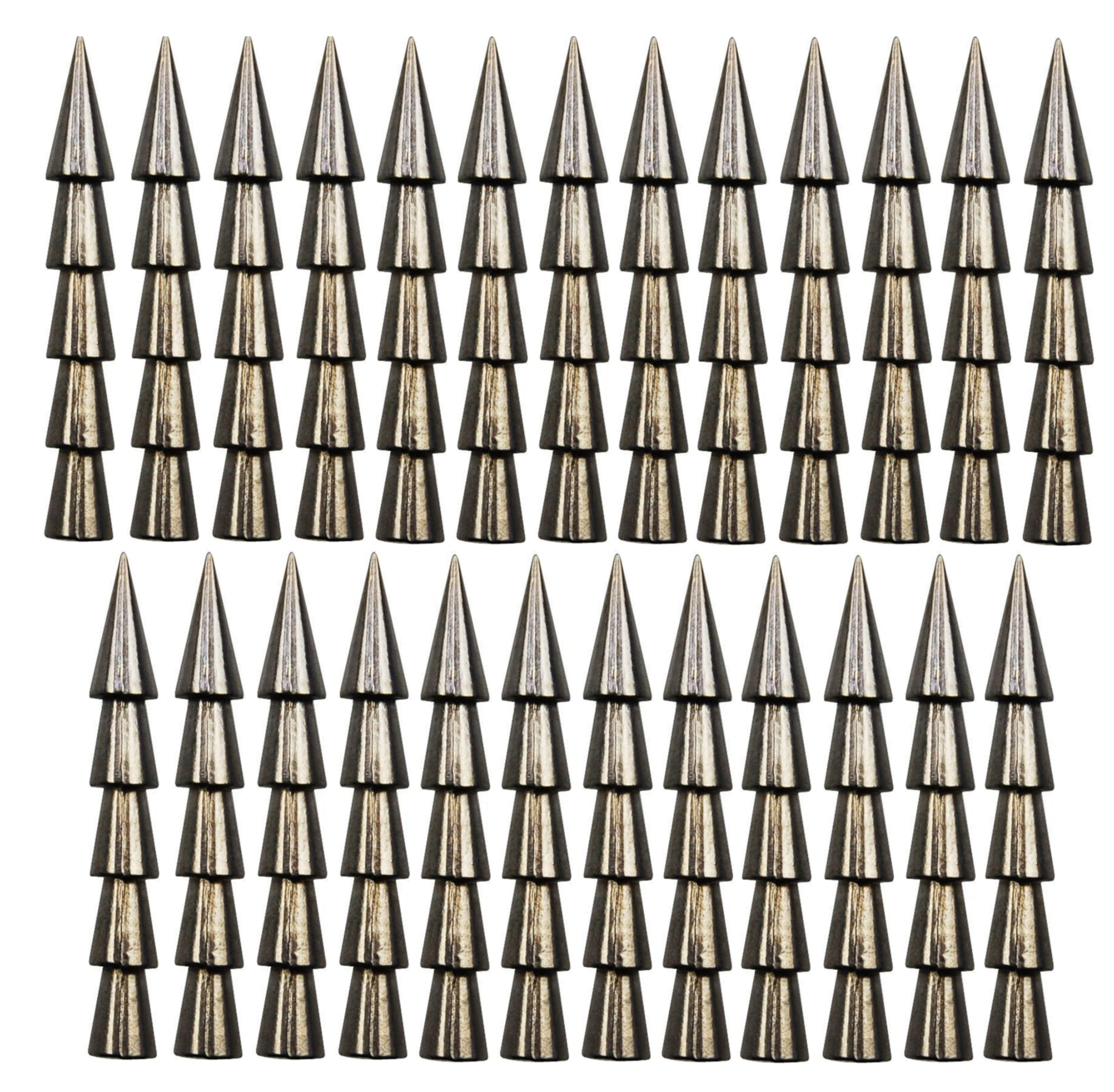
Ninety-seven percent tungsten is the number that decides this one. Tungsten is roughly twice as dense as lead, so the same 1/16 ounce arrives in about half the length, and length is what a nail weight is always fighting. A short pin disappears into the nose of a finesse worm without bulging the plastic, so the bait still looks like a bait falling through the water.

That's why these are the pins we reach for on small-diameter worms and 4-inch stickbaits, where a fatter lead pin distorts the plastic right at the insertion point. The taper starts with a thumb and holds through casts and hooksets; we've backed pins out to re-rig and found the worm around the hole intact more often than not. Four sizes, from 1/32 to 1/8 ounce, cover a slow wandering drop in clear water up to a nose-down search along the bottom in current.

A 25-pack of one size is the buy if your water has already told you what it wants. Most people are better off with the 40-piece kit, ten of each size, because fall rate is something you change on the water rather than before you leave the dock. There's also a 100-piece kit with a case, which is a serious amount of tungsten to own at once.

One adjustment we make: don't stack two pins in a nose to reach a heavier weight. Two entry holes in a slim worm is a dependable way to split it, and it deadens the action you were tuning in the first place. Size up instead, and if 1/8 ounce won't nose the bait down, the bait is too bulky for a pin and wants a different rig.

Pros

  • About half the pin length of lead
  • Tapered point inserts with a thumb and holds
  • Four sizes from 1/32 to 1/8 oz
  • Kits from 25 to 100 pieces

Cons

  • Costs more per pin than lead
Our verdict

We reach for these first: 97% tungsten keeps the pin short so a finesse worm falls naturally, and four sizes cover a slow clear-water drop through a bottom search in current.

Check Latest Price
2

Best Bulk Lead Kit

DAMIDEL 100-Piece Nail Weight Kit

89 /100
Angler Score Excellent

Key details

Sizes
1/6, 1/8, 1/14, 1/20, 1/25, 1/50 oz
Pieces
100 per box
Material
Lead
Check Details on Amazon

Six sizes, a hundred pins, and a box divided into its own little compartments — this is the kit we hand someone who is still working out what a nail weight does to a bait. Pulling a 1/20 ounce, then swapping to 1/8 when the wind picks up, without digging through loose lead in a bag, is worth as much as the pins.

The ladder runs 1/50, 1/25, 1/20, 1/14, 1/8 and 1/6 ounce, which reaches lower than most kits and higher than most insert weights should go. The heavy end is where lead shows its limits: it takes roughly twice the volume of tungsten to make the same weight, so a 1/6-ounce lead pin is a long spike that can distort a slim worm and change how the bait sits. Down at 1/25 and 1/50 it's a non-issue, and those are the pins for a 4-inch worm in cold water.

The die-cast surface is smooth and the oval profile pushes into soft plastic without pliers and comes back out for another bait. A hundred pins also changes how you fish around snags, because dropping one in the rocks isn't a loss, so you can fish the cover instead of steering around it.

Pros

  • Six sizes from 1/50 to 1/6 oz
  • Divided box keeps each size apart
  • Smooth die-cast pins go in without pliers
  • A hundred pins, so snags cost little

Cons

  • Heavy lead sizes run long for slim worms
Our verdict

A no-drama way to learn what weight does to a bait: six lead sizes in a divided box, so experimenting doesn't feel like burning tungsten.

Check Latest Price
3

Best Lead-Free Sampler

Harmony Fishing Tungsten Nail Weights

89 /100
Angler Score Excellent

Key details

Size
1/32 oz
Pieces
10 per pack
Material
100% tungsten
Warranty
1 year
Check Details on Amazon

The question worth answering before you commit to tungsten is whether it changes anything, and ten pins of 1/32 ounce is a small way to find out. Half the length of the lead pin in your box, in a size that fits a 4-inch finesse worm, is a difference you notice on the first cast.

It's 100% tungsten rather than a blend, so the density is the whole pin, and the bullet profile starts easily in soft plastic. At 1/32 ounce this is a slow-fall weight — clear water, cold fronts, fish following a bait down instead of eating it on the drop. It's also the pin that comes back out cleanest, because a small diameter leaves a small hole.

We like this as a test rather than a supply. Ten pins won't carry a season of snaggy fishing and there's only the one size, but if the first few convince you, move up to a kit instead of reordering ten-packs. Harmony warrants them for a year against manufacturing defects, which is more backup than most terminal tackle comes with.

Pros

  • 100% tungsten, so half the lead pin length
  • 1/32 oz suits small finesse worms
  • Lead-free option
  • One-year manufacturer warranty

Cons

  • Only ten pins, and only one size
Our verdict

Ten pins of pure tungsten in the size finesse fishing actually uses — the low-commitment way to find out whether tungsten earns a place in your box.

Check Latest Price
4

Best for Fine Fall-Rate Tuning

Fishfun Tungsten Nail Weights

86 /100
Angler Score Excellent

Key details

Sizes
1/32, 3/64, 1/16, 3/32, 7/64 oz
Pieces
12 per bag
Material
97% tungsten
Check Details on Amazon

Three sixty-fourths and seven sixty-fourths of an ounce are the sizes most kits skip, and they're the reason to look at these. Between 1/16 and 3/32 there's a gap you can feel in the water — one size ticks bottom a beat too late, the next drags — and a pin that splits the difference lets you tune a fall rate by a hair instead of a step.

Ninety-seven percent tungsten with a sharp point and ribs behind the shoulder. The point is what matters when your hands are cold and the deck is wet: it starts in a finesse worm with a push, no pilot hole and no pliers. The ribs are what keep it from backing out over a morning of casts.

The range runs 1/32, 3/64, 1/16, 3/32 and 7/64 ounce in 12- or 20-piece bags rather than big kits. That's the trade — you get the in-between sizes, but you're buying them a few at a time, and a bag of twelve goes faster than you expect once the 3/64 becomes your default.

Where these earn their place for us is a finesse box that's already organized: you know your 1/16 and you want something just under it. Starting from nothing, buy a kit with a case and add one bag of 3/64 later. If you've been fishing 1/16 and 3/32 and wishing for something between them, start here.

Pros

  • 3/64 and 7/64 oz fill ladder gaps
  • 97% tungsten keeps the profile slim
  • Ribs help the pin stay seated

Cons

  • Sold in small 12- or 20-pin bags
Our verdict

The reason to buy these is the size ladder: 3/64 and 7/64 oz let you tune a fall rate by a hair, and the ribbed tungsten pin holds while you do it.

Check Latest Price
5

Best Single-Size Pack

Dobyns Rods Nail Weight 3/32 oz

86 /100
Angler Score Excellent

Key details

Size
3/32 oz
Shank
Ridged
Pieces
15 per pack
Check Details on Amazon

Ridges down the shank are the whole idea. A smooth nail weight relies on friction and a snug hole; the ridges give the plastic somewhere to bite, so the pin holds through a cast and a hookset without the nose of the bait mushrooming around it.

It's one size, 3/32 ounce, fifteen to a pack, with a sharp point that starts in a stickbait with very little effort. Dobyns shapes it to leave the bait its action rather than turning the nose into dead weight, and 3/32 is about right for a 5-inch senko — enough to nose it down, not so much that it plows.

We keep a pack in the boat as a top-up rather than a supply. Fifteen pins of a single size is a small commitment when 3/32 is already your number and a poor fit if you're still choosing between sizes. It's also a forgiving pin to hand someone rigging their first Neko bait, because the ridges hold while they work out how deep to set it.

Pros

  • Ridges give the plastic something to grip
  • Sharp point starts easily in a stickbait
  • 3/32 oz suits 5-inch stickbaits

Cons

  • One size only, fifteen to a pack
Our verdict

A single size done properly: 3/32 oz with a ridged shank that grips a stickbait, sold in a small pack for topping up rather than starting over.

Check Latest Price
6

Best for Snaggy Water

Reaction Tackle Lead Nail Weights

88 /100
Angler Score Excellent

Key details

Sizes
1/32, 1/16, 3/32, 1/8 oz
Pieces
25 per pack
Material
Lead
Check Details on Amazon

This is the same tapered pin as our top pick in lead instead of tungsten, with the same four sizes and the same 25-piece packs — and the difference between the two is obvious the moment the pin is in your hand.

Lead is roughly half as dense, so the pin has to be longer to weigh the same. At 1/32 ounce that barely shows; at 1/8 ounce you're holding a long spike, and a long spike in the nose of a 4-inch worm is a lot to ask of a slim bait. Our rule is to buy the small sizes in lead and the big ones in tungsten, which gives you a full range without paying tungsten prices for a weight that mostly sits in the box.

The practical split is by water rather than preference. In rock, docks and flooded timber, where pins go missing, lead lets you fish the cover instead of steering around it. In open water and over grass, where you want the pin to disappear into a slim bait, tungsten earns its price. Buying both isn't a compromise; it's how you stop rationing the expensive pins.

What we keep coming back to is the shape. The taper that made the tungsten version our default is here too: it starts in a bait with a thumb and holds through a hookset, and the lead costs you a little length. If you fish finesse plastics in places that eat tackle, that's the whole trade, and it's a good one.

Pros

  • Same tapered shape as our top pick
  • Four sizes from 1/32 to 1/8 oz
  • Costs less per pin than tungsten

Cons

  • Thin pins can bend when they hit rock
Our verdict

The lead version of a shape we already trust: same taper, same four sizes, and a pin we don't mind losing in the rocks.

Check Latest Price
7

Micro Finesse

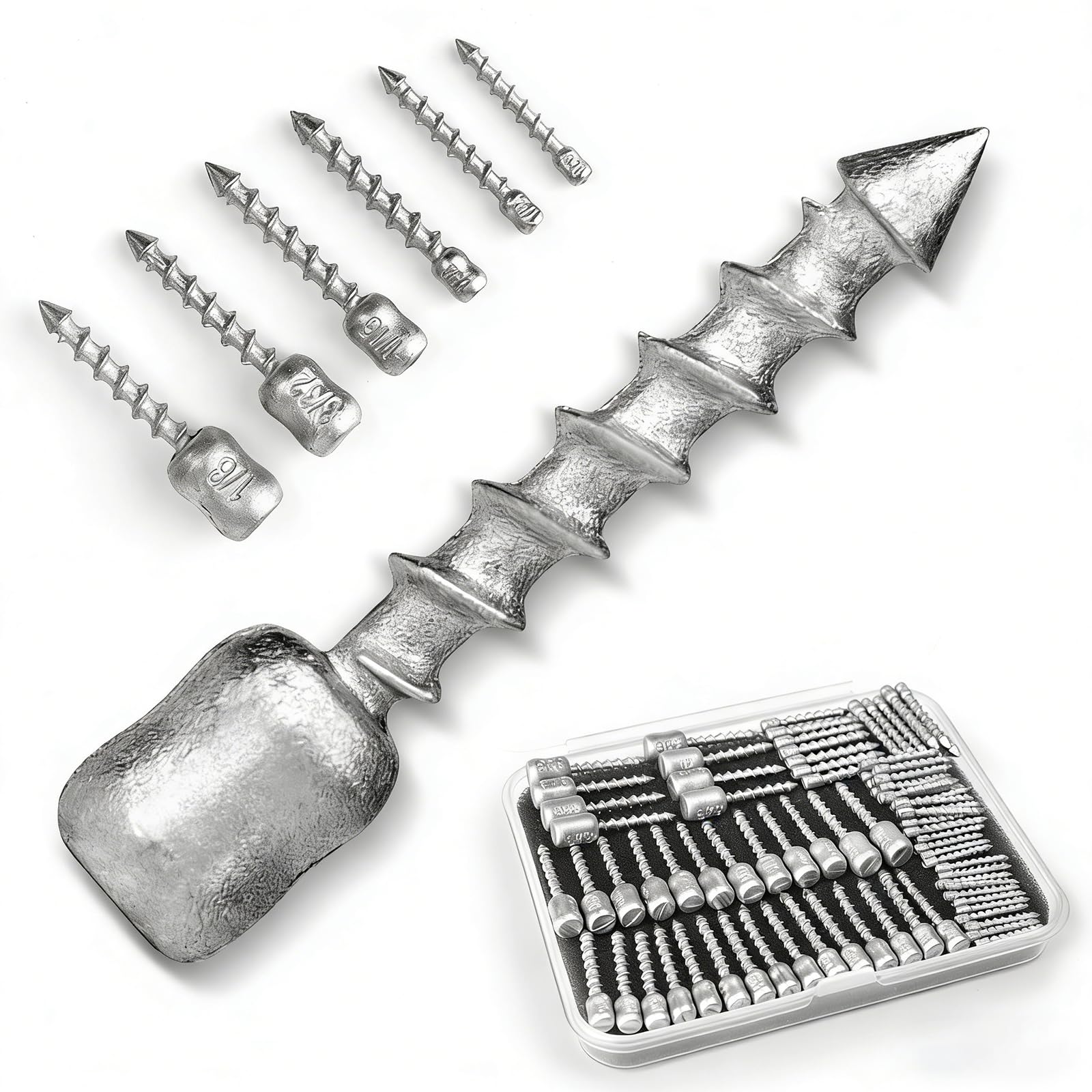
OJYDOIIIY Screw Nail Weight Kit

87 /100
Angler Score Excellent

Key details

Sizes
1/96, 1/48, 1/32, 1/16, 3/32, 1/8 oz
Pieces
80 per kit
Marking
Weight stamped on each pin
Check Details on Amazon

Every pin in this kit is stamped with its weight, and that's the detail that sold us. In a mixed box, the difference between a 1/48 and a 1/32 is smaller than your fingers can reliably tell at dusk; reading it off the pin takes a second and saves you from a bait that falls wrong all evening.

The range goes lower than most: 1/96, 1/48, 1/32, 1/16, 3/32 and 1/8 ounce, in 60- or 80-piece packs, with the 80-piece kit covering all six sizes. The screw-knob profile is shaped to bite into the plastic and stay put, and it sits tighter in a worn bait than a smooth pin does. The small end is genuinely useful on micro finesse — a 1/96 in the tail of a small worm adds a slow, tail-down fall without killing the action.

The trade is that pins this small are easy to drop and hard to find on a boat deck, so the stamped numbers matter most in the sizes you use least. If your fishing is all 5-inch senkos, you'll live in the 1/16 and 3/32 and ignore the rest; the micro sizes are for the days when the bait is small and the fish are fussy.

Pros

  • Weight stamped on every pin
  • Six sizes down to 1/96 oz
  • Screw-knob profile sits tight in a worn bait

Cons

  • Tiny sizes are easy to drop and lose
Our verdict

Six sizes down to 1/96 oz, each stamped with its weight — the kit for micro finesse, and for anyone tired of guessing which pin they're holding.

Check Latest Price
8

Single-Size Refills

VMC Neko Weights 1/16 oz

89 /100
Angler Score Excellent

Key details

Size
1/16 oz
Shape
Rectangular
Pieces
10 per pack
Check Details on Amazon

One size, ten pins, and a rectangular cross-section you don't see often. The flat faces give the plastic more surface to grab than a round taper does, and that's the argument for the shape: the pin doesn't have to rely on friction alone.

At 1/16 ounce it's the weight a 5-inch stickbait wants for a Neko rig, and ten to a pack is a session or two of fishing rather than a season. We treat it as a refill: plain natural finish, no fuss, and the pin does the one job without drama. There's no second size to move to, though, so if you're still deciding between 1/32 and 3/32, this pack makes the decision for you.

The shape is also less forgiving than a round taper. Push it in at an angle and it can pucker the nose of a bait; straight down the centerline and it seats clean, with the flat sides holding their line in the plastic instead of rolling.

Pros

  • Flat faces grip more plastic than a round taper
  • 1/16 oz suits 5-inch stickbaits

Cons

  • One size only, ten per pack
Our verdict

Flat-sided 1/16 oz pins in a ten-pack — the refill for an angler who has already settled on a weight and wants it to stay put.

Check Latest Price

How We Tested the Nail Weights

We started with roughly 40 packs — everything from tournament-circuit staples to the mixed boxes that turn up in tackle shop bargain bins — then cut that to 16 finalists based on whether the manufacturer published real weights, whether they came as single sizes or assortments, and what they cost per piece rather than per pack. Tungsten and lead both made the cut, as did painted and bare finishes.

Testing ran from early spring into August on a handful of mid-size reservoirs and one river backwater, plus a windy afternoon on a community lake where the bite was terrible and the data was good. Every weight went onto a digital kitchen scale against the number stamped on the package — most were close, a couple were not — and then into a half-dozen soft plastics, from thin finesse worms to thick creatures, to see which seated snugly and which split the plastic or slid out mid-cast.

On the water we watched how each bait fell and whether it glided or spiraled, and we counted the casts and fish each insert survived before the worm's nose tore out. We also skipped weights across riprap and dragged them over gravel to check for chipped paint and mushroomed edges, and we tallied what a box actually delivered: usable size variety versus filler, and cost per weight instead of cost per label.

How to Choose Nail Weights

Tungsten or Lead: What Density Changes

Tungsten is roughly twice as dense as lead, so a tungsten pin of a given weight is about half the length. On a slim bait that's the whole difference: a long lead pin bulges the nose of a 4-inch finesse worm and changes its profile, while a short tungsten pin hides inside it. On a full-size stickbait or a creature bait, the extra length of lead matters much less.

The catch is cost, and it's a real one. Tungsten pins run several times more per pin, and a pin lost in a snag costs accordingly. Our answer is to split the box: tungsten for the small sizes and the slim baits, lead for the heavier pins and for water that eats tackle.

Match the Pin to the Bait's Diameter

Judge a pin against the bait rather than against the depth. A pin that's too fat splits the nose on insertion and leaves a hole that lets water in; one that's too thin backs out on the first cast. Slim finesse worms are the hardest baits to weight well, which is exactly where a denser pin earns its keep.

A rough test at the counter: if the pin's diameter looks like more than a third of the bait's body width, it's too much. When you're between two sizes, go slimmer and fish it, because a bait that falls naturally outfishes an over-weighted one every time.

The Size Ladder Matters More Than the Count

A hundred pins sounds generous until you look at the steps. Four sizes with a gap between 1/16 and 3/32 leave you choosing between a fall that's too slow and one that's too fast, which is why in-between sizes like 3/64 and 7/64 exist. Before you buy bulk, read the ladder and ask whether the two sizes you'd actually fish are in it.

A mixed kit is the right first purchase and a single-size refill is the right second one. Buying twenty-five of a size you've never fished is how a drawer fills up with pins that never get wet.

Grip, Taper, and Getting the Pin Back Out

The taper gets a pin in; ridges, ribs or a screw-knob profile keep it there. A smooth round pin depends on a snug hole, and in a bait that's been wet for an hour that isn't much to depend on. Ridges give the plastic something to bite, and they're the difference between a pin that survives a hookset and one that backs out mid-cast.

Retrieval matters too. A pin you can pull out and move to a fresh bait saves plastic, and a slim pin leaves a smaller hole than a fat one. If you plan to re-rig the same worm several times, favor the smaller diameter and accept a slower fall.

Frequently Asked Questions

Final Verdict

If you're buying one thing, make it tungsten in the small sizes. Our top pick covers 1/32 through 1/8 ounce in a pin short enough to disappear into a finesse worm, and the 40-piece kit lets you change fall rate on the water instead of guessing before you leave the dock.

If your water eats tackle, the lead version of the same taper keeps the cost of a snag low. And if you're still working out what weight does to a bait, the six-size DAMIDEL box is the least expensive way here to try six sizes at once — fish a season with it and you'll know which pins to restock in tungsten.