
Best Offshore Fishing Rods of 2026

Offshore rods carry a built-in tradeoff: the one-piece blank that fights a fish best is the one that won't fit in a sedan. Break it into three pieces and it travels easily, but cheap ferrules can rattle loose right as something big is running. What a good offshore rod fixes is that math — real lifting power without making you dread getting it to the water.

I've watched rods quit at bad moments: a guide failing under drag, a reel seat twisting on a hookset. Over the past eight months, my team and I fished a dozen offshore rods — trolling, jigging, casting — from a charter transom, a pier, and a truck bed crammed with gear, and the ones that stuck around felt the same on the tenth trip as the first. One thing to know before you scroll: match a rod's line rating to the drag you actually fish, not the heaviest line it claims to handle. The picks below are the ones we'd spool up again.

1

Best Overall

Fiblink 1-Piece Offshore Trolling Rod

84 /100
Angler Score Excellent

Key details

Guides
Stainless steel roller
Pieces
1
Line Class
80-120 lb
Rod Length
6 feet
Check Details on Amazon

One piece, six feet, 80 to 120 pounds of line class: this is the shape of a working trolling rod, and it's the one we point a boat owner to first. There's no ferrule to seat, check, or twist back into line halfway through a fight, which is the whole argument for giving up the convenience of a two-piece blank. On a boat with a rod locker, that trade is worth making every time. If the rod has to ride in a car trunk or live in a closet, it isn't, and our three-piece pick further down is the honest answer.

The hardware is what earns the recommendation. Stainless steel roller guides give heavy trolling line a low-friction path when a fish takes a long run against the drag, and rollers are why a heavy conventional rod doesn't chew up monofilament on the second or third run. The reel seat is aluminum with tapered hoods above and below, so a reel sits down hard and stays put, and metal is the right call on a rod that will spend its life wet and salty. Fiblink bills the blank as an IGFA tournament trolling rod; read that as a description of the class it's built to rather than a certificate, because tournament legality comes down to your line, leader and terminal tackle as much as the rod.

E-glass and graphite together give it the stiff, deep-bending feel we want under a heavy drag, and the camo EVA grips stay grippy when wet and hose off clean; the camouflage is a matter of taste and doesn't change how the rod fishes. Six feet is a fighting length, not a casting one: it gives you leverage in a holder or against a harness and gives up distance on a cast. The rod bag it arrives in matters more than it sounds, because a one-piece blank this long spends half its life traveling to and from the boat, and a bag is what keeps the guides straight on the way.

Pros

  • Roller guides cut friction on long trolling runs
  • Aluminum reel seat holds up to salt water
  • One-piece blank has no joint to work loose
  • Straight butt works in a holder or a harness

Cons

  • One-piece blank won't fit a trunk or short locker
  • Six-foot length limits casting distance
Our verdict

The rod we point a boat owner to first: an 80-120 lb class blank with roller guides, a metal seat and a straight butt that works in a holder or against a harness.
Check Latest Price
2

Best Spinning Option

Ugly Stik Bigwater Spinning Rod

87 /100
Angler Score Excellent

Key details

Power
Medium
Action
Fast
Reel Seat
Fuji
Rod Length
7 feet
Check Details on Amazon

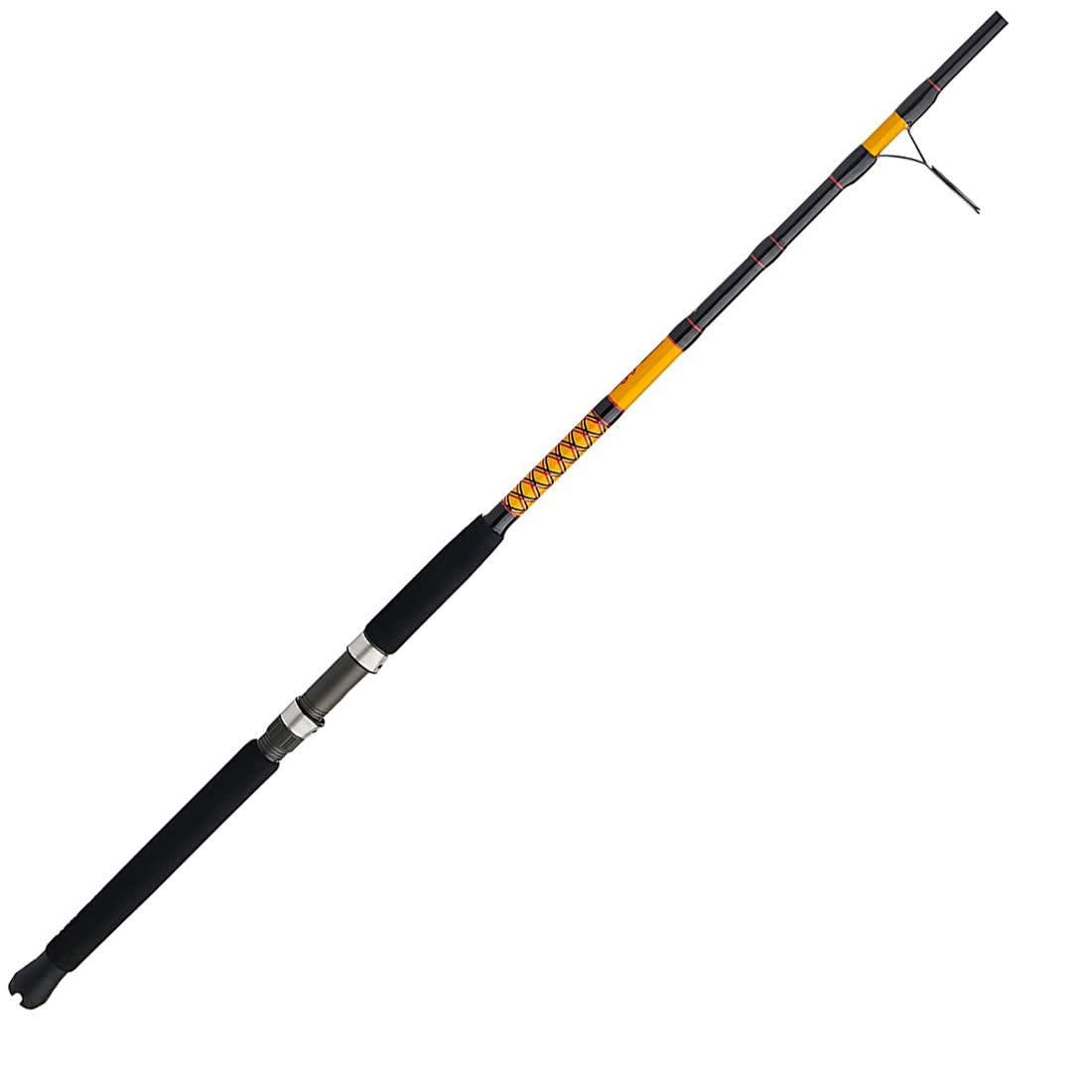
A word about which rod shows up, before the praise: the Bigwater badge covers a wide family, and this one, model BW1020S702, is a 7-foot medium-power spinning rod built for big water rather than the long surf sticks that share the name. Check the model number before you click buy. What arrives is a fast-action blank that throws a lure a long way, works a live bait without much fuss, and fights a big-water fish from a deck without feeling like a broomstick.

Ugly Stik's blended blank is why it feels the way it does: forgiving, hard to break, and a little heavier in the hand than an all-graphite rod of the same length. We like that trade on a boat, where rods get stepped over, leaned on gunwales and dunked in the wash. If you're counting ounces through a long day of casting you'll feel the difference; if the rod lives on deck and takes abuse, the blend is the point.

Where this rod stops is heavy trolling. Medium power puts a ceiling on the drag you can run, so the offshore work it suits is casting to surface fish, slow-trolling live baits and general big-water duty rather than dragging a skirted lure for tuna. When the fish are up and eating on top, we take it over any heavy conventional on the boat. The rest of the package holds up its end: Ugly Tuff guides shrug off salt, and 7 feet gives you reach without giving up much leverage from a deck.

The Fuji reel seat is the detail that makes it feel like more rod than it is, because that's where cheaper rods give trouble first: it locks a reel down without flex. Pair it with a mid-size spinner and braid in the 20- to 30-pound range and it covers most light-tackle offshore days. Ours has been rinsed and re-rigged more often than anything else in the rack, which is as good a sign as any.

Pros

  • Casts lures and live baits with easy distance
  • Fuji reel seat locks a reel down firmly
  • Blended blank forgives boat abuse

Cons

  • Medium power caps drag and fish size
Our verdict

Our spinning pick for offshore boat work: a 7-foot fast blank with a Fuji seat that casts to surface fish and works live baits, as long as you keep it off heavy trolling duty.

Check Latest Price
3

Best for Travel

Fiblink 3-Piece Travel Rod

83 /100
Angler Score Excellent

Key details

Pieces
3
Line Class
50 lb
Rod Length
7 feet
Rod Case Length
35 inches
Check Details on Amazon

Thirty-five inches is the number that sells this rod, and it's about more than the case. The longest section, the handle, runs 30 to 34 inches, so a 7-foot 50-pound-class conventional rod breaks down into something that fits a large suitcase, a truck cab or a duffel next to your boots. We keep it in the travel kit for exactly that reason: a trip that begins with a flight ends with you fishing instead of hunting for a rod tube.

The blank is carbon fiber and fiberglass, rated heavy and fast, and the 50-pound line class covers school tuna, wahoo, mahi and big striped bass without being overkill for any of them. Stainless double-foot guides with ceramic rings are the right call here rather than rollers, since at this line class you don't need a roller's friction advantage, and ring guides cast better and rinse cleaner. The DPS reel seat has stainless hoods, and the aluminum cross-shaped butt gives you something to brace against a gimbal belt.

The joints are where a three-piece rod lives or dies, and they're what we pay closest attention to. Seat each section firmly and wipe the male ends before you break the rod down at the end of the day; a joint that isn't fully home will work loose under load, and one broken down salty can be genuinely stubborn to separate. One buying note: stay at 7 feet. The 8-foot version in this family won't fit most luggage, which defeats the whole point of buying a travel rod.

Pros

  • Packs into a case that fits luggage
  • Ceramic ring guides cast well and rinse clean
  • Aluminum butt braces against a gimbal belt

Cons

  • 50-pound class won't handle big tuna
Our verdict

The offshore rod we pack when the trip starts with a flight: three sections, a 35-inch case and a 50-pound class that suits school tuna, wahoo and mahi.

Check Latest Price
4

Rod-Holder Trolling

Topline Tackle Bent Butt Trolling Rod

87 /100
Angler Score Excellent

Key details

Butt
Aluminum bent butt
Guides
Polished roller
Line Class
30-80 lb
Rod Length
5.5 feet
Check Details on Amazon

A bent butt isn't a styling choice. The bend drops the reel below the line of the blank so line leaves the tip lower, and the flat of the butt locks into a rod holder or a chair gimbal instead of spinning in it. On a boat that trolls with the rods parked in holders, that geometry does more for you than another foot of length, and we noticed the difference the first time we set it in a holder.

We like this one for exactly that job. The aluminum bent butt and dense EVA grip sit comfortably in a holder, the double-screw reel seat clamps a big conventional reel down hard, and the polished roller guides are built for the mono and braid a trolling spread runs. Solid fiberglass gives it a soft, forgiving bend that keeps pressure on a fish without tearing hooks, and at under 2 pounds it stays manageable on and off the rack.

Capacity is the other boundary. The line class sits a step below the top pick's, which is right for school tuna, wahoo, mahi and deep-drop work and not what you want under a big yellowfin or a marlin. Between this and the straight-butt rod, the choice comes down to where the rod spends its day: in a holder, this one; in your hands, the other.

Pros

  • Bent butt locks into holders and gimbals
  • Double-screw seat clamps a big reel
  • Polished roller guides suit trolling line

Cons

  • Bent butt is awkward to fish hand-held
Our verdict

Buy this one for a rod that lives in a holder: the bent butt and polished rollers are built for trolling and deep drop in the 30-80 lb class.

Check Latest Price

How We Tested the Best Offshore Fishing Rods

We started by pulling every offshore-capable rod we could find — conventional trolling sticks, big-water spinning rods, and multi-piece travel models — then cut the list by line rating, guide type, and whether the blank was genuinely built for saltwater. Price mattered too, since we wanted rods that made sense for someone spooling up a first boat rod as much as for an angler replacing a tired one. That narrowed to 12 rods, which we fished for eight months.

Testing happened where these rods actually live: in rod holders at trolling speed, on the bottom off a pier, and on a crowded deck where gear gets stepped on. We timed how long each multi-piece rod took one person to assemble and break down — ferrules seated, guides aligned, guides lined up to the reel — and whether it went back into its case without a fight. Every rod was weighed, then fished a full day so we could feel where the fatigue landed in our arms and shoulders. In the holder we watched for tip chatter, checked the backbone under drag, and noted any twisting when a fish changed direction.

Durability ran on its own slow clock. After each trip we rinsed every rod in fresh water and looked for corrosion in the guides, wobble at the reel seat, and grips that had swollen or gone slick. On fish, we paid attention to how the blank loaded on the hookset and how much pressure it could take near the boat before it locked up. Cosmetically we compared wraps and finish, though we've never seen a pretty rod outlast a well-built one. Value came down to what was actually in the box versus what we had to buy separately.

How to Choose an Offshore Fishing Rod

Start With Line Class, Not Species

A rod's line class sets a ceiling on everything downstream: drag, leader, and how much pressure you can put on a fish. An 80-120 lb class blank is the standard heavy trolling tool for tuna and marlin, while a 30-50 lb class covers school tuna, wahoo and mahi and is far more pleasant to fish all day. Look at where your fishing actually sits and work backwards from there.

Our default for a first offshore trolling rod is the heavy class, because it covers the fish most people book trips for. If your season is mostly school tuna and mahi, buy the lighter rod instead; you'll notice it in your arms by mid-afternoon.

Straight Butt or Bent Butt

A straight butt is the versatile choice: it works in a holder, against a harness, or tucked under your arm, which is why most boat rods use one. A bent butt drops the reel below the line of the blank so the line leaves the tip lower and the butt locks into a holder or a chair gimbal. Decide where the rod lives. If it spends the day in a holder, the bent butt is a real upgrade; if you fight fish standing up, stay straight.

Roller Guides or Ring Guides

Roller guides run the line over a spinning wheel instead of a fixed ring, which cuts friction and heat when a fish takes a long run against heavy drag. On an 80-120 lb trolling rod that's worth having. At 50 lb and below, stainless frames with ceramic rings are lighter, cast better, and give you nothing that can seize up.

One Piece, Two, or Three

The fewer the joints, the more direct the rod feels and the less there is to go wrong under load. One-piece blanks are the strongest and the most awkward, since a 6- or 7-foot rod needs a locker, a long vehicle, or a bag carried separately. Two-piece rods break down to about half length; three-piece travel rods go further, with our travel pick's longest section running under three feet. Check the packed length against the case you actually own before you buy.

Frequently Asked Questions

Final Verdict

The Fiblink 1-Piece Offshore Trolling Rod is the one to buy first: 80-120 lb class, roller guides, a metal reel seat and no ferrule to think about, which is what a boat-based offshore setup needs most.

If your trips start with a flight, take the three-piece Fiblink and accept the lighter line class; packing into a suitcase beats shipping a rod tube. For casting to surface fish rather than dragging lures, the Ugly Stik is the spinning answer, and the Topline earns its place the moment the rod lives in a holder.