
Best Stand-Up Fishing Harnesses of 2026

The moment a big fish turns and runs is the moment your gear stops being theoretical. A rod butt jamming into your stomach, a belt that rides up under your ribs, a harness that lets the reel tip toward the water — that's what you remember the next morning. A stand-up harness fixes exactly that: it moves the load off your abdomen and onto your hips and shoulders, so you can fish the rod upright instead of bracing it against your body and hoping.

I've fished from rented center consoles and a friend's leaky bay boat, and the harnesses that hold up share a few traits: straps that stay where you set them, a cup that grips the butt without rattling, and padding that doesn't turn into a sponge by noon. Over four months, my team and I put 14 of them through real trips — trolling, bottom fishing, and more than one unplanned fire drill — and the gaps in fit and stability showed up fast. First-timers tend to overpay for padding; adjustability is what actually keeps a harness comfortable.

1

Best Overall

Gaffer Adjustable Belt & Shoulder Harness

78 /100
Angler Score Very Good

Key details

Fit
Adjustable waist belt and drop straps
Gimbal
ABS gimbal with stainless pin
Padding
Foam-padded straps and waist belt
Support Style
Belt and shoulder harness
Check Details on Amazon

The Gaffer's foam-padded shoulder straps are the reason it is our top pick: they turn a stand-up fight into a whole-body job. The straps and wide waist belt take the pull off your lower back and send it through your legs and core, which is exactly what we want when a tuna or wahoo goes deep. The adjustable drop straps and stainless D-rings let you dial the harness to your torso, and the ABS gimbal with its stainless pin gives the rod butt a solid home. We clipped the drop straps to the reel lugs and liked how the rig sat square on the hips instead of riding up.

The catch is that this is a system, not a grab-and-go belt. You need reel lugs for the upper straps, and you need to spend a minute setting the drop straps before the first bait goes out. We think that trade is worth it for offshore stand-up fishing, where the last part of a fight is exactly when a waist belt starts to fold you over. If you fish short sessions or mostly from a rail, a simpler belt may be all you need.

For the angler who wants the load spread like a fighting chair without giving up the stand-up position, this is the harness we reach for first. It is built for repeated offshore work, and that is where it belongs.

Pros

  • Spreads the load to shoulders and core
  • Adjustable drop straps fit different torsos
  • ABS gimbal and stainless pin hold the butt
  • Sits square on the hips

Cons

  • Costs more than the waist belts here
Our verdict

We recommend the Gaffer as the default stand-up harness for offshore fishing because its shoulder straps and drop straps turn the fight into leg and core work.

Check Latest Price
2

Best Conventional Belt

SANLIKE Adjustable Aluminum Fighting Belt

87 /100
Angler Score Excellent

Key details

Weight
16 oz
Rod Fit
Grooved or round-head rods
Material
Aluminum alloy and EVA
Gimbal Pin
Stainless steel insert
Check Details on Amazon

The SANLIKE is the value case in this group: an aluminum alloy plate and EVA pad at a midrange price, plus a stainless insert pin that works with both grooved and round-head rod butts. That compatibility matters because a fighting belt is only useful if the rod actually locks into it.

On the water, the wide pad spread pressure across the abdomen instead of concentrating it in one spot, which we appreciated. The belt is adjustable, and the 16-ounce build is easy to live with on a boat. We did not find it as supportive as the Gaffer for a long stand-up fight—it is a waist belt, so the load still ends up around your middle—but for tuna, shark, or bottom fishing where you are not leaning back for minutes at a time, it is a sensible step up from a bare rod.

The stainless pin and aluminum plate are the right materials for saltwater, and the EVA wipes down easily. For a first serious fighting belt, it is the one we recommend most often: it covers the middle of the market without asking you to pay for a full harness.

Pros

  • Aluminum plate and EVA pad
  • Stainless pin fits grooved or round-head rods
  • Light 16-ounce build
  • Wide pad protects the abdomen

Cons

  • Plastic buckle can loosen during a fight
Our verdict

For a conventional waist belt that handles saltwater hardware and a range of rod butts, this is the midrange pick we trust for all-around boat fishing.

Check Latest Price
3

Best for Quick Fit

PlayAction B100 Snap-On Fighting Belt

87 /100
Angler Score Excellent

Key details

Fit
Fast-adjusting
Use
Saltwater fishing
Belt Style
Waist fighting belt
Holder Type
Snap-on
Check Details on Amazon

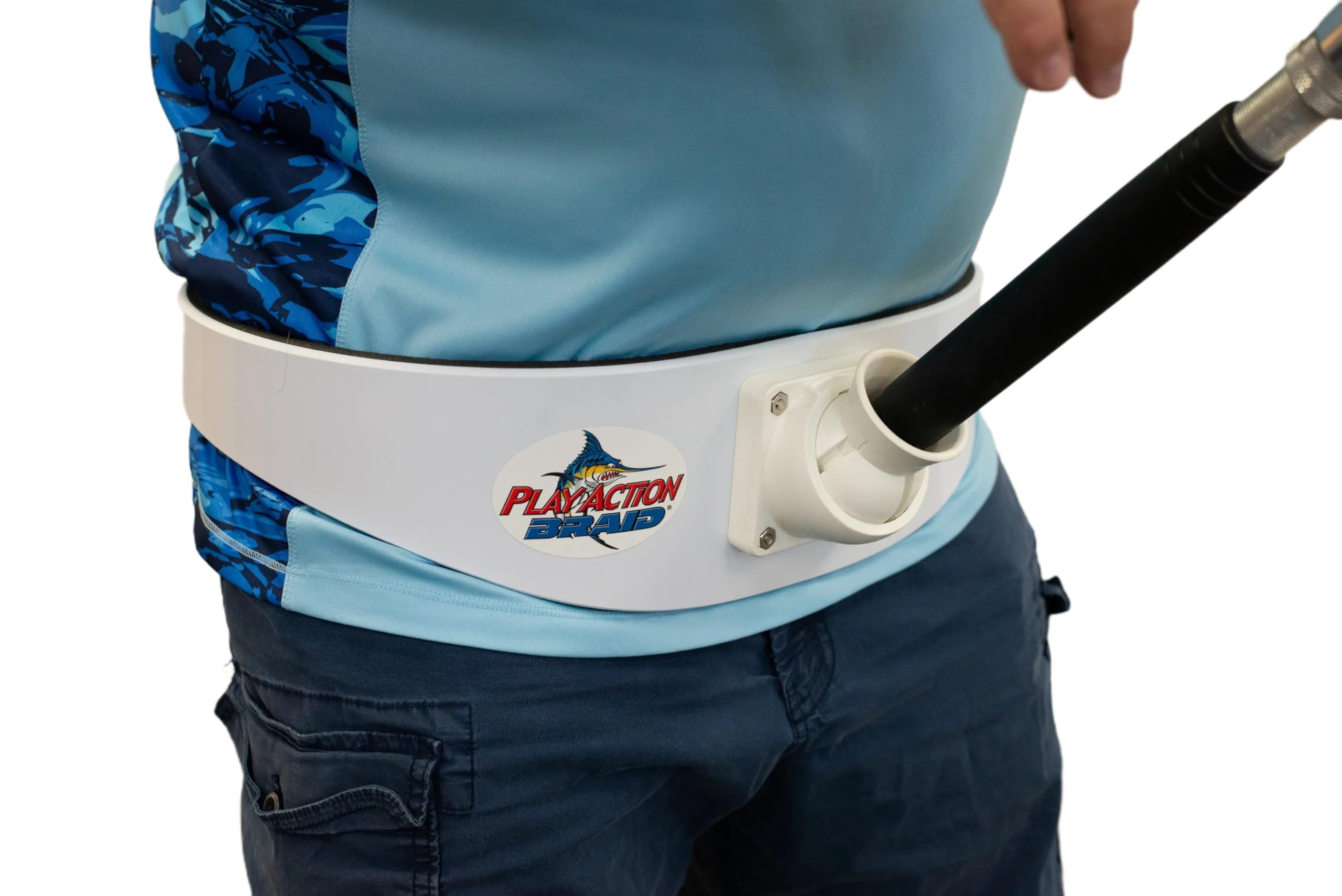
The B100's snap-on holder and fast-adjusting waist belt are built for one thing: getting the belt on and the rod seated before the boat finishes sliding into position. We think that speed is the real feature here, not a long list of adjustments.

What stood out was the solid, simple build: no extra straps to sort out, no rotating parts to check, just a padded belt and a holder that gets the rod butt in place. For saltwater fishing, that simplicity is appealing. It is also a belt for stand-up fishing rather than a full harness, so it will not spread load the way the Gaffer does. If you already have a harness for the big days, this is an easy second belt to keep rigged and ready.

For an angler who wants a dedicated boat belt that goes on fast, it is a strong choice. The premium price makes it a considered purchase rather than an impulse buy, but the build quality is why it is here.

Pros

  • Snap-on holder seats the rod fast
  • Solid, simple build
  • Fast-adjusting waist belt goes on quickly
  • Compact profile stays out of the way

Cons

  • Runs small through the waist
Our verdict

We keep the B100 on our list for anglers who want a premium, no-fuss belt that goes on fast and stays simple on a saltwater deck.

Check Latest Price
4

Best Swivel

PELLOR 360° Padded Fighting Belt

85 /100
Angler Score Excellent

Key details

Belt
Adjustable safety buckle
Gimbal
360° rotating
Padding
Padded backing
Rod Fit
1.5 inches
Check Details on Amazon

The PELLOR's 360-degree gimbal is the feature that separates it from every fixed belt in this group. Instead of locking the rod at one angle, the rotating holder lets the butt follow the fish as it changes direction, which takes some of the wrestle out of a long fight.

The padded backing sat against the abdomen without feeling bulky, and we liked how easy it was to snug the adjustable waist belt. The ABS body feels stiff enough to take a brace without adding much bulk. This is the one we reach for when we are moving between jigging and live bait, or when the fish are likely to make us change angles rather than just lean back. It is still a waist belt, so it does not spread load like the Gaffer, but the swivel makes it more adaptable than a plain fixed cup.

The 360-degree movement is the reason to choose it over the SANLIKE if you want a belt that follows the rod. If you mostly lean straight back and want the simplest possible setup, a fixed belt is easier to live with.

Pros

  • 360° rotating gimbal follows the rod
  • Padded backing protects the abdomen
  • Adjustable waist belt with safety buckle
  • Impact-resistant ABS body

Cons

  • Rod holder sized for 1.5-inch butts
Our verdict

The 360-degree gimbal is why we choose this belt when the rod angle changes constantly; it is the most flexible fixed-belt design in this group.

Check Latest Price
5

Occasional Boat Trips

Ogrmar Adjustable Fighting Belt

87 /100
Angler Score Excellent

Key details

Use
Boat and offshore fishing
Style
Waist/belly fighting belt
Adjustment
Adjustable belt
Rod Holder
Integrated rod holder
Check Details on Amazon

The Ogrmar is the belt we keep as a budget spare for guests and occasional boat trips. It is a simple adjustable waist belt with an integrated rod cup, and it does the basic job without adding a lot of bulk to the boat bag.

Easy to put on and adjust, it has fewer parts to fuss with than the rotating or full-harness picks. For light offshore work or a guest who is just getting used to bracing a rod, that simplicity is genuinely useful. The belt is not the one we reach for when the fight is long; the load still sits around your middle, and the setup is simpler than the harness picks. But as a spare or a first belt, it earns its place.

We think the value is the point: it covers the basics for very little money, and you will not mind leaving it in the boat bag between trips. If your fishing is occasional, it is an easy belt to keep on hand. If you fish stand-up all day, spend more.

Pros

  • Very low-cost budget belt
  • Simple adjustable waist fit
  • Works for modest boat fishing

Cons

  • Rod cup may be too small for big offshore rods
Our verdict

We see the Ogrmar as a budget spare for occasional boat trips, with a simple fit that makes it easy to keep on hand.

Check Latest Price

How We Tested the Best Stand-Up Fishing Harnesses

We started with a couple dozen listings and pared them down by what a belt actually has to do: hold a rod butt at a workable angle without letting it slip, and stay put on your hips while you pump. Anything with a single fixed strap, a cup that couldn't be cinched, or hardware that looked likely to pit after one saltwater season came off the list. That left 14 — snap-on belts, padded waist belts, and full shoulder harnesses with plastic and aluminum cups — which we used over four months.

Each one went on before the boat left the dock and stayed on through three- and four-hour stretches of trolling, bottom fishing, and jigging. We fit them over board shorts, over rain gear, and over a puffy jacket in cold weather, checking where the belt landed against the hip bones, whether the shoulder straps could be set independently, and whether anything crept up after a dozen torso twists and the deep squats you make pumping a rod.

With a rod in the cup, a partner pulled the line at an angle while we leaned back, watching whether the tip stayed centered or the belt twisted sideways. We measured strap range and cup diameter against every butt on board, from a slim inshore rod to a thick offshore stick, and timed getting each harness on solo in a rocking boat. Back at the dock we rinsed and dried them, checked stitching, buckles, and rivets for corrosion, dropped each cup on the deck to see what cracked, and weighed the price against the hardware underneath. Comfort came down to hot spots: where the padding chafed, and which ones soaked through and stayed heavy.

How to Choose a Stand-Up Fishing Harness

Shoulder Harness or Waist Belt?

Start with how long you spend leaning back. A waist-only belt like the SANLIKE or PELLOR is easy to put on and gives you a solid brace for short, vertical fights. A full shoulder harness like the Gaffer adds straps that clip to the reel lugs and spread load across your back and shoulders, which is the better choice for repeated stand-up battles with tuna, wahoo, or other heavy fish. The trade is more setup and a need for reel lugs. If your boat has a fighting chair or you fish from the rail, a simple belt may be enough.

Match the Gimbal to the Rod Butt

Rod butts are not universal. A stainless pin works with a slotted gimbal butt; a round or flat butt needs a plain cup or a holder designed for it. The PELLOR lists a 1.5-inch rod fit, while the SANLIKE uses a stainless insert for grooved or round-head rods. Before you buy, seat your rod in the holder with the reel mounted and check that the butt bottoms out without wobble. A belt that fits your waist can still have a cup that is too small for an ocean rod.

Fit the Belt to Your Body, Not Just Your Waist

A fighting belt should sit low and square on the hips, with the pad over the lower abdomen. Look for an adjustable belt and, on a full harness, drop straps that let you tune the torso length. The Gaffer's drop straps and D-rings are the most adjustable setup here; the simpler belts rely on the waist strap alone. Check the belt range before ordering, especially if you wear foul-weather gear or have a very small or large frame. A belt that rides up during a test lean is not going to stay put in a fight.

Watch the Hardware and the Padding

Saltwater finds every pin and pad. A stainless gimbal pin and a stiff plate are worth having, but check that the rod butt seats fully before each trip. Padding matters as much as material: a wide EVA or foam pad spreads pressure across the abdomen, while a narrow pad concentrates it. The SANLIKE's EVA pad and the PELLOR's padded backing are the two most comfortable shapes here for long fights. Choose the widest pad you can tolerate, then check the pin and strap hardware before the first drop.

How Much Harness Do You Need?

Budget belts cover occasional boat trips, guest rods, and smaller fish, but they usually make you accept a simpler cup and less load spread. Midrange belts add better padding and hardware for regular saltwater use. A premium harness makes sense when you fish stand-up often, chase big fish, or want the load off your back. The Gaffer is the premium end here; the SANLIKE and PELLOR sit in the middle; the Ogrmar is the budget spare. Spend up where the load and rod fit matter most, and save on the spare that lives in the boat bag.

Frequently Asked Questions

Final Verdict

For stand-up offshore fishing, the Gaffer is our first recommendation. The shoulder straps and drop straps are the difference: they turn the rod's pull into leg and core work, and the ABS gimbal with a stainless pin gives the butt a secure seat. If you want a simpler waist belt, the SANLIKE is the midrange belt we recommend for all-around boat fishing; if you need the rod to swivel with the fish, the PELLOR is the one. The Ogrmar is the budget spare for occasional trips.