
Best Survival Kits of 2026

Most survival kits get bought after a bad week — a storm warning, a wildfire two counties over, a friend who went three nights without power. The problem is that the category swings to two extremes: a bag so loaded you'd never carry it past the garage shelf, or a tidy little pouch holding three bandages and a whistle. What you want is something you could actually grab and carry, stocked well enough that you aren't improvising with a pocketknife and a torn T-shirt. We've spent the past eight months opening, weighing, and using 12 kits to find the ones that thread that needle.

The first thing I'd tell a friend is to ignore the piece count on the box. One manufacturer counts every adhesive bandage separately; another counts a two-person tent as a single item, so the number tells you nothing about completeness. What matters is whether the flashlight actually lights, the shears actually cut, and the bag still zips after you add a water bottle. The kits below are the ones that survived all of it.

1

Best Overall

EVERLIT 250 Pc Survival First Aid Kit

96 /100
Angler Score Outstanding

Key details

Pieces
250
Container
MOLLE pouch, 1000D nylon
Dimensions
6.5 x 4 x 8 inches
Item Weight
2 lb
Check Details on Amazon

Two hundred and fifty pieces sounds like a locker's worth of gear until you open the pouch and find out what they are: gauze, bandages, wipes, and tape, with a mylar space blanket, a three-mode flashlight, and a paracord bracelet making up the survival side. That split is exactly why this is our top pick. Most people shopping for a survival kit are really buying the medical half, the part you reach for in the first ten minutes of a bad afternoon, and nothing else here goes as deep on that half.

The pouch is the detail we keep coming back to. It's 1000D nylon with three large compartments and MOLLE straps, so it lashes to a pack, a seat back, or a roll bar instead of sliding around the trunk. At two pounds and roughly 6.5 by 4 by 8 inches it fits under a seat or in a saddlebag, and there's slack in the compartments for prescription meds and a spare lighter.

Stitching is the other thing we noticed, since a kit that splits a seam is a pile of loose bandages. The tan nylon doesn't advertise itself the way a red bag does, and the compartments mean you can put a hand on the gauze in the dark without unpacking the whole thing — which matters more at midnight than another folding gadget.

Pros

  • Deep medical supplies for a family, not one person
  • MOLLE straps mount to a pack, seat back, or roll bar
  • Three compartments leave room for your own additions
  • Two pounds and small enough for a saddlebag

Cons

  • No food, water, or real shelter included
Our verdict

Our pick for most people: a complete medical kit with survival tools in a 2-pound MOLLE pouch that goes wherever you do.
Check Latest Price
2

Best for Home Evacuation

Ready America 2-Person 3-Day Survival Backpack

94 /100
Angler Score Outstanding

Key details

Duration
3 days
Item Weight
7.8 lb
Food And Water
2 food bars, 12 water pouches
People Supported
2
Check Details on Amazon

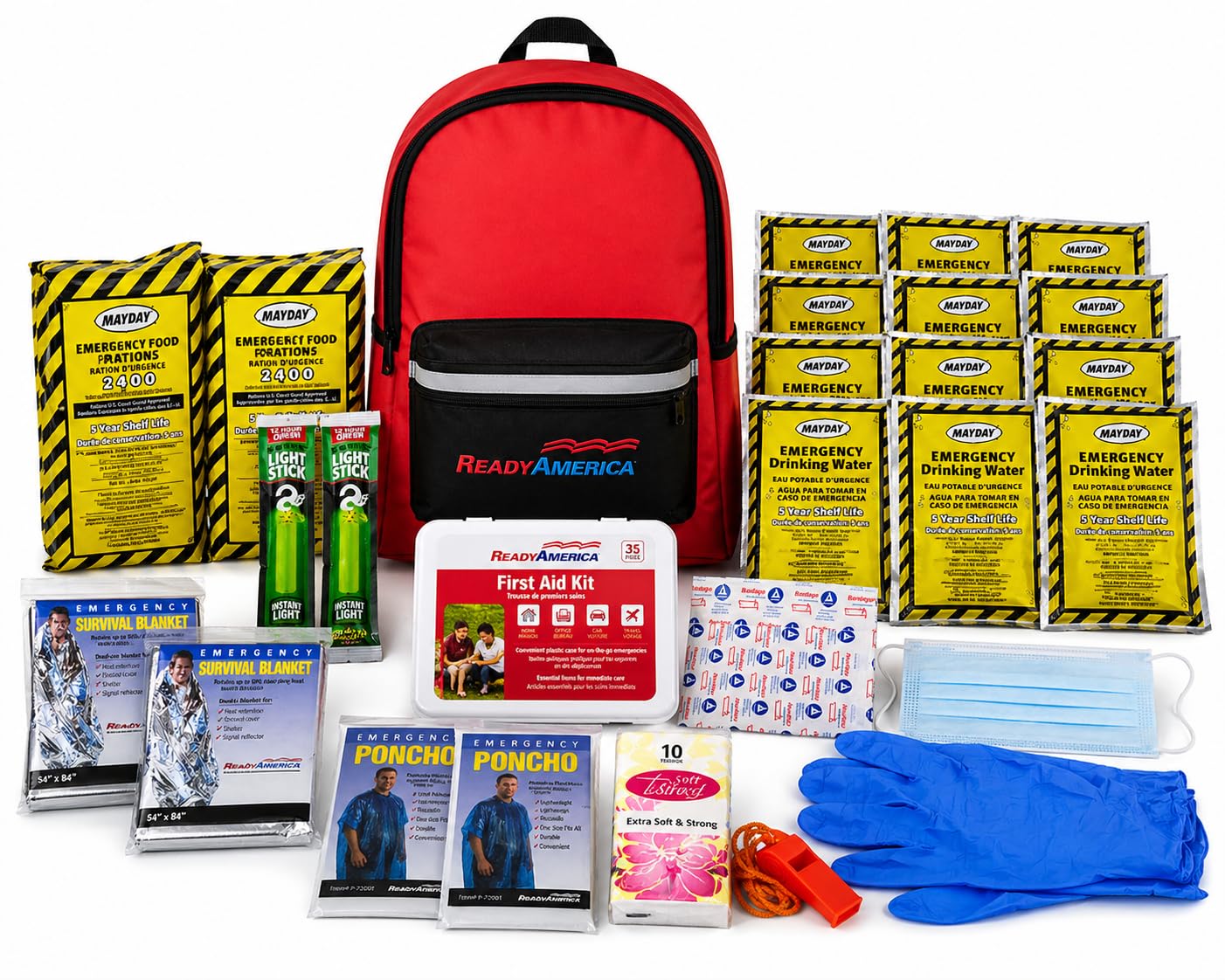
Two 2,400-calorie food bars and a dozen sealed water pouches are what separate this backpack from every other kit here. It's the only one you could ride out a three-day evacuation with without opening a kitchen cupboard, and the rest of the contents follow the same logic: two survival blankets, two ponchos, two 12-hour lightsticks, dust masks, gloves, a whistle, and a 33-piece first aid kit for basic wound care.

Seven point eight pounds, most of it water, is the trade for a bag that feeds two people for three days, and we think it's the right one for a kit that lives in a hall closet or a garage rather than on your back for miles. The rations carry a five-year shelf life, so this is a purchase you date with a marker and check every spring rather than something you rebuy.

Where it earns its place is the plan, not the gear. A hotel room, a shelter, or a night in the car after a storm all start with the same three questions — water, calories, warmth — and this bag answers all three before you open anything else. If you already keep a deep pantry and a full water supply, one of the medical-forward pouches here makes more sense.

Pros

  • Food and water for two people across three days
  • Shelter, warmth, and light included
  • Five-year shelf life on the rations

Cons

  • Pack is child-sized and snug on most adults
Our verdict

The one to buy if a home evacuation is your worry: real food, water, and warmth for two people, in a bag you can grab on the way out.

Check Latest Price
3

Best for Open Country

HIHEGD 250 Pc Survival Gear Kit

93 /100
Angler Score Outstanding

Key details

Pieces
250
Shelter
Emergency tent
Bag Size
8 x 6.5 x 6 inches
Container
1000D nylon MOLLE bag
Check Details on Amazon

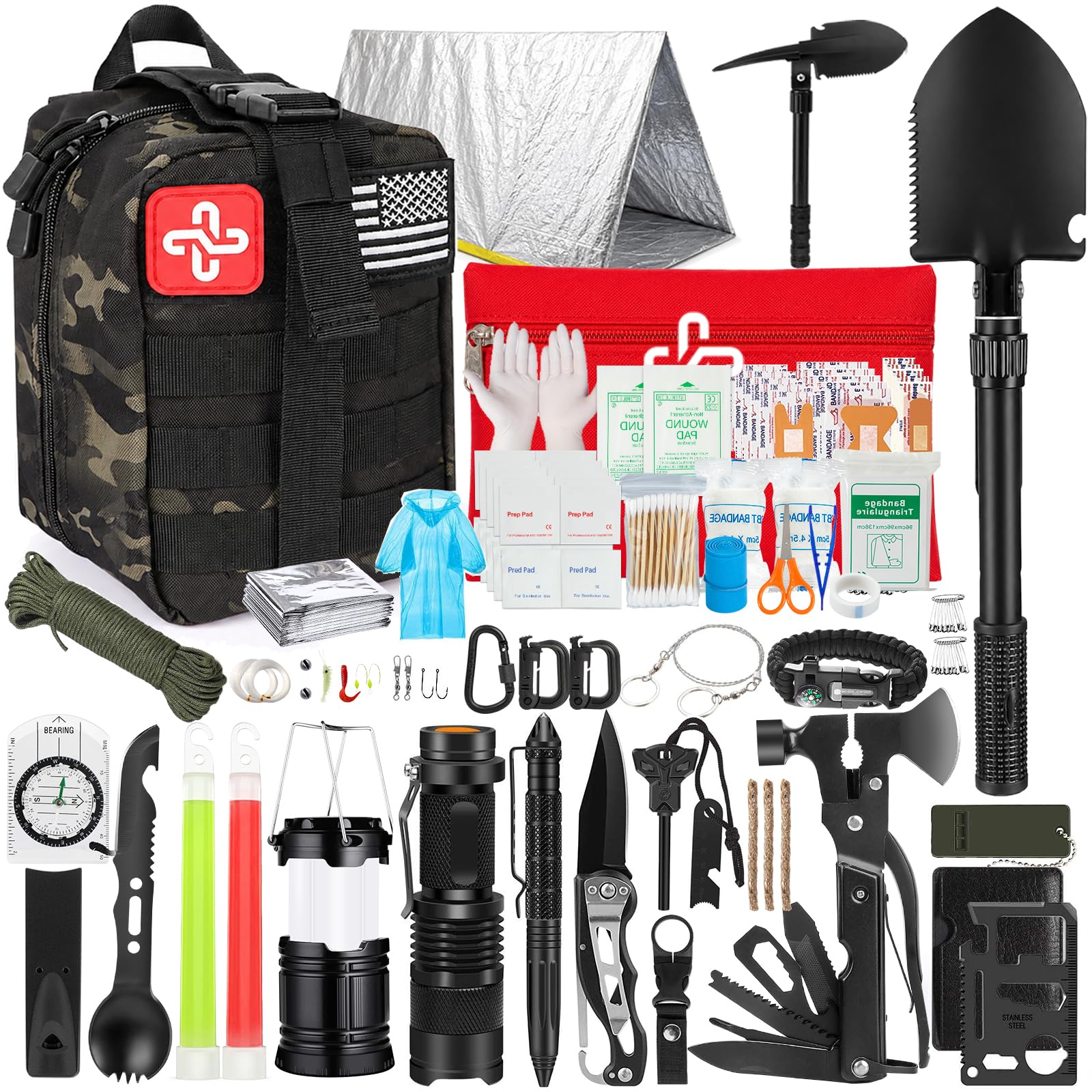
A bright red bag sounds like a small thing until you've looked for a kit in a dim garage. This is the only pick here with an emergency tent, and the only one whose bag you could spot across a campsite at dusk — two reasons it ends up in the truck for us.

The 250 pieces are spread across a 1000D nylon MOLLE bag measuring 8 by 6.5 by 6 inches, covering cutting tools, fire starting, light, cordage, and a first aid set. The tent is what turns a tool collection into something you could spend an unplanned night in, and that's what we're paying for here: the other kits handle a cut and a dark walk back to the car, this one handles being stuck.

The catch is scale. Tools are much smaller than the listing photos suggest — fine in a pack, a surprise in the hand — and anyone expecting a full-size knife will be disappointed. What you get in exchange is a bag with room to spare, enough to swallow spare batteries and a water filter and still close.

Pros

  • Only kit here that includes an emergency tent
  • Bright red bag is easy to locate quickly
  • Room left for batteries and a water filter
  • Broad coverage of tools, fire, light, and first aid

Cons

  • Compass and lantern can arrive not working
Our verdict

Buy it if you camp or drive where help is far away; the tent and the high-visibility bag are worth more than another dozen gadgets.

Check Latest Price
4

Best for the Truck

XKASE 19-in-1 Survival Kit

93 /100
Angler Score Outstanding

Key details

Case
Waterproof, shockproof hard case
Pieces
19
Case Size
8.2 x 5.1 x 2.7 inches
Check Details on Amazon

The case is the reason to buy this one. It's hard plastic, waterproof, foam-lined, and about the size of a thick paperback at 8.2 by 5.1 by 2.7 inches, so it drops into a door pocket or a glovebox and stays there through a wet winter. It's the kit we leave in the truck.

Inside are 19 pieces: a folding knife, a wire saw, a flashlight, a flint and striker, a 5-in-1 paracord bracelet, a multi-function card, and a spork-knife among them. We were pleasantly surprised by the flint, which throws sparks reliably, and the foam keeps the tools from rattling into a heap between outings.

Where it stops is scope. Nineteen tools won't build a shelter or treat a wound, so this is the layer that sits beside a first aid kit rather than instead of one, and it's the pick when space rather than contents is the constraint. The car is where kits quietly earn their keep, and this one asks nothing of you to stay there.

Pros

  • Waterproof hard case survives a wet truck bed
  • Small enough for a door pocket or glovebox
  • Flint and striker work reliably

Cons

  • Compass accuracy is the weak link
Our verdict

Buy it for the case: a waterproof hard kit that lives in the truck and takes up almost no room.

Check Latest Price
5

Tools-Heavy Camping

LUXMOM 142 Pc Survival Kit

93 /100
Angler Score Outstanding

Key details

Pieces
142
Bag Size
9 x 6 x 5 inches
Included
Hatchet, flashlight, survival bracelet
Container
600D nylon bag
Check Details on Amazon

There's a hatchet in this bag — a real one, not a keychain charm — and that single fact puts it in a different class from the pocket-tool boxes in this group. For a camper who splits kindling at a fire ring, it's the difference between a kit that's a novelty and one that does work.

Around the hatchet, 142 pieces fill a 600D nylon bag measuring 9 by 6 by 5 inches: a three-mode flashlight, a multi-function card, a survival bracelet, fire starting, and a first aid set to go with them. It's the kit here that looks most like the survival gear in a movie, and for a certain kind of buyer that's not a small part of the appeal.

We like it for basecamp and truck duty, where a hatchet earns its keep and the kit isn't the only thing you've packed. As the single kit on a family's emergency shelf it reads more tool than treatment, and the folding knife has no blade lock, so we treat it as a light-duty blade and keep our fingers clear of the spine. That's a fair trade for the hatchet, which is the reason to buy this one.

Pros

  • Hatchet makes it genuinely useful at camp
  • 142 pieces cover fire, light, cordage, and first aid
  • A convincing gift for a young outdoorsperson

Cons

  • Knife and shovel durability is unpredictable
Our verdict

Buy it as a gift or a camp kit where the hatchet does real work; it's the tools-forward pick, not the medical one.

Check Latest Price

What We Put Every Kit Through

We built the shortlist from kits that kept surfacing in customer reviews and best-seller lists, then cut anything that was really a first aid pouch with a survival sticker on it, anything whose listed contents we couldn't confirm before ordering, and anything that pushed past 10 pounds empty. Twelve kits made the cut, and we've lived with them for eight months.

The first thing we did was empty each bag onto a table and inventory it ourselves. We sorted every item into essentials, nice-to-haves, and filler, then weighed each kit both as shipped and with the filler pulled out, since that gap is where value for money actually lives. We also tried to stow each one three ways: under a car seat, in the bottom of a daypack, and on a garage shelf.

The carry test was a three-mile hike with each pack fully loaded — we noted where straps dug in, whether the bag stayed shut at a jog, and how much the contents rattled. A two-night camping trip in steady rain did the rest, showing us which zippers, seams, and MOLLE stitching held and which bags soaked through.

For emergency use, we killed the breaker for a four-hour evening and worked only from what was in each kit — light, warmth, water, a way to treat a cut. Afterward we checked every battery, hunted for expired or dried-out first aid supplies, and repacked each bag to see if it went back together easily or had to be forced shut. Anything that leaked, corroded, or needed two people to close after eight months on a shelf didn't make the list.

How to Choose a Survival Kit

Start With the Emergency You're Picturing

Two different buyers end up on this page. One wants a pouch in the car for a cut hand or a cold hour waiting for a tow truck. The other wants a bag by the door for a wildfire warning or a three-day outage. Those needs pull in opposite directions. The trail kit is compact and medical-heavy, and it's the one you can leave in a vehicle year-round without thinking about it. The evacuation kit carries food, water, and shelter, weighs several times as much, and wants a shelf by the exit. Settle which one you're buying before you compare contents, because a kit built for both usually does neither well.

Read the Contents List, Not the Piece Count

A 250-piece kit and a 19-piece kit can both be good buys, because the numbers don't measure the same thing. Most of those 250 pieces are bandages, wipes, and gauze; the 19-piece kit is nearly all tools. What matters is whether the contents cover the categories you'd actually reach for: bleeding control, light, fire, cutting, cordage, shelter, water, and a way to signal. Walk the list against those eight and the gaps show up in seconds.

Watch the photos as closely as the list. Miniature tools photograph at full size, and a hatchet the length of your palm is not a hatchet.

Test the Small Things Before You Need Them

Compasses, fire starters, lanterns, and flashlights are where inexpensive kits give ground, and it rarely shows until you're outdoors. Do the check in your kitchen: strike the ferro rod, switch the light on and leave it running, and compare the compass against your phone. Whatever fails gets replaced with a lighter, a button compass, and a headlamp you already trust — three small additions that fix the most common weak points in this category. A disappointing accessory you've already swapped out is a nuisance; the same one discovered at dusk is a problem.

Match the Container to Where It Lives

Three shapes show up here and each suits a different address. A MOLLE pouch straps to a seat back, a roll bar, or the outside of a pack and stays put. A backpack carries rations and a first aid kit but takes shelf space and weighs several times what a pouch does. A hard case shrugs off a wet truck bed and slides into a door pocket. Weight follows contents, so buy the one whose weight you'll tolerate carrying rather than the one with the longest list.

Plan to Finish the Kit Yourself

Every pre-assembled kit is a starting point, and the buyers who end up satisfied are the ones who added to it in the first week. Prescriptions, spare glasses, a phone cable and battery, cash in small bills, a couple of granola bars, and a liter of water cost little and cover the gaps no manufacturer can fill for you. Look for slack in the bag — three compartments, or a pouch that still closes over a full load — and leave a note inside listing what you added and when it expires.

Frequently Asked Questions

Final Verdict

The EVERLIT is the kit we recommend to most people: 250 pieces with real medical depth, a MOLLE pouch that mounts wherever you need it, and two pounds that won't make you leave it behind. It's the one that travels with you, and that's the only kind that helps.

If your worry is a night out of the house rather than a bad afternoon on the trail, the Ready America bag answers the harder questions — food, water, warmth — for two people. If the kit is going in a truck and staying there, the XKASE hard case is the one that survives the trip.