Best Throwable Flotation Devices of 2026

A throwable flotation device is the one piece of safety gear you hope never has to leave its spot under the seat. Whether it actually buys you time comes down to things the label doesn't tell you: how dense the foam is, how the strap is anchored, and whether it lands where you throw it. What you're buying is a few extra seconds and a handhold that keeps a head above the chop.

We've spent a full boating season with 14 of them — cushions, rings, and a couple of seat-style throwables — hauled in and out of a skiff, a canoe, and a pontoon from May through September. Most did double duty as a seat, which turned out to be the fastest way to find the thin ones: foam that dents under a thumb or flattens after an afternoon of sitting won't hold a head up either. Single-row strap stitching, covers that split after a summer in the sun, safety yellow fading to cream — those were the tells. The picks below stayed firm, stayed bright, and stayed grabbable with wet hands.

1

Best Overall

Seachoice Foam Flotation Cushion

95 /100
Angler Score Outstanding

Key details

Color
Safety yellow
Shell
Nylon over PE foam
Dimensions
15 x 15 x 3.5 in
Certification
USCG Type IV
Check Details on Amazon

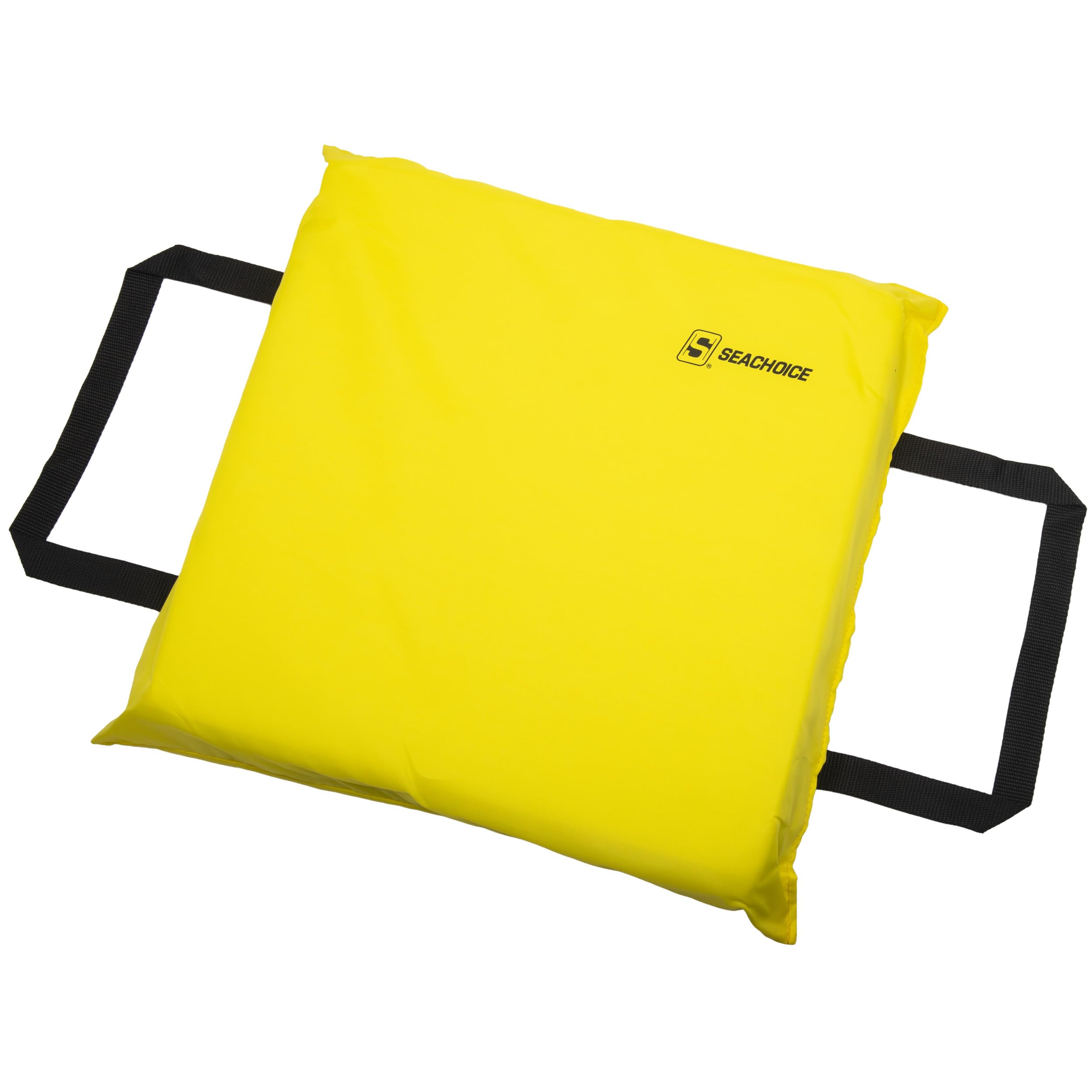
Three and a half inches of foam is what separates this cushion from nearly everything else here, and it is the reason the Seachoice is our default. That thickness does two jobs at once: it puts more buoyant material under a person who has gone over the side, and it makes the cushion comfortable enough to sit on through a long morning of fishing. The safety yellow is loud in the best way, and the Coast Guard certification is marked where an inspector can read it without turning the cushion over twice.

The nylon cover wipes down at the end of the day instead of staying damp, and the square 15-by-15-inch shape fits across a bench seat or a cooler lid. It is the thickest cushion in this group, which you notice when you stack it into a locker — a slab that deep takes up real room. In practice that hasn't pushed it out of the boat, because it slides under a bench or into the well beside the console and stays there.

The foam is polyethylene, the same family as most of the cushions here, so the advantage is quantity rather than a fancier material; if you want denser foam you're shopping the Bradley. What we appreciate is that nothing about this cushion asks for special handling. Sit on it, throw it, rinse it, put it back.

Keep it within arm's reach of where you sit — under the console, clipped to a gunwale cleat, or wedged beside the helm seat. A Type IV that lives behind the cooler is one you'll be digging out while someone is already in the water.

Pros

  • Thickest foam of any cushion here
  • Coast Guard Type IV label clearly marked
  • Safety yellow is easy to spot
  • Comfortable enough to use as a real seat

Cons

  • Shell feels thin next to the foam
Our verdict

For most boats, this is the throwable we buy: 3.5 inches of foam, a Coast Guard label an inspector finds instantly, and yellow you can see from the helm.

Check Latest Price
2

Best for Sitting

Stearns Throwable Flotation Cushion

95 /100
Angler Score Outstanding

Key details

Weight
10.2 oz
Dimensions
16 x 14 in
Certification
USCG Type IV
Shell And Foam
Polyester and Crosstech foam
Check Details on Amazon

This is the cushion that gets sat on most. It weighs 10.24 ounces, less than half the Seachoice, and the soft polyester shell feels closer to a stadium seat than to the vinyl slabs some boats carry, which is what turns a canoe thwart or an aluminum bench into somewhere you can spend an afternoon. Two of them cover both paddlers and the throwable requirement in a single purchase.

It tucks under a kayak's deck bungee or behind a canoe seat, and 16 by 14 inches is small enough to leave aboard without rearranging anything. Ours has been rained on, sat on with wet trunks and stuffed into a hatch, and it still wipes clean. The orange cover is visible from the dock, which is more than you can say for the white cushions in this guide.

What it isn't is the toughest cushion on the page. The foam is deliberately soft, and soft foam is the first thing to compress where you sit, so expect it to flatten a little each season. Buy it for comfort and light carry, and treat the rescue duty as the requirement it satisfies rather than the job it was designed around.

Pros

  • Lightest cushion in this group at 10.24 oz
  • Softest shell here for sitting
  • One-inch webbed straps are easy to grab

Cons

  • Strap stitching stops at the cushion sides
Our verdict

The softest, lightest cushion here — we reach for it when the throwable is really a seat for a kayak or canoe that happens to keep you legal.

Check Latest Price
3

Best Budget

O'Brien Throwable Seat Cushion

91 /100
Angler Score Outstanding

Key details

Color
Blue
Weight
16 oz
Dimensions
15.5 x 15 x 3.25 in
Certification
USCG Type IV
Check Details on Amazon

This is the least expensive cushion in the group, and it is thicker than most of the others — 3.25 inches of foam in a 15.5-by-15-inch square. The blue nylon cover is the brightest thing here after the yellow Seachoice, and the straps sit across the back where a hand finds them for a throw or a carry down the dock.

Where it gives ground is under a heavier body. The pad firms up quickly and a couple of hours is a more realistic sitting session than a full day of fishing. That is an easy trade if the cushion is mainly there to keep you legal and gets used as a seat between casts; if sitting comfort is the main reason you're shopping, the Stearns is the softer seat for about the same money.

Pros

  • Budget price without losing foam thickness
  • Bright blue cover is easy to see
  • Back straps make throwing and carrying easy

Cons

  • Padding compresses under heavier adults
Our verdict

Cheapest here and thicker than most, which is a combination worth taking seriously if the cushion is mostly a compliance item that gets used at the sandbar.

Check Latest Price
4

Best Ring Buoy

Taylor Made Life Ring

92 /100
Angler Score Outstanding

Key details

Grab Line
1,350 lb tensile
Certification
USCG Type IV
Inner Diameter
13 in
Outer Diameter
24 in
Check Details on Amazon

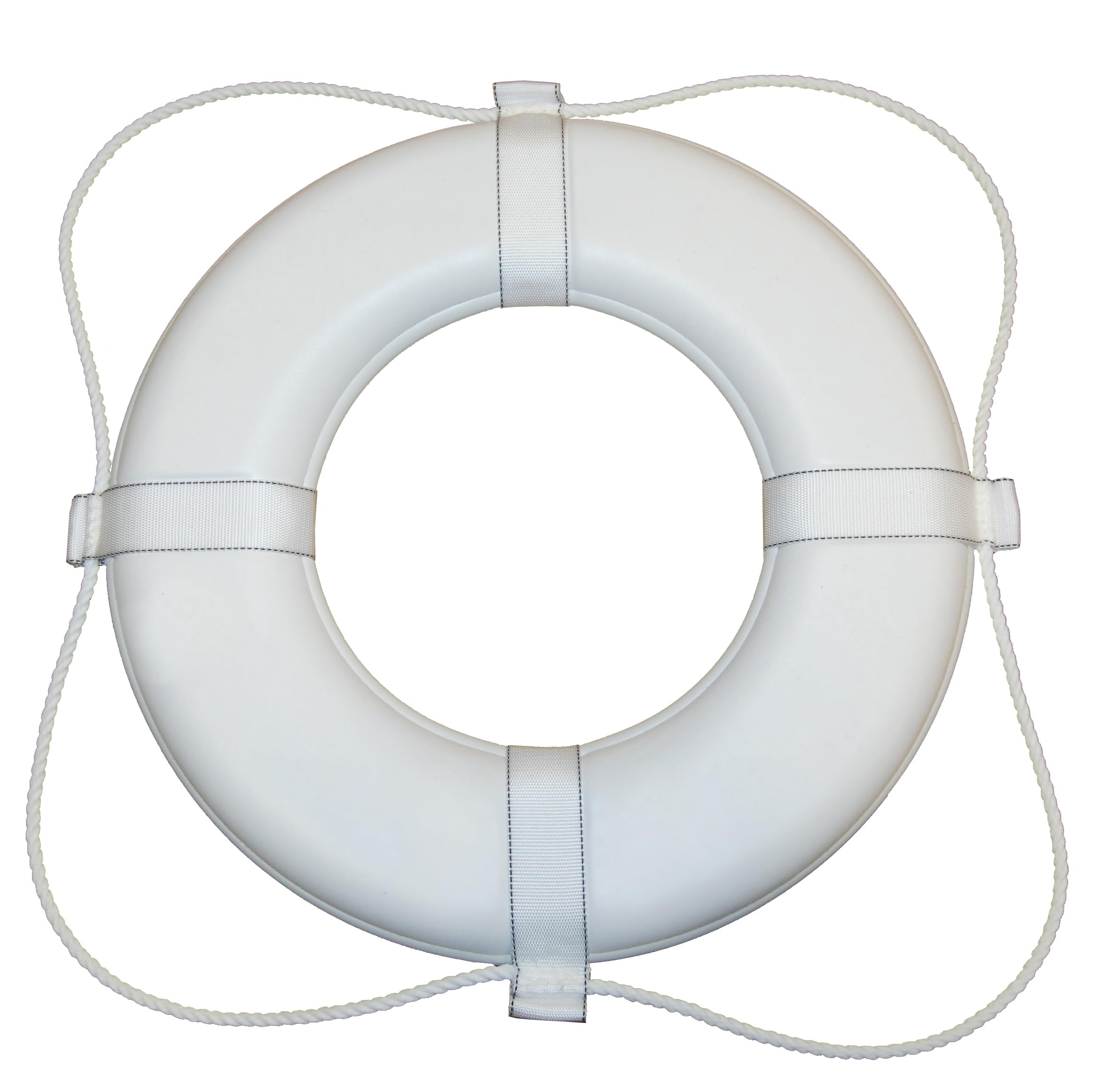
A ring does something no cushion can: it gives a person in the water a hole to put an arm through and a line to hold, so an imperfect throw still ends with them attached to the boat. Twenty-four inches outside, 13 inches inside, and a grab line rated to 1,350 pounds around the perimeter — that is a target you can hit from the helm on a bad arm day.

The vinyl coating over the foam is the part that earns its keep on a dock. It resists puncture, fuel and chemicals, so a ring that hangs outdoors all season still looks like safety equipment rather than a pool toy. It is also the heaviest thing in this group at 1.72 kilograms, which helps on a windy day, when a light cushion gets pushed around mid-throw.

The one thing to plan is where it lives. A ring wants a rail, a post or a hook; it doesn't slide under a bench the way a cushion does, and a ring buried in a locker is no faster to reach than a cushion buried in the same locker. On a boat with nowhere to hang it, this is the wrong shape.

For a pontoon, a dock or a bigger boat with a rail to spare, we think the ring is the better rescue tool of the two forms — easier to aim at a panicking swimmer and much easier for that swimmer to grab. On a kayak or a twelve-foot skiff, stay with a flat cushion; there's nowhere to hang a ring and the slab stows better.

Pros

  • 1,350-pound grab line around the perimeter
  • Vinyl coating resists fuel, sun and puncture
  • Heft steadies the throw in wind
  • Hangs on a rail or dock post

Cons

  • Sizing can run under the listed 24 inches
Our verdict

The ring buoy we hang on a dock or a pontoon: 24 inches across with a 1,350-pound grab line that a tired swimmer can find without aiming.

Check Latest Price
5

Best Step-Up

Bradley Type IV Boat Cushion

91 /100
Angler Score Outstanding

Key details

Foam
Closed-cell PU
Color
Neon yellow
Dimensions
15 x 15 x 3 in
Certification
USCG Type IV
Check Details on Amazon

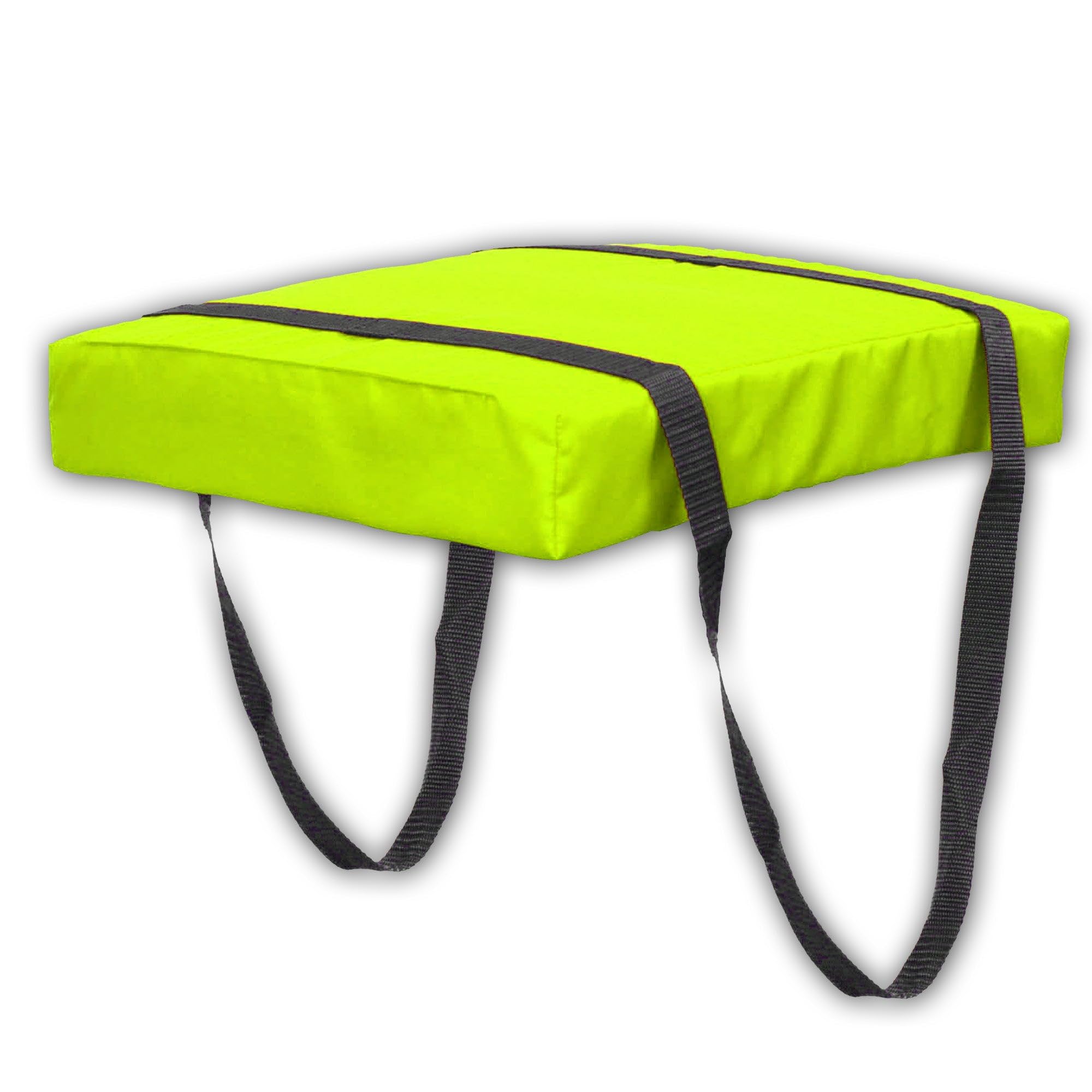
Closed-cell foam is what the extra money buys. Most cushions here use polyethylene, which is light, cheap and gradually flattens where you sit; closed-cell PU is the denser, springier material, and the nylon outer is a slicker cover than the soft polyester on the Stearns and the Airhead. That combination is the argument for spending more, and it is a real one on a boat that sees regular use.

The seat is firm rather than plush, the cover wipes dry in a minute, and the neon yellow is the loudest color we compared — you will not lose this one under a towel. It is a compact square at 15 by 15 by 3 inches, so it stows where a bulkier slab won't, and the finish looks designed rather than assembled.

Whether the premium pays off depends entirely on the boat. On something you own and keep, denser foam and a tougher cover are the difference between replacing a cushion every few seasons and not thinking about it again. On a rental, a borrowed skiff or a boat that gets used twice a summer, the Seachoice does the same legal job with more foam for less money, and that's the smarter buy.

Pros

  • Closed-cell PU foam holds its shape
  • Nylon cover resists abrasion
  • Neon yellow is highly visible
  • Compact 15-inch square stows easily

Cons

  • Costs the most of the cushions here
Our verdict

Closed-cell foam, a nylon shell and the highest price in this group — a cushion to buy once and keep on a boat you own.

Check Latest Price
6

White Boat Interiors

Flowt Type IV Throwable Cushion

93 /100
Angler Score Outstanding

Key details

Foam
Polyethylene
Color
White
Dimensions
16 x 14.38 in
Certification
USCG Type IV
Check Details on Amazon

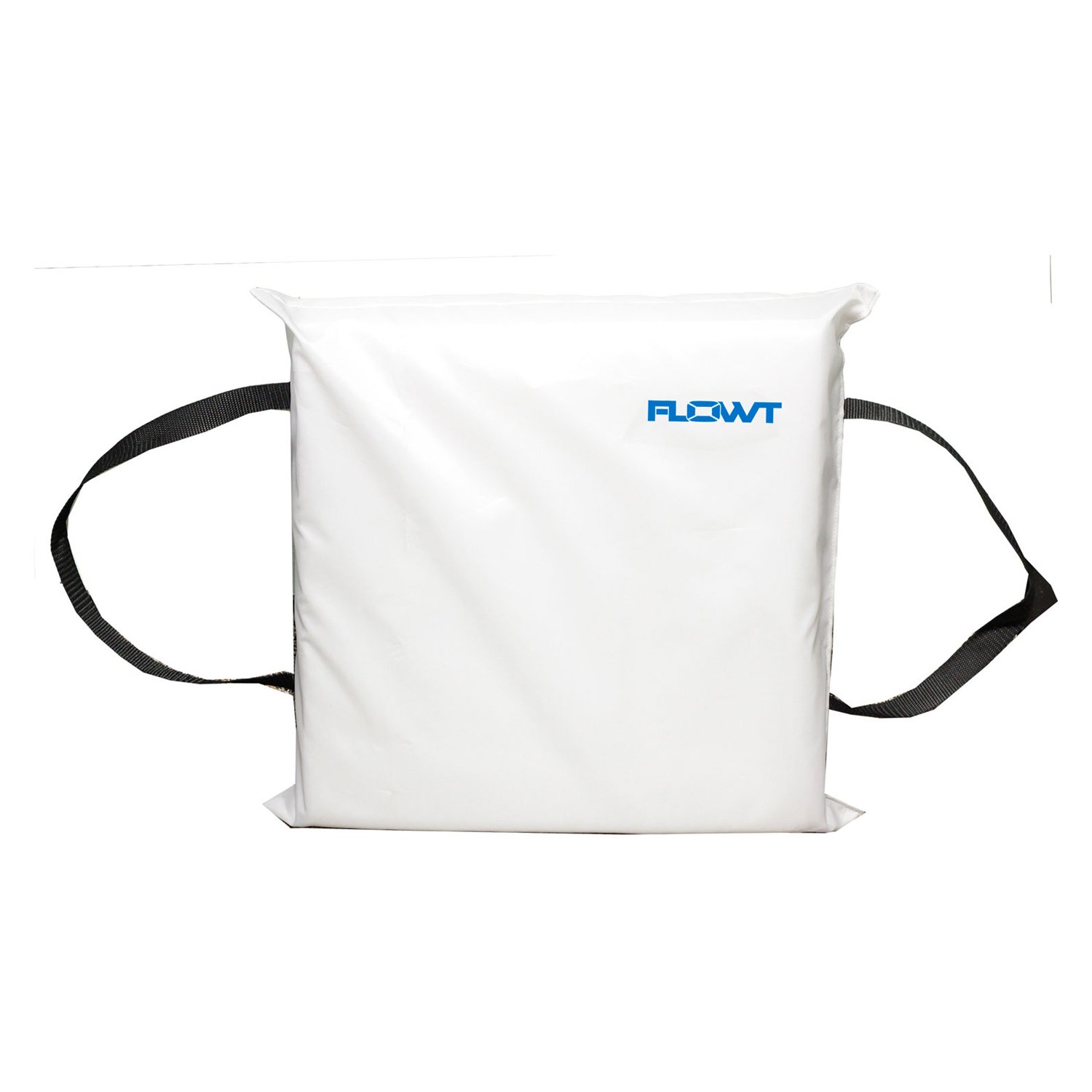
White is the entire argument. If your boat has white vinyl seats and a white console, a yellow slab or a flag print is the thing that never matches anything, and this is the one cushion here that does. It sounds like a small thing, and it isn't: mismatched safety gear is the gear that ends up buried under a towel in the stern.

The rest is competent rather than special: 16 by 14-3/8 inches, polyethylene foam, webbed handles, a white shell that wipes clean, and a hand-wash-only note we ignore until the end of the season. It throws, it floats, and it is comfortable enough for a couple of hours of fishing.

The trade is visibility, and it is a real one — white against sun glare and whitecaps is the hardest color to pick out, and a throwable's whole job happens in a hurry. Buy it if the cushion lives on deck as a seat on a white boat and you want it to vanish into the upholstery. If it lives in a locker and only comes out in an emergency, buy the loudest color you can find instead.

Pros

  • Blends with white boat interiors
  • Webbed handles are easy to grab
  • Wipes clean at the end of the day

Cons

  • Foam is layered rather than one solid block
Our verdict

A plain white cushion that satisfies the requirement and disappears into a white interior, which is more of a feature than it sounds.

Check Latest Price
7

On-Deck Seating

Airhead Type IV Throwable Cushion

93 /100
Angler Score Outstanding

Key details

Color
American flag
Shell
Polyester
Dimensions
15 x 15 in
Certification
USCG Type IV
Check Details on Amazon

The flag print is the whole pitch, and we're not being flip about it. A throwable that looks good enough to leave on deck is a throwable that's within reach when someone goes over the side, and gear that gets shoved into a locker because it's ugly is how the requirement gets technically met and practically missed.

Underneath the graphic it's a straightforward cushion: 15 by 15 inches, webbing straps across the back, thick enough to sit on and light enough to throw without thinking. It takes being sat on, dropped on the dock and rained on without complaint, and the print still reads clearly from a few feet away.

Where it fits best is a small boat with limited flat surfaces — it doubles as a bow cushion, a kneeler at the launch, or a backrest against an aluminum bench. This is the cushion for the boat where the throwable is going to be out anyway. If that isn't your boat, the plain white Flowt hides better in a locker.

Pros

  • Flag print looks like boat trim
  • Webbing straps are easy to grip
  • Firm enough to sit on all afternoon

Cons

  • Polyester cover can tear with hard use
Our verdict

The best-looking cushion here, and the one that actually stays on deck — a flag print you won't mind looking at all afternoon.

Check Latest Price

How We Tested Throwable Flotation Devices

We started by rounding up every USCG-approved Type IV device we could get our hands on — foam cushions, life rings, and the seat-style throwables — then filtered by foam type, cover material, strap setup, and overall size, since a cushion too bulky to stow under a bench seat tends to get left in the garage. That left 14 units, which we ran through one full boating season, May through September, aboard a skiff, a canoe, and a pontoon.

Each one lived where it would on a real boat: under a bench seat, in a bow locker, clipped to a thwart. We sat on every device through full afternoons of fishing, left them on the dock in direct sun for weeks at a stretch, hosed them down with lake water, and threw each at a marker buoy from about 20 feet, one-handed and wet, noting whether it landed where we aimed and whether the strap stayed in our grip or slid through our fingers. In calm water, a 165-pound tester held onto each device for 10 minutes while we watched how high the chest rode and whether nearby chop washed over the face.

We pressed a thumbnail into every cushion to see how quickly the foam sprang back, then checked for dents after a full day of sitting — the thin ones stayed compressed. Each device rode out the season in the sun so we could watch seams, edge binding, grommets, and cover fabric for splitting and fading, and we noted where straps were anchored with a single row of stitching versus a doubled one. At the end, we set what each cost against how it looked and held up after all that abuse. The ones that won were the ones we'd still trust after being sat on, soaked, and forgotten in the sun.

How to Choose a Throwable Flotation Device

Meet the Requirement, Then Find the Spot

Coast Guard rules call for one Type IV throwable on boats 16 feet and longer, and it has to be immediately accessible — not sealed in a bag, not under the anchor, not behind the cooler. That second half is where most boats actually fail. Pick the spot before you pick the product: a flat cushion wedges under a console, slides beneath a bench or hangs from a strap on a cleat, while a ring needs a rail or a post. If you can't name the place it will sit, you've found the real problem.

Cushion or Ring Buoy

A cushion is the default for most small boats: it's flat, it doubles as a seat, it stores anywhere and it's the cheaper of the two forms. A ring buoy is the better rescue tool when there's room for it — the hole in the middle gives a panicking swimmer something to grab without a precise throw, and the perimeter line gives you something to pull on. Rings want a rail, a post or a dock piling, and most need a line added before they're useful at distance.

Foam, Shell and Strap Stitching

Thickness is the number worth comparing: the cushions here run from roughly 2.5 to 3.5 inches, and more foam means more buoyancy, a better seat and more bulk in the locker. The shell decides lifespan — nylon and tight-weave polyester resist abrasion, vinyl coatings shrug off fuel and sun. The detail most buyers miss is the strap. You haul a wet adult in by that strap, so it should be stitched across the full width of the cushion rather than tacked into the side seams, which is where cheap webbing pulls loose.

Color, Visibility and What You Pay

Color isn't cosmetic on a rescue device. Yellow, orange and neon show up against water and white fiberglass; white and navy are chosen to match the boat. If the cushion lives on deck as a seat, the color that matches gets left out where you can reach it; if it lives in a locker, buy the loudest one you can find. Price across this group runs from budget to premium, and the premium buys denser foam and a tougher cover rather than more flotation — every device here carries the same Type IV approval.

Frequently Asked Questions

Final Verdict

For one boat and one purchase, the Seachoice is the cushion we buy: the thickest foam in this group, a Coast Guard label an inspector finds in a second, and yellow bright enough that it gets left on deck instead of buried.

Add the Taylor Made ring when there's a rail to hang it on and open water to cover, or the O'Brien when the budget decides. Those three cover almost every boat we can picture, and the rest of this list is a variation on one of them.