
Best Trailer Hooks and Tie-Down Anchors of 2026

Trailer hooks look like a minor purchase until a strap starts sawing through a cheap ring on the way home. The point of a good hook or anchor is simple: it gives the strap a fixed, trustworthy place to pull against, so lumber, an ATV, or a loaded cooler stays put instead of shifting in the bed. I've spent the past six months using 16 tie-down hooks and anchor kits across a utility trailer, pickup bed, and flatbed, and the differences are not cosmetic.

The hardware packet matters as much as the hook. I lost count of sets that looked stout until screws spun or the mounting plate sat proud of the rail; a few hooks were the wrong size for strap widths, and some spring gates lost their snap after weeks of dust and rain. We loaded each anchor against a known weight to check whether the stated capacity felt honest, then inspected welds, ring openings, and bolt threads. The picks below are the ones that installed cleanly, fit the trailer, and felt tight after a season of use.

1

Best Overall

Mytee Stake Pocket D-Rings

95 /100
Angler Score Outstanding

Key details

Pocket Fit
Standard 2 in x 4 in
Assembly Capacity
18,000 lbs
Height Adjustment
4 pin holes, hitch pin
Working Load Limit
5,400 lbs per ring
Check Details on Amazon

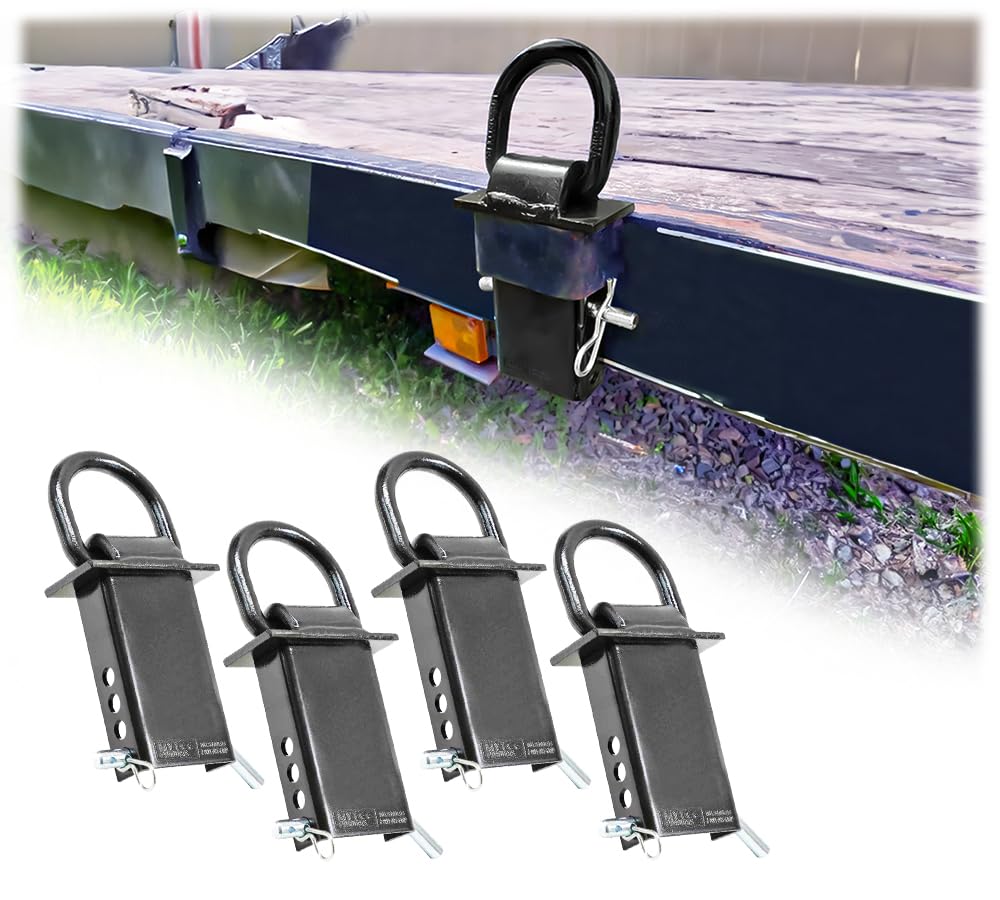
Drop one of these into a stake pocket and you have a 5,400-pound anchor point where a minute ago there was a hole. That is the whole trick: no drill, no welder, no fabricator, and the ring stands proud of the pocket so your strap runs over smooth steel instead of sawing against a raw edge. The 18,000-pound number on the label is the assembly capacity; the working load limit, the figure to plan around, is 5,400 pounds per ring.

The welds are the first thing we check on a D-ring, and these are clean and complete where the ring meets the channel. Four pin holes let you set the height, which matters more than it sounds: run the ring low for a deck-level load, higher when you want the strap clear of the rail. A half-inch hitch pin with a locking cotter pin holds the setting.

What we keep coming back to is the strap wear. A strap hooked straight into a stake pocket rubs that edge every time the load shifts, and a frayed strap is a strap you replace. One thing to check before ordering: these are built for standard 2 by 4 pockets, and pockets that run wide let the ring sit loose, so measure the inside of yours rather than assuming.

If your trailer has pockets, this is the anchor to buy first. If it does not, the bolt-on set below is the answer, because no amount of load rating helps hardware that has nowhere to sit.

Pros

  • 5,400 lb working load limit per ring
  • No drilling or welding to install
  • Four pin positions set the ring height
  • Keeps straps off the pocket's sharp edges

Cons

  • Lifts out of the pocket when unpinned
Our verdict

Our pick for any flatbed or utility trailer with 2 x 4 stake pockets: a 5,400-pound working load limit, no drilling or welding, and straps that stop chafing on the pocket edge.

Check Latest Price
2

Best Value Stake Pocket

VONLX Stake Pocket D-Rings

94 /100
Angler Score Outstanding

Key details

Pack
4 rings, hitch pins, bolts
Finish
Powder-coated black steel
Break Strength
18,000 lbs
Working Load Limit
5,400 lbs
Check Details on Amazon

The parts that decide whether a stake-pocket ring is any good are the ring, the weld, and the pin, and VONLX gets all three right for less money than the Mytee set. Same 18,000-pound break strength, same 5,400-pound working load limit, same four-hole height adjustment, and hitch pins and bolts in the box.

The steel is solid and the black powder coat has held up in weather. Where the ring meets the channel, the welds are substantial rather than merely tidy, and the D opening is wide enough to take a chain binder's hook as well as a ratchet strap hook, which is not true of the small surface-mount rings further down this list.

Fit is down to your trailer, not the ring. In a standard 2 by 4 pocket they sit properly; in a pocket that has been beaten out or built oversize they rattle, and no amount of pin tightening changes that. Measure first, and if yours are loose, a strip of rubber or a tack weld quiets them.

Pros

  • Matches our top pick's 5,400 lb limit
  • Powder-coated steel with substantial welds
  • Wide D takes chain binder hooks

Cons

  • Cotter pins have no lanyard and go missing
Our verdict

If you want the stake-pocket design but not the top pick's price, this is the set we point to — the same ratings and hardware with a finish that holds up outdoors.

Check Latest Price
3

Best Bolt-On

AUTOBOTS 1/2-Inch D-Rings

0 /100
Angler Score Fair

Key details

Pack
4 rings, backer plates, bolts
Footprint
3 in x 3 in
Load Rating
12,000 lbs
Ring Diameter
1/2 in
Check Details on Amazon

Plenty of trailers have nowhere to hook a strap: no stake pockets, just a frame rail and a deck. That is the trailer this set is for. Four forged half-inch D-rings, rated at 12,000 pounds, bolt through steel or wood and give you an anchor point that is not going anywhere.

The install kit is what sold us. Square-neck bolts sit in square holes in the base plate so the head cannot spin while you tighten the locknut from underneath, which turns a two-person argument into a one-person job. The backer plates go on the far side and spread the pull across a wider patch of steel, exactly what you want on a thin deck or a channel frame.

Drilling is unavoidable, and the supplied bolts are sized for a flat surface rather than a deep frame rail. Going through a channel plus a plate? Buy longer grade-5 bolts before you start. It is the difference between a solid install and a rattle you will hear every mile.

The finish has held up on our trailer, and the 3 by 3 footprint is small enough to fit between crossmembers. On a light utility trailer these are more anchor than you need; on a car hauler or equipment trailer without pockets, they are the practical answer.

Pros

  • 12,000 lb rating on forged rings
  • Backer plates and locknuts included
  • Square-neck bolts do not spin on install
  • Works on frames and decks with no pockets

Cons

  • Single 12,000 lb strength figure, no working load limit
Our verdict

Nothing on your trailer to drop a ring into? This bolt-down set gives you a 12,000-pound forged anchor, a backer plate, and a one-person install.

Check Latest Price
4

Best Flush-Mount

Lonffery Recessed D-Rings

93 /100
Angler Score Outstanding

Key details

Pack
4 rings, plates, 16 bolts
Ring Size
3 in x 3 1/4 in
Backing Plate
4 7/8 in x 4 1/2 in
Break Strength
6,000 lbs
Check Details on Amazon

A D-ring bolted to a trailer deck is a snag waiting to happen: it catches pallet corners, hooks stray straps, and finds shins in the dark. Recessed rings solve that by disappearing. You cut a rectangle, bolt the ring to a backing plate underneath, and the D folds down into the recess until you pull it up.

The kit is complete in a way that matters: four rings, four backing plates measuring 4 7/8 by 4 1/2 inches, 16 carriage bolts, and 16 self-locking nuts. Those oversized plates are why a 6,000-pound assembly rating means something, because the load spreads across the plate instead of tearing at four bolt holes.

Installing four of these is a real afternoon. A hole saw and a chisel do the cutting, and there are no instructions in the box, so watch a video before you start. Expect the rings to arrive stiff; ours needed lubricant and a few dozen lifts before they would fold down on their own.

Six thousand pounds of break strength puts these below the stake-pocket rings here, and that is fine for the job they are built for: quads, mowers, furniture, and boxes inside an enclosed trailer. It is not the anchor for winching a dead car onto a deck.

Pros

  • Folds flush so cargo slides over it
  • Oversized backing plates spread the load
  • Full bolt-and-nut kit for four points

Cons

  • Hardware has arrived short on bolts and nuts
  • Needs a hole saw and chisel to install
Our verdict

The tidiest way to add tie-downs to an enclosed trailer or a pallet deck: flush when you do not need them, 6,000 pounds of break strength when you do.

Check Latest Price
5

Best Weld-On

Grandroad Weld-On D-Rings

94 /100
Angler Score Outstanding

Key details

Pack
12 weld-on rings
Warranty
1 year
Ring Diameter
1/2 in
Breaking Strength
12,000 lbs
Check Details on Amazon

Welding is still the most permanent way to put a lot of anchor points on a trailer. Twelve forged half-inch rings rated at 12,000 pounds breaking strength, no plates, no pins, no fasteners to check: you weld them where you want them and they are part of the trailer from then on.

We welded a set along the top rail of a utility trailer and they have sat tight since, with no movement at the base. There is no bracket in the way, so the ring sits close to the steel rather than standing off it, and twelve of them means you can put an anchor roughly wherever a load ends up instead of working around two fixed points.

Plan for the finish. The coating burns back around each weld and bare steel will flash rust, so hit every ring with primer and paint while you are still outside with the grinder out. That is the trade for a welded anchor, and it takes less time than the welding did.

The rating is breaking strength only, with no working load limit published, and the warranty runs a year. For farm trailers, flatbeds, and rebuilds where the welder is already out, that is an easy trade; on a finished trailer you would rather not repaint, stick with bolt-on.

Pros

  • Twelve forged 1/2 in rings per set
  • 12,000 lb breaking strength
  • Nothing to pin, bolt, or rattle loose

Cons

  • Requires a welder and welding skill
  • No published working load limit
Our verdict

For a fabricator's trailer, twelve forged rings and a weld bead buy more permanent anchor points than any bolt-on kit here — with nothing to rattle loose.

Check Latest Price
6

Best for Safety Chains

CURT 82930 Threaded Quick Link

92 /100
Angler Score Outstanding

Key details

Closure
Threaded with hex nut
Diameter
3/8 in
Break Strength
11,000 lbs
Working Load Limit
2,200 lbs
Check Details on Amazon

Safety chains need a connector that stays closed, and a threaded quick link is the honest version of that. Unthread the hex nut, slip the link through the hitch loop, thread it back down and tighten. It costs you a few seconds at every hookup and it will not pop open the way a spring clip can.

The ratings suit a utility or boat trailer: 11,000 pounds breaking strength and a 2,200-pound working load limit on a three-eighths-inch link, finished in zinc that has shrugged off weather. One fit note, though. The nut sits close to the hook opening, so a fat hitch loop or a thick chain end can be a squeeze. Measure the loop before you assume it drops straight on.

We also use these away from the hitch, as a solid joiner between two straps or a fixed point on a winch line. What we value most is that it never does anything unexpected: no latch to press, no gate to bend, just thread and go. Compared with the snap hook below, it is the choice when the trailer is heavy and the hookups are few.

Pros

  • 11,000 lb break strength, 2,200 lb working load
  • Threaded closure cannot pop open
  • Zinc plating resists rust

Cons

  • Slow to thread on and off
  • Nut crowds the hook opening
Our verdict

Our pick for connecting safety chains: a threaded link rated to 2,200 pounds working load that cannot spring open on the road.

Check Latest Price
7

Light Cargo

JCHL 10-Pack D-Rings

93 /100
Angler Score Outstanding

Key details

Pack
10 rings
Capacity
2,400 lbs per ring
Material
Zinc-plated steel
Mounting Hole
1/4 in
Check Details on Amazon

Ten anchors for a fraction of what one heavy-duty stake-pocket ring costs is the whole pitch here, and for light cargo it is a good one. Quarter-inch surface-mount rings rated at 2,400 pounds each, zinc-plated, two fasteners apiece. Screw them to a trailer wall, a truck bed, a camper floor, anywhere you want a hook point that is not a hole you drilled in a hurry.

Respect the number. Two thousand four hundred pounds is a motorcycle, a snowmobile, or a stack of lumber in a pickup bed, not a car on a flatbed. The rings themselves are solid steel; the included screws are the weak link, so drill pilot holes and swap in your own bolts for anything that matters.

Where they earn their keep is coverage. A cargo trailer with ten along the walls gives you a tie point wherever a load ends up, instead of two anchors up front and a long strap. We also noted the two-hole base: with a fastener at each end, the ring cannot pivot under a pull the way a single-screw anchor does.

Pros

  • Ten rings per pack
  • 2,400 lb capacity covers light cargo
  • Two fasteners stop the ring pivoting

Cons

  • 2,400 lb rating rules out vehicle hauling
Our verdict

For bikes, gear, and light cargo, ten anchors turn any flat surface into a tie-down point without a serious spend.

Check Latest Price
8

Van Builds

VEEBELL 24-Pack D-Rings

92 /100
Angler Score Outstanding

Key details

Pack
24 rings, 48 screws
Capacity
2,400 lbs per ring
Bracket Size
2 1/4 in x 3/4 in
Ring Opening
1 in x 1 3/8 in
Check Details on Amazon

Lining a cargo trailer or a van conversion is a quantity problem before it is a strength problem. You do not need one heroic anchor, you need twenty of them down both walls. This box has 24 painted rings and 48 screws, enough to run a line of tie points with spares left for the next project.

The rings are small: a 1-inch by 1 3/8-inch opening on a 2 1/4 by 3/4-inch bracket. That is the trade you make for the count. Small ratchet strap hooks, bungee cords, and rope clip on easily; a big S-hook or a chain end will not fit through. For holding furniture, bikes, and boxes in a van, that is the right size.

Budget for your own fasteners. The included screws are for light duty, and on a wall you care about, predrill and use bolts with washers behind them. At this quantity the screws are a starter kit, not the finished job.

What we appreciated most was the uniformity. Twenty-four identical rings means every tie point in the trailer works the same way, so a strap that fits one fits all of them, and the black paint looks deliberate on a finished interior rather than like hardware-store eyes screwed to a wall.

Pros

  • 24 rings plus 48 screws
  • Compact bracket fits tight spots
  • Painted finish suits finished interiors

Cons

  • Small opening will not take large hooks or chain
Our verdict

The bulk buy for a van or cargo trailer build: 24 matching anchor points, small enough to fit anywhere and cheap enough to use everywhere.

Check Latest Price
9

Quick Chain Hookups

CURT 81266 Snap Hook

90 /100
Angler Score Outstanding

Key details

Finish
Zinc plated
Closure
Spring-loaded latch
Diameter
3/8 in
Gross Trailer Weight
2,000 lbs
Check Details on Amazon

Spring-latch hooks are for people who hook and unhook constantly: a landscape trailer that goes out five times a day, a boat trailer, a borrowed rig. Squeeze, clip, release. The trade is that a small spring is now the part standing between your chain and the road.

Rated for 2,000 pounds gross trailer weight in three-eighths-inch steel with zinc plating, this is the lightest hook here and the easiest to live with. We reach for it when the trailer is small and the hookups are frequent; on a heavy trailer, the threaded link above is the safer habit.

Check the latch before every season, because a spring that does not snap shut is a hook that can walk off a loop. Keep a spare in the glovebox. Fit is also hit or miss depending on your hitch plate: the hook is narrow, and some welded loops and chain ends are wider than the gate will open, so measure before you buy.

Pros

  • Spring latch connects one-handed
  • Zinc-plated steel
  • Fits common 3/8 in safety chains

Cons

  • Rated for 2,000 lbs gross trailer weight
Our verdict

For frequent hookups on a light trailer, the spring latch earns its keep: one-handed connection and a 2,000-pound gross trailer weight rating.

Check Latest Price

How We Tested Trailer Hooks and Tie-Down Anchors

To build the shortlist, I started with manufacturer spec sheets, replacement-part listings, and the one-star reviews that mention stripped screws or hooks that bent, then filtered for capacity, hardware included, price per usable anchor, and whether the footprint would fit common stake pockets, bed rails, and trailer decks. We ended up with 16 hook and anchor sets and lived with them for six months.

Installation was the first filter. I mounted each set with hand tools on a wooden utility trailer deck, a pickup bed rail, and a flatbed stake pocket, noting whether the screws started cleanly, whether the heads sat flush, and whether the bolts and washers in the bag matched the plate. A set that needed a trip to the hardware store for different bolts lost points; so did one whose ring crowded a 2-inch strap.

Then we used them. I strapped down a lawn tractor, lumber, and stacked bins, tensioning each strap by hand and watching for rings that spread, welds that ticked, or plates that shifted. Spring hooks got opened and closed repeatedly and left hanging in dust and rain; I checked whether the gate still snapped shut and whether the finish held. At the end, I weighed what each kit cost against the number of usable pieces and the hardware you didn't have to replace.

How to Choose Trailer Tie-Down Anchors and Hooks

Start With How It Attaches

Stake-pocket rings are the fastest route to a serious tie-down point: they drop into a standard 2 by 4 pocket and pin in place, so there is nothing to drill and nothing to weld. Measure the inside of your pockets first, because a pocket that has been beaten out or built oversize will let the ring sit loose and rattle no matter how tight the pin is.

No pockets? You are choosing between bolt-on rings, which need a drill and a surface you can back with a plate, and weld-on rings, which need a machine and a permanent commitment. Quarter-inch surface-mount rings screw to any flat panel and suit light cargo only.

Plan Around Working Load Limit, Not Break Strength

Most of this hardware carries two numbers, and the bigger one is the wrong one to shop by. Break strength is where the part fails outright; working load limit is the figure to size your cargo against, and it is usually a fraction of the break figure. The stake-pocket rings here break at 18,000 pounds and carry a 5,400-pound working load limit; the threaded chain link breaks at 11,000 pounds with a 2,200-pound limit.

A load that bounces on a rough road pulls harder than its own weight, so leave real headroom rather than loading to the limit. Where a listing gives only a single strength figure, treat that figure as a ceiling and stay well under it.

Match the Anchor to the Load and the Deck

Quarter-inch rings rated around 2,400 pounds are right for bikes, mowers, furniture, and gear in a truck bed or enclosed trailer. Vehicles, equipment, and anything heavy want a half-inch forged ring with a plate or a weld behind it.

Then look at what the anchor does to the deck. A ring that stands proud is quicker to hook but catches pallet corners, cargo, and shins; a recessed ring folds flush and disappears until you pull it up. If you load with a pallet jack or slide boxes across the floor, flush wins.

Budget for Better Fasteners

The screws and bolts in the box are the part most likely to let you down. Included wood screws are fine for a light anchor in a plywood wall; for anything carrying real weight, predrill and through-bolt with washers or a backing plate on the far side.

Check bolt length against what you are drilling through. Going through a frame rail plus a backing plate needs longer bolts than most kits supply, and buying a handful of grade-5 hardware before you start beats drilling the same holes twice.

Treat Safety Chains as a Separate Job

A cargo D-ring is not a safety-chain connector, and the hitch loop is not a place to improvise with an open hook. Use a hook with a positive closure, either a threaded quick link or a spring latch, rated for the loaded trailer, and check that closure every time you hitch up.

A spring latch is faster in the dark; a threaded link cannot be knocked open. Both are better than a bare hook that can bounce off a loop on washboard gravel.

Frequently Asked Questions

Final Verdict

For a flatbed or utility trailer with 2 by 4 stake pockets, the Mytee set is the one to order: no fabricator, no drilling, and 5,400 pounds of working load limit at each corner. No pockets? The AUTOBOTS bolt-on rings do the same job with a drill and a wrench.

And if the job is connecting safety chains rather than holding cargo, skip the D-rings entirely and put a CURT threaded link on the chain ends.