Best Backpacking Stoves of 2026

Every backpacking stove is a tradeoff between grams and everything else. The lightest ones can feel like balancing a full pot on the head of a pin, while the steady, wind-chewing models that hold a two-liter dinner without a wobble can add real weight to your pack. What you're actually after is the stove you forget about until the moment you're cold, hungry, and the wind is picking up — one that lights without drama, brings water to a boil before your hands go numb, and turns down low enough to simmer instead of scorch. That's the gap these stoves fill.

I've cooked on everything from folding titanium burners to canister-mounted jets, and my team and I have spent the last eight months living with 14 of them, from quick overnighters to a week-long trip where the stove ran three times a day. Here's the thing nobody tells a first-time buyer: the stove is rarely the heaviest item in your cook kit, and a fast boiler that wastes fuel or scorches rice costs you more than the few ounces you saved. Weighed, packed, and cooked on in real weather, the picks below are the ones that earned a spot in the bag.

1

Best Overall

MSR PocketRocket 2

96 /100
Angler Score Outstanding

Key details

Fuel
Isobutane-propane canister
Boil Time
1 L in 3.5 min
Packed Size
2 x 2 x 3 in
Stove Weight
2.6 oz (4.2 oz with case)
Check Details on Amazon

The PocketRocket 2 weighs 2.6 ounces and folds down to roughly the size of a shot glass, and that is the whole argument for it: a hot dinner costs you almost nothing in pack weight. Screw it onto a threaded isobutane canister, open the valve, light it, and a liter of water comes to a rolling boil in about three and a half minutes. It's the stove we point new backpackers toward, because there's nothing to learn, nothing to adjust, and not much to break.

The details are the ones that matter on the tenth trip rather than the first. The serrated pot supports splay wide enough for a 1.5-liter pot and close enough for a 550 ml mug, and the valve gives a usable simmer instead of the on-off blast cheaper burners deliver. The hard-shell case keeps the folded legs from snagging on a sleeping bag, and the whole stove drops into a 750 ml pot alongside a small canister.

Wind is where it gives ground. An open burner with no windscreen bleeds heat on an exposed ridge, which is the one reason we reach past it for the SOTO WindMaster. Below treeline, in ordinary three-season weather, that trade rarely comes up — and the PocketRocket is the stove that comes out of the pack every morning and lights on the first click of a lighter.

Pros

  • Boils a liter in about 3.5 minutes
  • 2.6 oz and folds to 2 x 2 x 3 in
  • Serrated supports fit a wide range of pots
  • Valve simmers as well as it boils

Cons

  • No igniter in the box
  • Pricier than budget burners with similar boil times
Our verdict

We recommend the PocketRocket 2 to almost every backpacker: 2.6 ounces, a liter boiled in 3.5 minutes, and a valve that actually simmers, for midrange money.
Check Latest Price
2

Best for Windy Conditions

SOTO WindMaster

95 /100
Angler Score Outstanding

Key details

Output
3,260 W
Igniter
Built-in stealth igniter
Pot Support
4Flex included
Stove Weight
3.07 oz
Check Details on Amazon

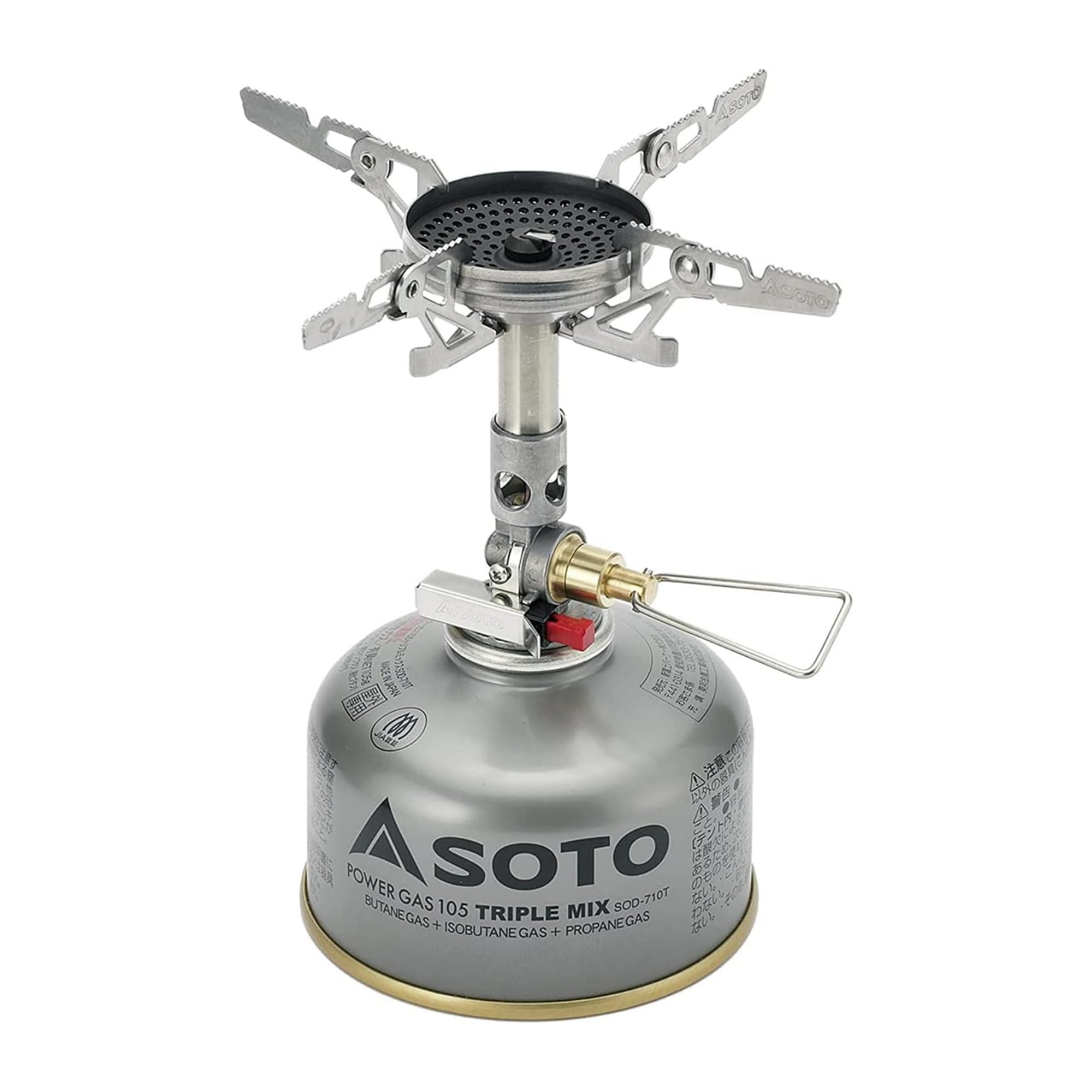
The PocketRocket is our default; the WindMaster is what we pack when the trip goes above treeline. SOTO's burner head is concave, with the pot sitting close to the flame, which works like a built-in windscreen, and a regulator holds the output steady as the canister cools. It's rated at 3,260 watts, it weighs 87 grams, and it ships with the 4Flex, wider legs that hold a larger pot securely.

The regulator is the part we care about most. A cold canister loses pressure as it empties, and a regulated stove keeps its flame instead of sagging into a weak flicker halfway through dinner; SOTO rates this one for consistent output in wind, cold, and gusts. We also like where the igniter lives — built into the burner post rather than clipped onto the outside, which is the piece that breaks on cheaper stoves.

None of that is free. At 87 grams it's about half an ounce heavier than the PocketRocket and it costs more, and the 4Flex is one more small part to lose in the dark. What you get is a stove that shrugs off weather the MSR has to be sheltered from, with pot legs wide enough that a 1.5-liter pot sits still even when the ground underneath it doesn't.

Pros

  • Holds output in wind and cold
  • Igniter built into the burner post
  • 4Flex supports larger cookware
  • 87 grams with a 3,260 W output

Cons

  • Heavier and pricier than our top pick
  • 4Flex is a separate piece to keep track of
Our verdict

Buy the WindMaster if your camps are exposed: the regulated burner holds its flame in wind and cold where open stoves struggle, and the 4Flex handles a bigger pot.

Check Latest Price
3

Best Fast-Boil System

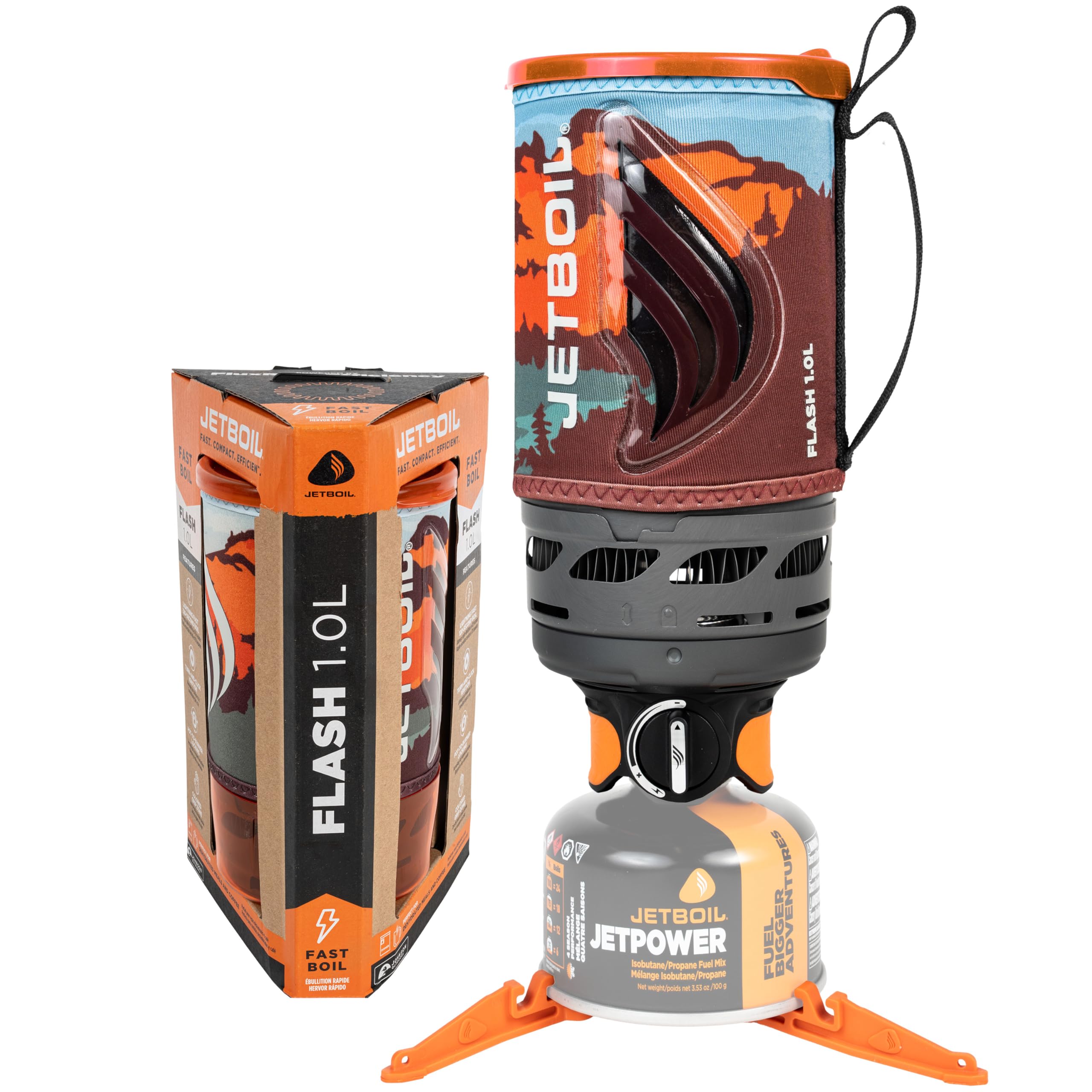
Jetboil Flash 1.0L

94 /100
Angler Score Outstanding

Key details

Weight
13.1 oz
Capacity
1.0 L
Ignition
Turn-and-click auto ignition
Boil Time
16 oz in 2 min
Check Details on Amazon

Two minutes for 16 ounces of water is the number that sells the Flash, and it changes the shape of an evening: coffee is ready before your hands are warm, and a freeze-dried dinner is rehydrating while you're still getting out of your layers. The burner locks onto the 1.0-liter pot at three points, the insulated cozy holds the heat, and the whole kit — burner, canister stabilizer, lid, and a 100-gram canister — packs inside the cup.

What we appreciate is how little thought the system asks for. Turn the knob and it clicks and lights; the rubberized safe-touch zones let you grab the pot while it's still hot; the bottom cup doubles as a bowl. Nothing here needs a windscreen or a second pot, which is why this is the stove we take when the forecast is marginal and dinner comes out of a bag.

It's a water boiler, and it's honest about that. Coffee, tea, soup, and rehydrated meals are its whole repertoire; it doesn't sauté, and you can't swap in your own titanium pot without giving up the efficiency that justifies the system. At 13.12 ounces it's five times the weight of the PocketRocket and the most expensive stove here — but for two-minute boils in one tidy bundle, nothing else in this group comes close.

Pros

  • 16 oz boiled in about 2 minutes
  • Burner, canister, and lid pack into the pot
  • Turn-and-click ignition, no lighter needed
  • Insulated cozy keeps water hot

Cons

  • 13.12 oz system weight
  • Boils water; not built for real cooking
Our verdict

For freeze-dried dinners and fast coffee, the Flash is the quickest system here: a 1.0-liter pot, auto ignition, and 16 ounces boiled in about two minutes.

Check Latest Price
4

Best Simmer Control

Jetboil MightyMo

94 /100
Angler Score Outstanding

Key details

Output
2,900 W
Weight
3.36 oz
Boil Time
About 3 min
Regulator
Four-turn simmer control
Check Details on Amazon

Most canister stoves have two settings: full blast and off. The MightyMo has a four-turn regulator that gives you everything in between, which is why it's the stove we hand someone who wants to actually cook — a pan of eggs, sautéed greens, a sauce that needs to sit at a simmer. It's rated at 2,900 watts, it hits a rolling boil in about three minutes, and it weighs 3.36 ounces.

The open-platform design is the smart part. The burner takes Jetboil's FluxRing pots and their skillet without a separate pot support, so you can buy the burner now and add cookware later. Jetboil rates it at half the fuel consumption of a traditional system, though that only holds with their pot on top — pair it with a plain titanium mug and you have an ordinary canister stove with an unusually good valve.

Two things to know. It's regulated down to 20 degrees Fahrenheit, so it keeps working on a below-freezing morning, but no windscreen comes in the box and an open burner in a breeze is a losing fight. And at 3.36 ounces it's still heavier than the PocketRocket for the same basic job, so the regulator and the cookware compatibility are what the extra weight buys. On a cold morning with onions going in a pan, that feels like a bargain.

Pros

  • Four-turn regulator gives real simmer control
  • 3.36 oz open-platform burner
  • Regulated down to 20°F
  • Takes Jetboil FluxRing pots and skillet

Cons

  • Fuel savings depend on Jetboil cookware
  • Pot and fuel sold separately
Our verdict

The MightyMo is the stove for people who cook rather than rehydrate: a four-turn regulator gives real simmer control, and it's still only 3.36 ounces.

Check Latest Price
5

Best Ultralight

BRS-3000T

91 /100
Angler Score Outstanding

Key details

Output
2,700 W
Weight
0.88 oz
Fuel Use
About 140 g per hour
Boil Time
1 L in about 3 min
Check Details on Amazon

Twenty-five grams. That's the BRS-3000T, and nothing else here is close — the stove folds smaller than your thumb and disappears into a 750 ml pot with a 110-gram canister. It's rated at 2,700 watts and brings a liter to a boil in about three minutes, which is right there with the stoves at the top of this list.

Living with it is the other half of the story. The pot supports are three short tabs, so a narrow mug or a 750 ml pot sits fine and a wide 1.5-liter pot rocks; keep it to one-person cookware and it behaves. Screwing it onto a canister can vent a little gas before the seal seats, so make the connection outdoors with the valve closed and give the O-ring a look before you head out.

What 25 grams buys you is less metal, and it shows. The supports flex under a full pot, and a season of hard use is a fair expectation rather than a guarantee. We treat it as a second stove, a backup, or the one that goes in the pack when the trip is short and the load is already heavy — not as the only stove you'll own. For very little money, though, it's hard to argue with.

Pros

  • 25 g folded
  • Boils a liter in about 3 minutes
  • Stove and 110 g canister nest in a 750 ml pot
  • Very inexpensive

Cons

  • Small pot tabs suit narrow pots only
  • Supports flex under a full pot
Our verdict

Buy the BRS-3000T as a second stove or for trips where every gram is counted: 25 grams and a three-minute liter for very little money.

Check Latest Price
6

Best Budget Stove with an Igniter

Fire-Maple Greenpeak 1

89 /100
Angler Score Excellent

Key details

Valve
EN417 threaded
Weight
3 oz
Ignition
Built-in piezo igniter
Folded Size
2.1 x 2.8 in
Check Details on Amazon

A piezo igniter, an 85-gram body, and a price that undercuts almost everything here: the Greenpeak 1 is the budget stove we don't wince at recommending. It folds to 2.1 by 2.8 inches, it uses the standard EN417 threaded valve, and it's built from stainless steel, ceramic, and aluminum rather than the paper-thin titanium of the ultralight featherweights.

It isn't the fastest stove in this group. Expect around five minutes for 16 ounces in a plain pot; pair it with Fire-Maple's own heat-exchanger pot and the boil comes down sharply, which is the upgrade worth knowing about. The pot supports are wide and flat, and the matching G3 pot sits on them as one solid unit rather than balancing on three points.

What we like most is how little it asks you to give up to save money. You get the igniter the PocketRocket leaves out, a sturdier feel than the 25-gram titanium stoves, and enough flame control to simmer rather than just blast. It's heavier than the BRS and slower than the MSR, but those feel like reasonable trades for a first stove, a spare, or a loaner you don't mind handing to a friend.

Pros

  • 85 g with a built-in piezo igniter
  • Folds to 2.1 x 2.8 in
  • Steel and ceramic build feels sturdier than titanium
  • Budget price

Cons

  • Around five minutes for 16 oz in a plain pot
  • Fast boils need a heat-exchanger pot
Our verdict

The Greenpeak 1 is the budget pick we trust: 85 grams, a built-in igniter, and a sturdy feel that the cheapest ultralight stoves lack.

Check Latest Price
7

Fuel-Free Backup

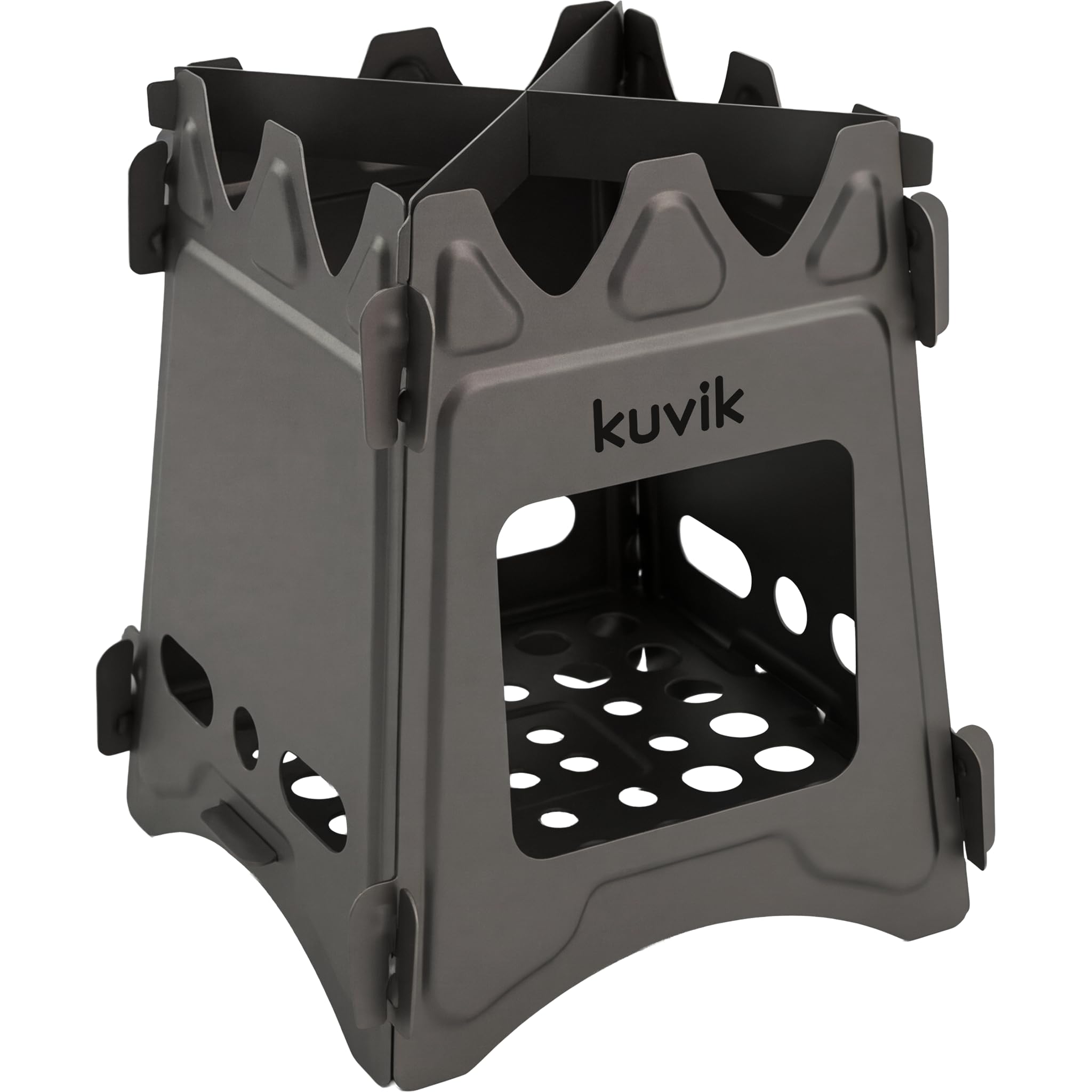
Kuvik Titanium Wood Stove

90 /100
Angler Score Outstanding

Key details

Fuel
Wood and natural tinder
Weight
6.88 oz
Open Size
6.25 x 5 x 5 in
Packed Thickness
0.2 in
Check Details on Amazon

There's no canister here at all. The Kuvik is a Grade-1 titanium firebox that assembles from flat panels — tabs into slots, no tools — into a 6.25 by 5 by 5 inch stove, and packs down to a 0.2-inch stack in its own pouch at 6.88 ounces. That's lighter than a Jetboil and it can't run out of fuel, because the fuel is whatever is lying on the ground.

It burns twigs, pinecones, bark, and scraps, and it burns them hot. A decent handful of dry sticks gets a mug or a pouch meal to a boil in a few minutes in still air; damp wood smolders, smokes, and needs feeding constantly, so the trip where it shines is a dry one.

The trade-offs are real. It soots the bottom of your pot, it leaves ash, it needs steady feeding, and under a seasonal fire ban you can't light it at all. It's also not the stove you want to be assembling with cold hands in the rain.

Where it earns a place in the pack is as insurance. A stove that can't fail because a valve jammed, and can't leave you cold because you forgot to buy a canister, is worth 6.88 ounces on a winter day trip or in a bug-out kit. For a wet three-day traverse, bring gas; for everything else, this is a fine second stove.

Pros

  • No fuel canisters to carry
  • 6.88 oz and packs 0.2 in flat
  • Burns twigs, bark, and scraps
  • Assembles without tools

Cons

  • Needs dry fuel and constant feeding
  • Soots the pot and leaves ash
Our verdict

The Kuvik earns its place as a fuel-free backup: 6.88 ounces of titanium that burns sticks, so a dead canister never ends the trip.

Check Latest Price
8

Car Camping

Coleman Classic 1-Burner

91 /100
Angler Score Outstanding

Key details

Fuel
1 lb propane
Output
10,000 BTU
Weight
8.32 oz
Boil Time
1 L in 3.25 min
Check Details on Amazon

The Classic 1-Burner is a propane stove with a folding body, 10,000 BTUs, and a liter of water in about 3.25 minutes. It weighs 8.32 ounces, it fits a 6-inch pan, and Coleman's PerfectFlow regulator is designed to hold output as the bottle chills — the sort of thing that matters on a cold morning at a trailhead.

What it's good at is cheap, available fuel. A one-pound propane bottle costs less per cook than a threaded canister and you can buy one at any hardware store, which makes this a natural truck-camping, tailgating, and emergency-kit stove. The burner head is wide enough that a 6-inch pan heats across the middle instead of scorching a ring into it.

Where it stops being a backpacking stove is the fuel. A one-pound bottle is roughly two pounds of steel and gas — fine in a trunk, miserable on your back — so this is a stove for the campsite you drive to, not for a three-day walk. If you already own a lantern and a buddy heater that run on the same bottles, the whole kit makes even more sense.

For that job we like it a lot. It simmers, it runs on the cheapest fuel there is, and it costs little enough that leaving it in the truck all season feels reasonable. It also makes a good second stove for a group: bring the Coleman for the big pot and a canister stove for the coffee.

Pros

  • 10,000 BTU and a liter in 3.25 min
  • Runs on cheap 1 lb propane
  • Adjustable flame with PerfectFlow
  • Folds for packing at 8.32 oz

Cons

  • No built-in igniter
  • Wide pans sit awkwardly on three supports
Our verdict

Take the Coleman Classic car camping: cheap propane, 10,000 BTUs, and a wide burner for a skillet, in a stove that folds for packing.

Check Latest Price

How We Tested Backpacking Stoves

We started by pulling together the stoves that show up again and again in thru-hiker forums, gear shop shelves, and trip reports, then filtered the field by burner output, packed weight with the stuff sack, folded footprint, pot support width, and price. Anything that couldn't comfortably hold a one-liter pot or that cost more than a decent sleeping pad got cut before we ever lit it. That left 14 stoves, which we rotated through eight months of trips: windy ridge campsites, damp mornings at lake campsites, and a few car-camping weekends where weight stopped mattering and we could focus on how the flame behaved.

In camp, we timed how long each stove took to boil two cups and then a full liter of cold water, and we ran that test again on a breezy afternoon to see which burners choked and which shrugged it off. We weighed every stove on a kitchen scale with its sack, then packed each one into a 750-milliliter pot alongside a small fuel canister to see how much room was actually left for the rest of our kit. Stability got tested the honest way — a full pot nudged with a spoon, then a heavier two-liter pot set on the arms to see if they sagged.

Flame control was the quiet separator. We tried to hold a bare simmer for rice and sauces, noting which valves jumped straight from off to roaring and which offered a usable range in between. After each trip we wiped everything down, checked the pot support arms and threads for wear, and noted which igniters had already started to need a backup lighter. Value came last: we compared what each stove weighed and how it performed against what it cost, because a bargain that boils slowly or fails at altitude isn't a bargain at all.

How to Choose a Backpacking Stove

Weigh the whole kit, not the stove

The PocketRocket 2 is 2.6 ounces and the Jetboil Flash is 13.12, but the number that matters is what goes into your pack: stove, lighter, canister, and pot together. A 100-gram canister weighs the same whichever burner it feeds, and a stove that nests inside the pot with the canister saves real volume as well as grams. Before you buy, load the stove, your lighter, and the canister you plan to carry into the pot you plan to bring. If it doesn't all fit, the packed size on the listing was never the figure you needed.

Wind and cold decide more than wattage

An open burner loses heat the moment the wind picks up, and a canister loses pressure as it empties, so the flame that boiled water at the trailhead sags exactly when dinner depends on it. Regulated stoves such as the SOTO WindMaster and the Jetboil MightyMo hold their output as the canister chills, and a concave burner head or a heat-exchanger pot squeezes more from the same gas.

If you cook in exposed places, pay for the regulator. If you don't, spend the money on fuel instead: keep the canister inside your jacket before lighting, and shelter the stove with your body and your pack rather than trusting a still morning to stay still.

Decide whether you boil or cook

Be honest about the menu. If dinner is a bag of freeze-dried food and breakfast is coffee, an integrated system like the Jetboil Flash is the efficient answer: pot, burner, and cozy as one unit, with the heat kept in the pot. If you sauté, simmer, or use a real pan, an open burner with a wide head and a proper valve, such as the MightyMo or the PocketRocket 2, is far more useful.

Then match the pot to the arms. Wide, heavy cookware wants long pot supports, and a 1.5-liter pot balanced on three tiny tabs is an accident waiting to happen. Load the pot you own on the stove before you commit; if it rocks, the stove is wrong for you no matter how fast it boils.

Treat the igniter as a convenience

A push-button piezo igniter is lovely on a cold morning, and it is also the first thing to stop working; the Jetboil Zip doesn't have one at all, and plenty of stoves that do end up lit with a match by the second season. Buy a stove for how it burns, not for the click, and when an igniter gives up, the trip doesn't have to.

A mini lighter weighs almost nothing, works when the igniter doesn't, and dries out after a soaking. Keep one in the cook kit regardless of what the stove claims, and you've removed the only part of the system that fails without warning.

Sort out fuel before you sort out the stove

Threaded EN417 canisters are sold in most of the world, which makes the MSR, SOTO, Jetboil, BRS, and Fire-Maple stoves easy travel companions. A one-pound propane bottle is cheap and everywhere in the U.S. but heavy to carry any distance. Wood is free, and sometimes illegal where fire restrictions are in force.

Check what you can actually buy at your resupply point before you commit, and remember that canisters can't fly. A stove that runs on the fuel you can find beats a better stove that doesn't.

Frequently Asked Questions

Final Verdict

The MSR PocketRocket 2 is the stove we point most backpackers toward, and nothing here beats it as a default: 2.6 ounces, a liter boiled in about three and a half minutes, and a valve that goes from a simmer to a rolling boil. Spend more only for a reason — the SOTO WindMaster if you cook in exposed, gusty places where a regulated flame keeps working, or the Jetboil Flash if dinner comes out of a bag and you want it ready in two minutes.