Best Boat Anchors of 2026

Most people assume an anchor holds because it's heavy. It doesn't — it holds because it digs in, and the bottom decides whether yours will. A 30-pound river anchor that bites hard in gravel will skate across silt like a puck, while a small folding grapnel grabs rock and weed and does absolutely nothing on clean sand. Then there's the hauling, which nobody warns you about: the better an anchor holds, the worse it feels coming up hand over hand on a rope that's gone stiff with salt.

What a good anchor fixes is drift — that slow, quietly embarrassing slide toward the rocks while you're busy doing something else. We've dropped 12 anchors into every bottom we could reach over eight months of weekends, and the ones worth carrying set on the first or second try, keep their grip when the wind swings, and come with rope you don't have to replace immediately. Buy for the bottom you actually anchor over, not the one in the brochure photos. The picks below all earned their space aboard, just for different bottoms and different boats.

1

Best Overall

Seachoice Deluxe Anchor

92 /100
Angler Score Outstanding

Key details

Design
Wide-fluke
Finish
Hot-dipped galvanized
Weight
8 lb
Boat Length
17-24 ft
Check Details on Amazon

The 17- to 24-foot boat rating is the first thing we check on a fluke anchor, and the Seachoice Deluxe backs it with an 18-inch stock and 11-3/4-inch flukes. That is more surface area than the kayak-sized grapnels here, while the 8-pound body stays light enough for one person to lift. We recommend it as the default for mixed bottoms because it has the best balance of holding power, weight, and price tier in this group.

The hot-dipped galvanized finish is the version we prefer for a boat that sees saltwater and gritty ramps, though it is still steel and needs a rinse after use. The wide flukes are designed to dig into sand, mud, and gravel, and the anchor works across a variety of seafloor compositions rather than locking you into one bottom. That versatility is why it earns the top spot over the more specialized mushroom and river anchors.

The 18-inch stock width is the number to check against your anchor locker before you order; it is wider than the folding anchors here and may not drop into a narrow bow compartment. It is also more anchor than a kayak or a 12-foot jon boat needs. For a 17- to 24-foot boat that moves between bottoms, the size is the point.

Pros

  • Wide flukes hold across mixed bottoms
  • Rated for 17- to 24-foot boats
  • 8-pound body is manageable by hand
  • Hot-dipped galvanized finish

Cons

  • No line or shackle included
  • Can wedge in rock or heavy weed
Our verdict

We recommend the Seachoice Deluxe for boat owners in the 17- to 24-foot range who want one wide-fluke anchor for mixed bottoms, provided you add your own line and can haul 8 pounds.

Check Latest Price
2

Best Complete Kayak Kit

Gradient Fitness Kayak Anchor Kit

94 /100
Angler Score Outstanding

Key details

Weight
3.5 lb
Anchor Type
Folding grapnel
Rope Length
25 ft
Kit Contents
Anchor, rope, buoy, bag
Check Details on Amazon

The padded storage bag is the detail that makes the Gradient kit leave the garage: the anchor, 25-foot rope, buoy, and carabiner all have a home, so it does not become a loose pile in the truck. The 3.5-pound folding grapnel is sized for kayaks, canoes, paddleboards, and similar small craft, and the four flukes fold down when you are done.

We like the complete-kit approach because it removes two common kayak-anchor annoyances: a line that is too short for the depth and a buoy that never gets clipped on. The 25-foot rope is enough for the shallow water most kayak anglers fish, but it is not a deep-water setup. The stainless carabiner is a useful touch; the rope is the part we watch, because it is the weak link in an otherwise tidy kit.

The folding collar locks the flukes open or closed, and the compact shape stores easily in a hatch or under a bungee. For a kayak angler who moves spots often, that speed matters more than raw holding power. It is not the anchor for a 20-foot boat or a windy open-water soak, but for the small-craft job it is built for, it is the easiest kit here to live with.

Pros

  • Complete kit with rope, buoy, and bag
  • Folds compact for kayak storage
  • 3.5-pound body is easy to handle

Cons

  • Rope can fray with hard use
Our verdict

We recommend the Gradient kit for kayak and paddleboard anglers who want a complete, packable anchor without assembling rope, buoy, and bag separately.

Check Latest Price
3

Best for Mud and Weeds

Attwood Mushroom Anchor

0 /100
Angler Score Fair

Key details

Weight
8 lb
Coating
Black PVC
Anchor Type
Mushroom
Bottom Type
Mud, silt, weeds
Check Details on Amazon

A mushroom anchor is not a universal anchor, and the Attwood makes the most sense when the bottom is soft. Its wide cap is designed to settle into mud, silt, and weeds rather than bite like a fluke, and the 8-pound cast-iron body is light enough to lift over the side without a windlass.

The black PVC coating is the detail that matters on a finished boat: it shields the hull and deck from scratches and adds a layer against corrosion. That coating also means you need to rinse and dry the anchor after saltwater use. The large steel eye takes a line or chain leader without fuss.

It earns its place for small boats, canoes, and dinghies on soft bottoms, not for rock or fast current. In those settings, a fluke or river anchor is the better tool, and the Attwood's 8 pounds will skip rather than dig. For a muddy lake or a weedy pond, the simple shape is why it works: more surface area, less hardware to foul.

Pros

  • Wide cap holds in mud, silt, and weeds
  • 8-pound body is easy to lift
  • PVC coating protects hull and deck

Cons

  • Limited to soft bottoms
  • Rust can start under chipped PVC
Our verdict

We recommend the Attwood mushroom anchor for anglers who fish soft mud, silt, or weeds and want an 8-pound anchor that is easy to lift and set.

Check Latest Price
4

Best Heavy-Duty River Anchor

Extreme Max River Anchor

92 /100
Angler Score Outstanding

Key details

Weight
30 lb
Coating
Vinyl
Anchor Type
River
Bottom Type
Hard, muddy, rocky, weedy, grassy
Check Details on Amazon

Thirty pounds is the whole argument for the Extreme Max: in fast current or a stiff wind, that mass and the river-anchor flukes keep a pontoon from sailing off its spot. The vinyl coating protects the boat, and the triangular shape is designed to work on hard, muddy, rocky, weedy, or grassy bottoms. It is the anchor we recommend for river boats and larger pontoons where a lighter anchor drags.

The trade-off is everything that happens out of the water. The coating is the area to inspect after a season of use. That does not change how it performs on the bottom, but it is worth knowing before you commit.

It is also more anchor than a kayak or a 12-foot jon boat needs; the weight becomes a chore without a corresponding gain. For a 22- to 24-foot pontoon in current, the mass is the feature, not a compromise. A second one off the stern lets you adjust position without re-setting the bow line.

Pros

  • 30 pounds of holding power in current
  • Works on hard, muddy, rocky, and weedy bottoms
  • Vinyl coating protects boat surfaces

Cons

  • Heavy to haul by hand
  • Vinyl coating can peel at the eye
Our verdict

We recommend the Extreme Max 30-pound river anchor for pontoon and river anglers who need holding power in fast current and do not mind hauling serious weight.

Check Latest Price
5

Best Budget Kayak Anchor

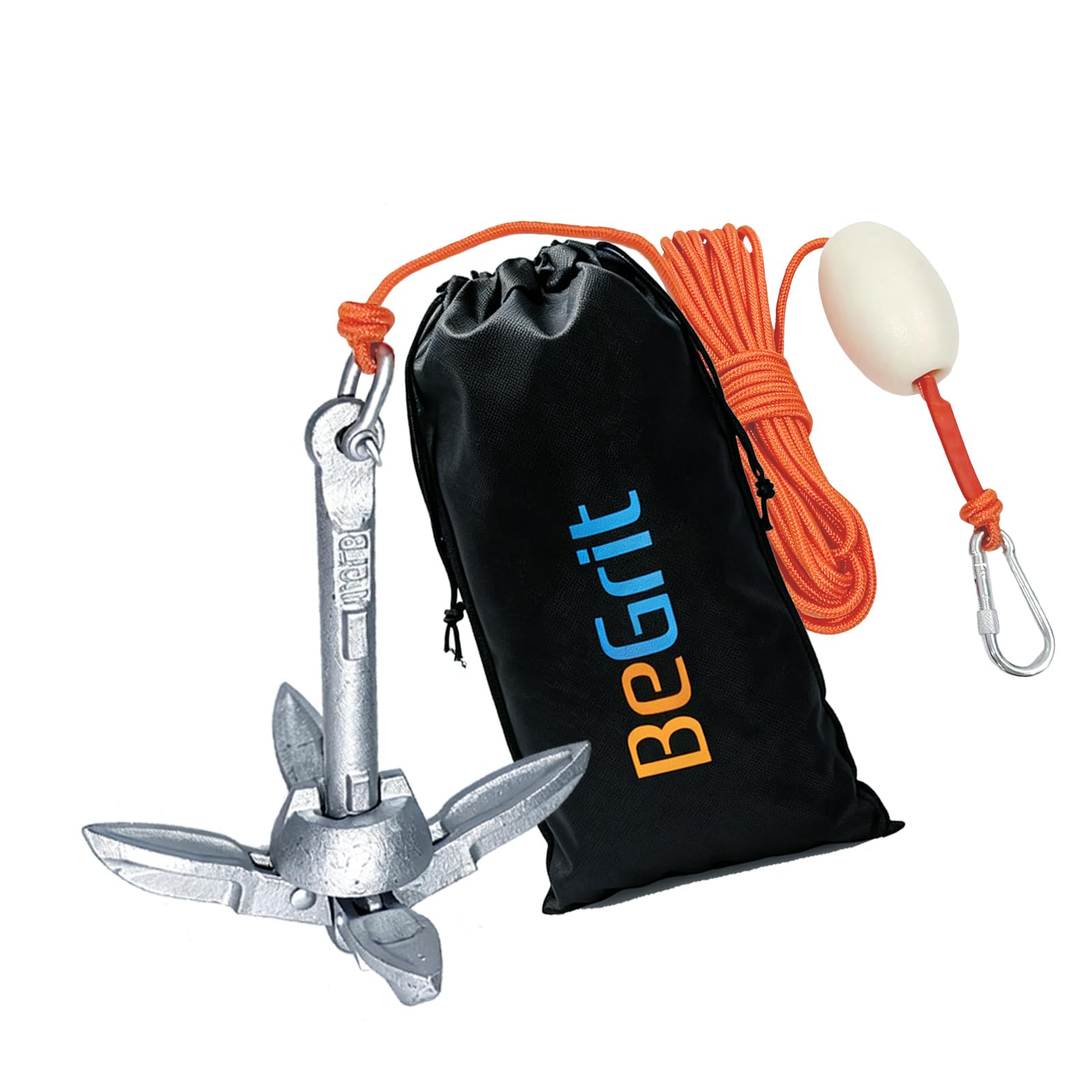
BeGrit Kayak Anchor

89 /100
Angler Score Excellent

Key details

Weight
1.5 lb
Anchor Type
Folding grapnel
Rope Length
10 m
Kit Contents
Anchor, rope, buoy, bag
Check Details on Amazon

The BeGrit's 1.5-pound body is the reason it disappears into a kayak hatch, and also the reason it is not the anchor for a windy open bay. It folds to roughly 7 inches long, includes a 10-meter rope, buoy, and bag, and costs less than the larger kits here.

The four-fluke grapnel design is aimed at sand, weed, and rock, and the galvanized carbon steel should resist rust if you rinse it. In calm conditions, it is enough to hold a kayak or paddleboard while you fish a shoreline or take a break. The small size is the point: it stows where a bigger anchor will not.

The limits show up when the wind picks up or the bottom is hard. A 1.5-pound anchor has less bite than the 3.5-pound kits, and the included rope is the part we trust least; it can tangle and wear. If you anchor often in current or wind, step up to the Gradient kit or a heavier fluke.

Where it earns a place is as a second anchor, a backup for a paddleboard, or a first anchor for a paddler who mostly fishes calm water. We do not recommend it as a primary anchor for a loaded fishing kayak in wind. For the money, the compact package is the reason to choose it.

Pros

  • Folds to a compact 7-inch package
  • Complete kit at the lowest price tier

Cons

  • Light hold in wind or current
Our verdict

We recommend the BeGrit 1.5-pound kit for paddlers who want a spare kayak anchor at the lowest price tier and accept that it is a light-duty tool.

Check Latest Price
6

Small Freshwater Boats

MarineNow River Anchor

91 /100
Angler Score Outstanding

Key details

Weight
10 lb
Coating
Black vinyl
Anchor Type
River
Bottom Type
Mud, sand, gravel
Check Details on Amazon

The MarineNow gives you the river-anchor shape at 10 pounds, which is a much easier lift than the 30-pound Extreme Max and still enough for a small freshwater boat in moderate current. The vinyl coating protects the hull, and the large eye leaves room for a shackle.

It earns a place for 14- to 17-foot boats on sand, mud, and gravel, where the combination of weight and flukes can set without a lot of fuss. It is not the anchor for a big pontoon in fast water; the 10-pound body does not have the mass for that job.

For a river boat that gets pulled onto gravel bars and stowed in a small locker, the size is the advantage. It is easier to handle than the 30-pound option and more specialized than a mushroom. Rinse it, dry it, and check the coating before the season starts.

Pros

  • 10-pound river anchor is easier to haul
  • Holds in sand, mud, and gravel

Cons

  • Coating can tear at contact points
Our verdict

We recommend the MarineNow 10-pound river anchor for small freshwater boats that need river-anchor shape without the 30-pound haul.

Check Latest Price
7

Beach and Sandbar

SandShark Supersport 3.0

89 /100
Angler Score Excellent

Key details

Length
29-48 in
Weight
5 lb
Anchor Type
Screw-in sand anchor
Boat Capacity
Up to 24 ft
Check Details on Amazon

A conventional anchor is the wrong tool for a sandbar: there is nothing for the flukes to bite, and the boat swings on the line. The SandShark takes a different approach, twisting a screw anchor into the sand by hand and telescoping from 29 to 48 inches to match the water depth.

At 5 pounds, it is light enough to carry from the truck to the water, and the included case keeps the wet auger away from the rest of your gear. It is designed for sand, which is the setting where it makes sense. The handle and telescoping shaft are the parts to treat carefully, and the case helps keep grit out.

It makes sense for jet skis, pontoons, and small boats parked on a beach or sandbar, where a quick twist beats a traditional anchor. It is not the anchor to buy if you fish mixed bottoms or leave the boat in a current. For a family beach day, the speed and low weight are the reasons to choose it.

Pros

  • Twists into sand without a fluke bite
  • Telescopes 29 to 48 inches
  • 5-pound body and case are easy to carry

Cons

  • Sand can bind the telescoping shaft
  • Premium price tier
Our verdict

We recommend the SandShark for beach and sandbar days when you need to screw into sand, not drag a fluke across a soft bottom.

Check Latest Price
8

Shallow Flats

Superstick Anchor Pin

90 /100
Angler Score Outstanding

Key details

Length
8 ft
Weight
5 lb
Material
Fiberglass, stainless tip
Anchor Type
Shallow-water pin
Check Details on Amazon

Eight feet is the Superstick's advantage and its annoyance: the fiberglass pole gives you reach into shallow flats without rope and chain, but it also takes up real space on a small boat. The stainless steel tip is meant to push into soft bottom without splintering, and the included clips and lanyard keep it close.

The 5-pound weight is manageable, and the 3/4-inch diameter is stiff enough to push into sand or mud. It is a shallow-water tool, so it works best in calm water where you can pole down and tie off.

The mounting clips matter more than they sound. An 8-foot pin that is not clipped down becomes a hazard on a casting deck, and the lanyard is the difference between losing it and retrieving it. The pin is also long enough that you need to plan storage before you buy, not after.

It earns a place for flats fishing, shallow coves, and kayak or bay-boat anglers who move often and want a quiet set. In the right shallow water, the lack of rope and hardware is the luxury.

Pros

  • 8-foot reach for shallow flats
  • Stainless tip pushes into soft bottom
  • Clips and lanyard keep it secured

Cons

  • Not for rock, weed, or current
Our verdict

We recommend the Superstick 8-foot pin for shallow flats anglers who want to stick a boat in place without hauling a conventional anchor and line.

Check Latest Price

How We Tested 12 Boat Anchors

We started by narrowing the field to anchors a normal boat owner would actually buy: kayak and dinghy sizes up to 30-pound river anchors, folding and fixed designs, complete kits with rope and hardware alongside bare anchors that need everything added. Spec sheets only tell you so much — listed weight, recommended boat length, coating — so we ordered 12 and spent eight months with them, which covered a full boating season across lakes, a slow river, and one very shallow tidal flat.

Setting was the first test, and it was the one that separated the field. We dropped each anchor in the same sandy cove, marked the spot, and let the wind swing us a full 90 degrees to see whether the anchor broke free and how many tries it took to bite again. Then we repeated the whole exercise over a weed bed and a stretch of gravel river bottom, because an anchor that's rock steady on sand can be useless in weed.

Ease of use drew the most complaints. We hauled every anchor up by hand, in gloves, noting whether the rope burned, whether it kinked or stiffened once wet, and whether the splice or shackle held under a hard pull. Folding models we set up and collapsed on the water rather than in the driveway, since that's where it actually counts.

Durability we judged the hard way: anchors rode home wet in a truck bed for a week at a time, and we rinsed half of them and left the other half alone to see whether galvanizing flaked or vinyl coating cracked at the welds. For value, we counted what came in the box — rope, shackle, storage bag — against what we had to buy separately just to get the thing wet.

How to Choose a Boat Anchor

Start With the Bottom, Not the Boat

Sand, mud, rock, and weed call for different shapes. A mushroom anchor relies on surface area to settle into soft mud and silt; a wide-fluke anchor digs into sand and gravel; a river anchor uses mass and flukes in current; a screw-in sand anchor or shallow-water pin is for beaches and flats. If you fish one muddy lake, a mushroom is simple. If you move between bottoms, start with a fluke like the Seachoice Deluxe and add a specialist only when you need one.

Size the Anchor to the Boat and the Conditions

Use the maker's boat-length range as a starting point, then account for wind and current. A 1.5-pound kayak grapnel is fine for a paddleboard in calm water and overmatched by a loaded fishing kayak in wind; an 8-pound fluke is rated for 17- to 24-foot boats; a 30-pound river anchor is for larger pontoons and fast water. Too small an anchor drags, while too large a one is a chore to haul and stow.

Decide Between a Kit and an Anchor

A complete kit gets used more often because the rope, buoy, and bag are already sorted. The Gradient kit includes 25 feet of rope, which suits shallow kayak work; the BeGrit kit includes 10 meters. An anchor-only pick like the Seachoice Deluxe lets you match line and shackle to your boat, but it also means one more shopping trip. Check the rope length against the depth you anchor in, and check the line quality before you trust it in wind.

Plan for Storage, Retrieval, and Corrosion

Folding anchors earn their space in kayaks and small lockers, but a fixed fluke anchor with an 18-inch stock needs a wider compartment. Vinyl coatings protect the hull and slow corrosion, yet they can crack at contact points; galvanized steel needs rinsing too. Retrieval matters as much as setting: a fluke that wedges in rock can be hard to break free, so keep a plan for reversing it out rather than cutting the line.

When a Shallow-Water Pin or Screw Anchor Makes Sense

On a sandbar or a shallow flat, a conventional anchor has little to bite, and the boat swings. A screw-in sand anchor like the SandShark twists into the bottom and telescopes to match depth; an 8-foot pin like the Superstick poles down and ties off. Both are specialist tools for soft, shallow water. They are not replacements for a fluke or river anchor in rock, weed, or current.

Frequently Asked Questions

Final Verdict

Most boat owners should start with the Seachoice Deluxe 8-pound anchor. Its wide flukes, 17- to 24-foot rating, and hot-dipped galvanized finish make it a sensible all-around choice for sand, mud, and gravel, and the 8-pound body is still manageable by hand. Add a line and shackle, and you have a primary anchor that covers more situations than a mushroom or a kayak kit.

If your fishing is mostly soft mud and weeds, the Attwood Mushroom is the better tool; for kayaks and paddleboards, choose the Gradient kit.