Best Boat Deck Lights of 2026

The best twenty minutes of a sunset cruise come right after the sun drops — until someone has to find the bow cleat in the dark. A deck light is a small, unglamorous purchase that decides whether tying off is a two-second habit or a fumbled phone-flashlight affair. It also has to survive exactly what kills most 12-volt accessories: spray over the bow, a hose-down at the end of the day, and a summer of UV that turns cheap plastic chalky. Get it right and the boat just works after dark; get it wrong and you're re-drilling holes next spring.

We've had 14 of these bolted to a pontoon and a center console over the past seven months, through flat calm and a chop that came over the bow. The one thing I'd tell a first-time buyer is that the IP number printed on the box matters less than how the housing seals where the wire exits, because that seam is where water actually finds its way in. What follows are the lights that held up — the ones I'd drill for again.

1

Best Overall

Wave One Dual-Color Spreader Light

91 /100
Angler Score Outstanding

Key details

Sold As
Single light
Power Draw
8.9W at 12V DC
Color Modes
White and blue
Waterproof Rating
IP68
Check Details on Amazon

Two wires, one switch, two colors: the driver on this spreader light lives inside the housing, so the toggle already on your panel flips it between white and blue, with no third conductor to pull and no three-position switch to find a home for. That is the detail that put it first in this group. Replacing an old halogen spreader becomes a swap rather than a rewire.

It is not the floodlight of the group. At 8.9 watts it throws a generous pool of light over a cockpit or an aft deck rather than a wash down the whole boat, which is the right amount for a fixture sitting a couple of feet above your head. Around that, the build is what you are paying for: an IP68 seal, stainless bracket and fasteners, and a polycarbonate lens on a 12-ounce body.

Two practical notes. It ships as a single light, so a matched pair is two orders, and the nut that tightens the bracket sits close in against the housing where a stubby wrench earns its keep. The painted finish is the part that ages first on a saltwater boat — a dab of grease on the fastener threads and a rinse at the end of the weekend go a long way.

Where it earns its place is the boat with one or two working areas that matter — a T-top leg, a hardtop underside, a radar arch — and a crew that wants white light to rig and blue light to fish. If all you want is the most light for the money, the flood pairs below deliver that with fewer fixtures.

Pros

  • Switches white to blue on two wires
  • IP68 seal with stainless bracket and hardware
  • Low 8.9W draw at 12V

Cons

  • Sold as a single light
  • Painted housing is the first thing to age
Our verdict

Our pick for a working deck light: marine-grade hardware, an IP68 seal, and white-to-blue switching on the wiring you already have.

Check Latest Price
2

Best for Maximum Light

EXZEIT 72W LED Boat Lights

92 /100
Angler Score Outstanding

Key details

Sold As
Pair
Beam Angle
180 degrees
Light Output
4,000 lumens (pair)
Operating Voltage
12/24V
Check Details on Amazon

Two 6-inch pods, 4,000 lumens between them, and a 180-degree flood that turns a black creek into something you can read a channel marker by. On output, nothing else in this group comes close. These are the lights for the person who wants the deck lit up for docking, not a polite pool of light around the console.

The trade-off is water. Rain and spray can find a way inside the lens over a season, so where you mount them matters as much as which pair you buy: hang them where water drains off rather than pools, aim them slightly down, and put a dab of sealant on the screw holes. The current version adds an anti-fog breather valve and heavier seals, which is the right direction. Under a covered hardtop or a T-top, the worry mostly goes away.

The rest is straightforward: cast aluminum housings, stainless brackets, and 12/24V compatibility, so the same pair works on either system. Wiring and connectors are not in the box, and the pods are polarity sensitive, so plan the harness before the drill comes out. A pigtail in the box would make this a better kit.

Pros

  • 4,000 lumens across a 180-degree flood
  • Anti-fog breather valve and reinforced seals
  • Cast aluminum body with stainless bracket

Cons

  • Water can reach the lens over a season
  • No wiring or connectors in the box
Our verdict

The most output for the money in this group — buy them to light up a deck, and mount them where water runs off rather than sits.

Check Latest Price
3

Best Budget Flood

Nilight 18W Marine Light Bar

87 /100
Angler Score Excellent

Key details

Sold As
Pair
Wattage
18W each
Light Output
1,800 lumens
Waterproof Rating
IP67
Check Details on Amazon

1,800 lumens from 18 watts, in a pair of pods small enough to bolt where nothing else fits. That is a modest number beside the 4,000-lumen pair above, and it is the right number for a swim platform, a transom, a poling platform, or the shadowed corner under a gunwale where a big flood only makes glare.

The brackets swivel through 180 degrees, which matters more than it sounds: you bolt them flat and aim them afterward instead of drilling a second set of holes. Die-cast aluminum housings, a PC lens, IP67 sealing, and a 10-to-30-volt range that shrugs off charging voltage. Two things to sort out before you drill — the supplied bolts run short on thick mounting surfaces, and the mounting holes are not always drilled dead center, so test-fit both pods first.

We fit these as task lights and keep a wide flood for the open deck. A spreader light is one fixture in one place; two pods can be aimed independently at the two spots that are actually dark, and at this size nobody notices they are there until they come on.

Pros

  • 1,800 lumens from an 18W pod
  • Swivel bracket lets you aim after mounting
  • Die-cast aluminum, IP67, 10 to 30V
  • Two-year warranty

Cons

  • Supplied bolts run short for thick mounts
  • Mounting holes can be drilled off-center
Our verdict

A pair of small, tough pods for the corners a spreader light cannot reach; buy them as task lights rather than a deck wash.

Check Latest Price
4

Best Courtesy Light

RVZONE 3-Inch Courtesy Lights

84 /100
Angler Score Excellent

Key details

Size
3-inch round
Pack Size
4 lights
Bezel Material
304 stainless steel
Waterproof Rating
IP68
Check Details on Amazon

The bezel is 304 stainless, not chrome-plated plastic, and that is the single biggest reason we point people at these for a saltwater boat. The cover also hides both screws, so what you see on the bulkhead is a clean 3-inch disc rather than a lens with two fastener heads sitting in it.

Behind it, the lens is sealed with infused glue to IP68 — the rating you want anywhere a fixture sits below a gunwale or takes spray. Output is modest by design: 1-watt LEDs behind high-transparency lenses, which gives you a pool of light at your feet rather than a beam down the dock.

Wiring is two leads through one hole plus two stainless screws, and each flip of the switch alternates white and blue. One circuit, then, buys you real working light and a dimmer blue that leaves your night vision intact. In a four-pack that is a cockpit lit two ways for about the money of a couple of the bigger fixtures.

This is the courtesy light we keep coming back to for cockpits, consoles, and walkaround side decks — two or three a side on a boat in the low twenties. If you need to see the whole foredeck from the helm, it is the wrong tool; that is a flood job.

Pros

  • 304 stainless bezel resists salt corrosion
  • IP68 lens sealed with infused glue
  • White and blue from one switch
  • Hidden screws give a clean face

Cons

  • Courtesy-level output only
  • One-year warranty
Our verdict

The courtesy light we fit on a saltwater boat: stainless, sealed to IP68, and switchable between white and blue on one circuit.

Check Latest Price
5

Best for Whole-Boat Lighting

PSEQT LED Boat Interior Lights

92 /100
Angler Score Outstanding

Key details

Size
3.8-inch surface mount
Pack Size
10 lights
LEDs Per Light
6
Waterproof Rating
IP67
Check Details on Amazon

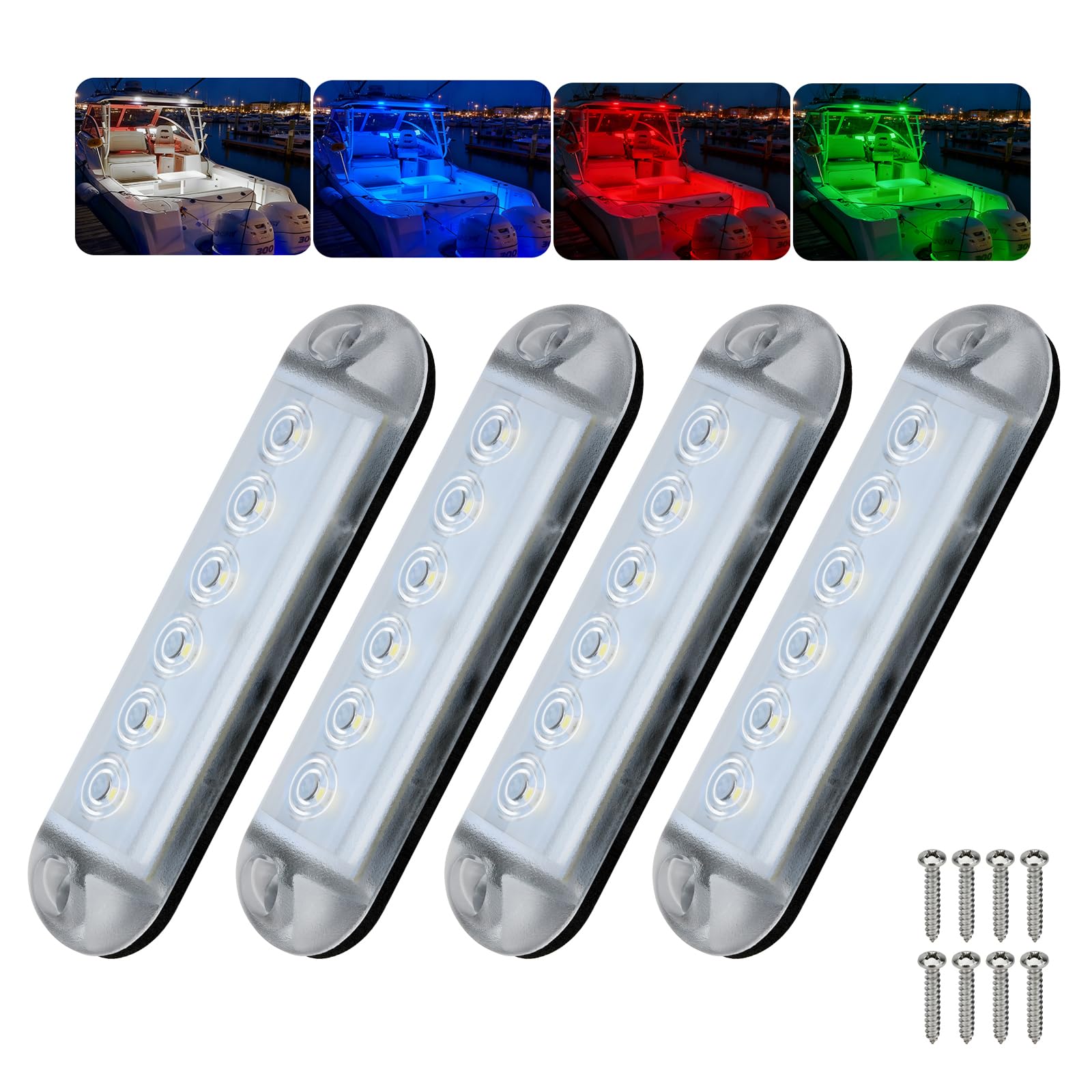
Ten surface-mount fixtures in one box is the argument here, and it is a persuasive one if you have just bought a used boat with empty switch blanks on the panel. Each light is a 3.8-inch bar with six LEDs behind a PC lens, sealed to IP67, and wired with two leads.

Mounting is a foam tape base plus screws, the right combination for a retrofit: the tape holds the fixture while you drive the screws and takes up the curve in a mold. Run them on separate switches if you want zones, because they are all the same white — this is a pack for even, unglamorous light in a cockpit, a cabin, or under a hardtop. At 2.4 watts each, ten of them add almost nothing to your battery draw.

Pros

  • Ten fixtures in one pack
  • Foam base plus screws for retrofit
  • IP67 sealed at 2.4W each

Cons

  • White output only
Our verdict

Ten sealed fixtures in one box, bright enough to be useful and cheap enough to replace — the fast way to light an unwired boat.

Check Latest Price
6

Best for Lockers and Steps

KEING Marine LED Lights

91 /100
Angler Score Outstanding

Key details

Wattage
1.5W each
Pack Size
10 lights
Operating Voltage
12V DC
Waterproof Rating
IP68
Check Details on Amazon

No bracket, no screws, no bezel: the body of this little light pushes into a drilled hole, two thin leads come out the back, and that is the whole installation. Ten of them arrive in one bag, each drawing 1.5 watts and sealed to IP68, so a splash in the bilge or a wet locker is not the end of it.

For lighting lockers, livewells, steps, and the inside of a console, this is the best value in the group — you can put light in every dark corner of a small boat for the price of one decent spreader, and there is no exposed hardware to corrode. The leads are very thin, so splice into a proper harness with heat-shrink and a fuse, and do not pull on them while fishing the wire through a channel.

Small and unfocused is the point. These are accents and compartment lights rather than deck lights, and what they buy you is light where your hands are working without a glare bomb sitting in your night vision.

Pros

  • Ten lights for very little money
  • Recessed install needs no mounting hardware
  • IP68 sealed at 1.5W each

Cons

  • Very thin lead wire
  • Small, unfocused light only
Our verdict

If you want light in every tight corner without spending much, buy the pack: drill a hole, splice two wires, and you are done.

Check Latest Price
7

Cockpit Color Options

ULITECO RGBW Courtesy Lights

85 /100
Angler Score Excellent

Key details

Size
4-inch
Pack Size
4 lights
Color Modes
White, blue, red, green
Waterproof Rating
IP67
Check Details on Amazon

Each LED in this fixture sits behind its own small condenser lens, which is a more considered build than most of the courtesy lights here. The result is a tighter, less glary pool of light than a bare bead behind frosted plastic, and on a dark deck that is the difference between seeing the cleat and being blinded by it.

The color change is switch-based: white, blue, red, green, stepping each time you cut and restore power. No remote to lose, no app, no extra conductor. Wire all four to one switch and they step together; split them across switches and they drift out of sync, which is worth knowing before you lay out the panel.

One watt each puts this firmly in courtesy territory, so we see it along a cockpit sole, a console face, or a set of steps rather than out on an open deck. Frosted PC and the EVA pad behind it make for a clean install on two stainless screws, and the four-color range is what earns it a place over a plain white set.

Pros

  • Four colors on a single switch
  • Condenser lens behind each LED cuts glare
  • Stainless screws and EVA mounting pad

Cons

  • Colors step through rather than select directly
Our verdict

Four colors, no remote, and a lens that keeps the glare down — the courtesy light for a cockpit that wants options without new wiring.

Check Latest Price

How We Tested 14 Boat Deck Lights Over Seven Months

We started by pulling specs for every deck, spreader, and courtesy light we could find, then filtered for a genuine IP67 or IP68 rating, a 12/24-volt range, a housing that wouldn't chalk out in a season, and a price that made sense for a boat owner buying four or six at a time. That cut the field to 14, which we ordered and mounted on a pontoon and a center console kept in salt water.

Each light went onto marine plywood first, then onto a real gunwale, and we timed the install solo — including whether the supplied lead reached the nearest 12-volt run and whether the screws stripped or snapped going into fiberglass and aluminum. We cut back six inches of insulation on every lead to see what the copper actually was; a few turned out to be copper-clad aluminum, which is the last thing you want in a wet boat.

For water resistance, every housing took ten minutes of full-blast hose at the lens and the wire exit, then a dunk in a bucket, followed by a week of checking for fogging behind the glass. After dark we ran each boat out and stood at the transom, then the bow, to see how far the beam actually threw and whether it lit the cleat or blinded whoever was on the dock. We also cycled the dual-color and dimming functions about 20 times to check the memory held, and wiped the finishes down all season to watch for spotting and corrosion.

At the end we tallied what came in each box — butt connectors, spare screws, an intact gasket — because a cheap light that needs ten dollars of parts to install isn't actually cheap.

How to Choose Boat Deck Lights

Start With the Job, Not the Lumen Count

A wide flood aimed at an open deck and a shielded courtesy light at ankle height solve different problems. Floods and spreaders throw a long, wide beam from a hardtop or T-top, which is what you want for docking, running a dark channel, or finding a marker. Courtesy lights sit low, throw a short pool, and keep glare out of your eyes.

Buying more lumens than the mounting height justifies is the most common mistake here. A high-output pod at head height in a small cockpit blinds the person at the helm. Match output to where the fixture will sit. If you stand under it, buy shaded and buy more of them.

Wiring and Switching

Everything in this category runs on 12V DC, and the wiring is where a simple afternoon turns annoying. A two-wire fixture uses the positive and negative you already have. A fixture that changes color internally cycles on that same pair, so one toggle does the work of two. Three-wire color lights need a three-position switch and an extra conductor pulled through the boat, which is the job most people regret starting.

If the boat has no 12V runs at all — a kayak, a jon boat, a tender — battery-powered fixtures exist for exactly that case, at the cost of batteries and a remote you have to keep track of.

What Survives Salt

Nearly every box in this category says waterproof; the failures happen in the details. IP67 means the fixture shrugs off temporary immersion, IP68 means continuous, and the difference matters on anything mounted low or under a cover where water sits.

Stainless bezels and fasteners outlast chrome-plated plastic, which pits and peels after a season on a saltwater boat. Water gets in at the wire exit and the screw holes rather than through the lens, so seal the fasteners, leave a drip loop in the lead, and rinse the fixtures when you rinse the boat.

Aim, Glare, and Zones

Mounting height and angle decide whether a light is useful or infuriating. Aim floods down and slightly outboard so the beam lands on the deck and the dock rather than in a crewmate's eyes, and keep the helm out of every beam you install.

Splitting fixtures across two switches — one for the cockpit, one for the foredeck — costs a little more at install and saves you lighting the whole boat to find a dropped knife. Where people fish at night, low blue or red courtesy light preserves night vision in a way white never does.

Frequently Asked Questions

Final Verdict

Wave One's dual-color spreader is the light we put first: it switches white to blue on the two wires already running to your panel, it is sealed and stainless where it counts, and it is the fixture here we expect to still be working after a few saltwater seasons.

If raw output is the goal, the EXZEIT pair lights a whole deck for less per fixture. If you are lighting a cockpit you stand in, start with the RVZONE courtesy lights and add a flood once the basics are in.