Best Boat Fenders of 2026

There's a sound every boat owner learns to hate: gelcoat meeting a piling at two in the morning when the wind shifts. Fenders are cheap insurance against it — they hang between your hull and whatever you tied up to and take the grind so the fiberglass doesn't. But they only work if the size matches your freeboard and they're hung at the right height; too small or slung too high, and a fender rolls out of the way just as the surge hits.

I've spent six months tying 14 fenders onto five boats — a pontoon, a bass boat, a low-freeboard skiff, a jet ski, and a cruiser — through a full season of docking, rafting up, and overnight transient slips. What separated them had little to do with brand. It came down to whether they held air after weeks in the sun (most inflatables arrive soft and need a pump with the right adapter), whether the size truly matched the hull, and whether the lines in the box were worth tying on. The picks below are the ones that stayed inflated, hung where I put them, and cost less than the gelcoat they saved.

1

Best Overall

Seachoice Twin Eye Fender Kit

94 /100
Angler Score Outstanding

Key details

Size
5.5 x 20 in
Material
Marine-grade vinyl
Warranty
1 year
Lines Included
Two 3/8 x 5 ft lines
Check Details on Amazon

The Seachoice kit is the closest thing here to a grab-and-go fender set. You get two 5.5 by 20-inch roto-molded vinyl fenders and a pair of 3/8-inch by 5-foot double-braided MFP lines, so there is no separate trip for rope before you can tie up. The recessed valve is the detail we appreciate most: it sits inside a molded housing rather than standing proud, which gives a dock edge or a loose line less to catch. The line ends have reinforced nylon mesh loops, too, and that is the part that usually wears first when you are threading through a cleat in a hurry.

On the water, the 5.5-inch diameter is a sensible middle ground. It is easy to handle and stow, and it gives a useful cushion without turning the side of the boat into a wall of vinyl. We prefer it for a mixed weekend fleet, where one boat may be tied to a clean dock and the next to a weathered piling. The ribbed body and even wall thickness feel substantial in hand, and the high-gloss finish looks tidier on the rail than the plain matte tubes we have used.

Where the Seachoice earns the top spot is not one flashy feature but the lack of loose ends. The fenders, lines, and attachment points arrive as a matched set, and the construction suggests they will hold up to regular weekend use. It is the rare kit where the included line is not the weak link.

Pros

  • Complete kit with two matched fender lines
  • Recessed valve resists snagging and pull-away
  • Roto-molded ribbed vinyl feels substantial
  • Easy to handle at 5.5 by 20 inches

Cons

  • Fixed 5-foot lines can be short at high docks
Our verdict

Buy the Seachoice kit if you want a complete, well-made two-fender setup without hunting for lines; it is our default for most trailerable boats.

Check Latest Price
2

Best for Larger Boats

Extreme Max BoatTector 2-Pack

94 /100
Angler Score Outstanding

Key details

Size
6.5 x 22 in
Material
Vinyl
Warranty
2-year limited
Lines Included
Two 3/8 x 5 ft lines
Check Details on Amazon

The Extreme Max BoatTector makes its case with size. At 6.5 inches across and 22 inches long, it puts more vinyl between the hull and whatever you are tied to, and that can matter on a boat with a high rubrail or a dock that is not kind. The two-pack also arrives with two 3/8-inch by 5-foot fender lines, so the set is ready to hang.

We still like this one for the value story rather than as a straight upgrade to the Seachoice. The molded eyelets are solid, the reinforced ribs give the body some structure, and the two-year limited warranty is longer than most here. The needle valve is the catch: it needs a pump with a sports needle, which is not included. If you already own one, the inflation routine is simple; if not, add one to the order.

The larger body is the reason to choose it over the top pick. On a bigger boat, the extra diameter gives you more margin when the dock is uneven or the water is choppy, and the fenders are still light enough to move around. For the boater who wants a little more margin without moving to a four-pack, that is a useful middle step.

Pros

  • Larger 6.5-inch body for more coverage
  • Two 5-foot fender lines included
  • Two-year limited warranty
  • Molded eyelets and reinforced ribs

Cons

  • Seams can tear under hard contact
Our verdict

Choose the Extreme Max two-pack when a larger 6.5-inch fender gives you more confidence at the dock; it is our value pick for bigger boats.

Check Latest Price
3

Best for Low-Freeboard Boats

Taylor Made Low Freeboard

92 /100
Angler Score Outstanding

Key details

Size
5 x 14 in
Shape
Square low freeboard
Valve
Inflation valve
Material
Marine-grade vinyl
Check Details on Amazon

Low freeboard is the problem this fender solves. The Taylor Made Low Freeboard is a 5 by 14-inch square, not a round tube, and that shape is the whole point: it sits against the gunwale instead of rolling out of place. We like it for bass boats, skiffs, and other boats whose rubrail sits close to the water, where a round fender tends to climb or spin when the boat moves.

The square profile also lets you tie it over a cleat and hold it higher, so the protection lands on the part of the hull that actually meets the dock. It is inflatable, with a valve for adjusting firmness, and the vinyl has a tough marine-grade finish. On a small boat, one or two of these may be all you need; on a larger hull, they work best as targeted protection rather than the only fenders on board.

Pros

  • Square shape resists rolling
  • Can be tied high over a cleat
  • Protects gunwales and rubrail
  • Marine-grade vinyl with inflation valve

Cons

  • Sold as a single fender without a line
Our verdict

The Taylor Made square fender is our pick for a low-freeboard boat where round fenders roll away; it is the most targeted shape here.

Check Latest Price
4

Best No-Inflation Fender

Attwood Softside Oval

0 /100
Angler Score Fair

Key details

Size
4 x 16 in
Profile
Oval anti-roll
Material
SoftSide polymer
Inflation
No valve
Check Details on Amazon

The Attwood SoftSide is for the boater who has finished with pumps, needles, and the annual question of whether a fender still holds air. It is a solid one-piece oval with no valve at all, so there is nothing to inflate and no air to lose. That alone makes it a useful alternative to a vinyl tube, especially on a small boat that lives on a trailer and does not need a locker full of spares.

The oval profile and deep side ribbing are what keep it from rolling along the hull. The SoftSide polymer is non-marring, and the surface is firm rather than balloon-soft, which is the trade-off for the no-maintenance construction. We also appreciate the lifetime guarantee against chalking and splitting; it is the kind of coverage that makes sense for a fender you plan to leave on the boat.

At 4 by 16 inches, this is a compact fender. It suits a small fishing boat, a tender, or a spot where you want extra protection without adding bulk. On a larger hull, treat it as a supplement rather than your only line of defense. It is the fender we leave hanging on the boat between trips because there is nothing to check.

Pros

  • No valve or inflation maintenance
  • Oval anti-roll profile
  • Non-marring SoftSide polymer
  • Lifetime guarantee against chalking and splitting

Cons

  • Sold as one fender without a line
Our verdict

For a fender that never needs air, we start with the Attwood SoftSide; it is the simplest no-inflation option here and a natural fit for a small boat.

Check Latest Price
5

Best Quick-Install Foam Fender

AWEMUFA Foam Fender

92 /100
Angler Score Outstanding

Key details

Pack
2 fenders
Size
17.12 x 8.27 x 4.5 in
Material
EVA shockproof foam
Attachment
Integrated locking strap
Check Details on Amazon

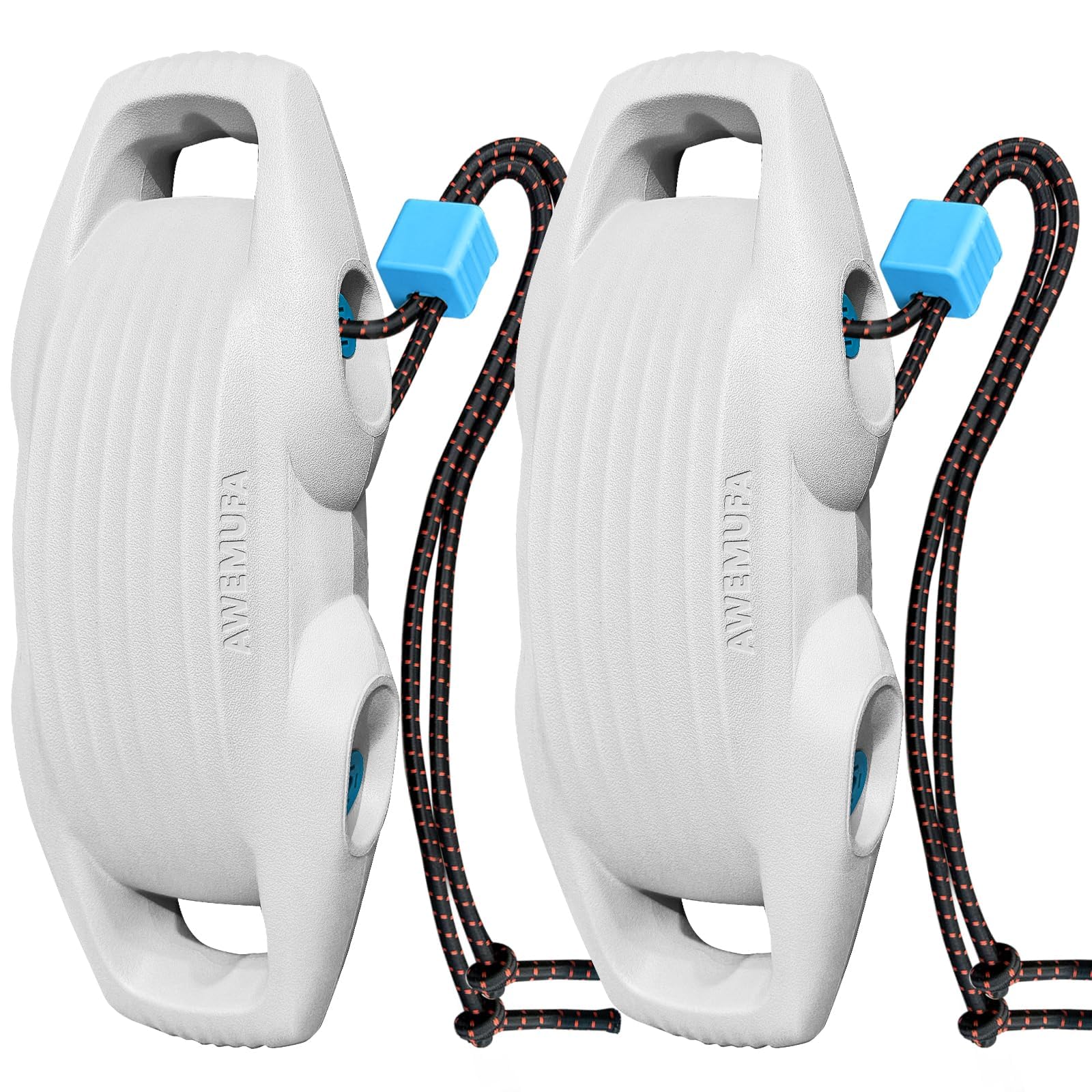
The AWEMUFA fenders do not look like the vinyl tubes most people picture. They are 17.12 by 8.27 by 4.5-inch EVA foam pads with an integrated strap and a locking system, and the difference is obvious the first time you hang one: there are no knots to tie and no pump to hunt for. We like that for a boat that gets tied up several times in a day, where fiddling with a fender line gets old fast.

The long strap runs through the fender and locks where you set it, so you can adjust the drop without retying. The foam is firm enough to keep its shape against a dock, and the flat back sits against the hull instead of rolling like a round fender. The maker's rule of one fender for every 10 feet of boat length is a good starting point; for a 20-foot boat, that means two, which is what this pack supplies. Larger boats will need a second set.

We recommend the AWEMUFA for quick, repeated docking on a small to mid-size boat. The no-knot setup is genuinely faster than threading a line through an eye, and the foam will not leave you checking valve seals at the ramp. For the right boat, it is the least fussy fender here. The strap stays with the fender, so there is no separate line to lose over the side.

Pros

  • Integrated locking strap, no knots
  • No inflation or valve maintenance
  • EVA foam holds shape against dock
  • Clear one-per-10-feet sizing rule

Cons

  • 17-inch length can come up short on high freeboard
Our verdict

If you want a fast, no-knot foam fender for a small or mid-size boat, we like the AWEMUFA's integrated locking strap.

Check Latest Price
6

Best Stowable Fender

Hull Hugr Contour

91 /100
Angler Score Outstanding

Key details

Size
24 x 6 x 2.5 in
Weight
12.8 oz
Storage
Folds flat
Material
EVA
Check Details on Amazon

The Hull Hugr is the fender we reach for when storage is the dealbreaker. It is a 24 by 6 by 2.5-inch flat panel that folds up and slides under a seat, and it weighs 12.8 ounces, so it disappears into a locker in a way no inflated tube does. The polycarbonate grommets at each end give you a proper attachment point without adding bulk.

We like the contour shape because it hugs the hull instead of rolling along it. On a dry-hull boat or a small skiff, that low profile keeps the fender where you put it and leaves less to trip over on the deck. It is not a pillow for a heavy cruiser; it is a compact pad for the kind of docking where you need protection without a lot of air volume.

The flat shape makes them easy to tuck away when the day is done, and a pair gives more coverage than one. For a boat with tight storage and a regular dock, it is a practical alternative to a round fender, especially if you have a place to hang it where it will not be crushed. The flat panel also makes a useful spare to slide under a seat for the day you forget the round fenders.

Pros

  • Folds flat for under-seat storage
  • Low-profile contour resists rolling
  • Lightweight at 12.8 ounces
  • Polycarbonate grommets for hanging

Cons

  • Cover can rip with repeated hard contact
Our verdict

When locker space is tight, we choose the Hull Hugr; it folds flat, weighs little, and hugs the hull without rolling.

Check Latest Price
7

Four-Pack Kit

Affordura 4-Pack

91 /100
Angler Score Outstanding

Key details

Inflation
Inflation valves
Kit Contents
4 fenders, 4 ropes, pump, bag
Sizing Guide
1 in per 4 to 5 ft of boat length
Fender Diameter
6.5 in
Check Details on Amazon

The Affordura kit is the closest thing here to a complete fender package. You get four 6.5-inch fenders, four color-matched ropes, a hand pump with needles, and a storage bag. The bag is sized to take the deflated set, which sounds like a small thing until you have spent a season stepping over loose fenders in a locker.

The maker's sizing rule is more useful than most: one inch of fender diameter for every four to five feet of boat length. That gives you a way to check whether four 6.5-inch fenders make sense for your hull and docking conditions instead of guessing from a photo. The reinforced eyelets let you hang the fenders vertically or horizontally, and the valves let you soften or firm the set as needed.

We like the kit approach for a family boat or a pontoon that needs a matched set. The fenders deflate for storage, the ropes are already matched, and the bag keeps the whole thing together between trips. It is not the cheapest way to buy four fenders, but it is one of the most complete.

For a family boat or a pontoon that needs a matched set, the Affordura kit is the one we point to. It is not the cheapest way to buy four fenders, but it is one of the most complete, and the storage bag makes the set easier to live with. If you want the simplest no-inflation fender instead, the Attwood is the better fit.

Pros

  • Four 6.5-inch fenders with matched ropes
  • Hand pump, needles, and storage bag included
  • Clear one-inch-per-four-to-five-feet sizing rule
  • Fenders deflate for compact storage

Cons

  • Air retention can vary across the set
Our verdict

The Affordura kit is our pick for a complete four-fender setup with lines, pump, and bag; it is the most complete package here.

Check Latest Price

How We Tested Boat Fenders Through a Full Season

We started with roughly 40 fenders sold in sets, pairs, and singles, then filtered by size range, whether rope or line came in the box, and price per fender — a four-pack that fits your boat beats a premium single that doesn't. That left 14, ranging from twin-eye ribbed cylinders to contour shapes to plain inflatable tubes, which went onto five boats from spring launch to fall haul-out.

Each one got used the way fenders actually get used: hung off a cleat overnight at a transient dock, wedged against a piling during a blustery Saturday landing, sandwiched between two hulls while rafting up, and left out in the sun for weeks at a stretch. We watched where each fender sat relative to the rub rail as the boat settled, and whether it stayed put or rolled out of position when the surge picked up.

Air retention got its own attention. The inflatables arrived soft, so we filled each to the maker's spec with a hand pump, noted whether the included adapter seated on the valve without leaking, and checked pressure again at two weeks, one month, and season's end. Durability showed up as scuffing and seam creep at the rope eye, plus sun fading on anything left exposed. Value we judged per fender including whatever line came with it, since a kit with usable rope saves you a second trip to the chandlery.

How to Choose Boat Fenders

Start with size and shape, not color

We start with size and shape because a fender has to sit between your hull and the dock through the whole tide and wave cycle, not just at the moment you tie up. Diameter and length matter together: a short, narrow fender can disappear under a rubrail or let a high dock touch the hull. Round fenders are the general-purpose choice; square or low-freeboard shapes, like the Taylor Made, hold a higher position on bass boats and skiffs. As a starting point, the maker of our four-pack suggests one inch of diameter for every four to five feet of boat length, then adjust for rough water or a difficult dock.

Choose inflation or no-inflation by your maintenance tolerance

We treat inflation as a maintenance choice, not a performance upgrade. Inflatable vinyl fenders give the softest cushion and let you tune firmness, but they depend on valves, seams, and a pump that works. If you leave fenders on the boat all season, that maintenance is the difference between a useful set and a locker full of soft tubes. Foam and solid polymer fenders, like the Attwood SoftSide or AWEMUFA, skip inflation entirely and are ready when you are. They feel firmer against the hull and generally offer less give, so match the size to the boat rather than expecting a small solid fender to do the work of a large inflatable.

Look at the lines and attachment points

A fender is only as good as the line holding it. Check whether lines are included, how long they are, and whether the eyelets are reinforced. Five-foot lines are common and fine for many trailerable boats, but a high dock or a deep freeboard may need more length. Integrated straps and locking systems, as on the AWEMUFA, are faster to adjust than a knotted line, though they are less flexible if you want to reconfigure the fender. For a low-freeboard boat, a square fender tied over a cleat can put protection higher than a round tube hung from the rail.

Plan storage and the number of fenders

We favor fenders that are easy to stow because the ones that are awkward to store tend to stay home. Inflatable sets can be deflated into a bag; flat panels such as the Hull Hugr fold under a seat; solid fenders take up fixed space but need no pump. Count matters as much as type: a pair is a common starting point, but a long pontoon or a boat that regularly ties to a rough dock may need four. Buy the set that matches the way you boat, not the one that looks smallest in the listing.

Frequently Asked Questions

Final Verdict

Seachoice is the fender kit we recommend first for most trailerable boats: the 5.5 by 20-inch pair arrives with reinforced lines, the recessed valve is a thoughtful touch, and the construction has the best quality story in this group. If your boat is larger or sits higher at the dock, the Extreme Max 6.5-inch pair gives you more margin. If you are done with inflation, the Attwood SoftSide is the simplest switch; if storage is tight, the Hull Hugr folds flat and disappears under a seat.