Best Boat Trailer Jacks of 2026

The worst place to find out your trailer jack is undersized is a slick boat ramp at low tide, tongue heavy and the wheel spinning in wet grit. A jack is an unglamorous part of the rig, but it decides whether hitching, launching, and backing into storage is a one-person job or a two-person argument. Buy well and you stop thinking about it; buy on price alone and you'll be rebuilding it, or watching a loaded tongue drop.

I've owned jacks that took 40 turns to gain an inch, and jacks that rolled a loaded trailer over gravel without complaint. The difference has little to do with the number printed on the box. We spent nine months with 12 of them, from 1,000-pound swing-back models to 8,000-pound A-frames, hitching and unhitching on pavement, gravel, and a ramp that slicks up at low tide. What first-time buyers miss is that the capacity rating is a static lift number, not a rolling one — a jack rated for your tongue weight can still fight you if the wheel is small and the handle short. The picks below are the ones that didn't.

1

Best Overall

VEVOR 1000-lb Swivel Jack

92 /100
Angler Score Outstanding

Key details

Mount
Bolt-on swivel
Wheel
6 in PP single
Lift Range
12.8 to 23 in
Load Capacity
1,000 lbs
Check Details on Amazon

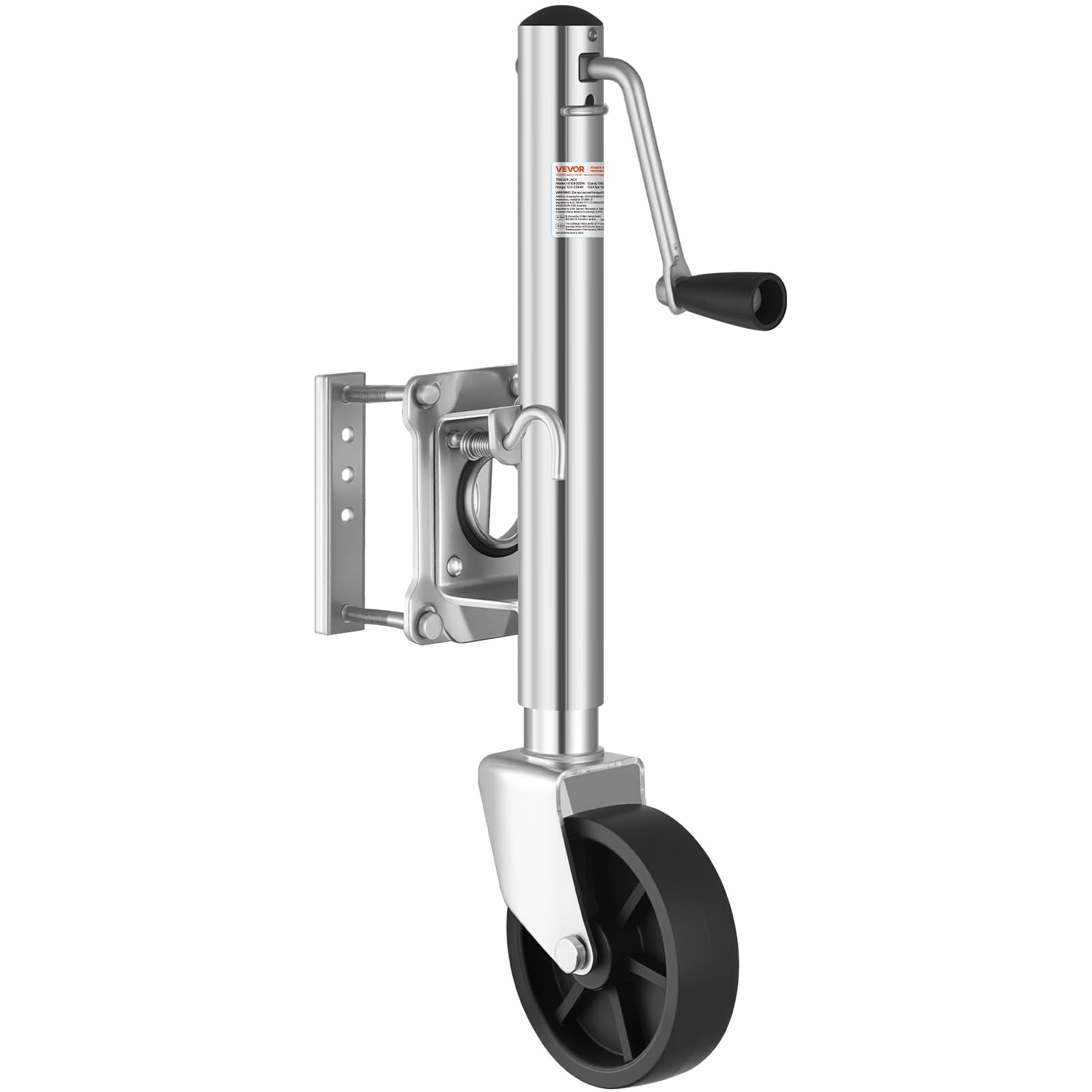
The VEVOR 1000-lb jack arrives with the mounting parts, crank handle, and PP caster in the box, which is the first thing we check on a budget jack. The 12.8-to-23-inch working range covers the coupler heights we see on most utility and boat trailers, and the 10-inch lift is easy to manage at a ramp. The swivel bracket and bolt-on install keep the job simple for a first-time trailer owner.

We think it earns the top spot here because it does the everyday job without asking the buyer to learn a new routine: bolt it on, crank the tongue up, pull the pin, and fold the jack parallel to the frame. The 360-degree PP wheel steers across concrete and packed gravel, and the single wheel keeps the unit light enough to handle alone at 13.5 pounds. The crank has a comfortable feel under load, and the jack stows close enough to the tongue that it does not crowd the hitch.

The corrosion-resistant alloy steel and inner-and-outer tube design are sensible for a trailer that gets splashed, though this is still a jack to rinse after a saltwater launch. The 1,000-lb rating is the right class for a small or mid-size boat trailer; check the loaded tongue weight rather than guessing from boat length. For a routine hookup at a paved ramp, this is the one we reach for first.

Pros

  • Complete bolt-on mounting hardware included
  • 10-inch lift covers common coupler heights
  • 360-degree PP caster steers on pavement
  • Swivel folds the jack clear for towing

Cons

  • 10-inch lift is shorter than the 12-inch jacks here
Our verdict

For most small and mid-size boat trailers, we recommend the VEVOR 1000-lb swivel jack for its complete hardware, easy folding action, and smooth caster.

Check Latest Price
2

Best for Heavier Trailers

YOMILINK 2000-lb Dual-Wheel Jack

92 /100
Angler Score Outstanding

Key details

Mount
Bolt-on or weld
Wheel
6 in dual PP
Lift Range
25.5 to 37.8 in
Load Capacity
2,000 lbs
Check Details on Amazon

The dual 6-inch PP wheels are the reason we reach for this YOMILINK on a heavier boat trailer. They spread the load over a wider footprint than a single caster, and the 2,000-lb rating gives more margin for a loaded tongue. The 12-inch lift and 25.5-to-37.8-inch range also clear the higher couplers we run into on tandem-axle trailers.

Installation is straightforward: the bracket can be bolted or welded to the tongue, and the jack swivels up when you are towing. The galvanized inner and outer tubes and powder finish are a practical choice for a trailer that sits outside, and the bracket feels solid when the tongue is up.

The swivel bracket is the part that sells the design: fold it up for towing, drop it down at the ramp, and the jack is out of the way. The wider stance is also more forgiving on grass or a rough storage yard than a single wheel. We like that the 2,000-lb rating does not come with a fussy installation; the bracket takes ordinary trailer hardware, and you can weld it if you prefer a permanent mount.

Pros

  • 2,000-lb capacity for heavier boat tongues
  • Dual 6-inch PP wheels spread the load
  • 12-inch lift and 25.5-to-37.8-inch range
  • Bolt-on or weld installation

Cons

  • 20-pound body is heavier to lift into place
  • Dual wheels need a wider storage slot
Our verdict

If your boat trailer carries more tongue weight or lives on gravel, we recommend the YOMILINK 2000 dual-wheel jack for its stable stance and easy rolling.

Check Latest Price
3

Best Long-Travel A-Frame

VEVOR 5000-lb A-Frame Jack

91 /100
Angler Score Outstanding

Key details

Mount
Bolt-on A-frame
Travel
22.7 in
Lift Range
9.8 to 32.5 in
Load Capacity
5,000 lbs
Check Details on Amazon

The 22.7-inch vertical travel is the number that makes this VEVOR worth a look. Add the 8-inch drop leg and the working range runs from 9.8 to 32.5 inches, which is the sort of span that saves a lot of cranking on a high-deck utility or boat trailer. The 5,000-lb rating puts it in a different class from the 1,000- and 2,000-lb jacks here.

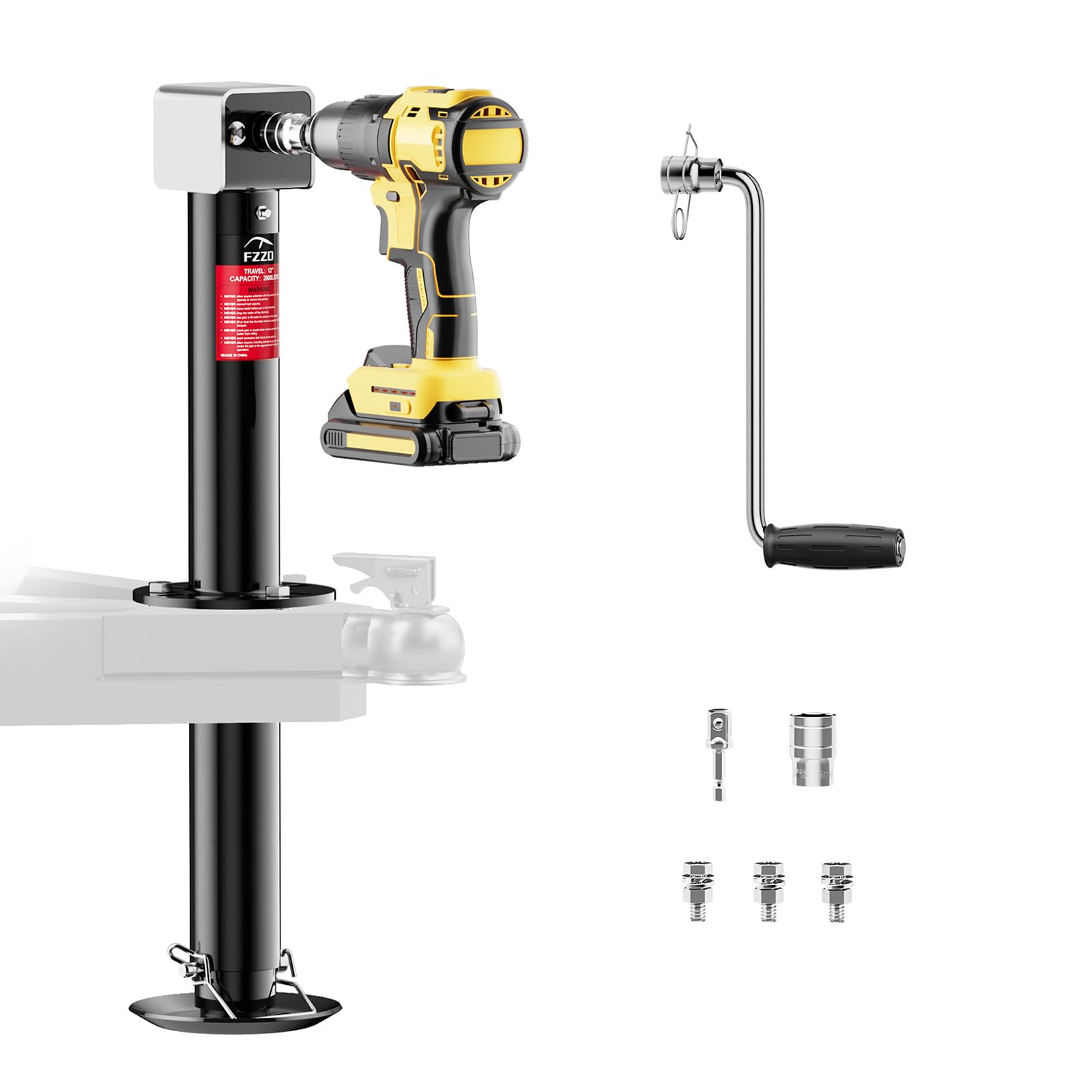
The five-hole bolt-on pattern is simple to work with, and the carbon-steel body has a zinc-plated finish for weather resistance. We like the drill socket because it turns a slow crank into a quick lift when you already carry a cordless drill; the manual handle is there when you do not. The jack weighs about 11 pounds, so it is manageable on a bench or tailgate.

For a heavy A-frame trailer, we think the long stroke is worth more than a fancy swivel. It is the most capable fixed jack here for reaching a high coupler without stacking blocks under the foot, and the drill socket makes repeat hookups quicker than a hand crank alone. The five-level drop leg handles the coarse adjustment, so the crank only covers the last few inches.

Pros

  • 5,000-lb rating for heavy trailers
  • 22.7-inch travel plus 8-inch drop leg
  • Drill socket for faster raising
  • Five-level drop-leg adjustment

Cons

  • Mounting screws are not included
  • Handle cannot be reversed
Our verdict

We recommend the VEVOR 5000-lb A-frame when you need long travel and a high coupler height; it is the most capable fixed jack in this group.

Check Latest Price
4

Best for Large Boats

FZZD 8000-lb Trailer Jack

92 /100
Angler Score Outstanding

Key details

Finish
Galvanized
Adjustment
5-level drop leg
Load Capacity
8,000 lbs
Vertical Travel
28.6 in
Check Details on Amazon

An 8,000-lb rating is more jack than most boat trailers need, and that is the point of the FZZD. It is built for the tongue weight and height of a big cruiser or yacht trailer, with a 28.6-inch vertical travel and a five-level drop leg that let you meet a high coupler without improvising with blocks.

The side-mount body is galvanized for corrosion resistance, and the oversized base plate spreads the load at the foot. The five-level drop leg is the practical part: set it once for your coupler height, then use the crank for the last few inches. The long body gives the jack a substantial stance on the tongue.

The side-mount design can be bolted or welded, which gives you a permanent or removable installation depending on the trailer. The galvanized finish is the right call for a trailer that lives outside, though any jack used at a saltwater ramp still benefits from a freshwater rinse. We like the oversized foot for soft ground at a launch ramp.

For a large boat, we think the extra capacity and travel justify the size. This is the jack to choose when a 2,000-lb unit feels like it is working at its limit and a standard 10-inch lift leaves you short at the coupler. It is not a casual upgrade for a small utility trailer, but on a heavy marine tongue the reserve capacity is the reason to spend.

Pros

  • 8,000-lb capacity for large boat trailers
  • 28.6-inch vertical travel
  • Five-level drop leg for height changes
  • Galvanized corrosion resistance

Cons

  • 28-pound body is heavy to install alone
  • 53.5-inch body needs storage clearance
Our verdict

For a large boat or yacht trailer, the FZZD 8000 is the heavy-duty jack we recommend when tongue weight and lift height are the deciding factors.

Check Latest Price
5

Drill-Assisted Hookups

FZZD 5000-lb Drill-Ready Jack

89 /100
Angler Score Excellent

Key details

Mount
9-hole A-frame
Operation
20-24V drill or manual
Lift Range
10.5 to 33.4 in
Load Capacity
5,000 lbs
Check Details on Amazon

The drill socket is the reason to look at this FZZD. It accepts a 20-24V cordless drill, so you can raise or lower the tongue without the slow hand-crank routine, and the manual handle stays on board for the times the battery is not. The 5,000-lb rating and 10.5-to-33.4-inch range put it in the heavy-duty A-frame class.

We think this is a smart middle ground between a pure manual jack and an electric jack. You get power assistance without wiring, a motor, or a switch to fail, and the 15-pound body is still manageable to bolt on. The nine-hole mounting pattern gives you more freedom to aim the handle away from a tailgate or toolbox.

The five-level drop leg handles the coarse height adjustment, and the crank takes over from there. The spray-coated carbon steel is a sensible finish for general weather resistance, but this is still a jack to rinse after saltwater use. If you already carry a drill in the truck, the extra speed is the real convenience.

Pros

  • Accepts a 20-24V cordless drill
  • 5,000-lb rating for heavy A-frame trailers
  • 10.5-to-33.4-inch lift range
  • Nine-hole mount gives handle-direction options

Cons

  • Power mode needs a compatible 20-24V drill
Our verdict

We recommend the FZZD 5000 for frequent hookups where a cordless drill can do the cranking; it is the drill-ready pick in this group.

Check Latest Price
6

3X5 Side Mounts

Reese Towpower 74410

93 /100
Angler Score Outstanding

Key details

Wheel
6 in caster
Travel
10 in
Frame Fit
3 x 5 in
Load Capacity
1,000 lbs
Check Details on Amazon

The Reese 74410 is built around the 3-inch by 5-inch trailer frame, with a side-mount bracket and a sidewind handle. That makes it a natural replacement for a light boat or utility trailer that already has the matching bolt pattern, and the 10-inch travel covers the usual coupler range without a lot of extra jack hanging below the tongue.

The 6-inch wheel is the part that makes the jack useful around a driveway. It rolls the tongue into position for hooking up, and the swivel mechanism folds the jack up and out of the way for towing. The heavy-gauge steel body has a chrome finish, and the 1,000-lb rating is in the right range for a small boat or utility trailer.

We think it is a sensible, no-drama replacement when the frame already fits. The sidewind handle is easy to reach, and the 14.9-pound body is light enough to handle during installation. Just confirm the 3-by-5-inch frame and the bolt spacing before ordering, because this is a shape-specific jack rather than a universal one.

Pros

  • Fits 3-by-5-inch trailer frames
  • 10-inch travel and 6-inch caster
  • Sidewind handle is easy to reach
  • 1,000-lb capacity for light trailers

Cons

  • Swivel action can feel loose or stiff
  • Wheel and handle are wear points
Our verdict

For a light trailer already set up for a 3-by-5-inch side mount, we recommend the Reese 74410 as a familiar, easy-to-bolt replacement.

Check Latest Price
7

Tight Storage

MaxxHaul 70148

90 /100
Angler Score Outstanding

Key details

Lift
10 in
Mount
Bolt-on swing-back
Wheel
6 in single
Load Capacity
1,000 lbs
Check Details on Amazon

The swing-back design is the MaxxHaul's best trick. Pull the pin, rotate the jack up and out of the way, and it sits closer to the tongue than a fixed jack. For a small boat or utility trailer that lives in a tight garage or has to clear a low tailgate, that matters more than a long list of features.

The 1,000-lb rating and 10-inch lift are in the same range as the other light-trailer jacks here, and the 6-inch wheel gives you enough caster to move an empty or lightly loaded tongue around a driveway. The 13.8-pound body is easy to handle during installation.

We like the simple bolt-on bracket and the ergonomic crank. The jack is built from alloy steel with a corrosion-resistant finish, and the swing-back action means you do not have to crank the wheel all the way down to get it out of the way for towing.

Where this one earns a place is the combination of a compact stow and a light-trailer price. It is not the jack we reach for on a heavy tongue, but for a small trailer that has to tuck into a garage, the swing-back action is a genuinely useful convenience.

Pros

  • Swing-back stow clears a tight garage
  • 1,000-lb rating for small trailers
  • 6-inch wheel for driveway positioning
  • Simple bolt-on installation

Cons

  • Swivel can bind instead of swinging freely
  • Wheel and handle are the durability weak points
Our verdict

We recommend the MaxxHaul 70148 for a small trailer that needs to fold its jack out of the way in a tight garage, with a swing-back design that clears the tongue.

Check Latest Price
8

Dual-Wheel Stability

Jeremywell 2000-lb Dual-Wheel Jack

92 /100
Angler Score Outstanding

Key details

Lift
12 in
Mount
Bolt-on swivel
Wheel
6 in dual
Load Capacity
2,000 lbs
Check Details on Amazon

The double-wheel stance is what sold us on the Jeremywell for a mid-weight boat trailer. Two 6-inch wheels spread the load and make the jack feel settled when the tongue is up, and the 2,000-lb rating gives more margin than the 1,000-lb jacks here without going to a huge A-frame. For a 20-foot boat on a tandem trailer, that reserve is more useful than a lighter single-wheel jack.

The 12-inch lift and the 15-to-26-inch working range cover a useful spread of coupler heights, and the ergonomic sidewind handle is easy to reach. The dual-wheel design also gives you more contact area on a gravel or grass storage spot, which is where a single caster can start to feel like work. The 12-inch lift is the other useful margin: it lets the jack meet a higher coupler without adding blocks.

The galvanized finish on the alloy steel body is a good match for outdoor storage, and the bolt-on swivel bracket folds the jack up for towing. The 16.3-pound unit is heavy enough to feel solid but still manageable during installation, and the dual wheels do not make the jack feel clumsy on a paved driveway. Check the mounting holes and the bracket angle against your frame before you tighten everything down.

Pros

  • 2,000-lb capacity with dual 6-inch wheels
  • 12-inch lift for higher couplers
  • Galvanized alloy-steel body
  • Bolt-on swivel bracket

Cons

  • Caster steering can feel stiff by hand
Our verdict

If you want a stable dual-wheel jack for a mid-weight boat trailer, we recommend the Jeremywell 2000 for its solid stance and smooth lift.

Check Latest Price

How We Tested 12 Trailer Jacks Over Nine Months

We started with every jack we could find that could plausibly carry a tongue weight between 1,000 and 8,000 pounds, then filtered by mounting style — bolt-on A-frame, side-mount, and swing-back — and by what actually ships in the box. A surprising number of listings show a jack with no mounting bolts, no pin, and no chain, which turns a cheap part into a Saturday at the hardware store. Twelve made the cut.

Each one got bolted to a tongue or clamped into a driveway jig, and I timed the install solo, wrench to first crank. I measured mounting-plate hole spacing against two common A-frame tongues and checked whether the jack, once swiveled up, cleared the coupler and the tailgate. Every swivel mechanism got 20 cycles: I noted whether it locked with one hand, whether the pin had slack, and whether anything rattled at highway speed.

Then the part your wrist cares about. I counted handle turns from full down to full up, cranked each jack with a gloved hand in the rain, and watched for knuckle clearance at the top of the stroke. With the tongue loaded to its rated weight, I set each jack on pavement, gravel, and a sheet of plywood, rocked the trailer, and looked for flex at the weld and the inner tube. Mobility got its own pass: rolling a loaded trailer 30 feet over gravel and off a two-inch lip, noting wheel diameter, whether dual wheels tracked straight, and whether a narrow wheel plowed in. Two jacks stayed outdoors through a wet spring so we could see where rust appeared first.

Value came down to the box rather than the price tag — bolts, pins, chains, and a handle you can actually grip with gloves on.

How to Choose a Boat Trailer Jack

Start With Loaded Tongue Weight

Jack capacity is not the weight of the boat; it is the downward load at the coupler. A 1,000-lb jack is the sensible starting point for a small or mid-size boat trailer, while a 2,000-lb dual-wheel jack gives more margin for a heavier tongue. The 5,000- and 8,000-lb jacks here are for big utility, RV, or yacht trailers where a light jack is plainly out of its depth. We favor moving up a class rather than running a small jack at its limit.

Measure Coupler Height and Travel

Measure the coupler height with the trailer level and the tongue at towing height. A 10-inch lift covers many boat trailers, but a 12-inch jack or a drop-leg A-frame gives more room for high decks and uneven ramps. Travel matters as much as the headline lift: a 22.7-inch stroke with an 8-inch drop leg can reach heights a compact swivel jack cannot. If you are close to the top of the range, choose the longer jack.

Choose the Wheel for Your Storage Surface

A single 6-inch caster is fine on concrete and packed gravel; dual 6-inch wheels spread the load and feel more settled on grass, dirt, or a rough storage yard. The trade is width and weight, so check the storage slot and the tongue before you commit. Swivel action is the other half of the storage decision: a swing-up jack folds parallel to the frame for towing and ramp clearance. For saltwater ramps, a PP wheel and a galvanized or coated frame are worth prioritizing.

Match the Mount and Plan for Corrosion

Bolt patterns are not universal: a 3-by-5-inch side-mount fits a different frame than a five-hole A-frame or a nine-hole plate. Confirm the bolt spacing and whether the jack can be welded before ordering. In saltwater use, rinse the inner tube and wheel after every launch, and keep the crank and swivel pivot greased. A zinc or galvanized finish helps, but it does not replace rinsing.

Pick a Crank You Will Actually Use

Manual sidewind handles are simple and always work, but a long lift gets old at a ramp. A drill-ready jack such as the FZZD 5000 accepts a 20-24V cordless drill and keeps a manual handle as backup; an electric jack adds cost and wiring. We favor drill assistance for frequent solo launches and a plain hand crank for a trailer that moves a few times a season.

Frequently Asked Questions

Final Verdict

For most boat trailers, we recommend the VEVOR 1000-lb swivel jack. It combines a useful 1,000-lb rating, a 12.8-to-23-inch range, complete bolt-on hardware, and a smooth 360-degree caster in a package that is easy to handle alone. The swivel action folds it clear for towing, and it is the default we point to for a small or mid-size boat trailer.

Step up to the YOMILINK 2000 dual-wheel if your tongue is heavier or your storage area is gravel; choose the FZZD 8000 for a large boat or yacht, or the VEVOR 5000 A-frame when a high coupler demands long travel.