Best Boat Transom Tie-Down Straps of 2026

The worst thing a transom strap can do is fail on the drive home, when the boat behind you is held by two lengths of webbing and a couple of hooks. The second worst is quieter and more common: a ratchet that gums up after a month of saltwater, a hook that won't seat on your trailer's eye, a strap that comes up six inches short at the ramp with the boat already floating. Good tie-downs erase both problems: they lock the hull to the trailer so the two move as one over potholes, and they come off fast enough that you're not holding up the ramp line.

Webbing width matters more than the break strength printed on the package — a 2-inch strap spreads the load across the hull and stays flat in the ratchet, while a 1-inch strap twists and binds under the same tension. Length trips people up too: measure from the trailer's tie-down point to the transom eye with the boat seated, not floating. We ran 12 sets through a full boating season, and the differences showed up by the second launch.

1

Best Overall

Rhino USA Transom Straps

92 /100
Angler Score Outstanding

Key details

Hardware
Stainless steel
Working Load
400 lb
Break Strength
1,200 lb
Adjustable Range
13.5 to 48 in
Check Details on Amazon

Thirteen and a half inches to 48 inches is the widest working range here, and it is why this pair ended up on everything from a jet-ski trailer to a pontoon's stern eyes without a second set on hand. The hooks are full-bend S hooks with safety clips, the hardware is stainless, and a hook-and-loop keeper gathers whatever tail is left.

What makes them our pick is that nothing about them asks for attention at the ramp. You hook it, pull the webbing snug, and close the buckle; there is no ratchet to crank and nothing to coil when you are done. The corrosion-resistant finish on the hooks is the detail that matters most if your ramp sees salt water, and Rhino backs the pair with a lifetime replacement, which is a real promise on a part designed to be dunked.

The number to check before ordering is the working load: 400 pounds per strap puts these mid-pack in this group, and a heavy glass boat on a roller trailer asks more of a tie-down than an aluminum fish-and-ski does. The BoatBuckle retractable below carries more than twice that. For everything else, the fit range, the hardware, the tail management, the warranty, these are the pair we reach for first.

Pros

  • Adjusts 13.5 to 48 inches for most trailers
  • Stainless hardware and corrosion-resistant hooks
  • Lifetime replacement warranty
  • Hook-and-loop keeper controls the loose end

Cons

  • 400-lb working load is mid-pack here
Our verdict

For most boats and trailers, these are the transom straps we point to first: a wide fit range, stainless hardware, and a lifetime replacement at a mid-range price.

Check Latest Price
2

Best for Fast Launches

BoatBuckle Retractable Tie-Down

96 /100
Angler Score Outstanding

Key details

Water Use
Freshwater only
Strap Size
2 in x 43 in
Working Load
833 lb per strap
Break Strength
2,500 lb
Check Details on Amazon

Nothing else here costs as much, and one launch was enough to stop us thinking about it. Bolt the bases to your trailer once and the straps live there: pull one out, hook the transom eye, ratchet it down, let it retract when you are done. No coil of wet webbing in the boat and no tail snapping in the wind on the highway.

The numbers justify the price. Break strength is 2,500 pounds per strap with an 833-pound working load, both the highest in this group, and that is the sort of margin a heavy glass boat or a pontoon wants when the trailer works the stern over a rough road. Mounting takes a drill and a wrench, and on some trailer beams you will need longer bolts than the ones in the box.

One limit is absolute: these are freshwater only. The manufacturer sells a separate stainless version for brackish and salt water, so a tidal ramp is the wrong home for this pair. On an inland lake, nothing else here gets you from trailer to water faster.

Pros

  • Retracts, so there is no tail to coil
  • 2,500-lb break strength, 833-lb working load
  • Bolts to the trailer and stays there
  • Mounting hardware in the box

Cons

  • Freshwater use only
  • Requires drilling into the trailer
Our verdict

If you launch often and stay on freshwater, these are the fastest straps here; the higher price buys strength and a strap that never needs coiling.

Check Latest Price
3

Best Budget

MEILI Transom Straps

94 /100
Angler Score Outstanding

Key details

Strap Size
2 in x 48 in
Buckle Type
Flip cam buckle
Working Load
400 lb
Break Strength
1,200 lb
Check Details on Amazon

There is no ratchet on the MEILI pair, just a flip-over buckle. Open it, pull the webbing through by hand, snap the handle down, and it locks where you left it. Nothing to crank, and nothing to bind up when the webbing comes back wet.

The strap is 2 inches wide and 48 inches long, with vinyl-coated S hooks and a fabric pad under each buckle so the metal never sits against the gelcoat. Break strength is 1,200 pounds per strap and the working load 400, the same headline as our top pick for less money.

The trade-off is that the last inch of tension is your job. You pull the strap tight by hand before the buckle locks, so there is no mechanical advantage to lean on. On a light boat that is nothing; on a heavy one with cold, wet hands, a ratchet earns its place. For a first set of transom straps, or a second set for a small boat that only sees the lake on weekends, this is the easiest recommendation on the page.

Pros

  • Flip buckle is fast and cannot bind
  • Coated hooks and buckle pads protect the hull
  • 1,200-lb break strength at a budget price

Cons

  • Hand tension only, with no ratchet leverage
  • 48-inch webbing runs long on short transoms
Our verdict

The simplest pair here: a flip buckle, coated hooks, and a 1,200-pound rating that suits a small or mid-size boat, at a budget price.

Check Latest Price
4

Best for Gelcoat Protection

Better Boat Transom Straps

93 /100
Angler Score Outstanding

Key details

Hardware
Stainless steel
Load Rating
900 lb
Hull Protection
Nylon shield, coated hooks
Adjustable Range
13.5 to 48 in
Check Details on Amazon

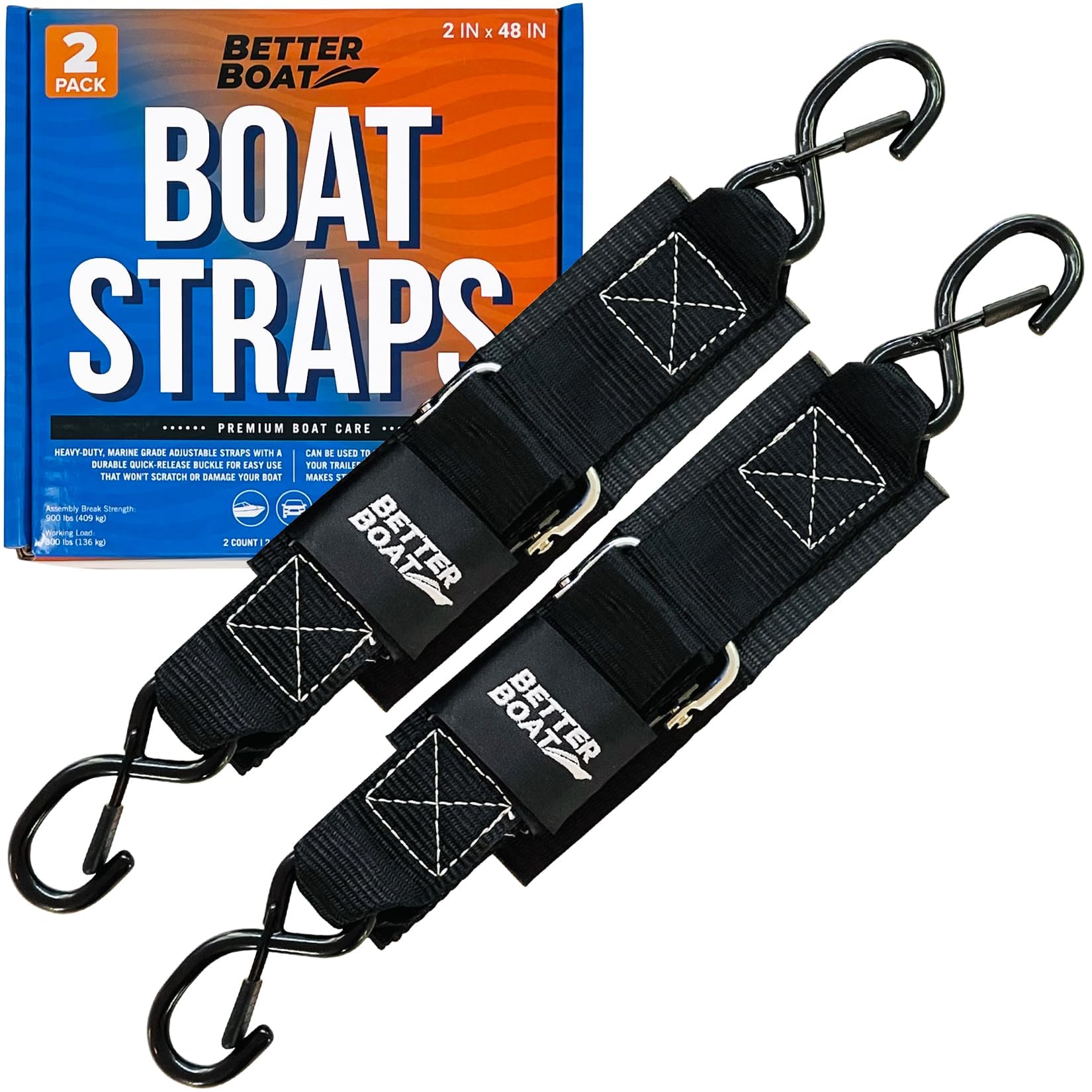
A wide nylon shield sits between the buckle and the hull, and the S hooks are PVC coated, so no metal touches your gelcoat. That is the whole pitch: a transom strap that holds the boat down without leaving a mark on the boat you spent the winter polishing.

We hand these to anyone with a newer boat and a finish they care about. The webbing is high-density nylon that resists stretch, the pair adjusts from 13.5 to 48 inches like our top pick, and a hook-and-loop keeper takes care of the tail. It is a hand-tensioned buckle rather than a ratchet, quicker at the ramp and with less leverage to lean on. Nothing about it feels like a budget part.

The spec to weigh is strength. The rating is 900 pounds, the lowest in this group, which is fine for an aluminum boat or a jet ski and thin for a heavy glass hull. Buy these for the protection and the fit range; if you need the biggest number on the page, look at the BoatBuckle or Aerofast pairs.

Pros

  • Nylon shield and coated hooks protect gelcoat
  • High-density nylon webbing resists stretch
  • Adjusts 13.5 to 48 inches
  • Hook-and-loop keeper for the loose end

Cons

  • 900-lb rating is the lowest here
Our verdict

Buy these when your gelcoat matters more than raw strength; the shield and coated hooks keep metal off the hull, and the rating suits small to mid-size boats.

Check Latest Price
5

Best for Jet Skis

WavesRx Transom Straps

92 /100
Angler Score Outstanding

Key details

Top Hook
Vinyl coated with safety lock
Warranty
3 years
Strap Size
2 in x 24 in
Buckle Type
Quick-release buckle
Check Details on Amazon

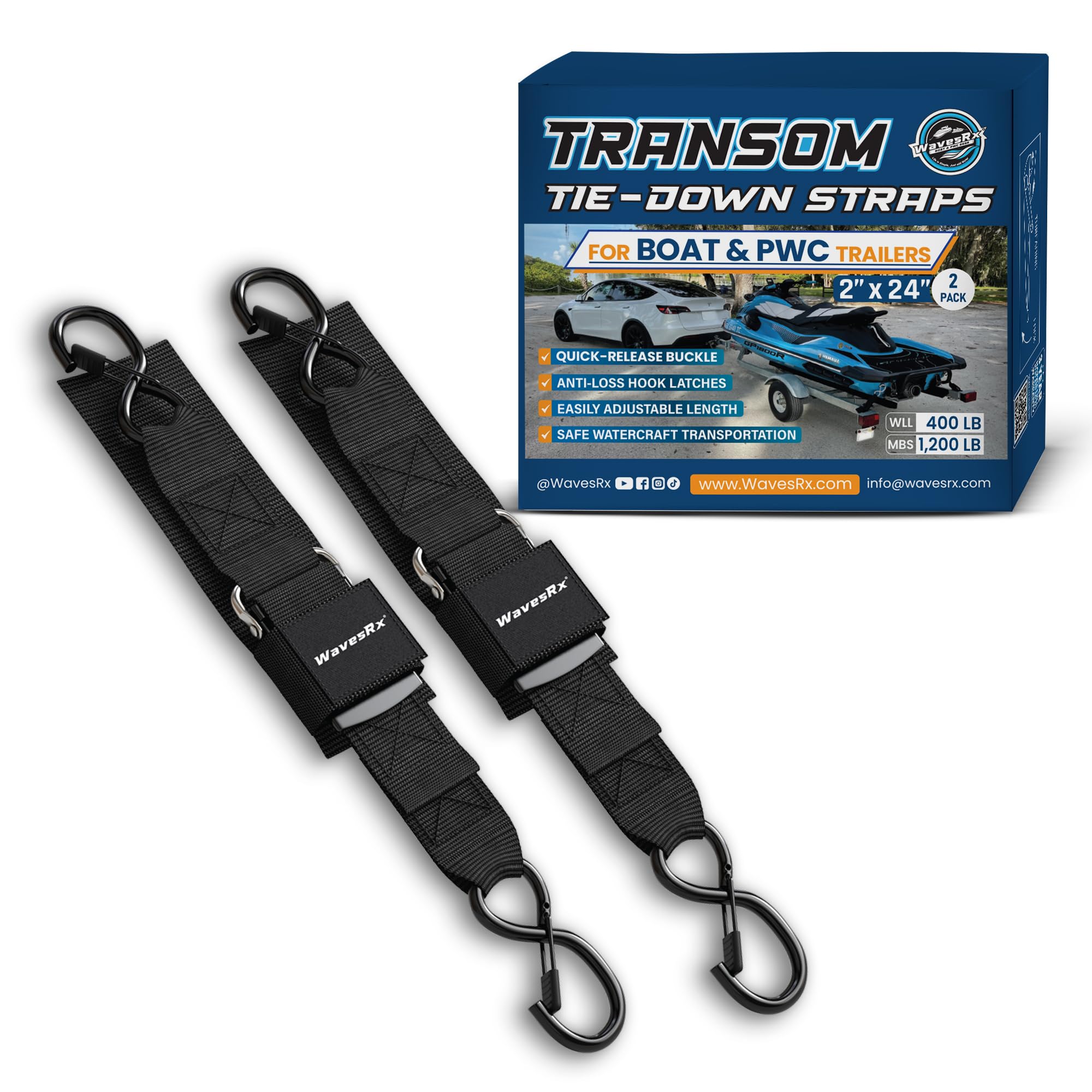
A jet-ski trailer leaves a short run between the stern eye and the frame, and a 4-foot strap just gives you a wad of tail to deal with. WavesRx sells a 24-inch set for exactly that gap, and it is the pair we put on a PWC trailer: short enough to sit tidy, with a safety lock on the top hook so it cannot bounce off when the strap goes slack.

The buckle is a quick-release cam rather than a ratchet, the top hook is vinyl coated so it will not mark the hull, and a three-year warranty sits behind the pair. Several states now require tie-downs on trailered watercraft, which is worth knowing if you have been relying on the winch strap alone.

Length is the thing to get right. The 24-inch set is right for a jet ski and wrong for a skiff with the transom eyes set high; the 48-inch version covers more boats. Measure the run from eye to frame before you order and there is no guesswork.

Pros

  • 24-inch set suits PWC trailers
  • Safety-lock top hook stays attached
  • Quick-release buckle, no ratchet to bind
  • Three-year warranty

Cons

  • Short set will not fit larger boats
Our verdict

The 24-inch set is the tidiest option we found for a jet-ski trailer; measure the gap between stern eye and frame before you order one.

Check Latest Price
6

Short Transom Runs

Aerofast Transom Straps

93 /100
Angler Score Outstanding

Key details

Hardware
Stainless steel
Strap Size
1 in x 2.5 ft
Buckle Type
Ratchet
Break Strength
2,400 lb per strap
Check Details on Amazon

Two thousand four hundred pounds of break strength in a one-inch-wide strap is the most strength per inch of webbing here. These are ratchets, made in New Zealand from UV-stabilized polypropylene with stainless hardware, built for anyone who prefers cranking a load down to snapping a buckle shut.

The narrow webbing is the catch. One inch concentrates the load on a smaller patch of hull, and 2.5 feet of length suits a close, direct run from a transom eye to the trailer frame, not a deep-V with the eyes set high or a boat with a long span to the rear crossmember.

The ratchet and the hook coating are the parts we watch. Coated hooks can chip, and in salt water the mechanism wants a freshwater rinse after every trip; a gritty ratchet binds halfway down, usually with the boat half loaded. Kept to that routine, these are a compact, strong pair for a small boat or a PWC with a short run to the frame.

Pros

  • 2,400-lb break strength per strap
  • Compact 1-inch webbing and 2.5-ft length
  • UV-stabilized webbing and stainless hardware
  • Ratchet gives mechanical advantage

Cons

  • 2.5-ft length only suits short runs
Our verdict

A compact, high-strength ratchet pair for short transom runs, provided you rinse the mechanism and keep an eye on the hook coating.

Check Latest Price
7

Yamaha Waverunners

Yamaha Deluxe Transom Tie Downs

93 /100
Angler Score Outstanding

Key details

Hook
Rubber-coated J hook
Webbing
Weather-resistant polypropylene
Strap Size
2 in x 2 ft
Buckle Type
Cam buckle, oversized handle
Check Details on Amazon

The oversized handle is the first thing you notice, and it is the detail that makes these easy to work: it is built to be grabbed with a wet hand and pulled over center in one motion, from a dock or knee-deep at the launch.

The rest is traditional and well judged: a 2-inch weather-resistant polypropylene strap, zinc-plated hardware with rubber-coated J hooks, and hook-and-loop fasteners sewn on so you can roll the loose end and stick it down instead of hunting for a keeper. Two feet of strap is the right length for a Waverunner's stern eye to trailer frame.

They are the factory part for Yamaha skis, which is why they fit a VX or an FX trailer without any fiddling, and they turn up on plenty of other PWC trailers too.

One thing to know before you buy: there is no published break strength on these. If you want a number to weigh against your boat and trailer, choose a strap that states one. For a Waverunner owner who wants the factory fit and a handle that works with wet hands, that is an easy trade to make.

Pros

  • Oversized handle works with wet hands
  • Rubber-coated J hooks protect the hull
  • Sewn-on fasteners hold the loose end
  • Factory fit for Yamaha Waverunners

Cons

  • 2-ft length will not reach a boat transom
Our verdict

Yamaha owners get the factory fit here: a big grab handle, rubber-coated hooks, and a clean match for a Waverunner trailer.

Check Latest Price
8

Second Trailer Setups

Ayaport Transom Straps

91 /100
Angler Score Outstanding

Key details

Hook
Coated S hook with safety clip
Strap Size
2 in x 4 ft
Working Load
600 lb
Break Strength
1,800 lb
Check Details on Amazon

Six hundred pounds of working load and safety clips on the S hooks, which are the kind of detail you notice the first time a slack strap slips off the trailer frame while you walk around to the other side.

The webbing is 2 inches wide and 4 feet long, nylon rather than polyester, and soft enough in the hand to work without gloves. Break strength is 1,800 pounds, the buckle is a quick-release cam, and the pair lands at a budget price.

One check before the first tow: run the webbing through the buckle by hand and make sure it is routed the right way round. A strap threaded backward pulls through instead of locking, and the ramp is a bad place to find that out.

Get that right and they are a useful budget pair: 600 pounds of working load, soft webbing, safety clips on both hooks, the set we leave on a utility trailer or a small aluminum boat. Keep the heavier towing for a strap with more margin.

Pros

  • 600-lb working load and 1,800-lb break strength
  • Safety clips keep hooks attached
  • Soft 2-inch nylon webbing
  • Quick-release cam buckle

Cons

  • Nylon webbing gives more under steady load than polyester
Our verdict

A useful budget second set with a 600-pound working load and safety-clip hooks; we keep it as a spare pair rather than the only one on a heavy boat.

Check Latest Price

How We Chose and Tested Boat Transom Tie-Downs

We started by pulling every transom strap we could find that listed a working load limit rather than only a break strength, then narrowed by webbing width, overall length, hook shape, and whether the buckle was a ratchet or a cam. Anything that quoted just a break number with no working load, or that came in a length too short to reach a standard trailer eye with the boat seated, we cut. That left 12 sets, all bought at retail.

Testing ran the length of a boating season, from the first launch in spring to haul-out in late fall. Each set stayed rigged on one boat and trailer for the whole run rather than getting swapped around, so we lived with whichever strap was on that trailer. In practice that meant Saturday morning launches, midweek evening retrievals, a handful of two-hour highway tows, and one trailer that sits outside in full sun all summer.

At the ramp we counted how many cranks it took to get the hull snug and whether the ratchet released cleanly with wet, sunscreen-slick hands. We timed solo installation from backing down the ramp to pulling away, and hooked each strap to trailer eyes of three different sizes to see which hooks seated without slop. Durability got the least glamorous test: a hose-down and a summer of sun to watch for fading and stiffening, plus a close look at the webbing where it bends through the hook, since that's where fraying starts first. We also noted whether a strap twisted as it spooled back into the ratchet, because a twisted strap never sits flat and never feels truly tight.

How to Choose Boat Transom Tie-Down Straps

Read the rating, not the headline

The two numbers on the package do different jobs. Break strength is where the webbing gives out; the working load limit is what the strap is rated to hold in service, and it is far lower. A typical pair of figures here is 1,200 pounds and 400 pounds; the strongest set in this group is 2,500 and 833.

Compare the working load to what your stern actually carries and leave margin. A heavy glass boat on a roller trailer asks much more of a tie-down than an aluminum fish-and-ski, and on a rough road the two straps do not share the load evenly.

Match the mechanism to your ramp

Ratchets winch the webbing down with leverage, which helps on a heavy boat or stubborn strap, but the mechanism is the part that binds once grit and salt get inside. A flip or cam buckle is faster and has nothing internal to corrode, though you tension it by hand. Bolt-on retractables remove tail handling altogether at the cost of drilling into the trailer.

If you launch alone and often, pay for speed. If the boat goes out a few weekends a summer, a cam buckle does the job and asks less of you in maintenance.

Length is a range, not a maximum

A strap sold as 4 feet is 4 feet at its longest, and the number that decides whether it fits is the minimum: 13.5 inches on several pairs here, 16 inches on others. Measure from the transom eye to the trailer frame, add a couple of inches for the hook and buckle, and buy a pair whose range covers that span.

Too long means a tail to stow, which is annoying. Too short means a strap that will not latch, which is the complaint that actually costs you a launch.

Hardware, finish, and your gelcoat

Salt water decides the hardware. Stainless hooks and a coated finish last; zinc-plated parts survive if you rinse them after every trip; a freshwater-only strap should stay on inland water no matter how tempting it looks. Where the strap crosses the hull, coated hooks, buckle pads, and a wide webbing shield keep metal and grit off the gelcoat.

Check the hooks each season. A chipped coating is where corrosion starts, and it is also where a hook begins to mark the boat it is holding.

Frequently Asked Questions

Final Verdict

Buy the Rhino USA pair for most boats and trailers. The 13.5-to-48-inch range covers a jet ski or a pontoon, the hardware is stainless, and a lifetime replacement means a worn strap is a phone call rather than a new purchase.

If you launch every weekend on inland water, the BoatBuckle retractable's 833-pound working load and bolt-on retraction are worth the step up in price. Outfitting a small boat on a tight budget? The MEILI pair does the same job with a flip buckle instead of a ratchet.