Best Boat Wax of 2026

Boat wax makes an easy promise in the bottle and a hard one on the hull: a deep, wet-looking gloss that lasts past Labor Day. Trouble is, the formulas with the best shine are often the ones that fight you going on and fight you harder coming off. What a good one actually fixes is the chalky fade gelcoat picks up after a few summers and the oxidation that gives every waterline stain somewhere to grab.

I've waxed everything from a 14-foot skiff to a friend's tired cruiser, and what separates a wax you reapply in July from one that sits in the garage is usually how it behaves in your hands. We spent five months working through 15 formulas on fiberglass, painted topsides, and two badly oxidized hulls, weighing the shine against the wipe-off every time. One thing first-timers don't hear enough: gelcoat is porous, and a product that just sits on the surface is gone by August, so the picks below run from heavy-duty sealants to spray-on mid-season refreshers.

1

Best Overall

Meguiar's Flagship Premium Marine Wax

95 /100
Angler Score Outstanding

Key details

Form
Liquid wax
Size
32 fl oz
Finish
Deep gloss
Application
Hand pad or DA polisher
Check Details on Amazon

Thirty-two ounces of liquid wax that goes on by hand or under a dual-action polisher is the shape most boat owners need, and Meguiar's Flagship Premium fills it better than anything else on this page. On sound gelcoat it does two jobs at once: it enriches color and builds a deep gloss, and it leaves a UV barrier behind. A finish you notice and protection you stop thinking about is exactly what a top pick should be.

Application is what decides whether a wax job actually gets finished, and this one is forgiving. We worked it in thin coats with a foam pad and buffed before it fully set, and it wiped off clean and even across gelcoat and painted panels. It's also specified for hand pads or a polisher, which matters once the hull is long enough that a hand pass stops being fun — with a machine you can lay a full coat down in one session instead of spreading the work over two weekends.

One practical warning before you start: watch the drips. This wax can leave a mark on bare concrete, so a drop cloth under the boat or a patch of grass for the bottle is cheap insurance. It's the sort of thing you learn once and then warn your dock neighbors about.

Where it falls short is condition, not performance. If your hull comes out of the season chalky and hazy, this wax seals the dullness in — start with a cleaner wax and come back to this for the coat that lasts. On a boat that is already in decent shape, it's the bottle we keep reaching for, and the 32-ounce size means you aren't rationing coats mid-hull.

Pros

  • Deep gloss that enriches gelcoat color
  • Hand pad or dual-action polisher application
  • UV protection built into the finish
  • Wipes off clean with a towel

Cons

  • Seals in chalk rather than removing it
  • Drips can stain bare concrete
Our verdict

Our default boat wax: a deep, color-rich gloss on sound gelcoat with UV protection behind it, applied by hand or machine.

Check Latest Price
2

Best for Chalky Gelcoat

Meguiar's M50 Marine/RV Cleaner Wax

94 /100
Angler Score Outstanding

Key details

Form
Liquid cleaner wax
Size
1 gallon (128 fl oz)
Removes
Light oxidation, haze, swirls
Surfaces
Fiberglass gel coat and RV
Check Details on Amazon

A hull that comes out of winter looking chalky doesn't need a fancier wax; it needs a step that cleans while it protects. Meguiar's M50 is a one-step cleaner wax: non-abrasive cleaners and polishing oils lift light oxidation, haze, and minor swirls, then leave protection behind on fiberglass gel coat. On a boat that is faded but sound, that's one pass instead of the three you'd spend polishing, waxing, and buffing separately.

The gallon is where this earns its place in the lineup. Meguiar's sizes it for larger boats and RVs, and anyone who has waxed a full hull plus topsides knows how much product disappears doing it. Buy the bulk jug and you stop rationing thin coats to make the bottle last, which is the real reason the per-coat math works out best of anything here.

The honest limit is the word light. M50 handles oxidation that has just started to haze the finish; gelcoat that has been chalky for several seasons needs a genuine compound and polish before any wax touches it, and no one-step product shortcuts that. For a boat kept on a trailer and wiped down after each trip, that ceiling rarely comes up. For a neglected hull, budget the polishing weekend first and use this to seal the result.

Pros

  • Cleans, polishes, and protects in one step
  • Lifts light oxidation, haze, and swirls
  • Gallon size suits large hulls and RVs

Cons

  • Light oxidation only; heavy chalk needs polish first
  • Gallon jug is heavy to pour and store
Our verdict

Buy this one when the hull is faded but structurally fine — it cleans and protects in a single pass, and the gallon suits big boats.

Check Latest Price
3

Best Paste Wax

Collinite 885 Fleetwax

92 /100
Angler Score Outstanding

Key details

Form
Paste wax
Size
12 oz
Finish
High gloss, water beading
Protection
UV and salt
Check Details on Amazon

Paste wax is slower, and the Collinite 885 tin doesn't apologize for it. What the extra time buys is the most marine-specific protection in this group: a carnauba and polymer paste built for fiberglass and gelcoat, with UV exposure and salt deposits named as the jobs it exists to handle. There's no cleaning action in the tin, so it goes on a surface that has already been cleaned and corrected.

Durability is where the effort pays back. The finish is a high-gloss wet look rather than a hard mirror, and it beads water aggressively and keeps beading — the coat is still standing up to sun and spray long after a spray product would have given up. Coverage is better than the 12-ounce size suggests, since Collinite rates the tin for multiple applications on a fiberglass boat, so the cost per season reads differently from the cost on the shelf.

Timing is the one technique worth learning. Work small sections and buff each one off before it sets hard; leave a panel too long and removal turns into real labor. The people who find this wax difficult are usually the ones who let it dry to a hard film in the sun. Take it panel by panel in the shade, and it comes off with a microfiber and very little pressure. Twelve ounces doesn't sound like much until you see how thin a working coat actually is.

Pros

  • Marine-grade formula aimed at UV and salt
  • Long-wearing protection for sun-exposed hulls
  • High-gloss finish with strong water beading

Cons

  • Slower to apply than the liquid waxes here
Our verdict

Our pick for a hull that lives in the sun: a marine-specific paste that lays down UV and salt protection and keeps beading for months.

Check Latest Price
4

Best Long-Lasting Protection

Collinite 845 Insulator Wax

94 /100
Angler Score Outstanding

Key details

Form
Liquid wax sealant
Size
16 fl oz
Finish
Warm carnauba gloss
Stated Protection
4 to 7 months
Check Details on Amazon

Four to seven months is the longest protection window stated by anything in this group, and that number explains why the Collinite 845 keeps turning up in boat detailing kits alongside the marine-labeled tins. It's a hybrid: grade-one carnauba for a warm, reflective gloss and polymers for durability and water beading. You get the look of a traditional wax with the staying power of a sealant.

Application rewards restraint. Prime an applicator pad, keep the coats thin, let the film haze, then buff with a clean microfiber — a little goes a very long way, and one 16-ounce bottle covers a full vehicle several times over. We like that it doesn't leave white residue packed into seams and rub strips, which is the usual tax on a paste.

Its lane is narrower than the label suggests. Collinite sells this for cars, trucks, RVs, and boats rather than for boats alone, and that breadth is the appeal — one bottle for the hull in the driveway and the truck beside it. What you give up is cleaning: it is a protective top coat with no oxidation removal, so a chalky hull needs a cleaner wax or a polish pass before this goes anywhere near it. On sound, prepped gelcoat it is the most durable finish on this page.

Pros

  • Stated four to seven months of protection
  • Warm carnauba gloss with tight water beading
  • A little product covers a full vehicle
  • One bottle for boat, truck, and RV

Cons

  • No cleaning action
Our verdict

The longest stated protection here, and the one bottle we'd hand someone who wants to wax the boat and the tow vehicle with the same product.

Check Latest Price
5

Best Spray Wax

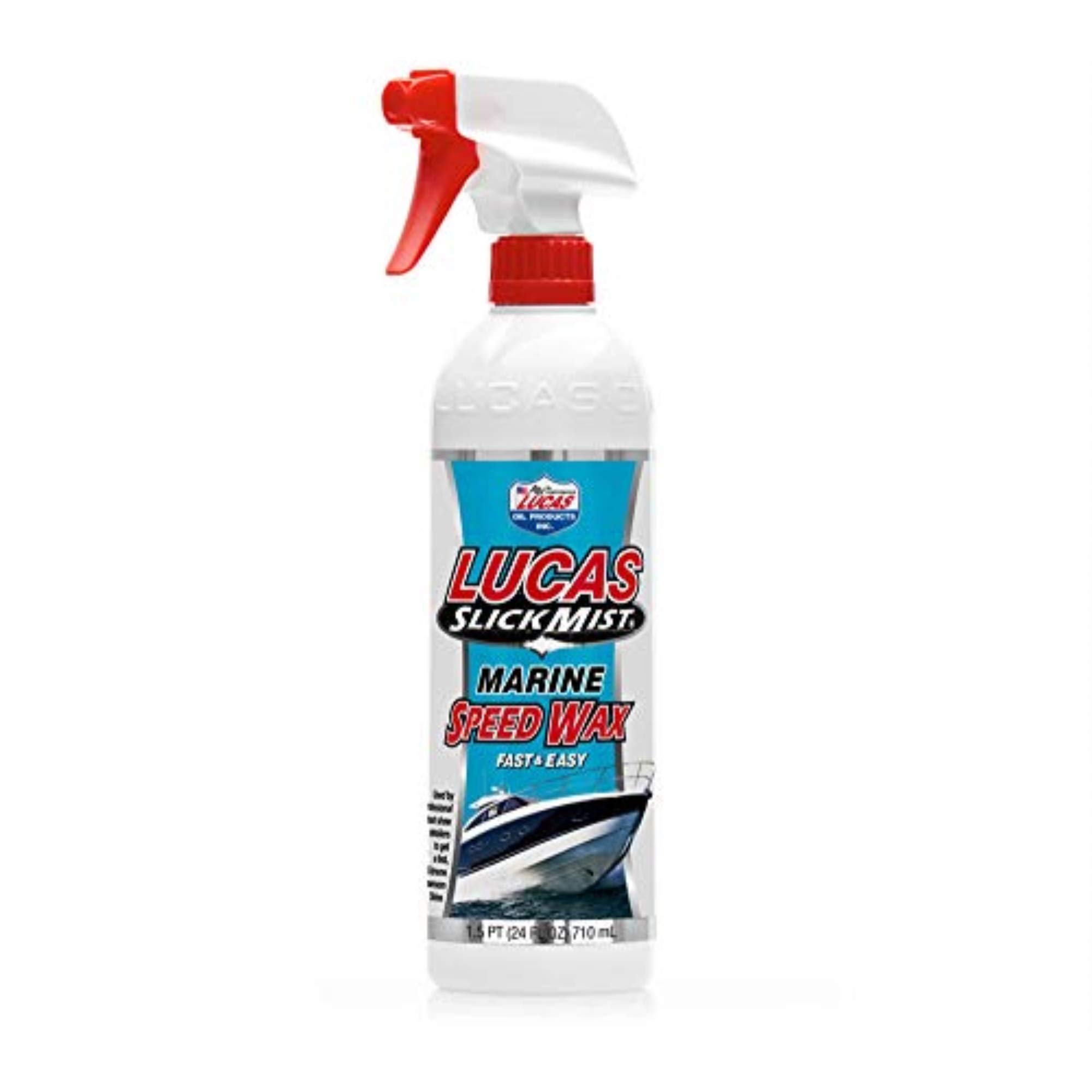
Lucas Oil Slick Mist Marine Speed Wax

92 /100
Angler Score Outstanding

Key details

Form
Spray wax
Size
24 fl oz
Surfaces
Paint, glass, chrome, vinyl decals
Application
Wet or dry, no buffing
Check Details on Amazon

Spray it on, wipe it off, done — the Lucas Slick Mist is the only product here that asks for no buffing at all, and it works on a wet or dry surface. That matters more than it sounds. The bottle lives in the boat rather than the garage, because you can hit the topsides at the ramp while everything is still wet and skip a second drying pass entirely.

It covers more than gelcoat, too: paint, glass, chrome, and vinyl decals all take it, so one bottle handles the windshield, the stainless, and the registration numbers without a second product. We also noticed it lifts lake scum and light water spotting as it goes, which makes it useful after a swim-heavy afternoon. The bubble-gum scent is either a perk or a distraction depending on your crew.

The trick is to treat it as a topper rather than a season's protection. It leaves the surface slick and glossy and makes the next wash easier, but it goes on thin and it goes fast — a 24-ounce bottle empties quickly on a full hull. Pair it with a real base coat in spring and it earns its shelf space.

Pros

  • Sprays on wet or dry with no buffing
  • Safe on paint, glass, chrome, and decals
  • Lifts lake scum and light spotting

Cons

  • Protection lasts weeks rather than a season
Our verdict

Keep this spray in the dock box for quick touch-ups: no buffing, no machine, and it wipes lake scum off in the same pass.

Check Latest Price

How We Tested Boat Wax on Real Hulls

We started by pulling every marine wax we could find that was actually sold for fiberglass boats rather than cars, then trimmed the list by reading labels: carnauba versus polymer chemistry, whether UV inhibitors were called out, and whether a product was a one-step cleaner wax or a pure sealant meant to sit on clean gelcoat. Price per ounce and container size narrowed it further, because a 12-ounce tin and a gallon jug are not the same purchase even at a similar sticker. Fifteen formulas made the cut, and we ran them for five months.

Each wax went onto a marked three-by-three-foot section of hull, applied by hand with a foam pad following the label — some in April shade in a driveway before launch, others in July sun on a mooring with the gelcoat warm to the touch. We timed how long a section took to cover and noted whether the product grabbed, streaked, or sagged on a vertical surface, then timed the haze and recorded how much pressure the wipe-off took, whether it dusted, and whether it left a film that needed a second pass. Shine was judged on the same panel in the same late-afternoon light, plus a shop light held at a low angle to catch swirls and hazing.

Durability got the least glamorous treatment: each section was hosed with salt water, left to bake, and checked weekly, with one untouched patch on every hull as a control. We watched whether water beaded tight or flattened into sheets and marked the week each section stopped beading. Value came down to arithmetic — price per ounce, how far a container actually went on a 20-foot hull, and whether the cheap tin needed two coats to match one of the expensive one.

How to Choose a Boat Wax

Cleaner Wax or Pure Wax

The test is your fingertips. Run a hand along the topsides: if the gelcoat feels chalky and looks hazy, the surface needs cleaning before it can be protected, and a cleaner wax does both in one pass. If it feels slick and even, a pure wax lays down protection without spending cleaner you don't need.

Waxing over chalk doesn't fix it — it seals the dullness under a shine that fades within weeks. And a cleaner wax handles light oxidation, not years of it. Deep chalk wants a compound and polish first, then a wax on top.

How Long the Protection Actually Lasts

This is where the products here differ most. A carnauba-polymer liquid or paste is built around months — the longest stated window in this group is four to seven months — while a spray wax is there for weeks at a stretch. Salt, sun, and a hull that lives outside push you toward the short end of any range.

If your boat sits on a trailer under a cover, the difference matters less. If it's moored in strong sun year-round, buy at the top of the range and put a second coat on the bow and gunwales.

Paste, Liquid, or Spray

Paste gives the most protection per ounce and demands the most time: you work small sections and buff each one before it sets hard. Liquids are the middle ground, and the better ones are specified for hand pads or a dual-action polisher, which is the difference between a two-hour job and an all-day one on a long hull.

Sprays are the wipe-on topper you keep for the weeks between real wax jobs. The trap is buying a spray as your only wax: it looks superb for a couple of weeks and then stops doing much of anything.

Buying the Right Size

Shelf price misleads here. A small tin of paste covers multiple applications because a thin coat is all you need, while a gallon is cheapest per coat but heavy to pour and awkward to store on a garage shelf.

Match the container to the hull. A 16-ounce bottle or a 12-ounce tin is plenty for a trailer boat; step up to 32 ounces or a gallon once you're waxing topsides, a hardtop, and an RV in the same afternoon. Whatever the size, thin coats beat thick ones — you use less and buff less.

Frequently Asked Questions

Final Verdict

Buy the Meguiar's Flagship Premium Marine Wax. It's the bottle that suits the most boats: a gloss you can see, UV protection you stop thinking about, and an application that works as well with a dual-action polisher as it does with a foam pad in your hand.

If your gelcoat comes out of winter chalky, start with Meguiar's M50 cleaner wax and finish with the Flagship. If you want the longest stated protection here and one bottle that covers the boat and the truck that pulls it, the Collinite 845 is the better buy. Keep the Lucas spray for the weeks in between.