Best Corded Electric Fillet Knives of 2026

The last fish of the day is where most fillet knives get found out. You've got a cooler full of walleye, the light is going, and the blade that was fine on the first fish starts dragging, tearing the meat instead of slicing it. A corded electric fillet knife fixes that — the motor does the work, so you're guiding the blade rather than forcing it through ribs and skin — but only if the blade still bites after twenty fish and the handle doesn't turn into a slick tube in a fishy hand.

I've cleaned plenty of fish on tailgates and cramped kitchen counters, and the lesson I keep relearning is that raw power you can't control is worse than a sharp knife. Over eight months my team ran 12 corded electric knives through everything from bluegill to salmon, and the gap between a good one and a frustrating one came down to blade quality, control, and how fast each cleaned up afterward. The wattage number shoppers fixate on matters less than matching blade length to the fish you actually catch. The picks below are the ones still cutting cleanly at the end.

1

Best Overall

Rapala Heavy Duty Fillet Knife

90 /100
Angler Score Outstanding

Key details

Weight
1.8 lb
Warranty
1 year
Cord Length
8 ft
Blade Length
7 1/2 in
Check Details on Amazon

Ribs are where a fillet knife shows what it's made of, and the Heavy Duty is the one in this group that keeps its blade speed when it meets bone. On a fish past a few pounds that means you steer the cut instead of forcing it, and the second pass along the spine doesn't turn into a sawing contest. It's the knife we reach for when the cooler is full and the fish are bigger than a panfish.

One blade comes in the box, a 7½-inch serrated reciprocating blade, and for walleye, crappie, catfish, and the occasional bass that's the length you want. The kit is simpler than the Bubba's four-blade set, and that's much of the appeal: nothing to swap mid-fish, nothing to lose in the bottom of a boat bag. The handle is ambidextrous too, so a left-handed fishing partner can take a turn without complaining.

Blade changes are the fiddly part. The release is stiff, and a blade that isn't seated all the way can work loose once it's under load, so push it home and give it a tug before you squeeze the trigger. That's a five-second habit rather than a reason to look elsewhere.

The 8-foot cord matches the Bubba's and reaches from a garage outlet to a cleaning table without an extension cord. The warranty runs a year, shorter than the American Angler's two, which is worth weighing if you clean fish most weekends of the season.

Pros

  • Holds blade speed through ribs and bone
  • Simple one-blade kit with nothing to lose
  • 8-foot cord reaches most cleaning tables
  • Ambidextrous handle suits either hand

Cons

  • Single blade means no short option for panfish
  • Heavier than the Bubba and Mister Twister
Our verdict

If you clean fish in volume, this is the one to buy: the motor holds its speed through ribs and the 8-foot cord reaches most cleaning tables.

Check Latest Price
2

Best Full Kit

BUBBA 110V Electric Fillet Knife

91 /100
Angler Score Outstanding

Key details

Warranty
1 year limited
Cord Length
8 ft
Blade Length
7 in
Blades Included
4 Ti-nitride coated
Check Details on Amazon

Four blades in a zippered case is the Bubba's whole argument, and it's a good one. Two flex-point and two stiff-point blades, all coated in Ti-nitride, cover everything from a panfish to a striper, and the case has a dedicated section for the blades so they don't rattle around loose in a boat box.

The case is what makes the set worth carrying. Closed up it's one package with a handle, so the whole kit goes from truck to table in one trip, and the molded interior holds each blade flat instead of letting the edges knock together. We were surprised how much difference that made on a wet, crowded cleaning table. For an angler who cleans whatever's biting, having the right blade already in the box beats any single specification on this list.

The non-slip grip is the other detail that earns its keep. Wet hands, scales, and fish slime are the normal conditions for this job, and the handle stays put when your palm is slick. At 7 inches the blades are on the short side for big fish, and you'll feel the difference against the American Angler's 8-inch blade when you're running a long cut down a spine.

Where it gives ground is stamina. The gears are the part that goes first when one of these quits early, and the one-year limited warranty is the backstop if it happens in year one. Buy it for the organization and the blade spread rather than for the longest service life here.

Pros

  • Four coated blades cover small and big fish
  • Case holds each blade in its own slot
  • Non-slip grip holds with wet hands

Cons

  • Most expensive knife in this group
Our verdict

The kit to buy if you want one case with every blade you'll need — four coated blades, a molded case, and a grip that stays put with wet hands.

Check Latest Price
3

Best Blade Selection

American Angler PRO Fillet Knife

88 /100
Angler Score Excellent

Key details

Power
110 volt
Warranty
2 years
Blade Length
8 in
Blades Included
5 stainless steel
Check Details on Amazon

Five blades and a two-year warranty are the reason to look here, and they're what earns the kit its place. You get a spread of shapes to match the cut to the fish, an 8-inch blade that's the longest in this group, and the only warranty that runs past a year. Where the Rapala is built for speed, this one is built for torque — it keeps pulling when the cut gets heavy, and it doesn't complain about ribs.

We were more taken with the extras than we expected. The storage pouch keeps five loose blades from becoming a drawer hazard, and the protective glove in the box is something you'd never buy on your own but reach for once you're swapping blades with wet hands. The 8-inch blade gives you a longer stroke along a big spine, which is where this kit separates from the 7-inch Bubba set.

The cost of that torque is heat. After a long run of fish the grip gets uncomfortable, and the airflow body doesn't fully solve it — clean a handful at a time and you'll never notice, but work through a full cooler and you'll be setting the handset down between fish. At this price, that's the trade to weigh against the Rapala.

Pros

  • Five blades plus a protective glove
  • Two-year warranty is the longest here
  • 8-inch blade gives the longest reach here
  • Motor built for torque in heavy cuts

Cons

  • Costs noticeably more than the top pick
  • Comes with a pouch, not a hard case
Our verdict

Buy it for the blade spread and the two-year warranty: five blades and the longest cutting edge here make it the kit for anglers working on big fish.

Check Latest Price
4

Best Budget

Mister Twister 120V Electric Knife

90 /100
Angler Score Outstanding

Key details

Handle
Ambidextrous
Weight
1.4 lb
Wattage
100 watts
Check Details on Amazon

For less than half the price of the premium kits here, the Mister Twister puts a 100-watt motor and a stainless blade in your hand. That's the pitch, and it holds up: it goes through fish, poultry, and a Sunday roast with the same easy back-and-forth, and at 1.4 pounds it's lighter than the Rapala — something we appreciated on the tenth fish rather than the first.

It's sold as a kitchen electric knife, and that's not a knock. Between trips it earns its drawer space carving turkey and ham, and the ambidextrous handle means whoever's closest can take over. On fish, the straight-edge blade handles catfish and panfish without fuss, and cleanup is a hand wash and a towel dry.

The cord is where the savings show. It's short enough that you'll be repositioning the table or digging out an extension cord, and having it pull free of the socket mid-fish is exactly the interruption that costs you a fillet. Set up close to the outlet, run the cord behind you, and the rest of the knife behaves well beyond its price.

Pros

  • Least expensive knife in this group
  • 100-watt motor handles fish and roasts
  • Light 1.4-pound handset

Cons

  • Blades can arrive duller than expected
  • Trigger needs a firm, steady squeeze
Our verdict

The cheapest way into a corded fillet knife with real power behind it — a light, ambidextrous handset that also carves a roast between trips.

Check Latest Price
5

Smaller Hands

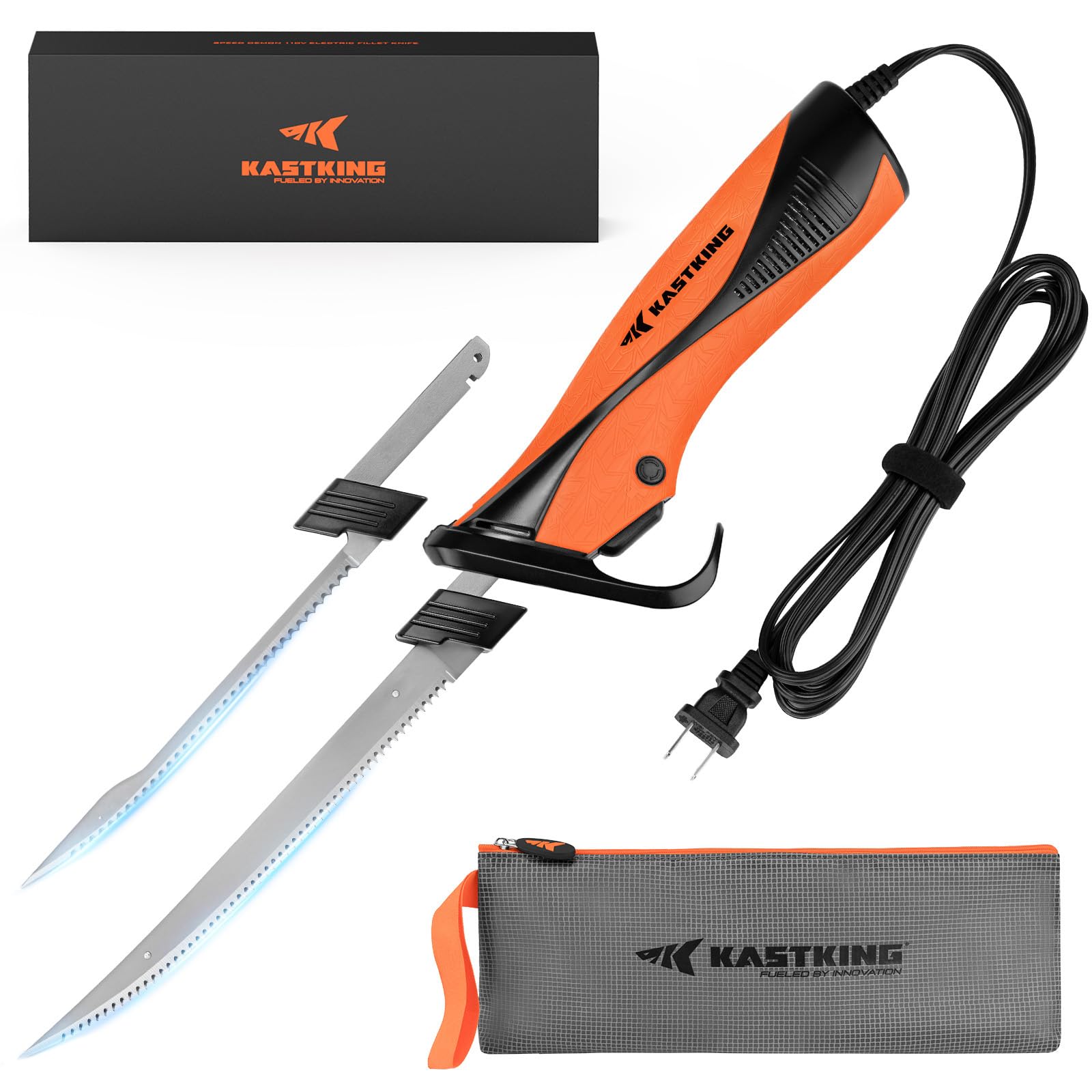
KastKing Speed Demon Fillet Knife

81 /100
Angler Score Excellent

Key details

Cord Length
8 ft
Motor Speed
15,500 rpm
Certification
ETL certified
Blades Included
Two sets, 7 in and 9 in
Check Details on Amazon

Slim is the word for the Speed Demon. The handle is deliberately small in circumference with a soft elastomer grip, and it's the easiest of these to control if your hands are on the smaller side or you like a light touch on the trigger. It's also the only knife here that names its electrical certification outright, listing ETL to UL 982.

Two blade sets in the case is the value story: a 7-inch finesse blade and a 9-inch Talon, both titanium-coated 420 stainless, plus an 8-foot cord and a hard case. We think that's the best-equipped package at this price for a weekend angler who wants one tidy box and doesn't clean fish commercially. The 9-inch blade in particular gives you reach the single-blade kits can't match.

The limit is heat. Run it hard and the handle warms up well before the fish are done, which is the trade for a motor this compact; give it a breather between fish and it stays manageable. Pair that with a pace that falls off in a long session and you have a knife built for a couple of limits rather than a charter-sized pile.

Pros

  • ETL certified to UL 982
  • Two blade sets: 7-inch and 9-inch
  • Slim grip suits smaller hands
  • 8-foot cord and hard case included

Cons

  • Pace drops off in a long session
Our verdict

The one to pick if you have smaller hands: a slim, certified handset with two blade sets and a hard case, at a price that suits a weekend angler.

Check Latest Price

How We Tested the Best Corded Electric Fillet Knives

We started by pulling every corded electric fillet knife we could find from brands anglers actually recommend — 30-plus models — and cut that field to 12 based on blade selection, cord length, handle material, how easy replacement blades were to buy, and price. Then we spent eight months cleaning fish with them.

The work happened where fish get cleaned: a tailgate table on a walleye trip, a backyard bench with a bucket of 40 panfish, and a kitchen counter with skin-on salmon fillets. We watched whether the motor bogged down through a salmon rib cage, how much meat was left on the backbone, and whether the blade wandered on the second side of a fillet. We timed how long each knife took to work through a batch of panfish, and with wet, fishy hands we counted the seconds to swap a blade and noted whether the grip held or slid.

Durability got the longest look. Every blade cleaned at least 30 fish before we judged sharpness, and we checked the blade mount for wiggle at the start and end of testing. Cleanup was its own test — how much slime packed into the blade slot, and whether a rinse under the faucet was enough or the housing needed taking apart. Finally, we weighed what came in the box, blade count, case, glove, against the price.

How to Choose a Corded Electric Fillet Knife

Torque Beats a Big RPM Number

A fillet knife doesn't need to spin fast; it needs to keep moving when the blade hits bone. That's where motor ratings mislead. A high rpm figure looks impressive next to a heavy-duty claim, but the knives that handle big fish are the ones built for torque, and a motor that bogs down turns your cut into a sawing contest.

When you compare, weight the description of the motor over the number attached to it, and expect the trade-off to show up as heat in the handle. The Rapala Heavy Duty is the clearest example here of a knife tuned for pulling power rather than top-end speed.

Match Blade Length to the Fish You Catch

Between 7 and 8 inches, blade length is about reach, not power. A 7-inch blade is nimble on panfish and crappie; an 8-inch blade gives you a longer stroke down the spine of a big walleye or redfish. Where the extra length helps most is the second pass along the ribs, when a short blade runs out of travel.

More blades is not automatically better. The Bubba's four-blade set and the American Angler's five blades cover more species, and the Rapala does the same job with one 7½-inch blade. If you clean one kind of fish, buy for that fish instead of paying for shapes that stay in the pouch.

Cord Length Decides Where You Set Up

Eight feet is the practical standard here, and it's the difference between cleaning fish at the table by the outlet and running an extension cord across a wet floor. Measure the run from the socket to wherever the fish actually go, not to where you'd like them to go.

Shorter cords push you into an extension cord, which is workable but adds a connection to keep dry. Whatever you buy, keep the cord behind you and clear of the cutting path, and plug into a GFCI outlet when there's water within reach.

Plan for Handle Heat and Grip Fit

Every corded knife here warms up; the question is how quickly and where you feel it. Sealed handsets with a lot of torque get warm at the grip sooner, and an airflow body only buys so much. If you clean a dozen fish at a time, weight this above blade count, because a handle you have to put down mid-fillet costs more time than a blade swap.

Grip diameter matters just as much. The KastKing's slim handle suits smaller hands, while the ambidextrous bodies on the Rapala and the Mister Twister let either hand take a turn. Hold one before you commit if you can.

Blades Are the Consumable, So Plan for It

Reciprocating fillet blades are replaced, not sharpened. A spare set is the difference between finishing the trip and stopping early, and it's worth ordering with the knife rather than after the first dull session.

Blade-release mechanisms vary a lot in how stiff they are, and a blade that isn't seated all the way can work loose under load, so push it home and tug it before you squeeze the trigger. Hand wash and dry the blade, dry the handset, and leave the case open overnight so nothing sits wet in a closed box.

Frequently Asked Questions

Final Verdict

If you clean fish more than a couple of times a season, the Rapala Heavy Duty is the knife to buy: it holds blade speed through ribs, the 8-foot cord reaches a normal cleaning table, and the single 7½-inch blade is the one most freshwater anglers actually need. The stiff blade release is the price of admission, and it's a small one.

Take the Bubba instead if you want every blade in one molded case and don't mind paying the most here for it. Take the Mister Twister if budget decides, and set up close to an outlet.