
Best Cordless Electric Fillet Knives of 2026

Cordless fillet knives ask for one trade: the endless power of a plug-in motor for the freedom to set up wherever the fish are. In return you get a knife that goes from boat to tailgate to kitchen sink without an extension cord dragging through the cleaning station. What you don't want is the model that dulls halfway through a limit and starts tearing instead of slicing — the right knife holds an edge, stays cool, and finishes the job on a single charge.

I've cleaned fish on tailgates, marina tables, and a few kitchen counters I'd rather not describe, and the gap between a good knife and a frustrating one shows up the second your hands are wet and slimy. Over eight months, my team and I ran 11 cordless models through whole fish, from paper-thin panfish to thick catfish fillets, and blade quality and battery life separated the field far more than the motor specs did. The picks below are the ones we kept reaching for after the test sheet was full.

1

Best Overall

BUBBA Li-Ion Cordless Fillet Knife

95 /100
Angler Score Outstanding

Key details

Blade Length
7 inches
Handle Length
8.5 inches
Blades Included
4 Ti-nitride coated
Battery Indicator
LED on handle
Check Details on Amazon

Four blades, a charger, and a zippered case with a pocket shaped for each blade: the BUBBA arrives ready for a cleaning table, and that completeness is much of why it is our top pick. The blades are Ti-nitride coated stainless, a finish meant to keep scales and slime from grabbing hold, which is the difference between a quick rinse and ten minutes of picking at the teeth. Everything has a home in the case, including the blades once they are off the handle.

The handle is where our opinion really forms. It is 8.5 inches of non-slip grip with a trigger guard, and the guard is the detail we appreciate most, because your hand stays where you put it when the fish is wet and your gloves are slimed. An LED indicator sits in the handle, so you can see what is left in the battery before you commit to a cooler full of fish. It is also a lot of handle: if your hands run small, this knife feels like it is steering you, and the 8.5-inch length is the reason.

At 1.11 pounds it is light enough to work one-handed, and the dual-rivet blade mount keeps the blade steady through a long cut. Our cutting notes are the good kind of boring: the motor does not bog, the blades come off without a fight, and cleanup is a rinse and a wipe since the whole knife is hand wash only. The limited one-year warranty is the part we push back on for a knife at the premium end of this group.

What the premium buys is the kit and the grip, and both are the sort of thing you notice on the second trip rather than the first: nothing rolls under the truck seat, nothing is missing when the bite turns on, and the knife comes out of the case ready to go. That is a real premium over the value kits here, and it is the part that keeps earning it back, trip after trip.

Pros

  • Four coated blades plus a slot for each
  • Non-slip grip with a trigger guard
  • LED battery indicator built into the handle
  • Blades come off easily for washing

Cons

  • Blades lose their edge faster than the price suggests
Our verdict

Our pick for most anglers: the most complete cordless kit here, with four coated blades and a non-slip grip that holds up when your hands are covered in slime.

Check Latest Price
2

Best Value

WORKPRO 12V Cordless Fillet Knife

89 /100
Angler Score Excellent

Key details

Case
Molded storage case
Weight
1 pound, knife only
Batteries
Two 2.0Ah lithium-ion
Blades Included
8-inch flex and 10-inch stiff
Check Details on Amazon

The WORKPRO is the kit we point at when someone wants to spend less and still show up with two batteries and two blade sizes. You get an 8-inch flex blade for panfish and walleye, a 10-inch stiff blade for bigger fish and rib sections, two 2.0Ah lithium packs, a charger and a molded case: essentially the same shopping list as the knives that cost noticeably more here, minus the blade count and the coating.

The second battery is the part that actually matters on the water. One pack charges while the other works, so a long afternoon does not end with you sitting in the truck waiting on a charger. The knife is about a pound before you add the blade and battery, light enough to steer with your wrist instead of your shoulder, and the non-slip grip holds a wet hand without asking you to squeeze harder.

Cutting is where it quietly embarrasses more expensive knives. The blades come sharp, they track straight along the ribs, and the motor does not slow when you hit a rib section. The 10-inch stiff blade is the one that surprised us most, taking a bigger fish in a single pass where a flex blade needs two or three. At this end of the price range, with a spare pack in the case, that is the whole argument.

Pros

  • Two packs, so one charges while you cut
  • 8-inch flex and 10-inch stiff blades included
  • Cuts through rib sections without bogging
  • About a pound before the blade and battery

Cons

  • Plastic drive gears can strip if a blade jams
Our verdict

The value pick: two batteries and two blade sizes at the low end of this group's prices, with cutting that holds up against pricier knives.

Check Latest Price
3

Best Battery Life

KastKing Speed Demon Pro Li

84 /100
Angler Score Excellent

Key details

Case
Slim EVA carry case
Battery
2500mAh lithium-ion
Rated Run Time
Up to 1 hour 40 minutes
Blades Included
2 titanium-coated 420 stainless
Check Details on Amazon

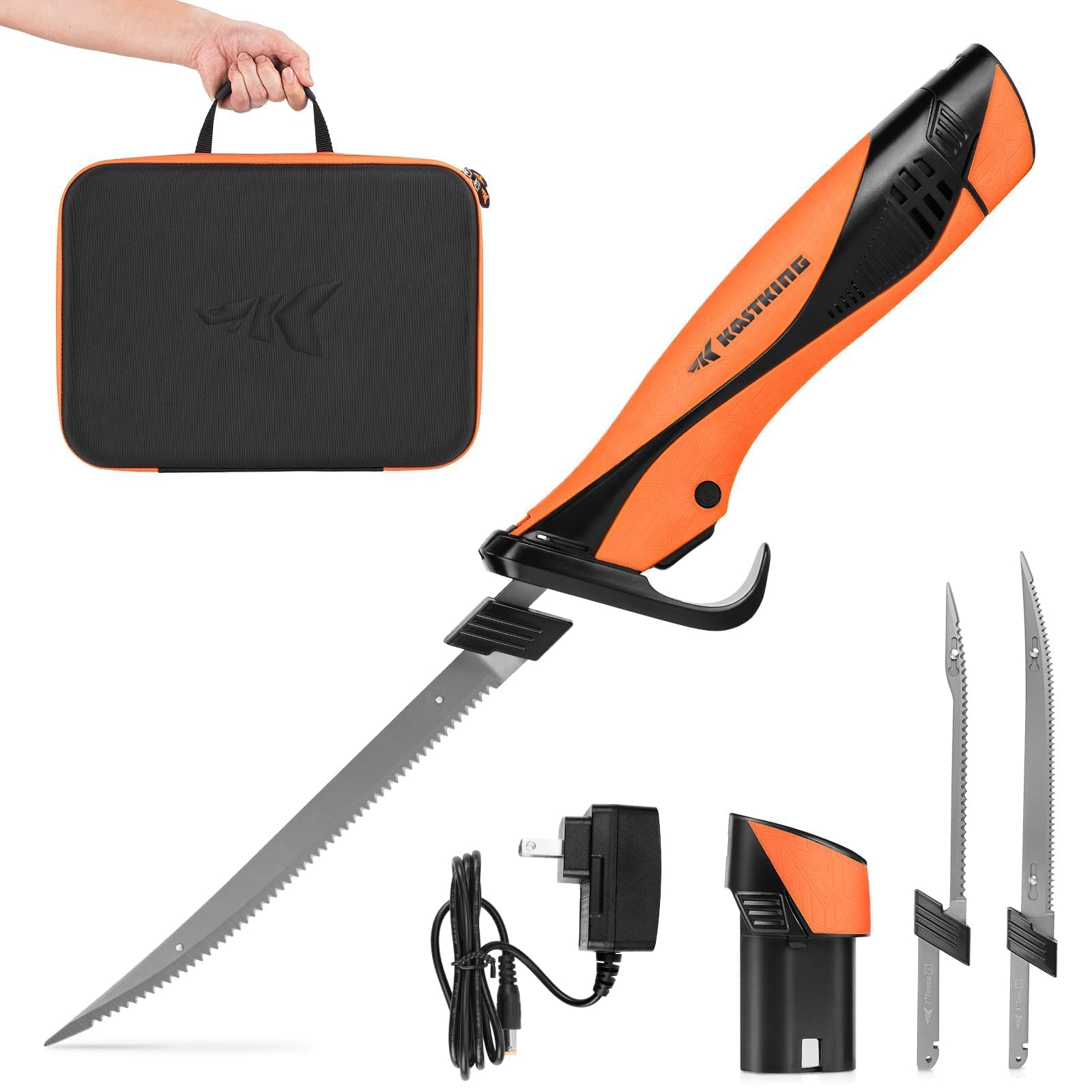
There is a number on the Speed Demon Pro Li that no other knife here states: 2500mAh, which KastKing rates at up to an hour and 40 minutes of continuous run time. Treat that as a ceiling rather than a promise, since nobody holds a trigger straight through a hundred minutes, but it is the biggest stated pack in this group, and it is why this is the one we pack for a charter-sized pile of fish.

Where it earns its place is the case. The slim EVA shell is the first one here that does not feel like a tackle box: it slides behind a boat seat or into a duffel, and the cutouts keep the blades from rattling around loose with the charger. Storage is not the feature we expected to care about on a fillet knife, but digging through a soft bag for the right blade gets old fast.

In the hand it is balanced, and the TPR grip stays put once your hands are wet. The 420 stainless blades carry a titanium coating and come sharp, with enough flex to follow a rib line instead of fighting it. The one adjustment is technique: this knife wants a steady sawing stroke, and pushing it straight through a big fish gets you a cut that wanders.

A single pack in the Angler Pack is the trade-off, and on a knife built for long sessions it is the thing we question most, because you get the run time without a spare in the box. For a day trip with a charger in the truck that is manageable. For a week off the grid, plan around it.

Pros

  • Biggest stated battery in this group at 2500mAh
  • Slim EVA case with cut compartments
  • Balanced TPR grip that holds when wet
  • Titanium-coated 420 stainless blades

Cons

  • Angler Pack ships with a single battery
  • Thick handle fills smaller hands
Our verdict

For a long day at the cleaning table, this is the one we reach for: the biggest stated battery in the group and a case that stows behind a boat seat.

Check Latest Price
4

Short Sessions

FLISSA 12V Cordless Fillet Knife

86 /100
Angler Score Excellent

Key details

Case
Custom hardshell case
Batteries
Two 2000mAh lithium-ion
Blades Included
8-inch flex and 10-inch stiff
Battery Indicator
LED
Check Details on Amazon

On paper the FLISSA is the WORKPRO's twin: an 8-inch flex blade, a 10-inch stiff blade, two 2000mAh packs, an LED indicator on the handle and a molded hard case, at the same end of this group's prices. What separates the two is heat. Run a long batch through it and the handle warms up, noticeably so once you are a dozen fish in, and by thirty it is the thing you are thinking about instead of the cut.

For a limit of panfish or a handful of walleye, that is a problem you will not meet. The knife is quick, the blades come sharp and hold their edge through a session, and the trigger guard keeps your grip where you set it. The blades do run long: the 8-inch is a lot of blade on a crappie, and the 10-inch is for fish worth the reach.

The hardshell case is stiff enough to protect a blade in a truck bed and has room for the second pack, and two packs is the right call on a knife that runs warm. Treat it as a knife for one sitting and it does everything you ask of it: sharp blades, a spare battery, and a case that survives the ride home.

Pros

  • Two 2000mAh packs and two blade sizes
  • Hardshell case holds the whole kit
  • LED indicator shows charge left
  • Trigger guard keeps a wet grip secure

Cons

  • Batteries are stiff to pull for a swap
Our verdict

A solid kit for clearing a limit in one sitting, with two packs and a hard case; it just does not stay comfortable in the hand as long as our top two.

Check Latest Price

Eight Months and a Lot of Fish: How We Tested Cordless Fillet Knives

Every knife here started as a spec sheet. We pulled cordless models that shipped with at least one spare blade or a second blade length, a charger that wasn't tied to a single hard-to-find source, and a battery rated to outlast a normal cleaning session, then cut anything with a reputation for blade wobble or a handle that couldn't be rinsed clean. That left 11 knives, and we spent eight months with them.

Testing happened where filleting actually happens: a tailgate table at the lake, a fish cleaning station, a garage workbench, and more than a few kitchen counters. We filleted batches of panfish and thicker catfish and salmon, timing how long a dozen fish took and noting whether the blade glided along the ribs or skipped and tore. Each knife also ran continuously for 15 minutes so we could feel the motor housing and blade hub for heat afterward, since a handle that gets hot is a handle you have to set down.

Battery life got measured two ways: run flat on a full charge, then left sitting in a tackle box for three weeks to see how much charge it lost. We swapped blades mid-session to compare sharpness on the second and third fish, checked whether a blade still cut cleanly after a full season of use, and handled every knife with wet, fish-slimed hands to see whether the grip held. Durability came down to small things — a blade collar that loosened, a charger door that stopped latching, a case that cracked in the truck bed.

Value was the last calculation: what you paid against how many seasons we thought the knife would last, and whether replacement blades were cheap and easy to track down. Several models did fine on the first fish and faded by the tenth, and those are the ones that stayed in the drawer.

How to Choose a Cordless Electric Fillet Knife

Start With the Blades, Not the Battery

An 8-inch flex blade does most of the everyday work, panfish to walleye to trout, because it follows the curve of the ribs and lies flat against the skin. A 10-inch stiff blade is for bigger fish and for rib sections that would flex a thin blade away from the bone. Two well-chosen blades beat four you will never mount, which is why the WORKPRO and FLISSA kits cover most freshwater cleaning with one of each. If you mostly clean one size of fish, buy for that size and ignore the blade count.

Grip, Weight and Heat

These knives get held for hours, so grip shape matters as much as the motor. The BUBBA's 8.5-inch handle suits a large hand and feels like a lot of knife in a smaller one, and about a pound is the weight class to aim for, since heavier knives tire your wrist by the second cooler. Heat is the quieter issue: a sealed handle around a reciprocating motor warms up over a long run, and a knife that is fine at ten fish can be unpleasant at thirty. If you clean in big batches, plan short breaks.

What Should Be in the Case

A case is not a freebie. It is how blades, spare battery and charger stay together, and it is the difference between a knife that lives in the boat bag and one that gets lost in the garage. Look for molded slots for each blade so you are not digging for the 10-inch through fish-scented plastic, and for a shell stiff enough to protect the teeth in a truck bed. Two packs are more useful than one big pack on a knife used away from power: one charges while the other works.

Cleanup and Blade Care

Every knife in this group is hand wash only, and the blades come off for it. Rinse and dry the blade before it goes back in the case; salt water and slime left on a coated blade is how you get pitting and a stiff release. The handle gets a wipe, not a soak, because water in the trigger mechanism is the usual way a cordless knife starts misbehaving. Seat and lock the blade every time you mount it, and keep a spare in the case for the day the cut starts tearing instead of slicing.

What the Price Tiers Actually Buy

The cheap end of this group gets you the same working kit as the expensive end: two batteries, two blades, a case and a motor that will clean a limit. The premium buys blade coating and blade count, a grip shaped for a bigger hand, and a longer record of use behind it. That is worth paying for if you clean fish most weeks. If you clean a dozen or two a season, the value kits cut just as cleanly, and the second battery matters more than the coating.

Frequently Asked Questions

Final Verdict

For most anglers, the BUBBA is the one to buy. It is the most complete cordless kit here, with four coated blades, a case that gives each of them a home, and a grip that stays put with wet hands, and it is the one we hand to someone heading out for a weekend on the water.

If the budget is tighter, the WORKPRO does the same job with two batteries and two blade sizes for a lot less, and it cuts as cleanly as anything in this group. Cleaning big numbers in a single sitting? The KastKing's larger pack and slim case make it the one to pack.