Best Women's Deck Boots of 2026

The first step onto a dew-slick dock is where deck boots earn their keep — and where a cheap pair gives itself away, skating sideways while your socks soak through. A good pair does two jobs at once: it bites into wet fiberglass and it keeps water out, without feeling like you laced up two buckets. Rainy dog walks taught me the rest comes down to small things — how the sole grips, how the shaft sits on your calf, how easily the boot comes off with wet hands — plus the fit and sizing quirks that make ordering online a gamble.

The past six months, my team and I have worn 12 pairs through marina ramps, fish-cleaning stations, muddy garden beds, and school-run puddles, pulling them on and off dozens of times a day. The keepers share a sole that holds on wet gelcoat, a fit that doesn't swim at the heel, and a price that doesn't sting — two of my favorites were also among the cheapest. Comfortable after eight hours and tidy enough for jeans, they're the ones below.

1

Best Overall

Furuian Women's Deck Boots

91 /100
Angler Score Outstanding

Key details

Fit
True to size, roomy
Style
Ankle deck boot
Closure
Slip-on, hands-free
Check Details on Amazon

The test we kept coming back to is the doorway test: can you get them off without bending down? These pass. The collar is wide enough to step into, and the boot holds its shape enough that you can shrug out of them with the other foot, which matters when your hands are full of cooler and rod. Underneath that convenience the basics hold: dry feet, a cushioned footbed, and a price below most of the boat-brand boots in this guide. None of that is exotic. It's just done properly, which is more than we can say for every pair here.

Fit is the part to get right, and these run true to size with enough width that a wide forefoot isn't pinched. There's room for a thick sock without the heel lifting. The footbed has real cushioning underfoot instead of a flat rubber slab, and that's what makes them bearable for the long walk from the parking lot to the ramp or an afternoon of errands afterward — the boot doesn't punish you for wearing it past the dock.

Water is where a deck boot earns the name. These keep feet dry in wet grass, shallow puddles, and a washdown at the dock, and mud hoses off the smooth upper and wipes away with a rag. The limit is the collar: step into water above the ankle and it comes straight over the top, so this isn't the pair for launching a boat by hand off a shallow ramp.

The one thing the listing never claims is slip resistance, and that's worth planning around. On a wet dock these behave like a normal rubber sole; on an algae-slicked ramp, cross slowly and keep a hand on the rail. That's true of every boot here, not just this one — we'd rather you know it than find out at the ramp.

Pros

  • Stays dry in wet grass, puddles, and dock washdowns
  • Cushioned footbed comfortable for long days
  • Hands-free on and off at the door
  • Roomy enough for a wide forefoot and thick socks

Cons

  • Smells strongly of new rubber for a few days
Our verdict

If you buy one pair of deck boots this year, we think it should be these: dry feet, real cushioning, and a price that undercuts the boat brands.

Check Latest Price
2

Best Classic Deck Boot

Xtratuf 6 In Ankle Deck Boot

93 /100
Angler Score Outstanding

Key details

Fit
Runs generous, no half sizes
Model
XMAB-301
Shaft Height
6 in
Check Details on Amazon

Xtratuf is the boot most people picture when they hear the words deck boot, and the 6-inch ankle version is the shape that made the reputation: a low rubber shell that stops above the ankle bone, colorways running from plain black to a printed scales pattern, and a bright white collar on several of them.

We recommend it for the look and the collar rather than the badge. This is the pair to buy if you want the boat-uniform silhouette and more splash protection than the short boots here offer — the 6-inch shaft catches spray that sails straight over a 4.5-inch collar. It also wears more like gear than like a gardening shoe, which is not nothing when you're stepping off a boat and into town.

Durability is where these are weakest in this group. The record is the most divided of any boot we compared, with pairs that go for years and pairs that come apart early, and we can't tell you which you'll get. What we can tell you is where to look: flex the heel and check the bond where the upper meets the sole during the first month, while a return is still straightforward.

One more detail we appreciated: the collar sits high enough that the boot reads as intentional with jeans, and the print options make it easy to match a jacket or a boat. Where it lands is simple — these are the deck boots for someone who wants the classic shape and will accept that they may not be the last pair they buy.

Pros

  • Classic deck-boot silhouette in many colorways
  • 6-inch collar adds real splash protection
  • Slips on and off without hands
  • Versatile from dock to town

Cons

  • No half sizes, and the fit runs generous
Our verdict

We still recommend these for the classic silhouette and the taller 6-inch collar, provided you're comfortable with a fit that skips half sizes.

Check Latest Price
3

Best for Anglers

HUK KC Print Rogue Wave

91 /100
Angler Score Outstanding

Key details

Fit
Cut small and narrow
Model
H6800002
Style
Slip-on fishing boot
Check Details on Amazon

The HUK Rogue Wave is the most expensive boot here, and the only one in the group that reads as fishing gear rather than rain gear. The printed patterns give it away — this is a boot designed to be seen on a boat, and it's the pair that looks deliberate with shorts and a fishing shirt instead of borrowed from the garden shed.

What the money buys is a snug, supported shell that hoses off after a morning of bait and fish blood, with quality as consistent as anything in this group and durability that's solid rather than remarkable. Fit is the catch: these are cut small and narrow, so plan on going up a half or full size and keeping a thin sock on. A wide forefoot should look at the Furuian or the Showave instead.

We think they're worth the premium for someone who fishes often and wants one pair that does boat duty and looks intentional doing it. If the same boots spend half their life in a garden bed, the price is hard to justify — the Bassdash and the Furuian handle the wet work for a lot less.

Pros

  • Hoses off fish blood, bait, and mud
  • Snug, boat-ready fit that stays put
  • Printed patterns look intentional on the water
  • Durability outlasts cheaper alternatives

Cons

  • Light-colored prints can yellow over time
Our verdict

Our pick for dedicated anglers: a snug, fast-cleaning boat boot with the sharpest looks on the water, worth the price if fishing is the main job.

Check Latest Price
4

Best Cushioned

Bassdash Explorer-DG Deck Boots

90 /100
Angler Score Outstanding

Key details

Sole
Cushioned, sneaker-style
Model
BG2025-001
Shaft Height
4.5 in
Waterproofing
Waterproof
Check Details on Amazon

A 4.5-inch shaft is the shortest in this guide, and it changes how a boot feels: less rubber wrapped around the ankle, more freedom to crouch and step, and a sole that feels borrowed from a sneaker. That combination is why this is the pair we reach for on days we know we'll be standing on a deck for hours.

The cushioning is the star. The insole is soft enough that a long day on a hard surface doesn't leave your heels aching, and the low shaft means you're not fighting it over a calf. There's a ledge at the back of the heel you can step on to peel them off, a small thing we ended up using every single time.

The weak point is the sole. Wear through the ball of the foot has happened within a month of steady farm use, which is the thing to weigh if your boots live on gravel and barn concrete rather than fiberglass. Keep an eye on the tread there — and treat the low shaft as a fair-weather choice, because spray clears a 4.5-inch collar long before it reaches a 6-inch one.

Pros

  • Cushioned, sneaker-like sole for long days
  • Short shaft frees the ankle and calf
  • Heel ledge lets you step out of them
  • Roomy enough for thick socks

Cons

  • Runs big; size down if you're between
Our verdict

We think these are the most comfortable boots here for standing all day — a sneaker-soft sole under the lowest shaft in the group.

Check Latest Price
5

Best for Everyday Wear

Sureway Waterproof Ankle Deck Boots

88 /100
Angler Score Excellent

Key details

Fit
Runs small and narrow
Style
Ankle deck boot
Waterproofing
Waterproof
Check Details on Amazon

Set the Sureway next to the Xtratuf and the difference is shape: this is a trimmer, more shoe-like boot with a softer step and a neater profile, the kind of thing you can wear to the feed store without announcing you're headed to the water.

Durability is where these surprised us. The record is the most consistently positive in the group — months of barn and garden work with no real wear showing — and the waterproofing holds the same way, with dry feet through rain, hose water, and shallow puddles.

Comfort is good rather than luxurious: no blisters, easy on and off, and a collar low enough that you're not wrestling a shaft over your calf every time you step inside. The pink colorway is genuinely pretty in person, which isn't something we expected to write about a rubber boot.

We recommend them for the unglamorous wet work that most deck boots actually do — a rainy commute, the dog, a pontoon deck, a morning in the beds. They're the pair that feels least like a piece of equipment and most like a shoe you happen to be able to hose off.

Pros

  • Most consistent durability record in this group
  • Keeps feet dry through rain and hose water
  • Easy slide on and off
  • Trim, shoe-like profile

Cons

  • Runs small and narrow
Our verdict

A snug, durable boot that surprised us, and our recommendation for narrow feet, wet commutes, and anyone who wants a deck boot that feels like a shoe.

Check Latest Price
6

Best for Garden Chores

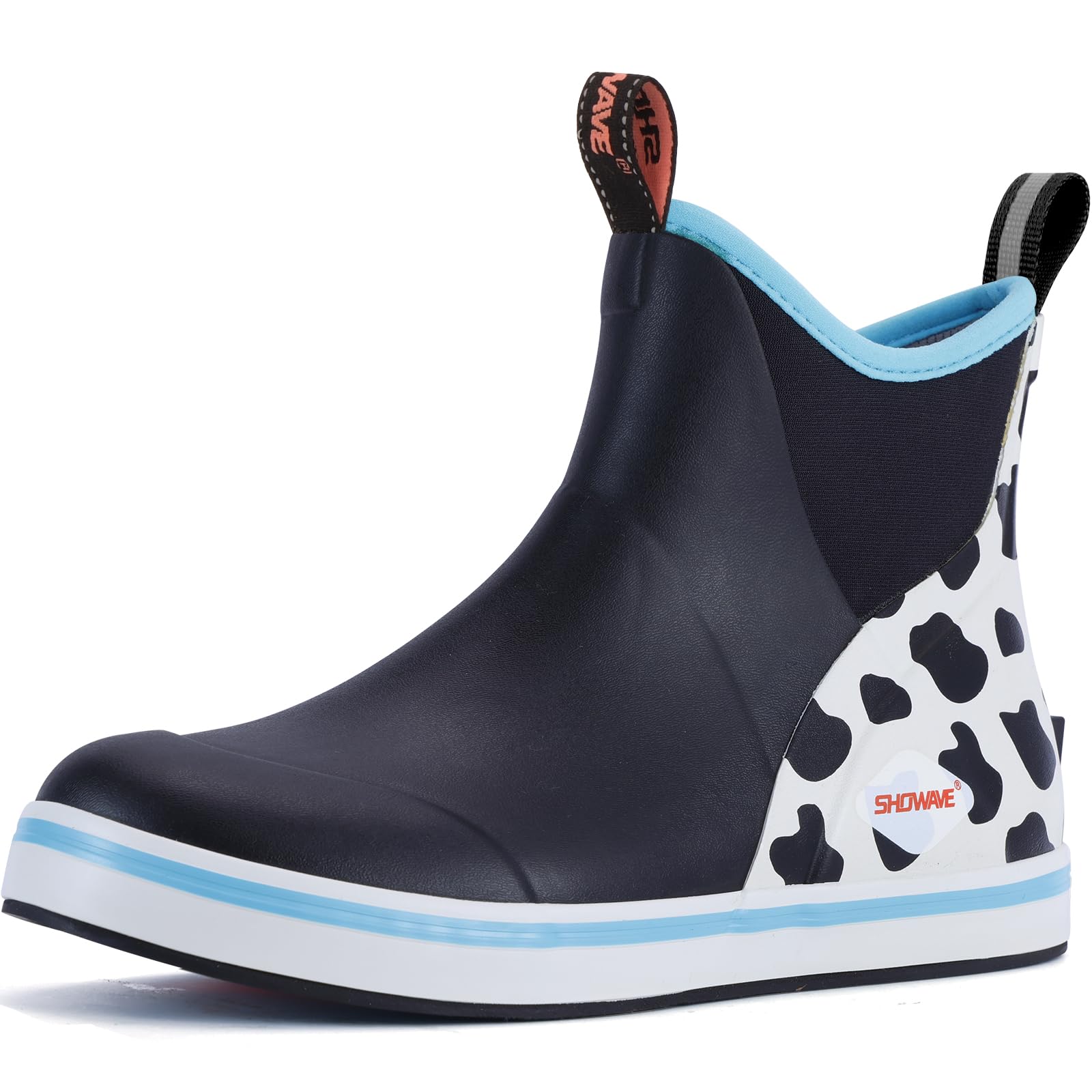
Showave Waterproof Ankle Rain Boots

93 /100
Angler Score Outstanding

Key details

Fit
True to size, wide-friendly
Style
Ankle rain boot
Closure
Heel pull tab
Waterproofing
Waterproof
Check Details on Amazon

Most deck boots are black rubber with a logo stamped on the side. The Showave comes in prints, and that's the first thing anyone notices — a boot you wear to shovel out the chicken coop that also gets compliments at the hardware store. Under the pattern is a competent ankle boot: dry, true to size, and cut wide enough that the top of the foot isn't pinched.

We like them best for garden work, and that's where the design makes sense: roomy across the instep for a thick sock, cushioned enough for a few hours of standing and shoveling, and easy to hose off once the mud dries. On a wide foot, they're the most comfortable boots here.

The details are small but well judged. A tab at the back makes pulling them on easy, the sole is flat and light enough to wear all afternoon, and the print hides mud better than plain black does. Where it stops: that light tread is fine on wet grass and a dock but not something to trust on an icy driveway in January.

Pros

  • True to size and roomy across the instep
  • Comfortable for hours of garden standing
  • Prints hide mud better than plain black
  • Back tab makes pulling them on easy

Cons

  • Back loop and heel seam can tear
Our verdict

The best of these for garden chores, in our view: true to size, wide-friendly, and patterned enough that a mud boot feels like something you chose.

Check Latest Price
7

Best Budget

CKWLXQY Women's Deck Boots

87 /100
Angler Score Excellent

Key details

Style
Ankle rain boot
Lining
Insulated
Waterproofing
Waterproof
Check Details on Amazon

The cheapest boot in this guide does most of what the expensive ones do. Feet stay dry in rain and mud, the shaft pulls on without a fight, and the whole thing wipes clean with a hose — which is why we don't mind leaving a pair by the back door to get destroyed.

Warmth is the surprise. The rubber is thick and insulated enough that a cold morning doesn't come up through the sole, and there's still room for a heavy sock. Fit is the thing to sort before you order, and the safest read is to go up if you're between sizes.

We recommend them for dirty, low-stakes jobs — coop cleaning, muddy beds, hosing down the boat — where a scuffed boot is no loss and dry feet are the whole point. Two things to expect: the ankle opening is wide and unstructured, so they won't feel as locked-in as the pricier picks, and the finish won't fool anyone up close.

Pros

  • Warm without a heavy lining
  • Keeps feet dry in rain and mud
  • Lowest price in this group
  • Hoses clean after yard work

Cons

  • Wide, unstructured ankle opening
  • Finish reads budget up close
Our verdict

The budget pick we keep by the back door: warm, dry, easy on, and inexpensive enough to beat up in the yard.

Check Latest Price
8

Adjustable Fit

Kalkal Seafoam-Trim Deck Boots

90 /100
Angler Score Outstanding

Key details

Style
Ankle deck boot
Insoles
Spare set included
Waterproofing
Waterproof
Check Details on Amazon

Two sets of insoles ship in the box, which tells you the fit runs big — and we like the honesty of the fix. Swap the thicker set for the thinner one and the boot tightens around the instep; keep both and you have a boot that follows your sock drawer from July to November.

The rest of the package is solid. The rubber is thick enough that cold ground doesn't bite through, the build holds up against pricier boots here, and the pull loops make them a two-second boot to get on. That thickness has a cost in summer: on a hot day these run warmer than the thinner boots in this group.

Range is where they earn their place — chicken run in the morning, a beach walk in the afternoon, the boat deck when the weather turns. The ankle collar is high enough to keep sand and grass out without the fight of a taller boot.

We think they're a fair mid-price choice for someone who wants one comfortable, roomy boot for everything outside the house, and the insole swap is what makes the fit workable. Use it before you decide they're too big.

Pros

  • Spare insoles let you tune the fit
  • Comfortable and roomy for all-day wear
  • Pull loops make them quick to put on
  • Handles garden, beach, and boat duty

Cons

  • Seams can separate within a month or two
Our verdict

Roomy and easy to pull on, with spare insoles that let you tune the fit — a fair mid-price boot for everything outside the house.

Check Latest Price

How We Tested Women's Deck Boots on Wet Docks, Boats, and Muddy Beds

I started by gathering every women's deck boot I could find — roughly 40 candidates — and reading through reviews for the same complaints: boots that leaked at the seam within weeks, soles that went slick on wet fiberglass, sizes that ran a full step small. From there I cut the list by price, whether half sizes existed, and how wide a calf each shaft was built for. Twelve pairs made it to testing, and we wore them for six months.

Testing happened wherever these boots actually live: marina ramps, wet boat decks, fish-cleaning stations, muddy garden beds, rainy dog walks, and one very sloshy school pickup line. For water resistance, we stood each pair in a few inches of water with paper towels stuffed inside, then checked the towels, and we kept notes on damp seams after long wet days. Traction got tested on a wet dock ramp and a hosed-down concrete path; we noted which soles bit and which skated. Ease of use meant pulling them on and off one-handed, with wet hands, and with thick socks on.

Comfort and fit we judged the slow way — eight-hour days on our feet, a mile walk on pavement, and testers with wide, narrow, and half-size feet comparing notes on the same size across pairs. We measured each footbed against a tape and noted who had to size up. For durability, we hosed mud off after every use, flexed the uppers at the ball of the foot, and checked seams and sole edges at the three- and six-month marks. Appearance came down to whether we'd wear them past the garden gate, and value was the last question: what held up, against what it cost.

How to Choose Women's Deck Boots

Collar Height Sets the Limits

Everything here stops between 4.5 and 6 inches, which is the whole point of the category: your calf stays free, the boot comes off in a second, and you don't overheat in July. The trade is depth. A collar just above the ankle keeps out spray, wet grass, and a hose-down; it does not keep out water you step into.

So be honest about the job. If your fishing means launching by hand off a shallow ramp or wading a flat, a tall rubber boot is still the right tool. If it means a wet deck, a dock, and a muddy yard, the low cut is the upgrade — and a 6-inch collar buys you noticeably more spray protection than a 4.5-inch one.

Fit, Half Sizes, and the Sock Question

Half sizes are rare in this category, and that's where most of the fit grumbling comes from. Decide your sock first: a thin liner on a summer boat versus a thick wool sock in November is close to half a size of difference, and it's the difference between snug and sloshing. Order for the sock you wear most.

Two other things matter more than the number on the box. Width — several of these run narrow, and a wide forefoot will feel it immediately. And the heel, which should hold without lifting as you walk. If the boot turns out roomy, a second insole is a legitimate fix; the Kalkal ships with a spare set for exactly that reason.

Soles and Wet Traction

Sole design is the least visible and most consequential choice here. A flat, cushioned rubber sole is comfortable for standing and walking on pavement; a sole with a defined heel and deeper tread clears water and finds grip on a wet deck. For boat work, favor the tread and accept a firmer ride. For garden beds and errands, favor the cushioning.

One caution worth repeating: no rubber sole grips algae-covered fiberglass or a slimy ramp. Step carefully on those in any of these boots, and don't read a soft sole as a safety feature.

Seams, Rubber, and Care

A one-piece rubber shell has fewer places to leak than a stitched boot, and the seams that do exist — the heel counter, the pull loop, the bond where the upper meets the sole — are where failures start. When you try a pair on, flex the heel and look at those three spots before the return window closes.

Care is simple and it genuinely extends life. Rinse saltwater and mud off after a trip, and dry the boots in the shade rather than on a radiator or in a hot car, which hardens rubber and cracks it at the flex point over the toes.

What You Pay For

The picks here range from budget to premium, and the extra money mostly buys finishing, sole shape, and consistency of fit rather than waterproofing — a cheap rubber boot keeps water out about as well as an expensive one. Spend up if you're on your feet all day or want a specific look on the water; spend down if the boots live by the back door for chores and you'd rather replace them than baby them.

Frequently Asked Questions

Final Verdict

The Furuian deck boots are the pair we tell most women to buy. They're comfortable enough for a full day on a dock or in a yard, they keep feet genuinely dry, they come off without using your hands, and they cost less than the boat-brand boots here. That's the whole job, done properly.

If the classic silhouette matters and you want a taller collar, the Xtratuf is the better-looking buy — check the heel seam early. Dedicated anglers who want a snug, quick-cleaning boat boot should look at the HUK, and if the budget is tight, the CKWLXQY handles muddy chores for a fraction of the price.