Best Deck Boots of 2026

A wet boat deck at dawn is basically a skating rink, and the wrong boot turns a routine trip down the dock into a fall you feel for a week. Deck boots are the answer: ankle-height rubber or neoprene boots with a soft, siped outsole that grips fiberglass and sheds water instead of soaking it up like a sneaker. The catch is that plenty of boots sold as deck boots are just rain boots with a nautical colorway — stiff, sweaty, and slick the second the deck gets hosed down.

I keep a pair by the back door from April through November, and what I've learned is that fit decides everything else. Deck boots are often cut for a wide, thick-socked foot, so the size that's snug over wool socks may swim on you in July. My team and I have spent the past six months wearing 12 pairs through wet ramps, fish slime, and rainy errands, weighing comfort and grip against water resistance, price, and how each pair cleaned up. The ones below are the pairs we kept reaching for.

1

Best Overall

HUK Rogue Wave

95 /100
Angler Score Outstanding

Key details

Height
Ankle
Model Number
H8021007
Waterproofing
Waterproof
Package Weight
2.73 lb
Check Details on Amazon

Grip on a wet, slimy deck is the one job that separates a deck boot from a rain boot, and the HUK Rogue Wave is the pair from this group we reach for first. The outsole holds on wet fiberglass, dock planking, and a ramp slicked with rain, and it's a non-marking sole, so it won't leave black scuffs across white gelcoat. On a boat where shoes come off before anyone goes below, the low profile makes that a two-second job instead of a wrestling match.

Comfort is why it stays on after the boat is tied up. Nothing pinches across the instep or rubs at the heel, the footbed takes a full day of standing, and the pairs we wore through long, wet mornings came off dry and without hot spots. Waterproofing is complete to the cuff, which is the honest limit of any ankle boot: spray, rain, and a wet bilge are fine, standing water above the collar is not.

Fit is the thing to plan around. The Rogue Wave runs small, so if you're a half size or you wear thick wool socks from November on, order up. The lining is the part to watch over time — comfortable and quick to dry, but the first thing to tear on a hard-used pair, which puts these in the boat-and-yard category rather than the jobsite one.

What settles it for us is that the HUK removes the thinking. On a wet deck you stop checking where your feet are landing, and that isn't something a spec sheet can tell you. It's also why this pair lives by the door and not in the gear bin.

Pros

  • Best wet-surface grip in this set
  • Keeps feet dry through spray and rain
  • Comfortable for a full day on deck
  • Pulls on and off without sitting down

Cons

  • Lining can tear with hard daily use
  • Ankle height only; water over the cuff gets in
Our verdict

We recommend the Rogue Wave to anyone who spends real hours on a wet deck: the grip is the best of the boots in this guide, and it stays comfortable long after the lines are tied.

Check Latest Price
2

Best Classic Deck Boot

XTRATUF Men's Ankle Deck Boot

93 /100
Angler Score Outstanding

Key details

Height
Ankle
Model Number
22736
Waterproofing
Waterproof
Package Weight
4.5 lb
Check Details on Amazon

The loop on the back of the XTRATUF is wide enough to hook two fingers, and it tells you most of what this boot is about: step in, pull, done — no sitting down, no boot jack, no wrestling a wet foot into a wet boot at six in the morning. Of everything here, this is the pair that goes on and comes off fastest.

That ease is why it stays in rotation. The low-cut shape wears like a shoe rather than a wellington, so it goes from the boat to the hardware store to the school pickup without looking like you forgot to change. Feet stay dry through rain, dew, and spray, and the fit is roomy enough across the toes to take a thick sock without squeezing.

The trade-offs are real. The outsole is the part that gives out on hard-used pairs — separation at the heel and toe is what ends these boots — so we treat them as a boat and yard boot, not a work boot. Paying the premium here buys the shape and the one-handed pull-on, not extra toughness.

What keeps them in the guide is that shape. It's the classic deck-boot profile, low and rounded with rubber from cuff to sole, and it's the pair that looks like it belongs on a dock in a way the budget boots don't quite manage.

Pros

  • Fastest one-handed pull-on here
  • Wears like a shoe off the boat
  • Dry feet through rain, dew, and spray

Cons

  • Runs small, with no wide sizes
Our verdict

The deck boot we hand someone who wants the classic look and the easiest pull-on here — just know the outsole and the sizing are the two things to watch.

Check Latest Price
3

Best Value

SUREWAY Men's Deck Boots

90 /100
Angler Score Outstanding

Key details

Tread
Non-slip
Height
Ankle
Waterproofing
Waterproof
Check Details on Amazon

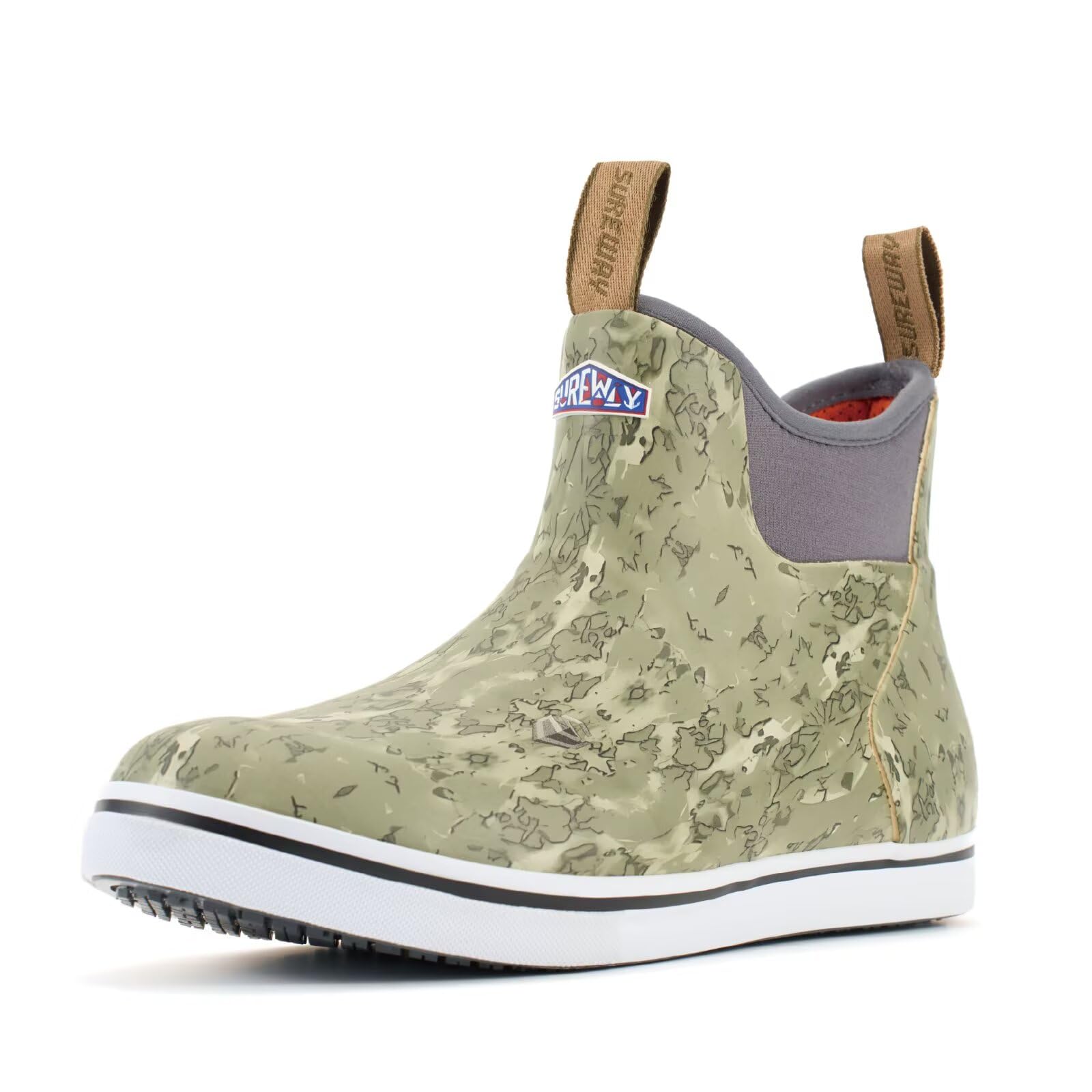
Take the shape of the classic deck boot, cut the price by a good margin, and you have the SUREWAY. It's our value pick: the profile is right, the upper has the same low, rounded line, and the insole is thicker than most of the boots here.

That insole is the surprise. It's thick enough that a full day standing on a dock, a garage floor, or a concrete slip doesn't leave your heels aching, and it stays comfortable when you wear the boots off the water. Waterproofing holds through rain and spray, and the pull tabs at the back do the work of getting them on.

Grip is better than the price suggests. The tread holds on wet concrete and dock boards, and it doesn't skate on the oily patches around a fuel dock or a garage floor. Between that and the comfort, these get worn for mowing and mud as readily as for a charter.

Pros

  • Classic deck-boot look for far less
  • Thick insole for long days standing
  • Grip holds on wet and oily surfaces

Cons

  • No half sizes, so fit is a gamble
Our verdict

Our value pick: it does most of what the famous deck boot does for a good deal less, and the insole is more comfortable than the price suggests.

Check Latest Price
4

Best for Women

Furuian Women's Deck Boots

91 /100
Angler Score Outstanding

Key details

Height
Ankle
Department
Women's
Waterproofing
Waterproof
Check Details on Amazon

These are the deck boots in this guide that get worn when there's no boat involved. The colorways and the trim shape read closer to a sneaker than a wellington, which is why they end up paired with jeans on a rainy Saturday rather than left in the garage.

They do the job, too. The fit is true to size with enough width that a thick sock doesn't turn them tight, the cushioning carries you on a walk to the marina or the bus stop, and they slip on hands-free when both hands are full.

What we like most is that nothing about them feels like a compromise on a wet day: feet stay dry standing in a puddle on a path, the tread is fine on wet grass and a damp dock, and mud hoses straight off. For the price, that's the best all-round package in the women's group.

Two things to know before you buy. The insole is the first part to give out and can start coming apart within weeks, so plan on dropping in a replacement if you wear them daily. And they're heavier than they look, which you notice on a long errand day but never on the boat.

Pros

  • True to size with room for thick socks
  • Pulls on hands-free
  • Good-looking enough for everyday wear

Cons

  • Feels heavy on long walking days
Our verdict

The women's boot we recommend first — true to size, dry in the rain, comfortable on a walk, and good-looking enough that you'll wear it without a boat in sight.

Check Latest Price
5

Best for All-Day Comfort

Kalkal Men's Deck Boots

89 /100
Angler Score Excellent

Key details

Sizes
7–14
Height
Ankle
Footbed
Memory foam
Waterproofing
Waterproof
Check Details on Amazon

Memory foam in a deck boot sounds like marketing until you spend a shift on concrete. The footbed here is thick and soft enough that a long day standing on a dock, a garage floor, or a stone jetty doesn't come back to you at night, and that's the reason this boot made the list over plainer rubber ones.

Grip is better than we expected. The tread holds on wet boards, wet rock, and the icy end of a parking lot, and it doesn't pack up with mud the way a deep lug does. They also pull on without bending over, which stops being a small thing when your hands are full or your back is sore.

Longevity is the open question. Some pairs have ripped at the upper within days, while others are still going after two seasons, so check the seams and the sole bond in the first month and keep the receipt where you can find it.

Sizing runs 7 to 14 with room in the toe box for a wider foot. The memory foam is cushioning rather than support, though, so if you need real arch support, plan on swapping in your own insole — there's enough depth for one.

Pros

  • Memory-foam footbed softens hard floors
  • Grip holds on wet boards and ice
  • Pulls on without bending over

Cons

  • Early seam and upper failures on some pairs
Our verdict

Pick the Kalkal if you're on your feet all day: the memory-foam footbed is the plushest here, and the grip holds up on wet boards and icy ramps.

Check Latest Price
6

Roomy Fit

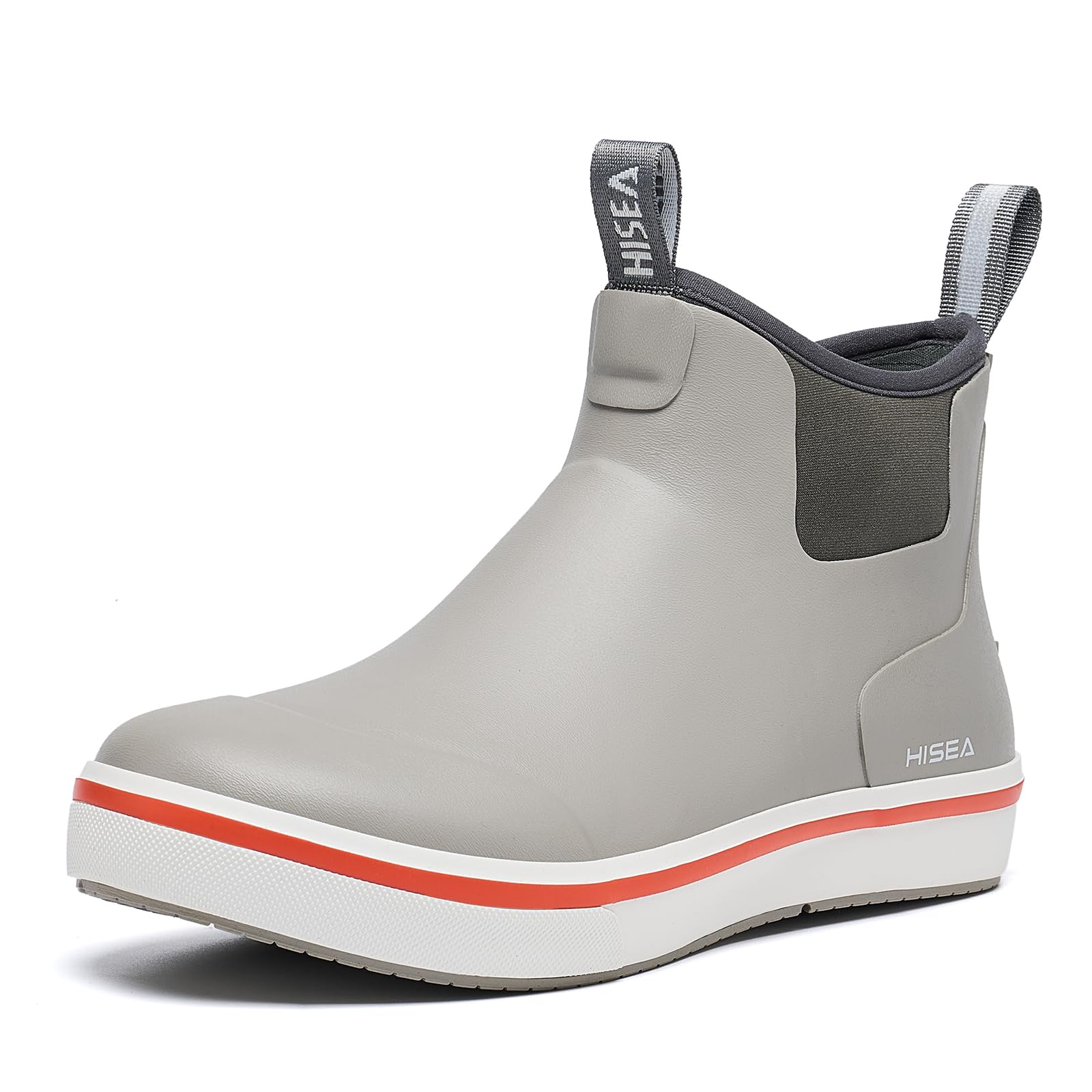
HISEA Men's Ankle Deck Boots

90 /100
Angler Score Outstanding

Key details

Upper
Rubber and neoprene
Height
Ankle
Waterproofing
Waterproof
Check Details on Amazon

The back pull loop is the first thing to fail on the HISEA. Yank it every morning the way a boot loop invites and it's the seam that tears, so pull from the collar instead and the rest of the boot holds up around it.

That's a pity, because the fit is the best thing here: the cut is roomier than a regular shoe, closer to a wide fit, which suits anyone between sizes or wearing wool socks from October on. The padded sole is genuinely comfortable, and the rubber-and-neoprene upper keeps water out through rain, wet grass, and a hose-down at the end of the day.

Traction is fine on grass, gravel, and a dock with some texture to it, but smooth wet surfaces are where these stop being sure-footed — a painted concrete ramp or a wet tile floor is where to slow down. That's the line between these and the boots at the top of the guide.

The toe box area is where the upper eventually cracks under hard use, so treat them as rain-and-yard footwear rather than daily work boots. For the money, that's a fair trade, and it's why they're here.

Pros

  • Roomier cut than a standard shoe
  • Padded sole comfortable all day
  • Rubber and neoprene keep water out

Cons

  • Grip is unsure on smooth wet surfaces
  • Toe box can crack with hard use
Our verdict

A roomy, dry, comfortable boot for wet weather and yard work — worth it if your feet are broad, less so if you're often on smooth wet concrete.

Check Latest Price
7

Hands-Free Entry

SUREWAY Women's Deck Boots

88 /100
Angler Score Excellent

Key details

Height
Ankle
Department
Women's
Waterproofing
Waterproof
Check Details on Amazon

Knee-high rubber boots are a nuisance to get on and off, and for anyone with a sore knee, a stiff hip, or a toddler on one arm, they're worse than a nuisance. These ankle boots solve that: they go on with a hand against the wall and come off with the toe of the other boot.

What we like beyond the easy on-off is how they wear. Months of mucking out, dog walks, and wet mornings haven't left them baggy or chalky, and the waterproofing is complete for rain, wet grass, and a wet boat deck. The pink colorway is a bonus if you're tired of black rubber.

Sizing is the thing to get right: order a full size up if you're between sizes or wear thick socks, and give them a week to soften at the ankle.

Next to the Furuian, they're the sturdier build and the narrower fit; next to a knee-high, they're the boot you'll actually wear. That's about where this pair belongs.

Pros

  • Slides on without bending or pulling
  • Dry through rain and wet grass
  • Holds its shape after months of use

Cons

  • Narrow cut with no wide option
Our verdict

The women's pair we point to for the easiest entry — pull them on with one hand, and size up a full size if you're between sizes.

Check Latest Price
8

Budget Yard Work

Furuian Men's Deck Boots

91 /100
Angler Score Outstanding

Key details

Height
Ankle
Model Number
db002
Waterproofing
Waterproof
Check Details on Amazon

Wet grass, a muddy driveway, a rainy walk to the truck: that's the territory the men's Furuian owns. It's the cheapest way into a waterproof ankle boot here, and it doesn't feel like a plastic bag on your foot — a low bar that plenty of cheap boots still miss.

Comfort is better than the price suggests. The fit runs true, there's room for an added insole if you want one, and they slide on and off with a tab and a pull. Waterproofing is complete through rain, slush, and standing water on a path.

Traction is the catch, and it's the reason this pair sits below the top picks. The sole is flatter and harder than the boots above it, and on a smooth wet surface — a painted ramp, a wet dock board, a tiled floor — it lets go in a way that will catch you out. On grass, gravel, and textured concrete it's fine.

Breathability is the other trade: the upper doesn't breathe, so a warm day in them means a damp sock by afternoon. Wear them for the wet chores, not a July hike, and they'll do everything you paid for.

Pros

  • Cheapest waterproof boot in this guide
  • Slips on and off in seconds
  • Comfortable for yard work and errands

Cons

  • Flat tread loses grip on smooth wet surfaces
  • Not breathable on warm days
Our verdict

The cheapest way into a waterproof ankle boot here, and a good one for yard work, rain, and errands — just not the boot for a wet, smooth deck.

Check Latest Price
9

Cold Wet Mornings

CKWLXQY Women's Deck Boots

87 /100
Angler Score Excellent

Key details

Height
Ankle
Department
Women's
Waterproofing
Waterproof
Check Details on Amazon

Most deck boots are a rubber shell with not much inside, which is why a raw October morning can leave your feet aching. This pair has insulation in it, and that changes the season you can wear them: wet snow, cold rain, a frosty walk to the chicken coop, all without the sock-and-liner routine.

For the money, it's the value pick of the women's boots here. Feet stay dry in rain and mud, the boots wipe clean in seconds, and they're warm without being so thick that October becomes uncomfortable.

Fit is where it gets muddy. Sizing is inconsistent across pairs — some come up small enough that a half size up is the right call, others run true — and there are no half sizes at all. Order your usual size, check the toe room the day they arrive, and send them back if the heel lifts.

The ankle opening is wide, which is why they kick off at the door without a fight and also why they can gap on a slim leg. A wool sock fixes the second part.

Pros

  • Insulated enough for cold, wet mornings
  • Keeps feet dry in rain and mud
  • Least expensive women's boot here

Cons

  • Sizing is inconsistent, with no half sizes
  • Ankle opening gaps on slim legs
Our verdict

Buy these for warm, dry feet on cold wet mornings at the lowest price in the women's group, and check the fit early because the sizing is inconsistent.

Check Latest Price

How We Tested Deck Boots on Wet Decks and Worse

We built the shortlist by first pinning down what separates a deck boot from a rain boot: a siped rubber outsole soft enough to grab wet fiberglass, an upper that stays flexible in cold water, and an ankle height that blocks spray without fighting your pant leg. From there we filtered on price, available sizes, and whether half sizes were offered, and dropped anything with a hard lug sole or a pattern of sizing complaints.

Twelve pairs went out with testers for six months. They lived in truck beds and under marina benches, and they went to work at dawn on a wet aluminum ramp, through all-day trips where fish blood and slime got hosed off at the dock, and through the unglamorous stuff — wet grass, muddy driveways, rainy errands. Every pair was rinsed at least weekly and left to dry outside.

Grip got the hardest test: we walked the same algae-slicked ramp and recorded who slid. For water resistance, we stood each boot in ankle-deep water for ten minutes with a paper towel stuffed in the toe and checked for damp. We timed how long each pair took to pull on and kick off, wore them for ten-hour days to track heel rub and arch support, and measured our feet against each size chart rather than trusting our sneaker size. Over the months we checked the flex points above the heel for cracking, watched the outsoles wear, and judged appearance by how each pair looked after a rinse.

How to Choose Deck Boots

Grip Comes First, and It's Specific

A softer rubber sole conforms to a wet, slimy surface; a hard, flat one skates across it. Deep lugs are built for mud and gravel and do less for you on fiberglass, which is why the two jobs pull in different directions. If the boat is the main event, put traction at the top of your list and accept slightly less elsewhere — the HUK is our pick here for exactly that reason.

If you're mostly in the yard, the driveway, and the school run, a flatter and cheaper sole is fine, which is where the men's Furuian earns its place. Just don't expect it to hold a sloped, algae-slicked dock on a humid morning.

Ankle Height Keeps Spray Out, Not Water

Every boot in this guide stops at the ankle, which is what makes them comfortable to drive in and easy to kick off at the door. That cuff is also the limit: step past the collar and water comes straight over the top, faster than people expect on a low swim platform or a flooded dock.

If you hose decks, launch a boat, or work in standing water, a taller rubber boot is the right tool. If you want one pair for spray, rain, and the ride home, ankle height is the whole point.

Assume You'll Size Up

Half sizes are rare in this category and most of these boots run small or inconsistently. If you wear a 10.5, order an 11, and if you plan on thick wool socks from November through March, give yourself a little more room. Wide feet are the harder problem, because the rubber doesn't stretch and not every model offers a wide option.

Measure your foot late in the day, when it's at its largest, and check the return window before you commit. Ordering two sizes and sending one back is a normal way to buy these.

Rubber, Neoprene, and the Breathability Trade

The rubber shell is what keeps water out; a neoprene collar like the one on the HISEA is there for flex and comfort at the ankle, not for extra waterproofing. What you give up for a dry foot is breathability — a waterproof ankle boot is a warm, damp place to spend a July afternoon.

That's the reason to buy them for the boat and the wet chores rather than as a daily shoe, and a reason to look for a cushioned insole you can pull out and replace when it flattens.

What You Get When You Spend More

The money goes into three places: the bond between outsole and upper, the lining, and the shape of the fit. Cheaper boots fail at the sole seam, the heel loop, or the lining first, and a premium boot buys a better bond and a lining that doesn't tear. The XTRATUF is the test case for both — it has the best pull-on shape here, and its outsole is the one to keep an eye on.

If you're on deck weekly, that's worth paying for. If you're out a few weekends a season and the boots live by the back door, a mid-priced pair does the job.

Frequently Asked Questions

Final Verdict

Buy the HUK Rogue Wave. It's the boot we reach for when the deck is wet and the day is long, and it's the one here where real grip and all-day comfort arrive in the same pair. If you want the classic deck-boot shape and the fastest one-handed pull-on, the XTRATUF is still that boot — just know the outsole bond is what ends its life.

For a women's pair you'll wear from the boat to the shops, start with the Furuian, and go to the SUREWAY if getting them on without bending matters more than anything else.