Best Electric Smokers of 2026

An electric smoker makes one big promise: load the wood chips, set a temperature, walk away. The catch is that plenty of them can't hold that temperature, or they burn through a full chip tray in 40 minutes and then just blow hot air for the rest of the cook. I've had both kinds in my backyard, and the difference between a pork butt that pulls clean and one that stalls for six hours usually comes down to how steady the box runs — not the rub, and not the wood.

Over the past eight months, my team and I have cooked on eight electric smokers, from big insulated cabinets to a compact front-loader built for fish and jerky. The keepers share a few traits: they hold their set temperature within a few degrees, they let you add chips without dumping all the heat, and they're simple enough that you'll actually fire one up on a Tuesday night, not just for a party. What follows is what I'd buy again, and why.

1

Best Overall

East Oak 30-In. with Window

93 /100
Angler Score Outstanding

Key details

Racks
4 removable
Weight
52.3 lb
Controls
Digital with meat probe
Cooking Area
725 sq. in.
Check Details on Amazon

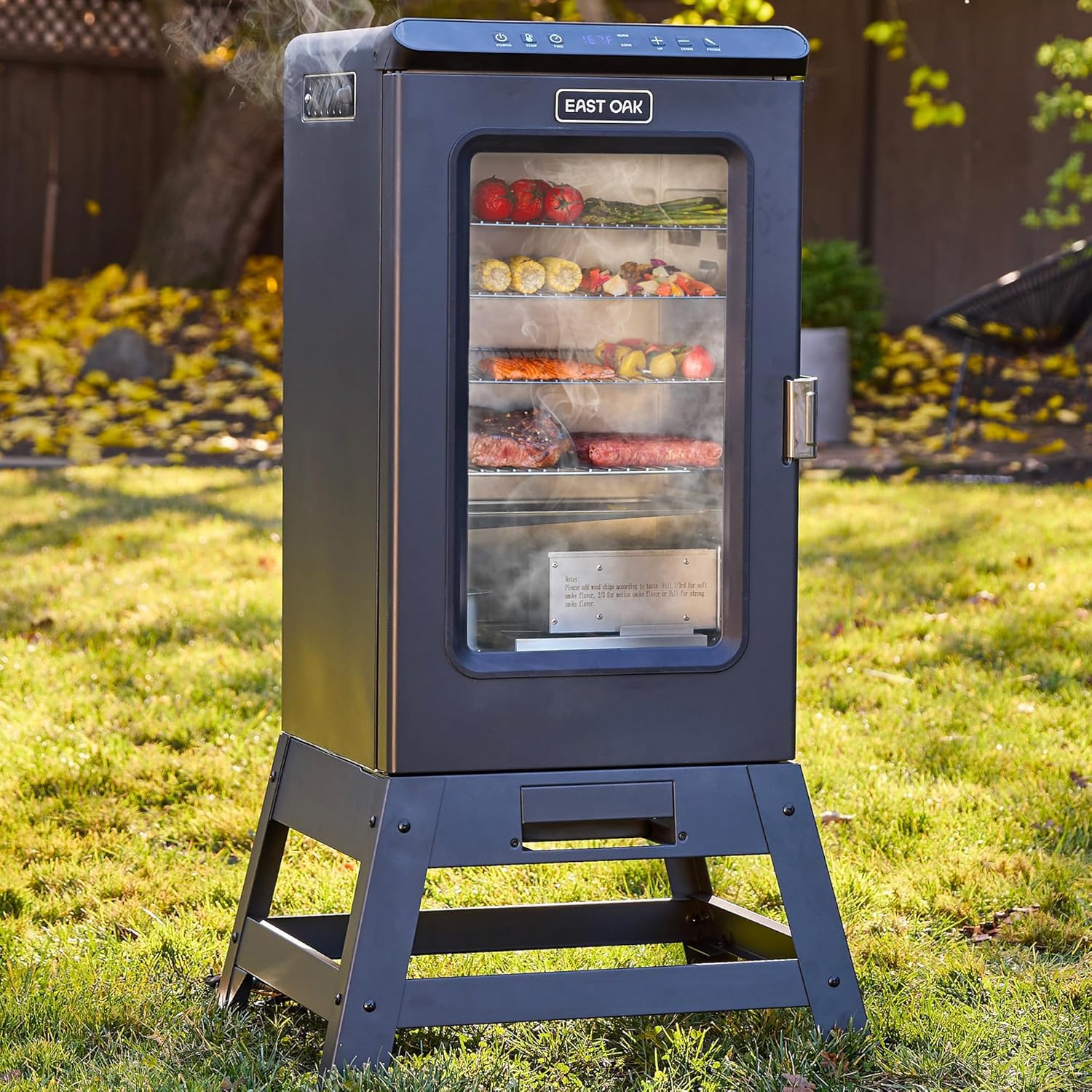
A glass panel in the door and a meat probe wired into the controller — those two features are what sold us on this East Oak, and they hold up. The window ends the guessing game about bark color without costing you 30 degrees of chamber heat to answer it, and the probe means a pork butt comes out when it is actually done rather than when the clock says so. Behind them sits a 725-square-inch cabinet on four racks, 32 inches tall, with a side drawer for chips.

We recommend this one first because it is the most complete package here: the largest cooking area in the group, four racks, and a body short enough to reach into without a step stool. Double-wall steel with insulation between the layers keeps it steady on a breezy afternoon, and a full drawer of chips smokes through most of a long cook instead of needing a top-up every hour. That combination is what separates it from the cheaper analog cabinets.

The cooking itself is set-and-forget in the way that matters. Set a temperature and a time, slide the water bowl in above the element, and the cabinet holds a humid heat that keeps a brisket from drying out over eight hours. Cleanup is a grease tray and a bowl, both removable, and the interior wipes down once it is cool. At 52.3 pounds it is not a smoker you reposition for each cook, so pick the spot before you assemble it.

Pros

  • 725 sq. in. across four racks feeds a crowd
  • Side loader stretches one box of chips across a long cook
  • Built-in meat probe without opening the door
  • Glass door for checking bark without heat loss

Cons

  • Chamber can run 25-60°F hotter than the panel shows
Our verdict

The one we point people to first: 725 square inches, a probe, and a door you can see through, with enough insulation to hold heat on a windy day.
Check Latest Price
2

Best for Easy Loading

East Oak 30-In. with Stand

88 /100
Angler Score Excellent

Key details

Weight
58 lb
Chip Loader
Side-load, 4-6 hours
Cooking Area
725 sq. in.
Overall Height
42 in.
Check Details on Amazon

Forty-two inches does not sound like a feature until you are loading a cold smoker in the rain. The PR30BK sits on an elevated stand that puts the door at roughly waist height, so a foil pan of pork butt goes in and comes out without a squat, a kneel, or a balancing act on wet grass.

Above the stand it is the same well-sorted cabinet East Oak sells in this size: 725 square inches over four racks, a built-in meat probe, digital time and temperature, and a side chip drawer rated for four to six hours between refills. Double-layer steel with foam between the layers does the insulation, a water bowl sits over the element, and the grease tray lifts out. At 58 pounds it is the heavier of the two full-size East Oaks, and you feel that getting it onto a patio.

The height is why this earns its own slot rather than being a duplicate of our top pick — the cooking is comparable, the standing posture is not, and on a long cook you are in and out of that door with a pan and a probe. The trade-off is cold-smoking: this cabinet stays essentially smokeless below about 200°F, so cheese and cured salmon are not on the menu. A 225°F brisket is.

What we appreciate most is how little thought the thing demands once it is lit: chips go in from the side, the probe stays in the meat, and the only reason to open the door is to wrap. Give it a level slab and leave it there.

Pros

  • Loads at waist height
  • 725 sq. in. with a built-in meat probe
  • Side loader covers 4-6 hours of smoke
  • Double-wall steel with foam insulation

Cons

  • Smokeless below about 200°F, so no cold-smoking
Our verdict

Buy it if you want to load standing up: waist-height door, the same 725 square inches and probe as our top pick, and a chip loader good for a long afternoon.

Check Latest Price
3

Best Analog Smoker

Charbroil Analog Electric Smoker

87 /100
Angler Score Excellent

Key details

Racks
3 chrome-plated
Cooking Area
544 sq. in.
Heating Element
1,200 watts
Temperature Gauge
Door-mounted
Check Details on Amazon

No screen, no probe, no app — and that is precisely why we like the Char-Broil for a first smoker or a cabin. One dial sets the heat, a needle on the door tells you roughly where the chamber landed, and three chrome grates hold 544 square inches of ribs and chicken. It is the least complicated route to real smoke in this group.

Assembly is legs and a handle, ten minutes with a wrench, which is not a sentence we can write about the cabinet units with panels and controllers to wire up. The 1,200-watt element sits under an aluminized steel water pan and chip tray, and with the door shut the insulated body holds heat well enough for a six-hour cook. The dial is a number rather than a temperature, so you learn which position gives you 225°F and adjust as the load changes.

Where an analog cabinet shows its limits is consistency. As meat goes in and the door opens, the needle drifts and you nudge the dial; for a Saturday of ribs that is part of the pleasure, and for an overnight brisket the digital picks here are less work. The rest is honest budget construction: three racks that slide cleanly, a water pan that lifts out, and a body that wants a cover if it lives outside.

Pros

  • 544 sq. in. across three chrome grates
  • Legs go on in about ten minutes
  • Dial and door gauge need no manual
  • 1,200 watts in an insulated chamber

Cons

  • Door seams can leak smoke
  • No probe or timer
Our verdict

For a first smoker or a second one for the cabin: a dial, a door gauge, 544 square inches, and nothing to configure before dinner.

Check Latest Price
4

Best Premium Pick

SmokinTex 1400 Pro Series

85 /100
Angler Score Excellent

Key details

Food Capacity
38 lb
Rack Positions
5
Heating Element
700 watts
Temperature Range
100-250°F
Check Details on Amazon

The priciest smoker in this guide spends the money in specific places: stainless steel inside and out, an insulated cabinet that stays cool on the outside while it runs, and a 700-watt element that holds anywhere from 100°F to 250°F. It is built like a commercial box and weighs like one — 75 pounds on four casters, two of them locking.

We think it is the right answer for two buyers. One is smoking through a real winter, where the insulation pays off in steadier temperatures and less element cycling. The other is doing fish, sausage, and cheese at 150°F, which most cabinets here cannot reach. It also runs on remarkably little wood, so a bag of chunks lasts a season, and there is no water pan to top up.

Five rack positions and 38 pounds of food capacity sound generous until you measure the rack itself. The cabinet is tall and narrow, and a full packer brisket simply will not lie flat; ribs, butts, chickens, and anything you drape across two racks are fine. That is the trade for insulation this good in a body this size, and it is the one thing to check against your shopping list.

Pros

  • Stainless inside and out, with real insulation
  • Holds anywhere from 100°F to 250°F
  • Runs an all-day cook on very little wood
  • 38 pounds of food across five rack positions

Cons

  • Too narrow for a full packer brisket
Our verdict

Worth the money if you smoke in cold weather or below 200°F: stainless, insulated, and steady, as long as a whole packer brisket is not on your list.

Check Latest Price
5

Small Patios

Royal Gourmet SE2805

85 /100
Angler Score Excellent

Key details

Racks
3 chrome-plated
Weight
42.1 lb
Cooking Area
454 sq. in.
Heating Element
1,350 watts
Check Details on Amazon

1,350 watts is a lot of heat for a 28-inch cabinet — more than the Char-Broil's 1,200 and double the SmokinTex's 700 — and it is the first thing we noticed about the SE2805. Small body, big element, and quick recovery every time you open the door.

The rest is straightforward: three chrome-plated grates over 454 square inches, a stainless water pan and chip box sitting above a full-width heating tube, and an analog controller with a built-in thermometer. At 42.1 pounds it is the lightest of the full-size cabinets here, and one person can shift it across a patio without drama.

Control is where it gives ground. The thermometer sits where it does not read the middle of the chamber, so holding a steady 225°F is a hands-on job, and there is no probe or timer to fall back on. For a household of four doing wings, ribs, and the occasional batch of jerky, that is a fair trade for the footprint and the wattage. For overnight cooks, spend more and get a digital panel.

Pros

  • 1,350-watt element in a small cabinet
  • 42.1 pounds
  • 454 sq. in. on three chrome grates
  • Full-width heating tube under the water pan

Cons

  • Gauge placement makes 225°F a hands-on job
  • Analog only
Our verdict

A compact, hot-running analog cabinet for small yards: 454 square inches, 42 pounds, and enough wattage to recover fast, provided you keep an eye on the dial.

Check Latest Price
6

Fish and Jerky

Smokehouse Little Chief

86 /100
Angler Score Excellent

Key details

Weight
12.2 lb
Footprint
11.5 x 11.5 in.
Food Capacity
25 lb
Smoking Temperature
165°F
Check Details on Amazon

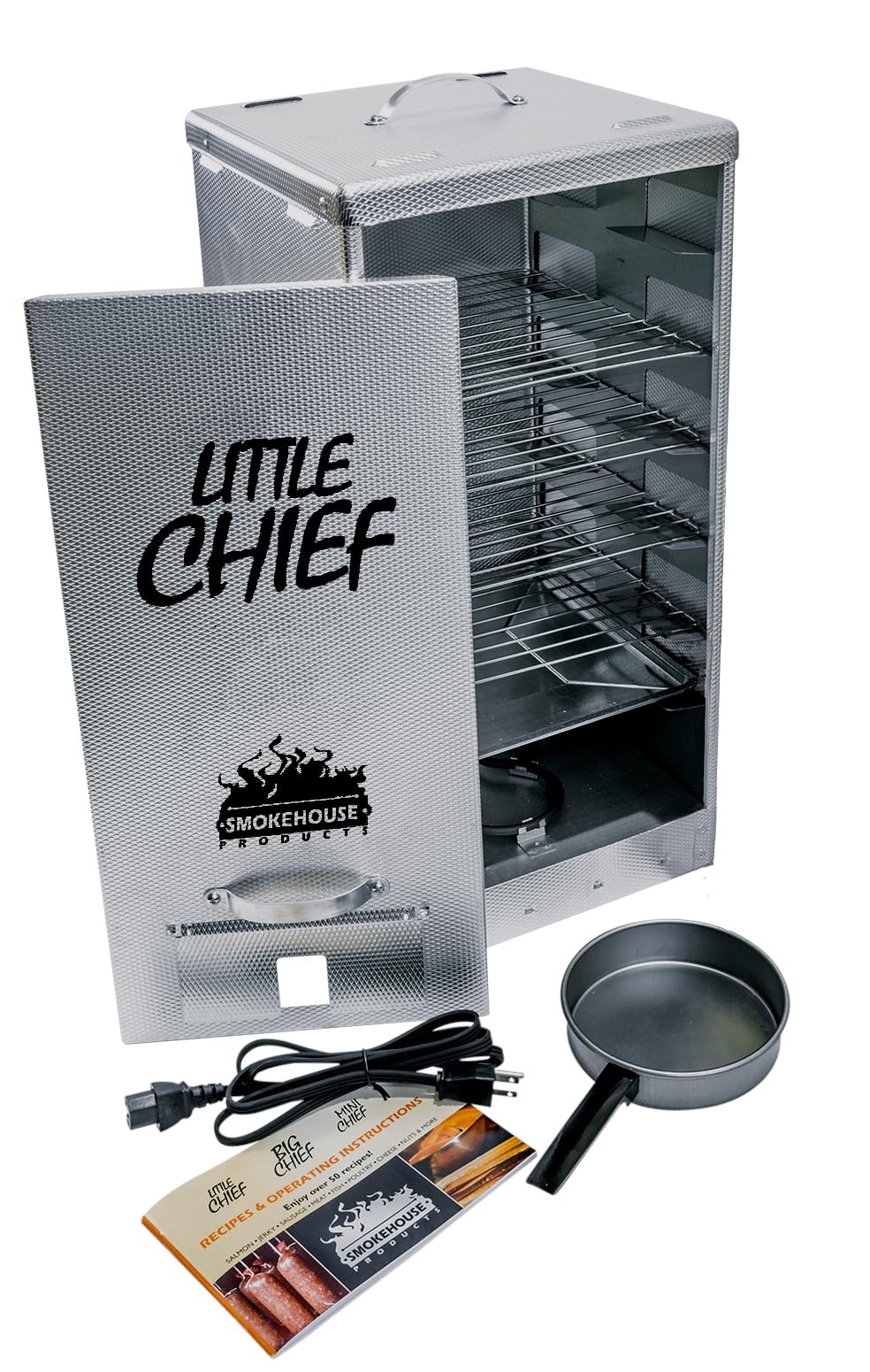
The Little Chief holds about 165°F and will not go higher, which reads as a limitation until you see what it is for. Salmon, jerky, cheese, and sausage come out of this box properly smoked, and the aluminum cabinet weighs 12.2 pounds, so it lives on a shelf and comes out when the fish does.

Front-loading is the detail that makes it pleasant to own. The door hinges down, the racks slide out toward you, and the chip pan pulls free without opening the cabinet at all, so you are not dumping heat to add alder. A 25-pound load across the racks is realistic, which is a serious batch of fillets for a home setup.

What it does not do is cook. There is no thermostat and no gauge on the door — the element runs at one heat — so a pork butt takes smoke here but needs finishing in a 300°F oven to reach a safe internal temperature. The same goes for anything thick: this is a flavor stage, not a finish line. The top of the cabinet also runs cooler than the bottom, so racks get swapped halfway through, and thin aluminum dents if you are careless with it.

Pros

  • Holds about 165°F for fish, jerky, and cheese
  • Chip pan pulls out without opening the door
  • 12.2 pounds
  • Up to 25 pounds of food per load

Cons

  • Thin aluminum body dents easily
Our verdict

The right box for salmon, jerky, and cheese at 165°F — light enough to carry out with one hand, and honest about the fact that it smokes rather than cooks.

Check Latest Price
7

Phone Monitoring

Masterbuilt 710 WiFi

80 /100
Angler Score Excellent

Key details

Racks
4 chrome-coated
Weight
50.7 lb
Meat Probes
Up to 4
Cooking Area
711 sq. in.
Check Details on Amazon

The feature you are paying for is the phone. The 710 pairs with the Masterbuilt app, where you set temperature and time, watch up to four meat probes, and get an alert when dinner hits target. On paper it is the most connected smoker in this group by a wide margin, layered on top of 711 square inches across four chrome racks and the side chip loader Masterbuilt has used for years.

The cabinet itself is fine. Four racks, 711 square inches, a water bowl for moisture, a 40.6-inch body at 50.7 pounds — big enough for two butts and a pan of beans, tall enough that the top rack is a reach. Loading chips from the side without opening the door remains the best idea in this category, and it works here.

The app is where it comes apart. Pairing is fussy on mesh networks, the connection drops, and opening the door can knock the smoker offline and send you back through the pairing routine. The saving grace is that the smoker runs perfectly well from the panel: when the phone loses the plot, you walk out and press buttons, which is how most of a cook ends up running.

So treat it as a three-season machine — pleasant from spring through fall on a sheltered patio, frustrating in a cold snap, because the element is underpowered for a box this size. It suits the cook who wants to watch four probes from the kitchen and does not mind finishing at the panel. If winter brisket is the goal, the insulated SmokinTex is the safer buy.

Pros

  • Four meat probes viewable in the app
  • 711 sq. in. across four chrome racks
  • Side chip loader without opening the door
  • Runs fine from the panel when WiFi drops

Cons

  • App drops connections and needs re-pairing
  • Element struggles to hold 225°F in cool weather
Our verdict

Buy it for four probes and phone alerts, not for the app's reliability — the smoker runs fine at the panel, and 711 square inches is a lot of room.

Check Latest Price

How We Tested the Best Electric Smokers

We started with every electric smoker that had a real following and a return policy, then cut anything with a cooking area too small for a full packer brisket, a controller with no readout, or a chip door that forces you to open the main cabinet. That left eight units, spanning inexpensive analog cabinets to insulated stainless boxes. Each one lived on my patio for the better part of eight months.

Temperature honesty came first. We clipped a calibrated ambient probe to the center grate and compared the controller's number to what the box was actually doing every 15 minutes through an eight-hour pork butt, then again on a cold, windy Saturday when the wind fought the heating element. We also timed how long each smoker took to climb back to set temperature after we opened the door.

For smoke, we noted how long a full chip load kept producing visible smoke before it died out, and whether that smoke ran thin and blue or thick and white. Reloading mid-cook told us whether a side loader genuinely let us add wood without dumping the heat. Between cooks we checked what grease, rain, and repeated heat cycles did to door seals, hinges, and control panels, and on the connected models we watched whether the app held a signal through an entire overnight cook or dropped somewhere around hour five.

Ease of use got scored the unglamorous way: assembly time out of the box, how far we got on the first cook without opening the manual, and how long the racks and drip tray took to scrub the next morning. Value was the last pass — what each smoker cost against how much of the cook it genuinely handled on its own.

How to Choose an Electric Smoker

Start with the chamber, not the square inches

Square inches are the number on the box; depth is what decides whether a brisket fits. Most of these cabinets are around 15 inches deep, and a full packer runs longer than that, so it goes in diagonally, gets split, or takes a trip to the butcher. If whole packers are the plan, look for a wider cabinet and measure the rack itself rather than trusting the total.

For ribs, chickens, and pork butt, roughly 450 to 550 square inches covers a family of four with room to rotate racks. Anything past 700 is for crowds or batch cooking. Rack count matters as much as area — three racks over 544 square inches is a different kitchen from four racks over 725.

Temperature range, and the readout trap

Most units here top out at 275°F, which is plenty for barbecue and useless for searing. An electric smoker is an oven with wood in it, so if you want grill marks, this is the wrong appliance. At the other end, check how low it goes: the SmokinTex reaches 100°F for cold-smoking, while the Little Chief is built to sit at about 165°F and no higher.

The trap is trusting the panel. Analog dials and digital controllers on this class of smoker routinely sit well away from the real chamber temperature, so make the first cook a calibration run: clip a probe thermometer to a middle rack, note the gap at your target, and set from that number afterward. Two hours of homework saves a ruined brisket.

Chips, smoke, and reloading without losing heat

Smoke is a function of heat and contact. Chips need to sit against the element, and below roughly 200°F some cabinets will char a pile without making visible smoke — which is why the low-and-slow crowd checks the smoke floor before buying. Load dry chips; soaking delays the start and mostly steams the chamber. Larger chunks smolder longer than any soaked chip.

A side-loading drawer is the single biggest convenience upgrade in this category, because you add chips mid-cook without opening the door. The East Oaks rate theirs at a few hours a load, and the practical difference is one refill on a long brisket instead of six. Tray-style analog units want a top-up roughly hourly, and you feel every one of them on a cold day.

Insulation, weight, and where it lives

Double-wall bodies with foam between the layers hold temperature in wind and use less electricity doing it; single-wall steel swings with the weather and can bubble paint around the door over a couple of seasons. We rank insulation above raw wattage for anyone smoking through a real winter — a well-insulated 700-watt cabinet can beat a 1,350-watt one that leaks heat.

Then there is the practical half. These cabinets run from about 42 to 75 pounds, and only some have casters. Pick the spot before assembly: level ground, out from under the roof overhang, within reach of a GFCI outlet. If bending or kneeling is a problem, the loading height matters more than any spec on the panel — a 42-inch door changes the whole experience.

Frequently Asked Questions

Final Verdict

We recommend the East Oak with the window and the probe first. It has the capacity for a family cook, a probe and side loader that make a long smoke genuinely hands-off, and a cabinet that holds heat when the afternoon turns breezy. The gap between panel and chamber is a one-time calibration, not an ongoing fight.

Two changes of requirement move the pick. If loading from a standing position matters — a bad back, a bad knee, a wet deck — the taller East Oak puts the door at 42 inches and takes the kneeling out of the job. And if the food is salmon, jerky, and cheese rather than brisket, the Little Chief's steady 165°F does the work at a fraction of the size and weight.