
Best Fishing Kayaks of 2026

A fishing kayak is part casting platform, part gear locker, and part pack mule. The hull has to feel steady when you stand to sight-cast, yet light enough to slide into a truck bed alone—and that trade-off is where most shoppers get stuck. Wider boats are more stable but heavier and slower, while the seat and storage can make or break a four-hour trip. We spent eight months testing seven fishing kayaks on local lakes, slow rivers, and one breezy brackish flat, and the best balanced stability with portability.

What surprised me most was how much the small stuff mattered—a seat that stayed comfortable through an afternoon, rod holders angled where you actually reach, and a hull that tracked straight without constant correcting. Price didn't always predict quality; some value-priced boats fished as well as pricier ones, and a few high-dollar features turned out to be more fuss than function. The picks below are the ones we'd load up again, whether you fish ponds, rivers, or calm coastal water.

1

Best Overall

Pelican Catch Mode 110

89 /100
Angler Score Excellent

Key details

Width
34.5 in
Length
128 in
Hull Weight
75 lb
Weight Capacity
375 lb
Check Details on Amazon

The deck is what sold us. Pelican covers the Catch Mode 110 in anti-slip traction pads with a measuring ruler molded right into them, and between that surface and the 34.5-inch beam you get a deck you can genuinely stand on to stretch a cast or net a fish. That is the difference between a kayak you fish from and a kayak you fish out of, and it is why this one leads the group.

Everything above the hull is organized around the same idea. The Ergoboost seat adjusts for height and leg angle and sits you high enough to read the water ahead of you — the most comfortable seat here, and the one we minded least after a long morning afloat. Three flush-mount rod holders and two 4-inch gear rails mean a rod, a fish finder and a camera mount all have a home that isn't your lap. The retractable skeg earns its keep in wind: drop it and the boat tracks, lift it and the boat turns.

Pelican rates the hull to 375 pounds, and the scuppers sit high enough that a loaded deck drains rather than pooling around your feet. That is more capacity than a solo angler needs, which is exactly what makes the boat comfortable — you are never trimming gear to stay level. The lifetime limited warranty on the hull matches the other Pelicans here, and the one-year parts coverage is the standard caveat.

Pros

  • Stable enough to stand and cast
  • High, adjustable seat for long sessions
  • Three rod holders and two gear rails
  • Retractable skeg improves wind tracking

Cons

  • 75 pounds is a lot to get onto a roof rack
  • Side handles are the least durable hardware
Our verdict

Our pick for most anglers: it stands, it tracks, and the seat and deck are laid out for fishing rather than paddling. Buy it if you fish lakes and slow rivers.

Check Latest Price
2

Best for Bigger Anglers

Perception Outlaw 11.5

85 /100
Angler Score Excellent

Key details

Width
35 in
Length
138 in
Rod Holders
4
Weight Capacity
425 lb
Check Details on Amazon

Four hundred twenty-five pounds is the highest capacity in this group by a wide margin, and the Outlaw 11.5 uses it well: a 35-inch beam, an open deck and a seat that puts you up where you can see the shoreline. If you have been shopping for a kayak that stops feeling like a compromise at 240 pounds, this is the one that stops feeling like one.

The rigging is where it pulls ahead of the other big boats. Four rod holders are molded in, and the integrated tackle trays are the detail we keep coming back to — a couple of boxes sit where you can reach them without unzipping anything. The fold-away frame seat is the piece we appreciated most, though: it sits high like a boat chair and folds down out of the way when you want the deck clear to stand and cast.

What you get for the length and beam is a platform. Capacity for a cooler behind the seat, a crate of tackle and a full day on the water without a second trip to the truck. The deck is open from the seat forward, so your legs and your cast both have room, and there is enough secondary stability to lean over the gunwale and land a fish without a wobble. Perception builds it in the USA and backs the hull for five years.

Pros

  • 425-pound capacity swallows angler and gear
  • Four rod holders plus molded tackle trays
  • High frame seat folds away for standing
  • Stable enough to lean over and land fish

Cons

  • Heavy paddle against wind and current
Our verdict

If you are a bigger angler, or you want to stand and sight-cast all morning, this is the boat: more capacity and more usable deck than anything else here.

Check Latest Price
3

Best for Tight Storage

Reel Yaks Raptor

81 /100
Angler Score Excellent

Key details

Drive
Fin pedal drive
Width
30.3 in
Length
115 in
Weight Capacity
380 lb
Check Details on Amazon

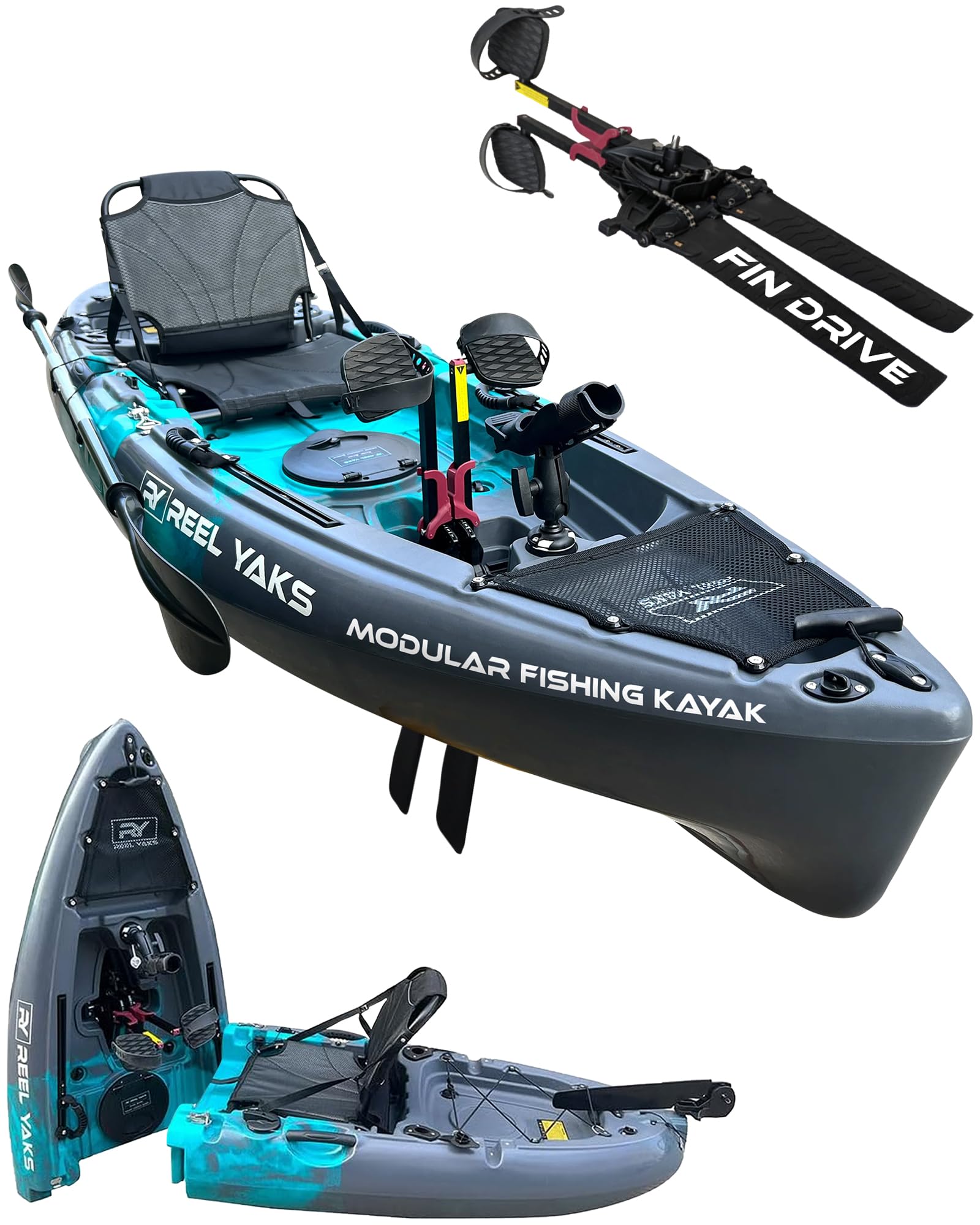
Take a kayak apart in the middle and two useful things happen: it fits in the back of a midsize SUV, and it fits in a closet. That is not a gimmick, it is why this boat earns a place here — for anyone without a roof rack, a garage, or a second pair of hands at the launch, the Raptor is the difference between owning a fishing kayak and not owning one. We carried it up a flight of stairs in two trips, which is the entire pitch.

The fin pedal drive is the second half of the argument. It is hands-free, which is what you want when you are working a weed edge and need to hold position, and a fin handles shallow, weedy water better than a prop does. Around it, Reel Yaks has rigged the boat properly: flush-mount rod holders, track rails for accessories, and storage hatches in both halves so the front section is not just dead weight in the trunk.

Two things to know before you order. The first is the drive hardware — a fin that works loose offshore leaves you paddling, so check the nut and pin before every launch rather than after. The second is that splitting the hull doesn't make it lighter overall: you are still moving 62 pounds, just in pieces, which is fine on stairs and less fun up a steep bank. Expect to spend an evening with the assembly instructions, which are thin on detail.

Pros

  • Splits in two for trunk and closet storage
  • Fin pedal drive leaves both hands free
  • 380-pound capacity with rails and hatches
  • Fin drive works well in weedy shallows

Cons

  • Narrow beam feels tender reaching behind you
  • Assembly instructions are thin on detail
Our verdict

The one to buy if storage or transport is what stands between you and a fishing kayak — the pedal drive is a genuine bonus on top.

Check Latest Price
4

Best Lightweight

Pelican Sentinel 100X Angler

86 /100
Angler Score Excellent

Key details

Width
29.92 in
Length
114.17 in
Hull Weight
44 lb
Weight Capacity
275 lb
Check Details on Amazon

Forty-four pounds is the number that decides whether a kayak actually gets used. The Sentinel 100X Angler is light enough to lift onto a sedan's roof alone, carry down a ramp and hang on a garage wall, and on a Saturday morning with the wind already up that counts for more than any line on the feature list. We noticed the difference at the end of the day, not the start.

Pelican put the money into the hull rather than the fittings, and at this end of the range that is the right call. The multi-chine flat bottom gives you more stability than a 29.9-inch beam suggests, and the ExoPak is a removable storage box that drops into the tank well and lifts out to carry to the car — a small thing that turns out to be useful on every trip. Two flush-mount rod holders, a mesh-covered front deck and a lifetime limited warranty on the hull round out a package that is honest about what it is.

Two hundred seventy-five pounds of capacity is the tightest here, and it is a real boundary rather than a technicality: fine for a 180-pound angler with a crate and a couple of rods, tight for someone at 230 with a cooler and an anchor. If that is you, spend more on the Catch Mode 110 or the Outlaw. If it isn't, you are getting a stable, uncomplicated boat with a lifetime warranty on the part that matters.

Pros

  • 44 pounds loads on a roof rack solo
  • Stable multi-chine hull in a narrow beam
  • Removable ExoPak gear box
  • Lifetime limited hull warranty

Cons

  • Seat is a pad, not a frame, for long days
Our verdict

The best choice here if you load and unload alone: light, steady enough to fish from all day, and simple enough that nothing gets in your way.

Check Latest Price
5

Best Budget

Lifetime Tamarack Angler 100

87 /100
Angler Score Excellent

Key details

Width
31 in
Length
120 in
Included
Paddle
Weight Capacity
275 lb
Check Details on Amazon

This is the only kayak in the group that arrives with a paddle, and at the bottom of the price range that is not a footnote — it is the difference between fishing this weekend and waiting on a second order. The Tamarack Angler 100 has been the default first fishing kayak for years, and the hull shape is the reason.

A flat bottom, a sharp bow, deep tracking channels and a skeg add up to a boat that is steady at rest and willing to run straight across a pond. It won't pivot like a short whitewater hull and it isn't meant to. The fishing kit is honest rather than generous: two flush-mount rod holders plus one top-mount, two six-inch storage compartments, an adjustable padded seat, and a paddle keeper with shock cords so the paddle stays put while you cast two-handed.

Two hundred seventy-five pounds of capacity puts it in the same bracket as the Sentinel — right for a solo angler and a crate, not right for a big paddler hauling a cooler and a motor. For a first boat, a pond boat or a spare for the family, that is a fair trade, and it is the cheapest route here to a hull that won't feel like a toy once the novelty wears off.

Pros

  • Paddle included, so it is ready to fish
  • Flat hull and skeg track well on ponds
  • Three rod holders and two storage compartments

Cons

  • Seat clips and trim are the first parts to go
  • Bundled paddle is a spare, not a keeper
Our verdict

Start here if you are new to kayak fishing or you fish small water: the paddle is in the box, the hull is steady, and nothing about it is fussy.

Check Latest Price
6

Seated River Fishing

Lifetime Tamarack Pro 103

84 /100
Angler Score Excellent

Key details

Width
31 in
Length
123 in
Hull Weight
57.5 lb
Weight Capacity
300 lb
Check Details on Amazon

The Tamarack Pro 103 is the Angler 100 with the upgrades you would otherwise buy separately: a framed adjustable seat instead of a padded backrest, adjustable footrests, a center hatch with a bucket inside it, and a deeper tank well for a crate. Lifetime also molded a ruler into the deck and fitted one adjustable rod holder where you can see it, plus two flush mounts.

Where it stops short is the beam. Thirty-one inches is narrow for a fishing kayak, and while the chine rails and deep hull channels keep it steady for seated fishing, it isn't a stand-and-cast platform and Lifetime doesn't pretend it is. If you fish sitting down — a jig rod, a bobber, a slow river — that is fine. If standing to sight-cast is the point, this is the wrong hull and the Outlaw is the right one.

At 300 pounds of capacity it splits the difference between the entry boats and the big platforms, and the deeper tank well means a crate sits down inside rather than perched on the rim. Our read: it is a sensible middle step for an angler who has decided kayak fishing is for them and wants a proper seat without paying for a stand-up deck they won't use.

Pros

  • Framed adjustable seat with adjustable footrests
  • Center hatch with bucket and deeper tank well
  • 300-pound capacity with three rod holders

Cons

  • 57.5 pounds makes solo roof loading a chore
Our verdict

Buy it if you fish from the seat and want a real chair and real storage — the most comfortable sit-down boat here for the money.

Check Latest Price

How We Tested Fishing Kayaks on the Water

We started by narrowing a shortlist of sit-on-top fishing kayaks by hull length, weight capacity, seat design, rod storage, and price, then eliminated anything that was too heavy for one person to car-top or too bare-bones to fish from comfortably. Over eight months, seven kayaks made it onto the water with us. We launched from gravel ramps, paddled slow rivers and local lakes, and spent a few windy afternoons on a brackish flat where chop tested our balance.

Stability was the first thing we judged: we stood to cast, leaned to reach a cooler behind the seat, and re-entered from waist-deep water after deliberately tipping each boat in a calm cove. We noted how quickly the hull settled, whether it tracked straight when we stopped paddling, and how much effort it took to hold a cruising speed across a short flat. Seat comfort got a separate clock—we sat through three- and four-hour sessions, adjusted the seat back and bottom, and paid attention to pressure points and whether the cushion stayed put after re-entry.

For fishing suitability and functionality, we loaded each kayak the way we actually fish: two rods, a small tackle bag, a net, and a cooler. We checked whether rod holders kept reels clear of the paddle stroke, whether hatches stayed dry after spray and rain, and whether the deck layout left room to move without stepping on gear. Weight and ease of use came down to chores—we timed car-to-water carry, roof-rack loading, and seat adjustments, then dragged each hull up a gravel ramp to see how the skid plates and scupper holes held up. Durability showed up as scratches, rattles, and hardware that loosened over the season. Value was the final filter: we weighed what each boat included against what it cost, and the best picks were the ones that felt sorted rather than stripped or overbuilt.

How to Choose a Fishing Kayak

Start With the Beam, Not the Feature List

The boats here run from 29.9 to 35 inches wide, and that number predicts how one will fish better than any accessory list. Wider hulls carry more primary stability, the kind that keeps you level while you reach for a net; narrower ones paddle easier and cut through wind. If standing to cast matters, look for 34 inches or more and a deck covered in real traction pads, as on the Catch Mode 110 and the Outlaw 11.5. If you fish sitting down, a 31-inch hull like the Tamarack Pro 103 is easier to keep moving all afternoon.

Subtract Yourself From the Capacity

The capacity figure has to cover you, your clothes, your rods and everything in the crate — not just you. A 275-pound hull works for a 180-pound angler with a tackle bag and a small cooler; it does not work for a 240-pound angler with the same load, and it stops working entirely once a trolling motor and battery are bolted on. Do the arithmetic before you fall for a hull. A boat loaded near its limit sits lower, drains more slowly through the scuppers and feels less settled than the same boat at half capacity.

Match Hull Weight to the Distance You Carry It

A 44-pound kayak and a 75-pound kayak look identical in a product photo and feel nothing alike at the end of a day. Under about 55 pounds, most people can get a hull onto a roof rack alone with a step stool and decent technique; past 70, you are recruiting a second person or buying a cart. A cart solves the ramp and the beach but does nothing for the roof, so weigh those two problems separately. And keep the word lightweight in perspective: 44 pounds is light for a sit-on-top fishing kayak, not light for a suitcase.

Count the Rod Holders You Can Actually Reach

Flush-mount holders are cheap, tidy and usually aimed straight up behind the seat, which is the worst place to reach while a fish is running. Two holders angled forward within arm's reach beat four behind you. Look for gear rails if you plan to add a fish finder or a camera mount — drilling a hull is a job you want to do once — and a tank well deep enough that a crate drops inside instead of perching on the rim. Hatches are for dry storage, so keep your phone out of the one that takes spray.

Paddle, Pedal or Inflatable

A paddle is simpler, lighter and less expensive, and on a 10-foot hull in a pond it is all you need. A pedal drive — the fin unit on the Reel Yaks Raptor is the one in this group — keeps both hands free to cast and hold position, but it adds weight and draft, and it only earns its money in water deep enough to use it; in the shallows you will be lifting the drive and paddling anyway. Inflatables trade packability for air retention and seams, so if you go that route, choose a multi-chamber hull and learn the repair kit before you launch.

Frequently Asked Questions

Final Verdict

Buy the Pelican Catch Mode 110. It is the best balance here of standing stability, seat comfort and fishing rigging, and it asks less of your wallet than the two boats that beat it on capacity alone. For a lake or a slow river, nothing else in this group is easier to spend a morning in.

If you are a bigger angler or you want to stand and sight-cast all morning, the Perception Outlaw 11.5 is the better buy: 425 pounds of capacity, four rod holders and molded tackle trays, in exchange for a heavier paddle. And if the kayak has to live on a garage wall or go up on a sedan by yourself, the 44-pound Sentinel 100X is the one that will actually get used.