Best Lower Unit Oil Pumps of 2026

Lower unit oil pours like cold honey and smells like a chemistry lab, and the whole job comes down to whether your pump cooperates. Fill a quart bottle, screw the pump onto the cap, thread the fitting into the fill hole, and crank until lube starts running out the vent — that's the entire procedure. A pump that sucks air, seeps at the bottle threads, or dribbles down your forearm turns a fifteen-minute task into an afternoon of cardboard and shop rags. The right one keeps the oil inside the bottle and puts a steady, bubble-free stream exactly where you point it, which is really all anyone wants from this tool.

I do my own lower unit service on everything from a tired 9.9 tiller to a friend's 150, so I've thrown away my share of pumps mid-job. This spring, my team and I ran 14 of them through four months of real maintenance, from spring commissioning through a late-summer round of oil changes, and the differences showed up fast. The details that matter are unglamorous: which adapters are in the box, whether the threads actually match your motor, how many strokes it takes to move a quart, and whether the thing is still sealing in October. If you're shopping, check the adapter sizes against your owners manual before anything else — a pump with the wrong thread is a pump you'll never use.

1

Best Overall

Slippery Pete Lower Unit Gear Oil Pump

95 /100
Angler Score Outstanding

Key details

Adapters
3/8-inch metal swivel, 8mm, 10mm
Bottle Fit
Standard quart, 28mm neck
Pump Stroke
8cc per stroke
Suction Tubes
Two rigid tubes
Check Details on Amazon

The metal swivel is the part that made this our default. You thread the fitting into the drain or fill hole and then work the plunger, and a swivel lets the hose and bottle turn without dragging on those threads — the difference between a fitting that comes out clean and one that fights you for ten minutes at ankle height. It sounds like a detail. It's the whole job.

The rest of the kit is sorted the same way. Three metal adapters — a 3/8-inch swivel plus 8mm and 10mm — cover the drain threads on most American and Japanese outboards, and two rigid suction tubes, one long and one short, reach the bottom of both tall and squat quart bottles so you aren't tipping the last third down the funnel. The 8cc stroke is ordinary for this class: the 10cc pumps here save a few pushes across a whole bottle and nothing more. Instructions are printed on the header card, and the whole thing goes back into a re-closeable bag.

The hose joint is where this style of pump needs watching. Cold 80W-90 is the test; a hose that isn't pushed fully home on the barb can creep off mid-fill and put a quart of lube in your drain pan instead of the gearcase. Seat it firmly, keep the pump upright, and the threaded connection does the rest. It's worth the minute of setup before you open the bottle.

It costs more than anything else on this list, and for a tool that comes out twice a season that is a fair thing to weigh. We still point people here first, because the swivel and the complete adapter set are exactly the two places cheap pumps cut corners. Volvo Penta drives are excluded outright, so anyone with one needs the drive maker's own fill fitting.

Pros

  • Metal swivel keeps the fitting from twisting out
  • Three metal adapters cover most outboard threads
  • Two suction tubes empty tall and short bottles
  • Printed instructions and a re-closeable bag

Cons

  • Not compatible with Volvo Penta drives
  • 90-day warranty only
Our verdict

Our default pick for a reason: the metal swivel and three adapters fit the widest spread of gearcases here, and the extra cost buys fewer fights at the fill hole.

Check Latest Price
2

Best for Wide-Mouth Bottles

Quicksilver Gear Lube Pump

93 /100
Angler Score Outstanding

Key details

Weight
2.08 oz
Bottle Fit
28mm and 38mm necks
Drain Port Fit
3/8-inch-16 and M8 x 1.25
Check Details on Amazon

Wide-mouth bottles are where most of these pumps quietly stop working. A fitting sized for a 28mm standard neck won't grip a 38mm jug, and plenty of gear lube now ships in the wide bottle, so you end up holding the pump down over the mouth with one hand while you work the plunger with the other. Quicksilver's included adapter handles both neck sizes, and the pump is rated for quart and liter bottles.

That alone makes it our pick for anyone whose lube comes in a wide-mouth jug, and pairing it with Quicksilver's own gear lube is the obvious way to go. The threaded connection takes 3/8-inch-16 drain ports, with an 8mm adapter for M8 x 1.25 gearcases, so Mercury and MerCruiser work is covered along with plenty of outboards. At just over two ounces it disappears into a tool bag.

The compromise is at the tip: it doesn't swivel, so threading it into a recessed port takes more patience than the Slippery Pete does, and that is the one place the difference between them shows up in use. The kit also stops at those two sizes, so a gearcase that wants a 10mm adapter is out. What you get in return is a pump sold as a Quicksilver part, at a price below our top pick.

Pros

  • Grips 28mm and 38mm bottle necks
  • 3/8-inch-16 and 8mm adapters cover most gearcases
  • Light 2.08-ounce body disappears in a bag

Cons

  • No 10mm adapter for some Japanese gearcases
Our verdict

Buy this one if your gear lube comes in a wide-mouth jug — it's the only pump here that grips both neck sizes, and the fitting set covers Mercury and MerCruiser threads.

Check Latest Price
3

Best No-Frills Pick

Attwood 11891D7 Gear Lube Pump

90 /100
Angler Score Outstanding

Key details

Material
Plastic
Bottle Size
32 oz
Included Adapter
One Yamaha adapter
Check Details on Amazon

One adapter in the bag — a Yamaha fitting — sitting next to the words universal fit on the card. That pairing tells you most of what the Attwood is: a pump meant to work with nearly any outboard or sterndrive, plus the one extra thread Yamaha gearcases need. There's no stack of adapters to sort through before you start.

It's built for a 32-ounce bottle and works best with the standard motor-oil-style quart, where the pickup tube is sized to reach the bottom without tipping the bottle. Wide-mouth jugs are the exception — the pump won't grip that 38mm opening, so you hold it down over the mouth, which works but is hardly hands-free. Body and fitting are plastic, light enough to leave in the toolbox all season.

If your motor is a Yamaha and your shelf holds standard quart bottles, this is the least fussy way into the job, and the price sits among the lowest here. It's also what we suggest to someone who isn't sure they'll do the change again next season: there is genuinely nothing to learn. If your gearcase takes an 8mm or 10mm fitting, look elsewhere — those adapters aren't in the box.

Pros

  • Works with standard 32-ounce quart bottles
  • One-piece setup with no assembly
  • Low price among the picks here

Cons

  • Plastic body and fitting, including the adapter
Our verdict

A simple pump for anyone running a Yamaha with standard quart bottles: we like it because there's nothing to assemble and nothing extra to lose.

Check Latest Price
4

Best Budget Kit

Jewheg Lower Unit Gear Oil Pump

85 /100
Angler Score Excellent

Key details

Adapters
3/8-inch swivel, 8mm, 10mm
Hose Length
19.5 inches
Pump Stroke
10cc per stroke
Suction Tubes
6.125 inch and 4.75 inch
Check Details on Amazon

Least expensive isn't the same as least complete, and the Jewheg manages both the lowest price here and a full kit: a 3/8-inch swivel, 8mm and 10mm metal adapters, a third-hand adapter that anchors the hose in the fill port, long and short suction tubes, and a 19.5-inch hose. For a job you do twice a year, that is the entire value argument in one paragraph.

The stroke is 10cc, the largest here alongside the LOZAGU. More lube per push means fewer pushes to empty a quart, which matters more than it sounds when you're crouched behind a trailer. The two suction tubes earn their place too: the long one empties a tall bottle, and the short one gets the last of a squat bottle instead of leaving an inch behind.

The thing we check first on a kit this cheap is the thread on the pump body — dry-fit all three adapters by hand before the bottle is open and send it back if one binds, because an adapter that doesn't start cleanly will weep. At four ounces with an all-plastic body, this is a tool to keep clean and store dry rather than one to leave sitting in a bucket of old oil.

Pros

  • Cheapest complete kit in this group
  • 10cc stroke moves more oil per push
  • Third-hand adapter holds the hose in the port
  • Long and short suction tubes included

Cons

  • Light, all-plastic build at four ounces
Our verdict

The value pick: we think it's the most complete kit for the least money here, and the third-hand adapter alone is worth the small outlay.

Check Latest Price
5

Fast Fills

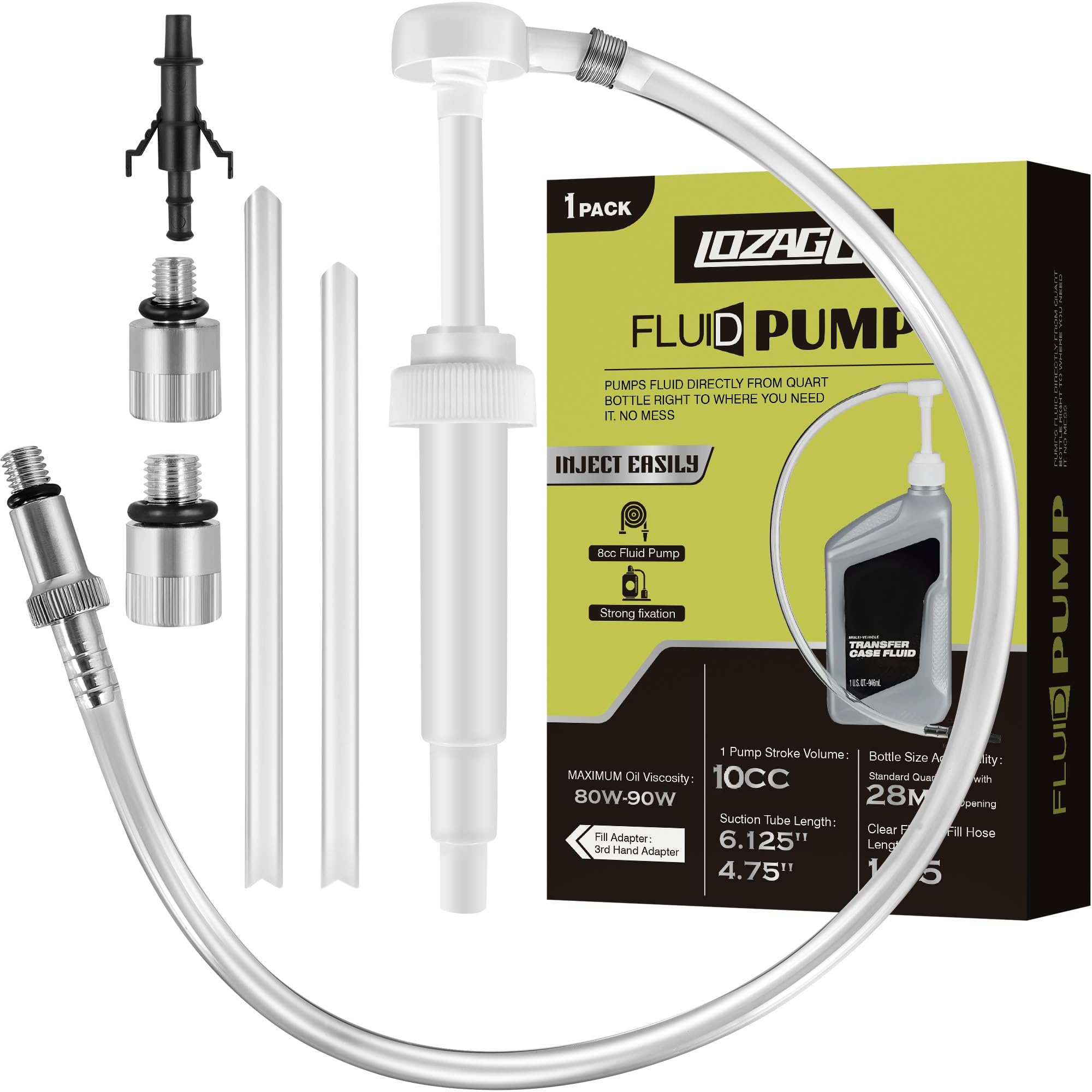
LOZAGU Lower Unit Gear Oil Pump

87 /100
Angler Score Excellent

Key details

Adapters
3/8-inch metal swivel, 8mm, 10mm
Hose Length
19.5 inches
Pump Stroke
10cc per stroke
Suction Tubes
6.125 inch and 4.75 inch
Check Details on Amazon

Ten cubic centimeters a stroke is the biggest number on this list, matched only by the Jewheg. Over a quart that's noticeably fewer pushes than an 8cc pump, and when the lube has been sitting in a cold garage, the extra volume per stroke is what keeps a cold-weather fill moving instead of stalling out.

The kit is the fuller of the two 10cc options: a 3/8-inch metal swivel, 8mm and 10mm metal adapters, a 6.125-inch suction tube for tall bottles and a 4.75-inch one for short, plus a 19.5-inch hose for reaching past a transom or a bunk. Nothing here feels improvised.

The cap is the seal that decides whether the job stays clean. Seat it square on the 28mm neck and it stays dry; cross-thread it and you'll know within two strokes. A pump stored full of old oil between seasons is the one that stiffens up, so run a few dry strokes before it goes into a bottle and put it away empty.

For anyone servicing two motors, or working with thick lube in a cold climate, the bigger stroke is worth having. It ranks behind the Slippery Pete on fittings — that swivel and adapter set is what the extra money buys there — and ahead of the 8cc pumps on volume per push.

Pros

  • 10cc stroke is the largest here
  • 3/8-inch metal swivel plus 8mm and 10mm
  • Two suction tubes and a 19.5-inch hose

Cons

  • Firmer pumping with cold lube than 8cc pumps
Our verdict

Worth the upgrade if you service more than one motor or pump cold, thick lube: the 10cc stroke is the biggest here and the adapter set is complete.

Check Latest Price
6

Keeping Aboard

Bzcovac Lower Unit Gear Oil Pump

84 /100
Angler Score Excellent

Key details

Weight
3.84 oz
Adapters
3/8-inch metal swivel, 8mm, 10mm
Pump Stroke
8cc per stroke
Check Details on Amazon

Small enough to live in the boat rather than the garage is how we think about this one: seven inches long, under four ounces, and still packed with a 3/8-inch metal swivel plus 8mm and 10mm adapters. It's the pump that's already aboard when you remember the lower unit on the last afternoon of a trip.

An 8cc stroke suits that role. The 10cc pumps here fill faster on a warm day, but a smaller piston is easier to push when the lube is cold and thick, and that's the condition you actually meet in October. We rate it the sensible second pump for anyone with a full-size kit at home.

The metal swivel is what separates it from the cheapest pumps here — it lets you spin the adapter into the fill hole without twisting the pump and hose around with it, which is the difference between a clean start and a crossed thread. Everything else is plain by design: a standard quart-bottle cap, one hose, no extra pieces to keep track of.

Pros

  • Fits in a boat bag at under four ounces
  • Metal swivel plus 8mm and 10mm adapters
  • 8cc stroke is easier to push in cold weather

Cons

No notable drawbacks to flag.

Our verdict

We keep this one in the boat rather than the garage — small, metal-swivelled, and easier to push than the 10cc pumps when the lube is cold.

Check Latest Price
7

Working Alone

DURATECH Lower Unit Gear Oil Pump

80 /100
Angler Score Excellent

Key details

Adapters
3/8-inch rotating metal, 8mm, 10mm
Hose Length
20 inches
Pump Stroke
8cc per stroke
Suction Tubes
5.9 inch and 4.7 inch
Check Details on Amazon

Filling a gearcase from below asks for three hands: one for the hose in the port, one for the bottle, one for the pump. DURATECH's answer is a butterfly adapter that threads onto the fill port and anchors the hose there, so the job drops back to two hands — or one, if you can brace the bottle against the skeg.

The rest of the kit is complete: 8cc per stroke, a 3/8-inch rotating metal adapter, 8mm and 10mm metal adapters, rigid suction tubes at 5.9 and 4.7 inches, and a 20-inch silicone hose that reaches past a trailer bunk or into a tight transom well.

That butterfly is worth paying a little over the cheapest kits here for. It does the same job as the Jewheg's third-hand adapter, and between them they're the only fittings on this list that change how the job feels rather than just how fast it goes. If you service the motor alone on a driveway on a Sunday, that is the part you'll notice.

Silicone is the right call for the hose, too — it stays supple when the temperature drops, where a stiff PVC hose wants to kink and coil back on you. Coil it loosely and it goes back in the box the same shape it came out.

Pros

  • Butterfly adapter holds the hose for solo fills
  • 20-inch hose reaches awkward transom wells
  • 3/8-inch rotating metal adapter plus both metrics

Cons

  • Butterfly piece is easy to misplace between seasons
Our verdict

Choose it if you fill alone: the butterfly adapter holds the hose in the port, which makes one-handed pumping practical, and the kit is complete.

Check Latest Price
8

Mercury/Mariner Threads

Yoursme Lower Unit Gear Lube Pump

88 /100
Angler Score Excellent

Key details

Weight
2.4 oz
Adapters
3/8-inch-16 and 8mm aluminum
Pump Stroke
8cc per stroke
Suction Tube
Single rigid tube
Check Details on Amazon

The card makes a specific promise: a 3/8-inch-16 adapter for Mercury and Mariner gearcases, an 8mm aluminum adapter for Yamaha, Honda, Nissan, Tohatsu and Johnson/Evinrude, and one rigid suction tube. That's a narrower kit than the three-adapter pumps here, and it puts a lot of the pump's reputation on a single thread.

What you get is light — 2.4 ounces, the lightest pump on this list, with an 8cc stroke and a tube long enough to reach the bottom of a 32-ounce bottle. In a tool roll or a splash well you won't know it's there until you need it.

The 8mm adapter is the part to test before you commit. It's aluminum, and on some drain holes it sits loose enough to weep, so thread it in dry and check that it bottoms out square before there's oil in the bottle. The hose end can work its way off the spout mid-fill, too — push it fully home and it behaves.

If your gearcase is a Mercury or Mariner with the 3/8-inch-16 thread and you want the smallest pump to keep aboard, this does the job at a sensible price. If you don't know your thread size, or you run more than one brand of motor, the extra adapters on the Slippery Pete or the Jewheg are worth having.

Pros

  • Lightest pump here at 2.4 ounces
  • Specific 3/8-inch-16 and 8mm fitment
  • Single tube reaches the bottom of a quart

Cons

  • Only two adapter sizes in the kit
Our verdict

A light, inexpensive, narrow pump for Mercury and Mariner threads; we point experienced owners at it and everyone else at a three-adapter kit.

Check Latest Price

How We Tested Gear Lube Pumps in Real Driveways

We started with listings for every pump that threads onto a standard quart bottle, then narrowed the field by the things that decide whether a pump works on your motor: the adapter sizes in the box, whether a Yamaha fitting was included, hose length, stated volume per stroke, and price against what you actually get. Pumps that shipped without adapters or with a single fixed fitting got cut early, and we skipped anything that only listed a proprietary bottle size. That left 14 pumps, which we bought and used ourselves.

Testing ran four months, from spring commissioning through a late-summer oil change, on boats sitting on trailers in the driveway and on one motor at the ramp. We counted strokes to fill a lower unit so we could compare an 8cc pump against a 10cc one in real time, and we watched the hose for air bubbles on the first ten strokes. Halfway through a bottle, we checked whether each pump still held prime after sitting capped overnight, and we ran the last inch of oil through every one to see whether it slurped air or kept pulling clean lube.

For mess and leakage, we capped each bottle and laid it on its side in a truck bed overnight, then looked for oil on the threads and in the cap. We also noted how much dripped off the hose when we pulled it out of the fill hole — the longer hoses made that easier to control. Durability got tested the unkind way: each pump was dropped on a garage floor, stored in a toolbox between uses, and checked at the end for cracked bodies, stiff hoses, and swivels that had started to weep. Fit, versatility, and value came down to the same question for every pump — could it handle a Mercury, a Yamaha, and a small Suzuki without a trip to the hardware store?

How to Choose a Lower Unit Oil Pump

Start With the Thread, Not the Pump

Everything downstream depends on the adapter matching the drain or fill port. Three sizes cover most of the market: 3/8-inch-16 on most American outboards and sterndrives, 8mm on a lot of Japanese motors, and 10mm on others. Metal adapters hold a thread better than plastic ones, which is why we look for them.

If you don't know your size, buy a kit with all three. It costs less than a second pump, and it covers the next motor as well as this one.

Check the Bottle Neck, Not Just the Bottle

A quart is a quart; a neck isn't. Standard bottles use a 28mm cap, and plenty of gear lube now ships in wide-mouth 38mm jugs. A pump sized for one will not grip the other, and the workaround — holding the pump down over the mouth with one hand while you work the plunger with the other — is exactly the mess you bought the tool to avoid.

Check the cap before you order. The Quicksilver pump here is the one that covers both neck sizes.

Decide How Much Oil One Push Should Move

An 8cc pump and a 10cc pump do the same job at different tempos. The bigger stroke empties a quart in fewer pushes, which is welcome in warm weather and with thin lube. The smaller one takes less force per push, and with cold 80W-90 sitting in an unheated garage that is the difference you feel in your forearm.

We lean toward 8cc for cold-climate servicing and 10cc for anyone filling two motors in summer.

Hose Length, Tube Length, and Where They Leak

Two rigid suction tubes beat one: the long tube empties a tall quart bottle, and the short one works a squat bottle without leaving the last inch behind. Hose length is about reach — 19 to 20 inches gets around a transom or past a trailer bunk.

When these pumps leak it is usually at the bottle cap or where the hose pushes onto the pump barb. Seat the cap square, push the hose fully home before you start, and keep the pump upright. If you fill alone, a third-hand or butterfly adapter that threads into the port is worth the small premium.

Frequently Asked Questions

Final Verdict

The Slippery Pete is the one we point to first. The metal swivel, the three metal adapters, and the two suction tubes cover the widest spread of gearcases here with the least fiddling, and that is what the extra money buys over a budget kit.

If your gear lube arrives in a wide-mouth jug, take the Quicksilver instead — it's the only pump here that grips both neck sizes. And if you want the job done for as little as possible, the Jewheg's third-hand adapter and 10cc stroke do it for the lowest price on this list.