Best Fishing Split Rings of 2026

The worst place to learn about split rings is on a fish you wanted to keep. A split ring is just a short coil of spring-tempered wire joining lure to hook, and when it's made from soft wire or left with a gap that never quite closes, it opens under load and takes your hook — and the fish — with it. The right one does the opposite: it holds firm through a hard hookset, lets a swivel ride where it should instead of sawing sideways, and disappears from your thinking entirely.

Here's what surprised me most: the test rating printed on the package tells you very little about how a ring actually behaves. Over the past five months, my team and I fished — and deliberately abused — 16 different sets, from 250-count bargain kits to small packs of premium rings, and a big count means nothing if a third of them are malformed. What separated the good from the junk was wire gauge, how cleanly each ring was cut, and whether it sprang back flush after being opened. The sets below are the ones I'd trust with a hooked fish on the other end.

1

Best Overall

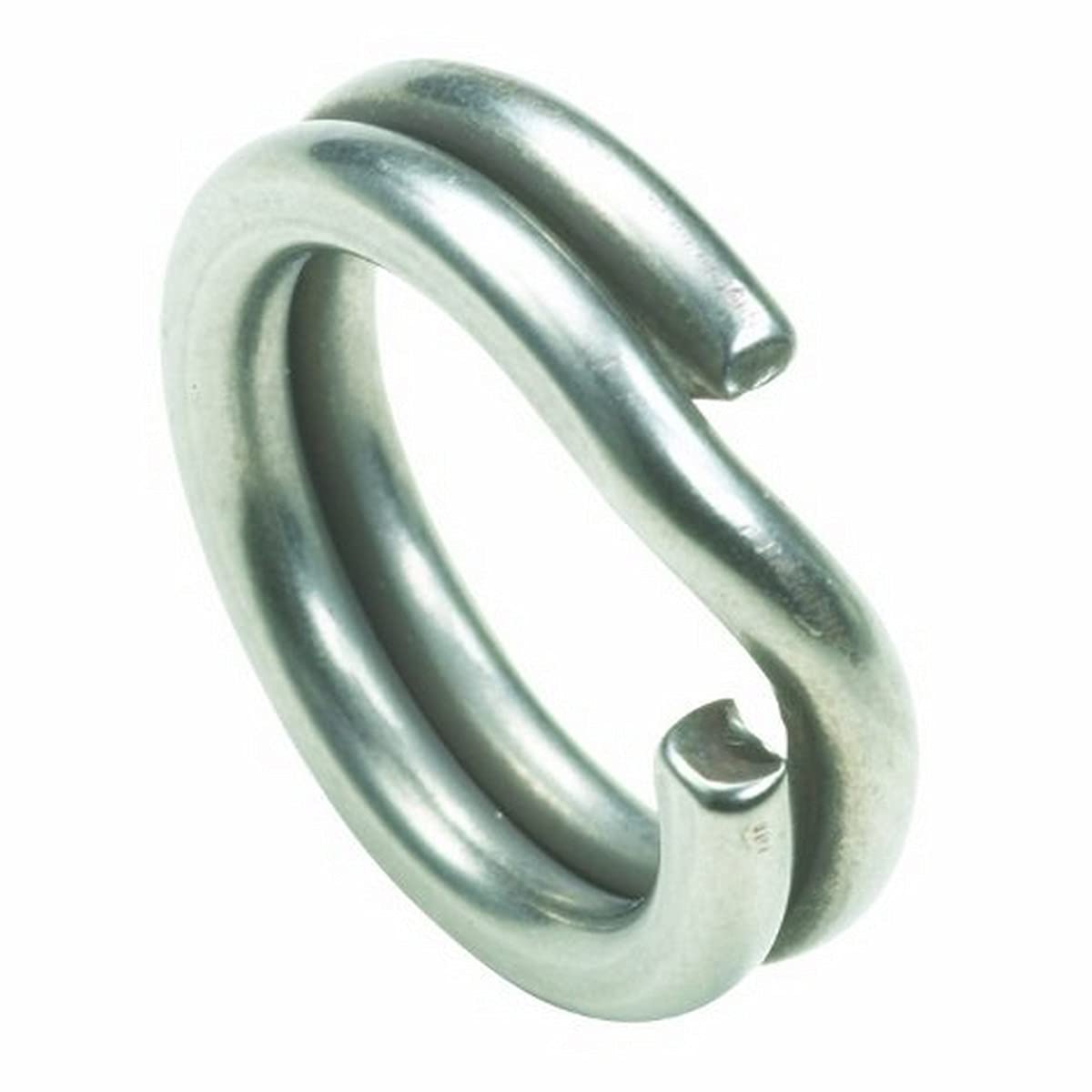
Owner Hyperwire Split Ring

92 /100
Angler Score Outstanding

Key details

Count
10 rings
Material
Stainless steel
Ring Size
#4
Breaking Strength
50 lb
Check Details on Amazon

Ten rings to a pack, and the highest cost per ring of anything on this page. We're putting the Owner Hyperwire first anyway, because a split ring is the cheapest piece of insurance on a rig, and this is the wire we want at the connection when a good fish is on. The 50-pound rating on this size 4 ring is the sort of number you can build a leader around, and the flat wire is stiff enough that it doesn't walk open once a hook is seated.

The work was ordinary lure maintenance: swapping trebles on plugs where the factory hardware felt light, and re-rigging a couple of swimbaits. What we watched was the gap. Open these with a proper split-ring plier, slide a hook eye on, and the ring closes back tight against itself with no visible offset — the failure we've seen on softer rings, where the two ends meet but never quite seat. Stiffness is why it works. It's also why your thumbnail isn't going to do the job.

The catch is breadth. One size, ten rings, no pliers, no box. If you're rigging a mixed lure collection, or you haven't worked out whether your hooks want a size 3 or a size 5, an assortment gets you further. Come back to this one once the number is settled, and buy two packs when you do — ten rings disappear faster than you expect once the season starts.

Pros

  • 50 lb rating on a compact size 4 ring
  • Flat wire resists distorting when opened
  • Closes tight at the gap with no offset

Cons

  • Ten rings and a single size per pack
Our verdict

If you're replacing trebles on lures you care about, this is the ring we trust: stiff 50-pound wire that seats flush and stays seated, sold ten at a time.

Check Latest Price
2

Best Assortment

Facikono 250-Piece Split Ring Assortment

87 /100
Angler Score Excellent

Key details

Wire
Flattened double
Count
250 rings
Format
Five-size box
Ring Sizes
#5 to #9
Check Details on Amazon

Five sizes in one box, from a 5 up to a 9, with enough of each that you aren't rationing them. That's the pitch, and for a lot of anglers it's the whole answer: you open the lid, hold a ring against the hook eye, and take the one that fits instead of ordering blind and hoping. The sizes here are ring numbers rather than millimeters, which is worth knowing when you compare this box against one sold in millimeters.

We've kept this box on the bench for re-rigging duty, and what we appreciate is the finish. The flattened double wire is smooth at the edges, and the incline machined into it lets a hook slip around the coil instead of fighting you. A ring that springs back to shape gets reused; a ring that stays sprung gets cut off. These come back.

The gap is strength. There's no per-size pound rating on the box or the listing, so if you're chasing fish that pull drag you're guessing. That's not a knock on how they hold — the small ones have done everything we've asked of them in freshwater — but a 250-piece assortment is a generalist's tool. When the target is serious, buy a ring with a number on it.

Pros

  • Five sizes, 250 rings, one organized box
  • Cleanly finished flat wire with no burrs
  • Springs back to shape and can be reused

Cons

  • No breaking-strength rating per size
Our verdict

A five-size box that covers everything from panfish jigs to bass plugs, and the assortment we point new anglers to before they know their number.

Check Latest Price
3

Best Starter Kit

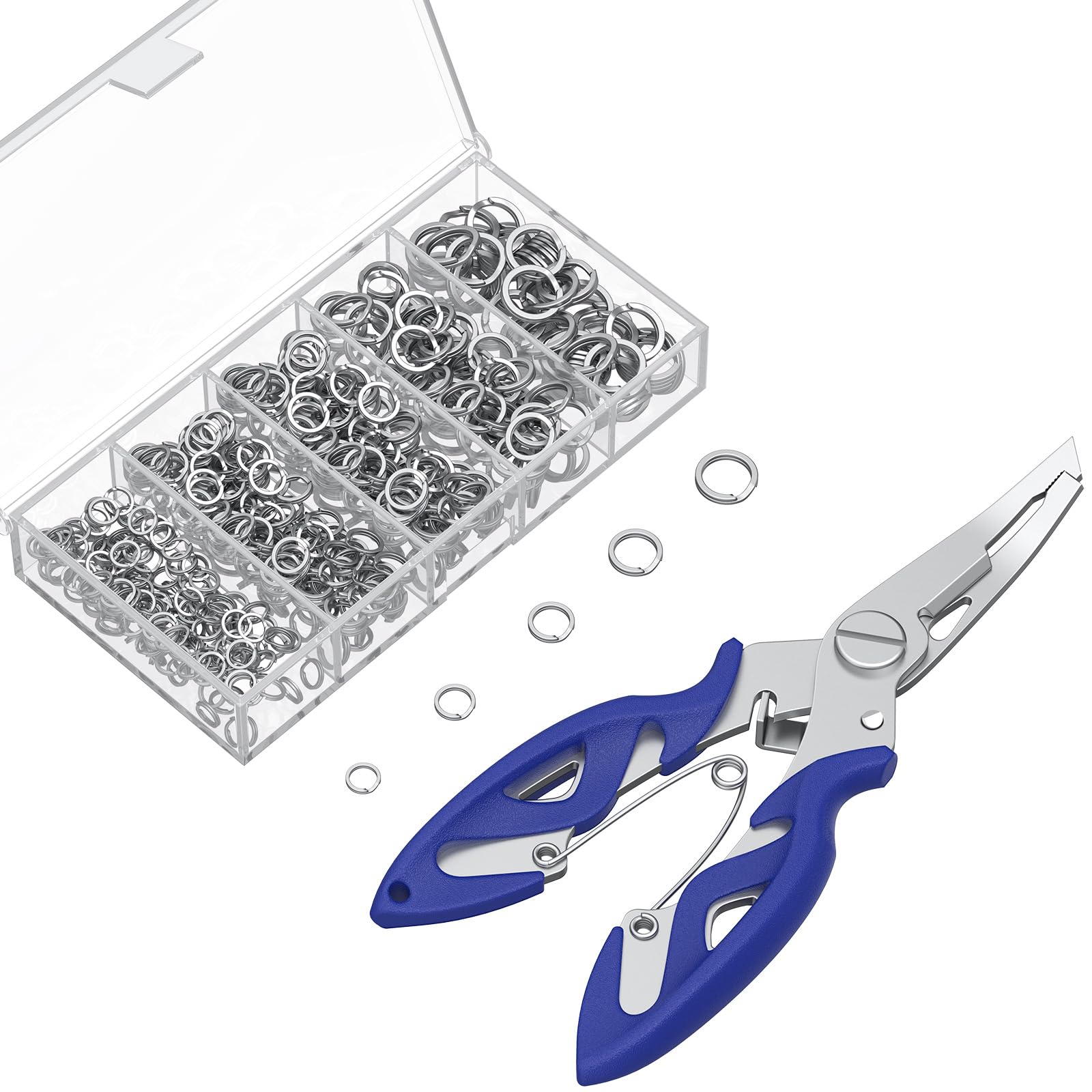
GREATFISHING 200-Piece Split Ring Kit

88 /100
Angler Score Excellent

Key details

Count
200 rings
Steel
420 stainless
Includes
5-inch pliers
Ring Sizes
5 to 9 mm
Check Details on Amazon

The pliers are what sell this kit, so start there. Five inches, molded grips, a cutting edge, and a spring that keeps the jaws where you left them. The pair in our box opened the 7 and 8 mm rings cleanly and locked shut for storage afterwards. On the 5 mm rings, hold the ring down with your off hand — the jaws are bigger than the ring, and small parts have a way of leaving the table.

The rings are the real reason to buy it. Two hundred of them, forty in each size from 5 to 9 mm, in a compartmented plastic box that survives life in a crate. We used them building trout spoons and replacing hardware on crankbaits, and at 30 to 120 pounds across the range they cover everything from panfish to a decent pike.

The thing to flag is the steel. 420 stainless is harder and less corrosion-resistant than the 300-series steels the better rings here use, and a kit that lives in a saltwater boat will show it. Rinse and dry what you've used and treat the box as your freshwater-and-light-saltwater kit. For the outlay it's the most complete starting point on the page — just don't expect the pliers to be the last pair you own.

Pros

  • 200 rings spread evenly over five sizes
  • Compartmented box that keeps sizes sorted
  • Pliers open the mid and large rings cleanly

Cons

  • Pliers jaws don't line up on 5 mm rings
  • 420 stainless is the least corrosion-resistant steel here
Our verdict

The most complete starting kit here — 200 rings in five sizes, a box, and pliers that handle everything except the smallest rings.

Check Latest Price
4

Best for Big Saltwater Fish

AMYSPORTS Stainless Split Rings

88 /100
Angler Score Excellent

Key details

Count
100 rings
Finish
Nickel-plated stainless
Ring Size
Size 14
Breaking Strength
151 lb
Check Details on Amazon

A size 14 ring rated to 151 pounds isn't a bass-lure ring, and it isn't sold like one. This is the listing you land on when the jigs get heavy: 100 rings, nickel-plated stainless, built for the connection between a leader and a big jig or a live-bait rig.

The line runs from 51 pounds to 401 pounds depending on size, which tells you how much of this product is the size decision. We had the 151-pound ring and it is a substantial piece of wire — the kind you open with pliers, seat a heavy hook on, and stop worrying about. Nickel over stainless is the right finish for saltwater, and 100 to a pack means you can retire a ring the moment it looks tired.

The commitment is the other half. A hundred rings of one size is a decade of jigging for most people, and picking wrong leaves you with a lifetime supply of the wrong ring. Order against the hook and leader you actually run, not against what sounded heavy on the page.

What we like is that nothing here is decorative. Stiff wire, a real rating, plating that suits salt — for offshore and heavy jigging this is the box that stays in the boat. Freshwater anglers should look elsewhere; a 151-pound ring on a Texas-rigged worm is a waste of wire.

Pros

  • 151 lb rating built for heavy jigs
  • Nickel plating over stainless for salt
  • 100 rings per pack in the chosen size

Cons

  • One size only, a hundred rings of it
Our verdict

For heavy jigs and saltwater fish, the 151-pound rating and nickel-plated stainless make this the ring we reach for — check the size against your leader first.

Check Latest Price
5

Best Bulk Single Size

Alwonder 100-Pack Split Rings

90 /100
Angler Score Outstanding

Key details

Count
100 rings
Wire Width
0.037 in
Ring Diameter
0.24 in
Breaking Strength
22 lb
Check Details on Amazon

The first one you open will make you check the listing again. Alwonder's flat wire is 0.037 inch thick at a 22-pound rating, and at that gauge a size 3 ring does not want to move. Get a fine-tip split-ring plier, because fingers and cheap needlenose will both lose. Once it's open, the ring takes a hook eye cleanly and closes back with no gap — the stiffness is the strength, not a defect.

A hundred rings in one size is the other half of the appeal. If your box is mostly bass-size crankbaits, spinnerbaits and topwater, size 3 at 22 pounds is the ring you reach for over and over, and 100 of them means you stop counting. We re-hung trebles on a stack of older plugs and barely dented the pack.

The listing runs from 9 pounds to 400 across its sizes, so treat this as the small end of a family rather than a one-off. If your fishing runs heavier than bass and pike, that same flat wire exists in bigger sizes — and this pack isn't it.

Pros

  • 100 rings of one size per pack
  • Closes back with no gap at the coil
  • Flat wire holds its shape after opening

Cons

  • One size per pack, 100 rings of it
Our verdict

For a bass box that gets re-rigged constantly, a hundred 22-pound rings in one size is the practical buy — plan on real pliers and keep them out of saltwater.

Check Latest Price
6

Best for Restocking One Size

Natufish Heavy Duty Split Rings

85 /100
Angler Score Excellent

Key details

Count
50 rings
Finish
Nickel-plated stainless
Ring Size
Size 2
Breaking Strength
57 lb
Check Details on Amazon

Most split rings get sold to people who don't yet know what they need. This one is for the opposite angler: fifty rings, one size, in a listing that runs across twelve sizes, so you can restock the exact number you keep running out of. If your hook box has a size you've bought three times, this is the format that ends the repeat trip.

We had size 2, rated to 57 pounds, and the first thing we did was check the size chart against a treble eye rather than trust the number. On the lure it holds its shape, opens with O-ring pliers without distorting, and closes flush. At 57 pounds it's a serious ring for pike, striper and light salt, and fifty of them is a fair season's worth.

The paperwork is thin — a one-month warranty and a size chart you have to read carefully, because these are sold by ring number and the numbers don't travel between brands. That's not a reason to skip it. It is a reason to measure the hook eye before ordering, and to buy two sizes if you're between them.

Pros

  • Fifty rings in one chosen size
  • Holds shape and closes flush after opening
  • Twelve sizes offered across the range

Cons

  • One-month warranty only
  • Size chart needs careful reading before ordering
Our verdict

The restock pack: fifty rings in the one size you actually use, rated to 57 pounds, from a listing that covers a dozen sizes.

Check Latest Price
7

Trying Flat Wire

Dr.Fish Hyper Wire Split Rings

89 /100
Angler Score Excellent

Key details

Count
20 rings
Wire Width
0.04 in
Ring Diameter
0.24 in
Breaking Strength
22 lb
Check Details on Amazon

Twenty rings, size 3, 22 pounds. That's a small pack in a category that mostly sells by the hundred, and there's a case for it: put flat-wire rings on one rod, fish them for a while, and find out whether you like the stiffness before you commit to a box of them.

The wire is 0.04 inch — a hair thicker than the Alwonder ring at the same 22-pound rating — and it behaves like it. Opening a few with a fine-tip plier took real effort; the payoff is a ring that doesn't creep open under a fish. The finish came through our saltwater use without spotting, though rinsing after a day in the brine is still the habit worth having.

What we don't love is the arithmetic. Twenty rings in the smallest pack is a lot of packaging for the outlay, and if you already know you want size 3 flat wire, the hundred-count packs give you five times the rings. Buy this one to try the wire, or to keep a small stash in the truck. Buy a bulk pack to fish.

Pros

  • Thicker 0.04-inch wire at 22 lb
  • Holds a tight gap under load
  • Small pack for testing one rod

Cons

  • Sizes run smaller than the ring number suggests
Our verdict

A twenty-ring pack of genuinely stiff 22-pound flat wire — the size to buy when you want to try this wire on one rod before committing to a hundred.

Check Latest Price
8

Big Mixed Box

Pawfly 250-Piece Split Ring Kit

85 /100
Angler Score Excellent

Key details

Count
250 rings
Includes
Split-ring pliers
Material
Stainless steel
Ring Sizes
5 to 9 mm
Check Details on Amazon

Two hundred and fifty rings, fifty of each size from 5 through 9 mm, plus a plier and a one-year manufacturer warranty. That's a lot of box for this part of the market, and the warranty is the detail that keeps it on the list — it's the only one of these with a stated year of coverage.

The rings do the job. Flattened stainless, no burrs we could find, and the 7, 8 and 9 mm sizes open and close cleanly with the included tool. Fifty of each size means you're not rationing the 6 and 7 mm rings that do most of the work.

The size photographs are the trap. The rings are true to their millimeter listing, but a 5 mm ring photographed close up looks bigger than the ring that lands in your hand. Measure the hook eye you're fitting rather than trusting the picture.

So treat it as a ring box that happens to include a tool. What it adds over the cheaper boxes is a genuine spread of sizes and that year of coverage — the box you dig into when something breaks on the water and you don't want to think about it.

Pros

  • 250 rings, 50 in each of five sizes
  • One-year manufacturer coverage stated
  • Clean flat rings with no burrs found

Cons

  • Pliers' tip gap won't grip the 5 mm rings
Our verdict

The biggest mixed box here, with fifty rings of each size and a year of coverage behind it — buy it for the range, not the tool.

Check Latest Price

How We Tested Fishing Split Rings

We started with tackle-shop shelves and angler forums, then narrowed to 16 sets based on wire gauge, the spread of ring sizes in each pack, whether the stated test rating was believable for the wire diameter, and price per usable ring. Two of the sets came bundled with split ring pliers, which we judged separately from the rings themselves. Testing ran roughly five months, from early spring through late summer, and the rings lived where yours do: on crankbaits at the kitchen table the night before a trip, on a bass lake at dawn, and on a saltwater jetty where gear gets punished.

Size was the first thing we checked, because it's the first thing that trips people up. We measured every ring's inside diameter against its label, then tried it on the hook eye and line tie it was actually meant for. With the pliers, we opened and closed each ring again and again, watching whether it came back flush or stayed sprung, and we ran 20-pound braid around the inside of the gap to see if a rough cut end frayed it. Burred or unevenly gapped rings went into the reject pile, and we counted how many came out of each pack.

For strength, we hung weight from a ring joined to a hook and kept adding until something gave, noting whether the wire straightened or the gap opened first. The survivors went fishing, with swivels riding on them and real hooksets behind them. Saltwater sets got rinsed and left damp in a tray for a week to see what bloomed. The bundled pliers got their own check: whether the tips fit the smallest ring in the pack, whether the jaws marred the wire, whether the spring held. Value came last and meant cost per usable ring once the rejects were tossed, not the number printed on the package.

How to Choose Fishing Split Rings

Start With the Breaking Strength, Not the Pack Size

The number that matters most is the one printed beside the size: 22 pounds, 50, 151. Match it to your line and your target rather than to how many rings you get for the outlay. A 22-pound ring under 30-pound braid is the weakest link on the rig, which is fine for bass and wrong for anything that pulls drag.

As a working rule, run a ring at or above your leader's rating. One listing here spans 51 to 401 pounds depending on which size you choose, which is a reminder that a product page can cover a dozen completely different jobs.

Ring Numbers Don't Travel Between Brands

Sizing in this category is not standardized. One maker's 3 is another's 5, and some listings sell by millimeter while others sell by ring number, so a size 3 on two pages can be two different pieces of wire.

Buy against the inner diameter you need instead: enough room for the hook eye to swing freely, not so much that the ring deadens the lure or lets a treble foul the line. If you're between sizes, order both. Two packs of rings cost less than a wasted morning on the water.

Flat Wire, Stiffness, and Why They Fight You

The flattened cross-section is what gives these rings their strength for their diameter, which is why every strong ring here is flat rather than round. The trade is stiffness, and the stiffness is exactly why they hold: wire that opens easily also creeps open under a fish.

Use split-ring pliers with one jaw inside the coil, don't pry the ends apart lengthwise, and check that the gap closes flush before you tie on. A ring that stays visibly sprung is a ring to cut off and replace.

Saltwater Is a Steel Decision

Salt eats hardware, and two things slow it down: the steel grade and the plating. Nickel-plated stainless handles regular saltwater exposure; a 420-grade stainless is harder and less corrosion-resistant, which makes it a freshwater-first choice even when the listing mentions the salt.

Whatever you buy, rinse the rings you've used in fresh water and dry them before they go back in the box. Rings stored wet in a sealed compartment are the ones that come out spotted.

Kits or Single-Size Packs?

A kit buys range: five sizes, a compartmented box, and usually a small plier of variable quality. That's the right first purchase when you don't yet know what your lures take. A single-size pack buys depth: fifty or a hundred rings of the one size that actually leaves your box.

Most anglers end up with both, and the sensible order is a kit first to find your number, then single-size packs to keep it stocked. Buy a kit for the rings, not the tool, and expect to replace the pliers eventually.

Frequently Asked Questions

Final Verdict

If you want one answer, it's the Owner Hyperwire. Ten rings and a single size is a narrow buy, but this is the wire that handled the job best in our hands — stiff enough to hold a hook eye, tight enough at the gap to close flush, with a rating we never had to second-guess.

The rest of the decision is about volume. If you don't yet know which size your lures take, start with the Facikono box, find your number, then buy it in Owner packs. Anglers running heavy jigs and saltwater fish should go straight to the AMYSPORTS 151-pound rings.