Best Fixed-Mount Marine VHF Radios of 2026

A handheld VHF is only as good as its battery and its five or six watts. A fixed-mount radio is bolted to the console and wired into the boat's power, so it transmits at the full 25 watts — enough that your call reaches the Coast Guard instead of the next mooring. Since that output is capped by law, the real differences between models live in the display you have to read through glare, the mic you'll be shouting into, and whether the GPS is already built in.

Everyone on my dock has a strong opinion about which brand to buy; after eight months with a dozen fixed-mount radios, I've let most of that go. What held up was simpler — the ones that felt worth the money had screens that stayed readable with the sun behind you and speakers that cut cleanly through engine noise at cruise. The picks below cover everything from a bare-bones install to a fully networked dash.

1

Best Overall

Standard Horizon GX1400

89 /100
Angler Score Excellent

Key details

Display
31 x 55 mm dot matrix
Controls
All on the microphone
Position Input
NMEA in and out
Waterproof Rating
IPX8
Check Details on Amazon

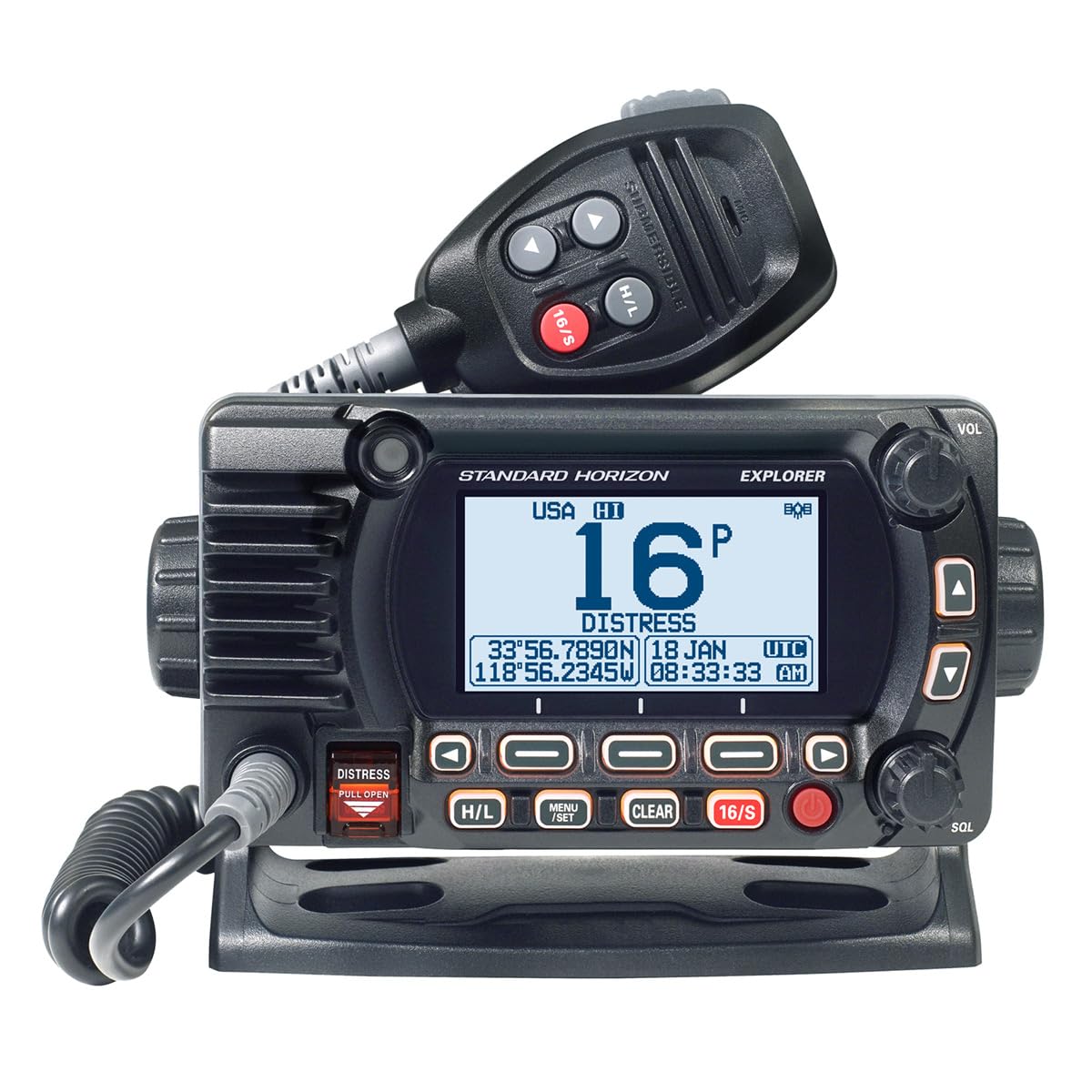
Standard Horizon put the whole radio on the microphone. Channel changes, volume, the 16/9 key and the soft keys you program for yourself all sit in your hand, so you can run the set without turning away from the water or reaching under the dash.

That's a large part of why we make it the default pick here. The rest is the specification doing exactly what a helm radio should: IPX8 submersible to 1.5 meters for 30 minutes, Class D DSC with its own Channel 70 receiver so a distress call still gets through while you're talking on 16, and an oversized 31 by 55 mm dot-matrix display that holds up in daylight.

Position is the one thing it doesn't bring with it. There's no GPS inside, so run the NMEA connections to your chartplotter and the distress button transmits coordinates; leave that wiring out and the alert still goes, just without telling anyone where you are. The preset key recalls ten channels, and NOAA weather alert covers the afternoons that turn sour.

The box arrives complete — bracket, knobs, microphone hanger, mounting hardware and power cord — which sounds like a small thing until you're mid-install on a Saturday missing the right bracket. The menu is deeper than daily use requires, but almost nothing you touch at the helm lives there anyway.

Pros

  • Every control you use at the helm sits on the mic
  • IPX8 rated to 1.5 m for 30 minutes
  • Class D DSC with a dedicated Channel 70 receiver
  • Oversized 31 x 55 mm dot-matrix display

Cons

  • No built-in GPS; DSC position needs a plotter feed
Our verdict

We tell most boat owners to start here: a submersible, mic-controlled 25-watt radio that does DSC properly once you run two wires from your plotter.

Check Latest Price
2

Best with Built-In GPS

Uniden UM725G

88 /100
Angler Score Excellent

Key details

Display
68 x 38 mm LCD
Position Source
Built-in GPS
NMEA Connections
NMEA 0183 in and out
Waterproof Rating
IPX8
Check Details on Amazon

GPS inside the radio is the reason to buy this one, and the price is the reason it's our GPS pick. It's a good deal less money than the GPS-equipped Icom here, and it does the same core job of telling the distress button where you are without a plotter, a separate receiver or a data cable to maintain.

The rest of the package is aimed at longer days: DSC distress send and receive, NOAA weather channels with alerts, NMEA 0183 in and out so you can still trade position and call data with a chartplotter, and a messaging feature that reaches another boat privately instead of tying up Channel 16. The 68 by 38 mm screen is one of the larger ones here, and we take big characters over extra menu layers every time.

Two practical notes before you order. The bracket in the box is a surface mount, so a clean flush install means buying the flush hardware separately. And because the GPS receiver lives inside the chassis, where you mount it matters — a spot under a metal hardtop isn't doing it any favors.

Pros

  • Built-in GPS feeds DSC with no extra wiring
  • NMEA 0183 in and out for plotter data
  • Boat-to-boat text messaging keeps Channel 16 clear
  • 68 x 38 mm LCD, larger than most here

Cons

  • Flush-mount hardware sold separately
Our verdict

If you want DSC that transmits your coordinates with nothing else wired in, this is the radio to buy — GPS on board, at a price well under the GPS-equipped Icom.

Check Latest Price
3

Best Budget

Uniden UM435BK

90 /100
Angler Score Outstanding

Key details

Transmit Power
1 W / 25 W
Water Warranty
3 years
Channel Coverage
USA, international, Canadian B
Waterproof Rating
IPX8
Check Details on Amazon

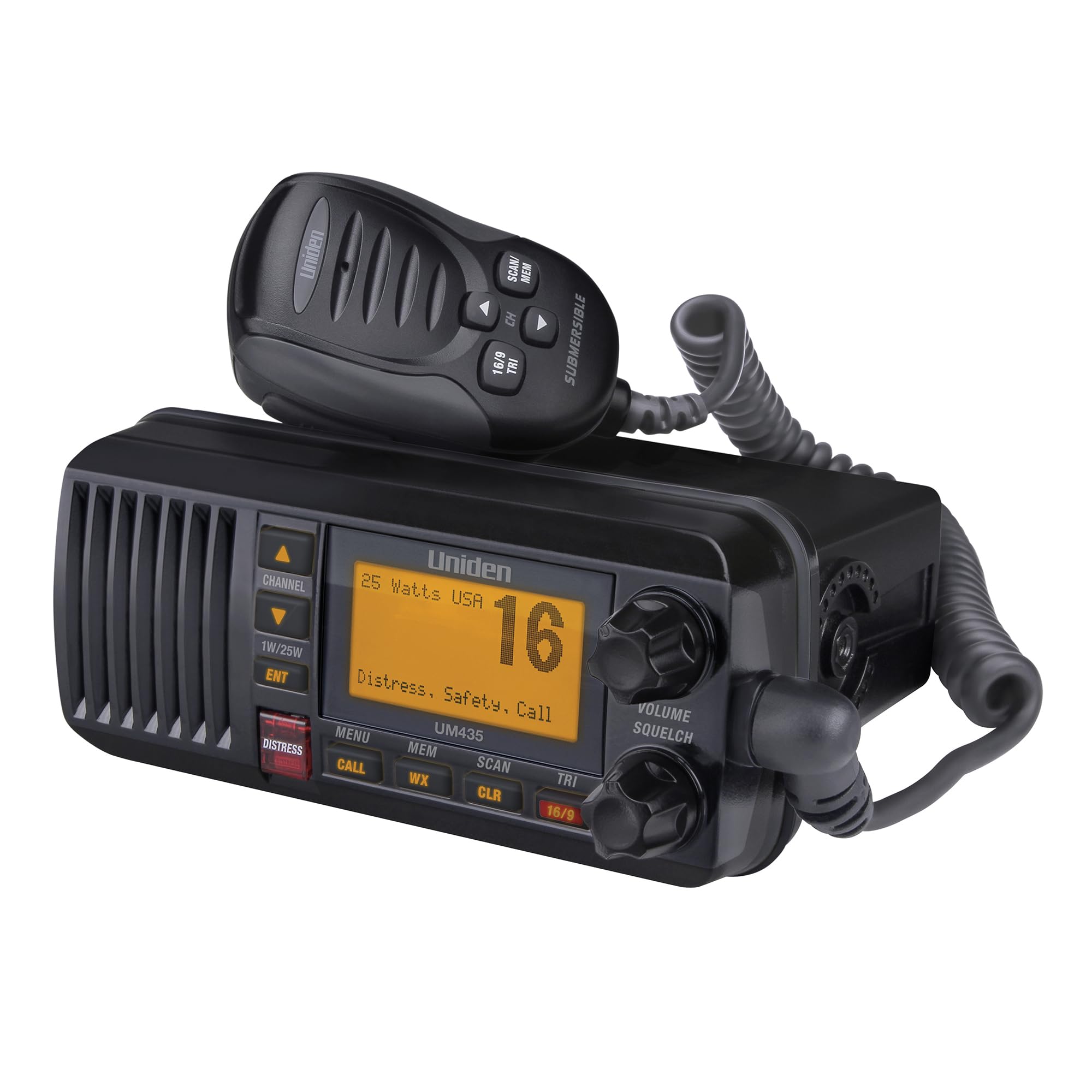
Cheapest here doesn't mean disposable. The UM435BK carries the same IPX8 submersible rating as radios that cost twice as much, and Uniden backs the water protection for three years — as long as anything else in this group.

What you get is the essentials done properly: 1 W and 25 W transmit, all U.S., international and Canadian channels including the Canadian B channels for border water, DSC with position send and request, triple and dual watch, and memory scan. Nothing on the front panel is decorative, and nothing you need is more than a press away.

What you give up is position. There's no GPS inside, so a DSC distress alert leaves this radio without coordinates unless you feed it from a receiver that supplies them. In a bay where the Coast Guard can see you, that matters less than it sounds; well offshore it matters a lot, and it's the honest reason to step up to a GPS model. Either way, put it through its paces in the first week — scan, the microphone clip, a radio check with a nearby station — while a return is still simple.

Pros

  • IPX8 submersible with a three-year water warranty
  • DSC with position send and request
  • Canadian B channels for border water

Cons

  • No built-in GPS, so DSC alerts carry no coordinates
Our verdict

The budget pick we're comfortable with: it puts the money into a submersible chassis and a three-year water warranty instead of a screen and GPS.

Check Latest Price
4

Best for Tight Helms

Icom IC-M330

87 /100
Angler Score Excellent

Key details

DSC
Class D
Chassis
Palm-sized
Waterproof Rating
IPX7
Receiver Selectivity
More than 70 dB
Check Details on Amazon

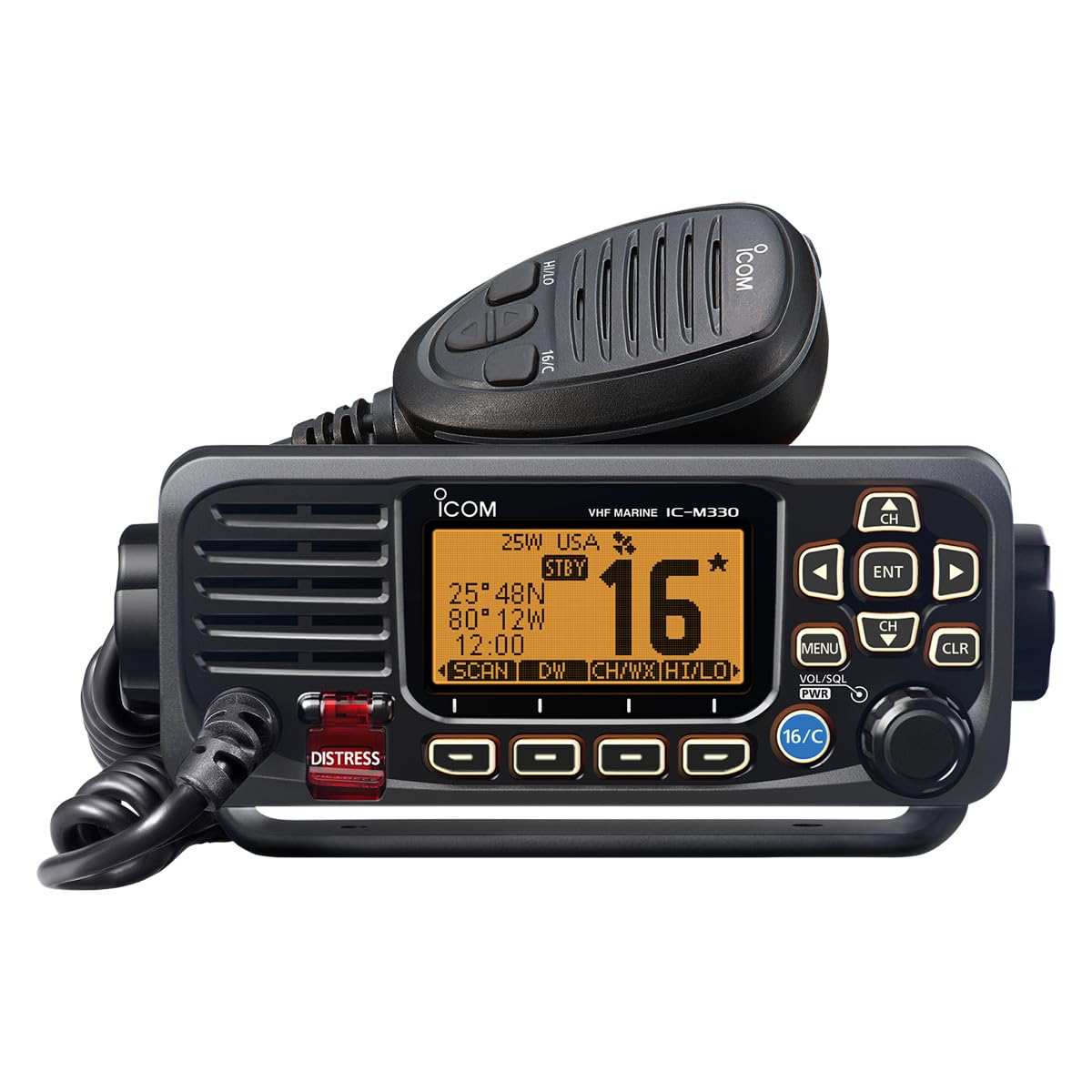
A palm-sized chassis is the whole argument for the M330. On a center console where the plotter, the compass and the drink holders are already fighting for dash space, this radio tucks into a corner and leaves everything else where it was.

Icom didn't get there by stripping the set down. There's a Class D DSC receiver watching Channel 70 continuously, a speaker designed to hold its clarity at full volume, and — the number we care most about — more than 70 dB of receiver selectivity. In a marina on a summer Saturday, that's the difference between hearing your harbor channel and hearing three others bleeding in on top of it.

The trade is paid in features. This is the version without GPS, so position comes from a data feed or not at all, and it costs more than the GPS-equipped Uniden while offering fewer headline features. You're buying compactness and receiver performance instead. Radios get switched off at the helm for boring reasons — usually because the function you need is buried behind a menu — so the directional keypad and programmable soft keys are the part that wears well.

Pros

  • Palm-sized chassis fits cramped consoles
  • More than 70 dB of receiver selectivity
  • Class D DSC with continuous Channel 70 watch
  • Programmable soft keys keep common functions close

Cons

  • No built-in GPS in this version
  • Costs more than the GPS-equipped Uniden here
Our verdict

Buy it if dash space is the constraint — a genuinely small chassis with marina-grade selectivity, and you supply position from your plotter.

Check Latest Price
5

Best Premium Pick

Icom M424G

85 /100
Angler Score Excellent

Key details

AIS
MA-500TR transponder compatible
Warranty
2 years
Position Source
Built-in GPS
Waterproof Rating
IPX7
Check Details on Amazon

The M424G answers the question the smaller Icom leaves open: what if the radio carried its own position? Icom puts a GPS receiver inside the chassis, keeps the compact control layout, and backs the whole thing with a two-year manufacturer warranty.

AquaQuake is the feature we didn't know to want and now look for. When spray fills the speaker grille and the audio goes muffled, the radio buzzes the water out of it instead of asking you to blow into the grille or wait a few minutes for it to drain. On an open helm, that's the kind of detail that shows up on every wet passage rather than once a season.

Audio is the other reason to step up. The speaker stays clear at volume, which is what you need with the engine running and wind over the bow, and clear sound in noise is the strength this radio is best at. Reception holds up at distance too, which is the part offshore sailors care about most.

Two things to weigh. IPX7 — one meter for 30 minutes — sits a step below the IPX8 ratings on several picks here, which is still fine for a wet helm but worth knowing if your installation takes spray head-on. And the premium is real: this is the priciest Icom in the group. Where it earns that back is the upgrade path, because it's compatible with the MA-500TR AIS transponder and targets can join the same position and DSC picture later without changing radios.

Pros

  • Internal GPS feeds DSC and position requests
  • AquaQuake clears water from the speaker
  • Compatible with the MA-500TR AIS transponder
  • Two-year manufacturer warranty

Cons

  • IPX7 rather than the IPX8 rating of several picks
  • Priciest Icom among our picks
Our verdict

Worth the step up for an open helm: the position is already inside, the speaker clears itself of water, and the warranty runs two years.

Check Latest Price
6

Best for NMEA 2000 Networks

Standard Horizon GX1850

89 /100
Angler Score Excellent

Key details

Networking
NMEA 2000 and NMEA 0183
Remote Mics
CT-100, SSM-70H, RAM4
Frequency Range
156-174 MHz
Waterproof Rating
IPX8
Check Details on Amazon

If your boat already has a NMEA 2000 backbone running between the plotter, the engine display and the autopilot, the GX1850 joins it rather than sitting beside it. Both NMEA 2000 and NMEA 0183 are supported, and Standard Horizon's CT-100, SSM-70H and RAM4 wired microphones add a working second station on the flybridge or in the cockpit without a second radio and a second hole in the dash.

We only recommend paying the premium if the network is the point. This is the most expensive radio in the group, and on a boat with one plotter and a simple dash, the GX1400 does the same core job — same IPX8 chassis, same manufacturer — for a lot less money. What the extra buys is integration and expansion, not better reception.

Expansion is where it pays off. Adding a station later is a microphone and a cable run, and the submersible chassis means the flybridge install is as weatherproof as the one below. If your refit plan already includes a backbone, this is the radio you fit once and stop thinking about.

Pros

  • NMEA 2000 and NMEA 0183 built in
  • Supports CT-100, SSM-70H and RAM4 remote mics
  • IPX8 submersible chassis

Cons

  • The most expensive radio in this group
  • Network features earn nothing without a backbone
Our verdict

The right radio for a networked boat — NMEA 2000 and 0183 built in, with wired second-station mics that save you buying a second set.

Check Latest Price
7

Retrofit Installs

Cobra MR F77W GPS

86 /100
Angler Score Excellent

Key details

Replay
Rewind-Say-Again, 20 seconds
Mounting
Flush and surface kit
Position Source
Built-in GPS
Waterproof Rating
IPX8
Check Details on Amazon

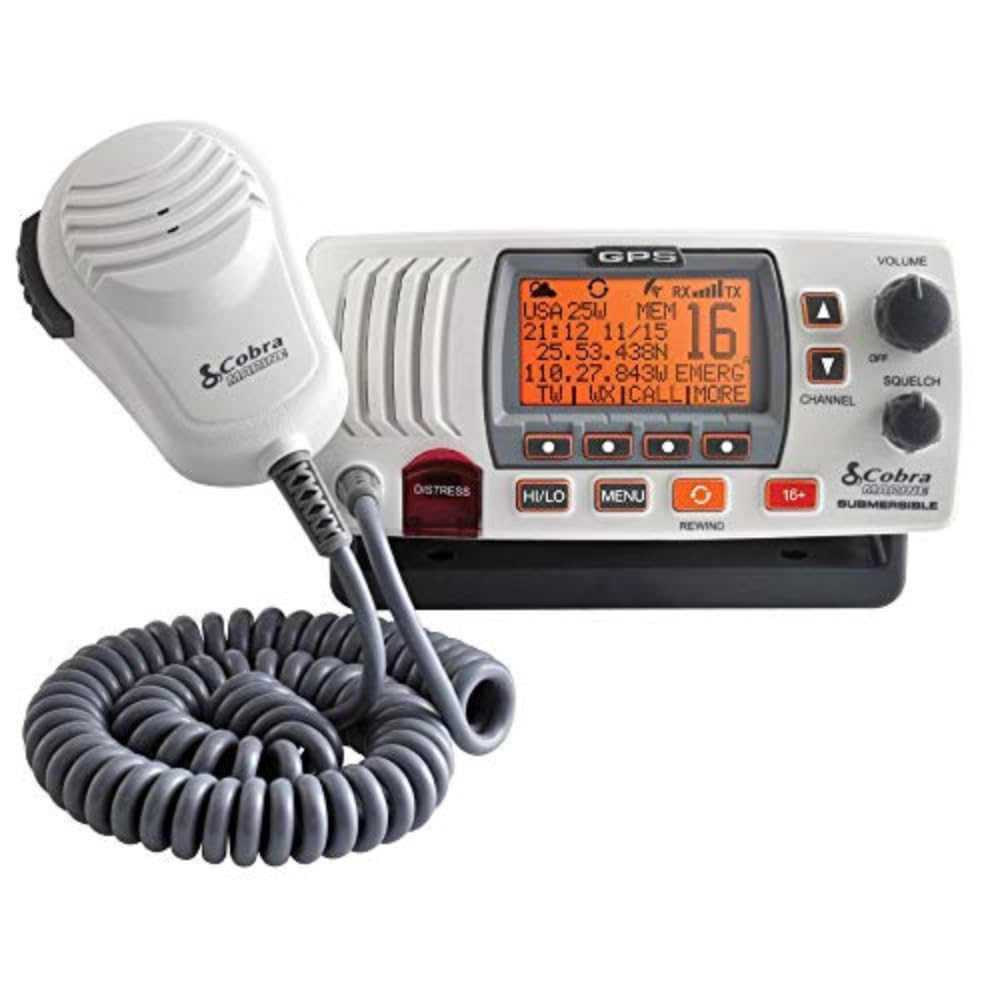
Replacing an old radio is its own job, and the F77W makes it easier by putting both mounting options in the box — a flush-mount kit for a clean dash cutout and a surface bracket if you'd rather not cut at all — plus the NMEA input cable for a plotter feed.

Feature for feature it's one of the more generous packages here: GPS built in so DSC carries your position, IPX8 submersible construction, a three-year limited warranty, a noise-cancelling microphone, NOAA weather, tri-watch, channel scan and a PA output for a deck horn. For a center console being brought back to life, it's a sensible fit.

Rewind-Say-Again is the sleeper. The radio keeps the last 20 seconds of an incoming transmission, so when a lockmaster or a bridge tender runs through instructions and you catch half of them, you replay instead of keying up to ask again. We rate that buffer higher than the PA output, honestly, and higher than the signal-strength meter too.

The caveat is the screen. A blank or garbled display is the failure that can take this radio out of service, and when the screen goes the radio goes with it, because you can't see which channel you're transmitting on. That's not a reason to avoid it, but it is a reason to buy where returns are simple and to check the display in the first week.

Pros

  • Built-in GPS feeds DSC alerts
  • Flush and surface mount kits both included
  • Rewind-Say-Again replays the last 20 seconds
  • Three-year limited manufacturer warranty

Cons

  • A blank or garbled display can disable the radio
Our verdict

A feature-rich, easy-to-fit radio for an older boat, with GPS inside and a replay buffer that earns its keep around locks and bridges.

Check Latest Price

How We Chose and Tested These Marine VHF Radios

We started with every fixed-mount VHF we could find that carries the full US, Canadian, and international channel sets, then cut anything missing DSC, NOAA weather alerts, or a documented waterproof rating. From there we filtered by how the unit gets its position — GPS built in versus fed from a chartplotter — and by what actually comes in the box, since a bargain radio that needs a separate antenna splitter and a speaker mic isn't a bargain. Twelve radios made the final cut.

Over eight months, each one went on the bench first, then into the dash of a 22-foot center console and an older cabin cruiser. We timed the install with a stopwatch — drilling the bracket, fishing the power leads, crimping, terminating the antenna — and wrote down every point where the manual lost us or a connector didn't match the drawing. Radios that ate a Saturday got marked down; the ones that went in over a lunch break didn't.

On the water we read each display at noon with the sun behind us and again at dusk at both brightness settings, and we counted the button presses it took to change channels or pull up a weather alert mid-run. Ease of use got settled by handing the mic to guests who'd never touched a VHF and watching what they did next. For sound, one person drove at cruise while another stood at the bow and repeated back a radio check, and at the end of the season we hosed down every faceplate to see which seals held.

How to Choose a Fixed-Mount Marine Vhf Radio

Start With the Water Rating

It's the spec most shoppers skim past and the one that decides whether the radio survives a season. IPX4 means splash-resistant: rain and spray from one direction, fine in an enclosed pilothouse, not fine on a center console taking green water over the bow. IPX7 and IPX8 mean the chassis can go under, typically a meter for 30 minutes at IPX7 and deeper at IPX8.

On anything with an open helm we treat IPX7 as the floor and don't consider IPX4 at all. If the radio lives behind glass with a hardtop over it, you can relax that — but the price difference between the ratings is small enough that we struggle to see the argument for saving it.

Decide Where Your Position Comes From

DSC is the reason a fixed-mount set is worth more than a handheld, and DSC is only as good as the position it transmits. There are three arrangements in this group: a GPS receiver built into the radio, an NMEA feed from your chartplotter, or neither.

If you have a plotter at the helm and a spare data port, a radio without GPS saves you money and duplicates nothing. If you don't, buy the receiver inside the radio — the Uniden UM725G and the Icom M424G both do it, and it's the difference between a distress alert that says where you are and one that doesn't.

Fit the Helm: Chassis, Screen, Controls

Fixed-mount radios vary less in width than you'd expect and more in depth and height, so measure the space behind the panel as well as the cutout in front. Icom's IC-M330 is the extreme case at palm size, and it's the one to look at when the radio is competing with a plotter for dash real estate.

Then look at where the controls sit. A set you can run entirely from the microphone lets you mount the box out of the way and keep your eyes forward, and a screen you can read at a glance with wet hands beats a larger one you have to focus on.

Networking Only Pays Off With a Backbone

NMEA 0183 is the older two-wire data link and is enough to pass position and DSC information between radio and plotter. NMEA 2000 is the modern bus: if your boat already runs one, a radio that drops onto it shares data with everything else without another cable pulled through the boat.

Remote microphones are the other feature that changes how you use the boat, because a wired second station at the flybridge or in the cockpit is a fraction of the work of a second radio. If you don't have a backbone and don't plan one, none of this earns its premium — buy the simpler set.

Budget for the Parts That Aren't in the Box

Any fixed-mount transceiver starts a small shopping list: an antenna and coax, a fused 12 V run, and connectors. If the boat already carries a sound masthead antenna, you're ahead of the game; if not, that hardware is part of the real cost of the upgrade.

You also need an MMSI number programmed in before the DSC button does anything useful, and if you want a flush, factory-looking install rather than a bracket, check whether the kit is included. On some of these radios it isn't.

Frequently Asked Questions

Final Verdict

If we were fitting one radio to a boat this weekend, it would be the Standard Horizon GX1400. It's submersible, its controls live on the microphone, and it handles Class D DSC properly once you run position in from a plotter — which most boats with a chartplotter already have.

If there's no plotter aboard, buy the Uniden UM725G instead and let the radio carry its own GPS. And if the dash is genuinely tiny, the Icom IC-M330 trades features for space without giving up receiver quality.