Best Weather Radios of 2026

A weather radio is the one piece of gear nobody shops for until the night the power dies, the cell network congests, and the only warnings left are the ones you can't hear. It's a simple machine: a receiver tuned to the seven NOAA channels, with an alarm that wakes you when your county goes under a watch or warning. What separates a good one from a frustrating one is whether it pulls the signal in your basement, whether you can program your county without a manual, and whether the batteries are still alive in hour twelve.

I've kept one on the kitchen counter for years, and my team just spent six months with 14 models, programming county codes, chasing test alerts, and running batteries flat on purpose. Reception is the whole ballgame — a modest radio with its antenna in the right spot will embarrass an expensive one parked beside a metal appliance. The picks below are the ones that held up through a real spring of storms.

1

Best Overall

Midland WR120B

91 /100
Angler Score Outstanding

Key details

Size
2 x 5.3 x 6.1 in
Power
AC adapter plus 6 AAA backup
Alert Types
60+ weather and emergency
Alert Coding
S.A.M.E., 25 counties
Check Details on Amazon

Program the WR120B properly and it does something no plain weather-band radio can: it stays silent for the counties next door and then tells your kitchen that a warning covers yours. That filtering is the whole reason we make it the top pick here. Up to 25 county codes, 60-plus alert types, and a radio that speaks only when your area is named — which is the difference between a device you keep plugged in for years and one that gets unplugged in a week because it won't shut up about a storm three hours away.

Setup is a manual, menu-driven job. You look up your county code, key it in, choose which alert categories you care about and then leave the thing alone. It's a one-sitting task rather than something you work out by pressing buttons, and the color-coded lights on the front mean you can read the difference between a watch and a warning from across a dark room.

Power is an AC adapter with six AAA batteries standing by, so the forecast keeps coming when the line goes down. Reception is where placement earns its keep. The weather band is a line-of-sight VHF signal, and this radio wants a window, an upright antenna and a little patience. On a kitchen counter facing the transmitter it's clear; in a basement it's a paperweight. Try it upstairs before you decide it's broken.

The alert tone overrides whatever else is playing, which is exactly right for a device whose job is to wake a sleeping house. At this end of the price range it is the most complete alert radio in this group, and the one we treat as the default for a hallway, a kitchen or a bedroom shelf.

Pros

  • County-coded S.A.M.E. alerts, 25 counties
  • Loud alert override cuts through a house
  • AC power with six AAA backup
  • Straightforward programming for a S.A.M.E. unit

Cons

  • Spoken broadcasts sound thin and compressed
Our verdict

If your goal is a radio that wakes you for your own county and keeps running when the power doesn't, we think the WR120B is the one to buy first.
Check Latest Price
2

Best Portable

Midland ER310

93 /100
Angler Score Outstanding

Key details

Size
9.61 x 2.95 x 6.85 in
Extras
Flashlight and SOS siren
Power Sources
Solar, hand crank, USB, 6 AA
Weather Bands
NOAA scan and alert
Check Details on Amazon

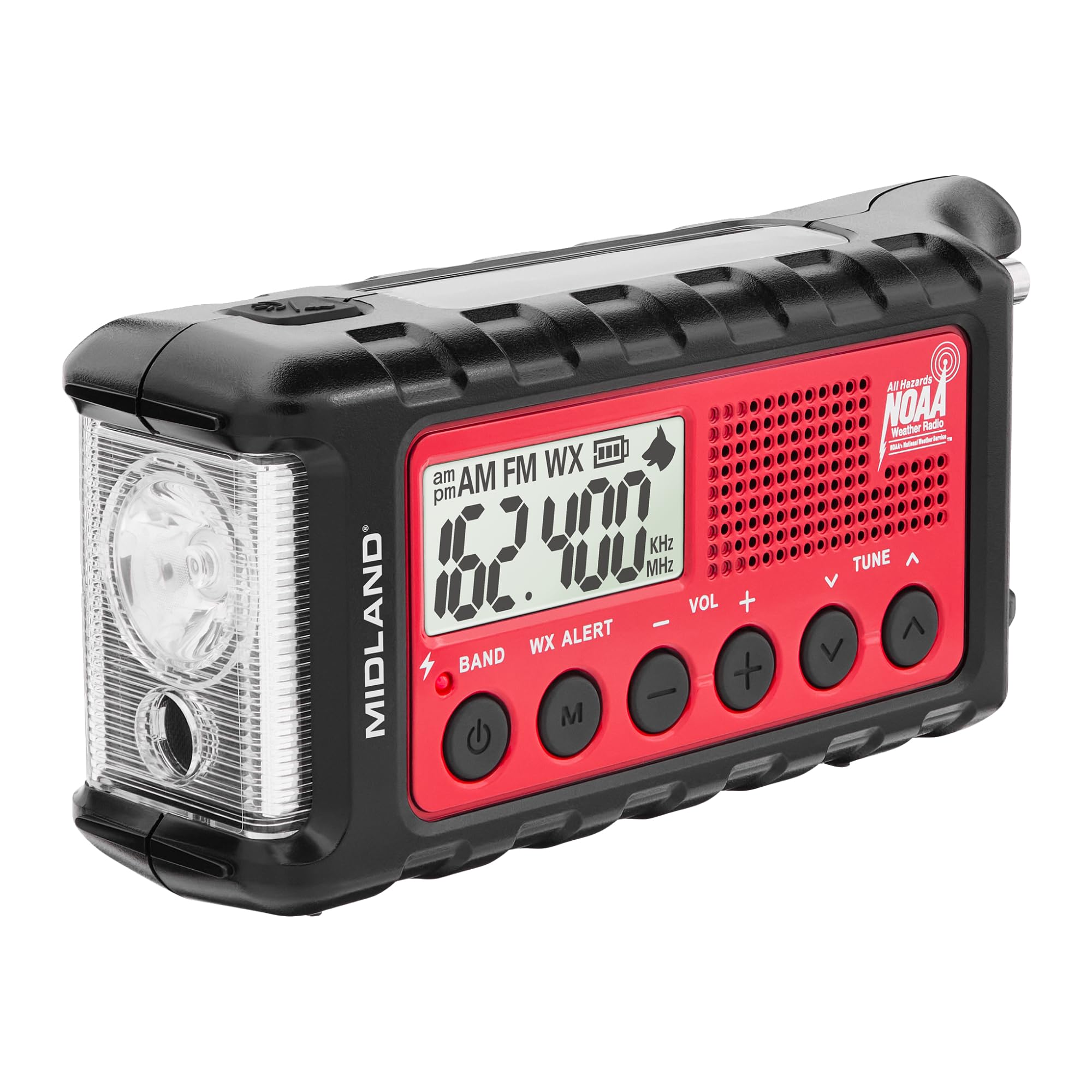
Of everything here, the ER310 is the one we picture in a car kit rather than on a nightstand. It's a handheld with a crank, a small solar panel, USB charging and six AA batteries as a backstop, plus a flashlight on the side — the closest thing in this set to a radio that doesn't care whether the grid comes back.

We like it because it does both jobs without ceremony. It scans the weather channels and locks on, it behaves like an ordinary AM/FM radio the rest of the time, and it has the kind of heft that suggests it will survive being thrown in a truck bed. There's even an ultrasonic dog whistle, which is either a thoughtful backcountry feature or a curiosity depending on your household.

Charging is where expectations need managing. Crank and solar are trickle sources: a few minutes of winding buys you a forecast, not an evening of listening, and the built-in rechargeable pack is the part most likely to let you down over time. The USB port and a wall outlet are what you'll actually use, with the AA compartment as the honest fallback when the pack gives up. That's a sensible hierarchy for a radio that mostly sits waiting.

Pros

  • Solar, crank, USB and AA power
  • NOAA weather scan with alert
  • Bright flashlight and SOS siren built in
  • Solid, heavy-duty feel

Cons

  • Not water resistant at all
  • Long at 9.6 inches, not a pocket radio
Our verdict

This is the weather radio we hand people who want one for the car, the camper or a closet shelf, where three charging paths matter more than a county code.

Check Latest Price
3

Best for Weak Signals

C. Crane CCRadio 3

88 /100
Angler Score Excellent

Key details

Bands
AM, FM, NOAA, 2-meter ham
Power
AC cord plus 4 D batteries
Weight
4 lb
Connectivity
Bluetooth
Check Details on Amazon

The CCRadio 3 is the most expensive radio in this group by a wide margin, and very little of that money goes into alert features. It goes into reception: a patented twin-coil ferrite AM antenna and FM circuitry that hauls in stations from much further out than the small portables manage.

You can hear where the money went. Voices come through full and clear rather than thin and compressed, the metal cabinet is a real step up from the plastic on everything else here, and the controls are big enough to work by feel in a dark room. There's Bluetooth if you want to stream, five presets per band, a clock and alarm, and a 2-meter ham band for local emergency traffic.

Where it earns its place is the fringe-signal household — the one where a cheaper radio delivers nothing but static and the local forecast is a rumor. If your problem is signal rather than filtering, this is the radio we point you to. The ferrite AM antenna is directional, by the way, so rotating the whole cabinet is how you tune out a station bleeding in from the next market. That trick is worth knowing before you decide the reception is bad.

The trade is weight and battery cost. Four pounds of metal and an eleven-inch cabinet mean it stays where it's put, and running it off four D cells for weeks isn't cheap. County-coded alerting is the Midland's job; this one's is making a weak station audible, and it does that better than anything else here.

Pros

  • Long-range AM and FM reception
  • Full, clear voice audio
  • Metal cabinet and simple controls
  • Bluetooth, presets, clock and 2-meter ham band

Cons

  • Four pounds; it stays where it's put
  • Premium price relative to the rest of this set
Our verdict

For a rural home where every other radio here picks up static, the CCRadio 3 is the one worth the premium; its job is signal, not alert filtering.

Check Latest Price
4

Best Rugged Option

Sangean MMR-99

84 /100
Angler Score Excellent

Key details

Battery
2600 mAh lithium-ion
Power Sources
Hand crank, solar, USB-C
Water Resistance
IP55
Weather Channels
7 NOAA with Public Alert
Check Details on Amazon

IP55 is the number that separates the MMR-99 from everything else here — dust-tight and sealed against sprayed water, in a body with rubber reinforcement and a metal-and-plastic shell. That's a radio you can leave on a boat, a tailgate table or a shed shelf without babying it, and we think it's the best-built portable in this group.

Three ways keep it alive: a hand crank, a solar panel across the top and USB-C, all feeding a 2600 mAh lithium pack that will also top up a phone through the USB-A output. The crank is a workout that buys minutes, and the panel is a maintenance trickle rather than a charger, but between them and a cable you're unlikely to be caught silent.

The feature list runs long: AM/FM with RDS and 45 presets, Bluetooth, seven NOAA channels with Public Alert, an adjustable LED flashlight with SOS and Morse modes, and a red light for preserving night vision in a tent. There's a genuine learning curve, and the first hour with it is spent reading rather than listening.

At two pounds and eight inches it's a two-hand radio, and the forest green finish is a welcome change from the black plastic that dominates this category. The hand strap is the detail we appreciate most, because a radio this size gets carried by the strap or not at all.

Pros

  • IP55 dust and water sealing
  • Crank, solar and USB-C charging
  • 45 presets, Bluetooth and 7 NOAA channels
  • Charges a phone from its battery

Cons

  • Built-in battery is not user-replaceable
Our verdict

Sealing, three power sources and a body that takes a knock: that's why the MMR-99 is our pick for anyone whose radio lives outdoors.

Check Latest Price
5

Best for Long Outages

Roxicosly CR1030

92 /100
Angler Score Outstanding

Key details

Bands
AM, FM, 7 NOAA
Battery
12,000 mAh
Power Sources
Solar, hand crank, USB-C, 3 AAA
Water Resistance
IPX6
Check Details on Amazon

Twelve thousand milliamp-hours is power-bank territory, and it's the reason this radio is on the list at all. The AM/FM tuning, seven NOAA channels and SOS alarm are what you'd expect from any emergency radio in this bracket. The capacity is the part that changes what the device can do for you across three days without power.

What we like is what that capacity buys: several phone charges, a 12-LED reading lamp bright enough to light a table, and a 5W flashlight with an adjustable beam, all from a radio that will also take three AAA cells if the internal pack dies. The monocrystalline solar panel and the crank are there for the long tail, though both are slow enough that we treat them as insurance rather than a charging plan.

It's 824 grams and about seven inches long, which is fine in a glovebox and annoying in a jacket pocket. The tuning and display are utilitarian rather than refined — this is a tool for a bad week, not a radio you'll enjoy fiddling with on a Sunday.

Pros

  • 12,000 mAh battery charges phones
  • IPX6 waterproof body
  • 5W flashlight plus 12-LED reading lamp
  • Solar, crank, USB-C and AAA power paths

Cons

  • Heavy at 824 g for a handheld
  • Crank and solar recharge slowly
Our verdict

During a long outage we want the CR1030 in the room: it runs the radio, lights a table and refills a phone from one battery.

Check Latest Price
6

Best Budget Alert Radio

DreamSky DS6227

85 /100
Angler Score Excellent

Key details

Power
AC adapter plus 3 AA backup
Extras
FM radio, alarm clock
Alert Types
80+
Alert Coding
S.A.M.E., 23 counties
Check Details on Amazon

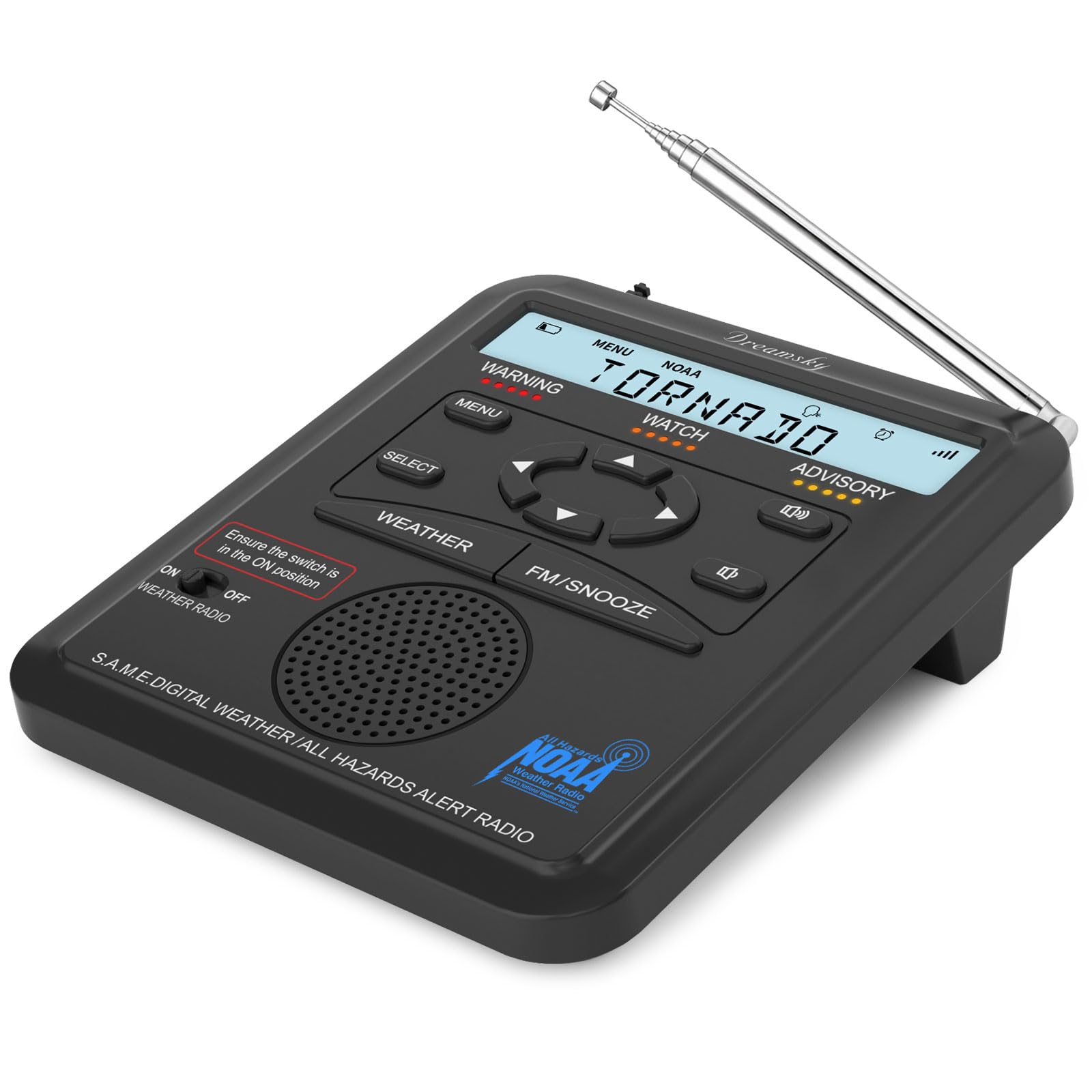
This one costs a fraction of our top pick and still does the thing that matters: S.A.M.E. county coding, 23 codes of it, so the alarm fires for your county rather than the one two hours west. If the barrier to owning an alert radio has been the price of a name you recognize, that barrier just came down.

You get 80-plus alert types with voice, tone and display modes, a color-coded screen with backlight, an FM radio and an alarm clock with snooze, all in a box about the size of a paperback. Power is an AC adapter with three AA batteries behind it, which is the right shape for a bedside unit that lives on the nightstand until it doesn't.

What you don't get is the depth of experience behind the Midland, and the controls are where that shows: volume steps are coarse, and FM stations that sit close together are fiddly to separate. For a first weather radio, or a second one for a bedroom or a shop, that's a fair trade at this end of the range.

Pros

  • S.A.M.E. alerts with 23 county codes
  • 80-plus alert types, three alert modes
  • FM radio and alarm clock included
  • Small enough for a nightstand

Cons

  • Coarse volume steps and fiddly FM tuning
  • Backup is three AA batteries only
Our verdict

What we like here is county-coded alerts in a small box for very little money; it's the cheapest real alert radio in this set.

Check Latest Price
7

Simple D-Cell Radio

PRUNUS J05

88 /100
Angler Score Excellent

Key details

Size
9.17 x 2.4 x 5.24 in
Bands
AM, FM, 7 weather channels
Power
AC cord plus 3 D batteries
Antenna
20 in telescopic
Check Details on Amazon

No menus, no county codes, no settings tree — the J05 has a tuning dial, a volume dial and a band switch. There's something genuinely reassuring about a weather radio you can hand to a neighbor and explain in one sentence, and that's most of its appeal.

The 20-inch telescopic antenna does real work. Extended and upright, it pulls in weather channels and AM/FM stations that a pocket radio misses, and the speaker is loud enough to fill a kitchen. Power is either the included AC cord or three D cells, and D cells are the right call for an outage radio — they hold up for days rather than hours, and you can find them in any hardware store.

The tuning dial is small and not easy to read in low light, and reception thins out once you're well away from a transmitter. There's a headphone jack too, which matters more than it sounds if you're in a shelter or a shared cabin and want the forecast without the whole room hearing it.

Be clear about what this is: you tune it to the weather channel yourself, and it won't interrupt the room when a warning drops. That makes it the right radio for a workshop, a boat cabin or an outage where you want information on demand — and the wrong one if you need to be woken at 3 a.m.

Pros

  • 20-inch antenna for the weather band
  • Runs on AC or three D batteries
  • Two-dial operation, nothing to program
  • Loud, clear speaker

Cons

  • Tuning dial is small and hard to read
Our verdict

For a workshop, a boat cabin or a long outage where you want forecasts on demand, the J05 is the simple, loud, D-cell radio we keep reaching for.

Check Latest Price
8

Pocket and Go-Bag

VONDIOR AM/FM/NOAA Radio

86 /100
Angler Score Excellent

Key details

Size
4.6 x 2.8 x 1.2 in
Bands
AM, FM, NOAA
Power
2 AA batteries
Weight
4.64 oz
Check Details on Amazon

The VONDIOR's weather band is exactly that: a band you tune to, not an alarm that finds you. Nobody is woken by this radio. What it will do is put a NOAA forecast in your hand for very little money, in a package that disappears into a jacket pocket.

Two AA batteries, a telescopic antenna, a body under five ounces, and a tuner that picks up weather, AM and FM with no programming whatsoever. In our testing the weather channels came in clearly wherever the antenna had a window to look through, and the sound is bigger than the box suggests.

The case is plastic and it feels it, and the speaker is small and mono. It also relies entirely on those two AA cells — no crank, no solar, no charging port — so keep a spare pair taped to the back and it will outlast any storm week.

Where it earns its place is redundancy. At this price you can put one in the car, one in the go-bag and one in a desk drawer, and never be more than arm's length from a forecast. That's a different job from the alert radios above, and for plenty of people it's the one that actually gets used.

Pros

  • NOAA weather band with no programming
  • Runs on two AA batteries
  • Under five ounces and pocket sized
  • Simple controls anyone can work

Cons

  • Thin plastic case
  • Small mono speaker
Our verdict

We keep one of these in the glovebox because it costs almost nothing, runs on two AAs and needs no setup at all — just don't expect it to wake you.

Check Latest Price

How We Tested Weather Radios Through Six Months of Storms

We started by pulling every weather radio we could find with a genuine NOAA tuner and narrowed the field on paper: SAME county-code capability, at least two power sources, a battery door that doesn't require a screwdriver, and a price that makes sense for something you hope never to use in anger. That left 14 radios, which we've lived with for six months — on kitchen counters overnight, in basement utility rooms, on a car seat, and on one very wet camping trip.

Reception got tested first, since it decides everything else. From three spots — a kitchen, a basement, and the far corner of a yard — we tuned to the same NOAA transmitter and listened for whether it locked on clean or drifted into hiss, repeating the pass with the antenna fully extended, half extended, and folded down. We simulated outages by killing the breaker for an evening, which is how we learned which models hold their alarm settings through a hard power loss.

For setup, we timed how long it took to program a county code out of the box without opening the manual, and counted how many button presses deep the menu ran. Alerts were judged against the weekly test broadcasts, noting whether the SAME code filtered out neighboring counties or woke the whole house. Sound quality got the unglamorous test: at 4 a.m. volume, from the next room, was the voice actually understandable? And we ran every radio on batteries until it went silent, stopwatch on the hand cranks too.

How to Choose a Weather Radio

An alert radio or a radio with a weather band

Two different products share this shelf. A S.A.M.E. alert radio stores your county codes and stays silent until the National Weather Service issues something for those counties; a radio with a weather band simply receives the broadcast, so it only tells you something if you happen to be in the room and listening. If the job is being woken at 3 a.m., buy the first kind. The Midland WR120B and the DreamSky DS6227 both do county coding for home use; the PRUNUS and the VONDIOR are the second kind.

The trap is the word NOAA on the box. It appears on almost everything here, including radios that will never make a sound on their own. If a listing doesn't mention S.A.M.E. or public alert, assume you're the alarm.

Power: what happens after the lights go out

A plug-in alert radio with battery backup is the right home setup, because the batteries only have to cover the outage, not everyday listening. Portables add a hand crank, a solar panel or a USB-C rechargeable, and those are worth having but easy to overrate: cranking for a minute buys minutes of listening, and a solar panel the size of a phone is a trickle charger. Capacity is what carries a long outage, whether that's a big lithium pack or a set of D cells.

Reception is mostly a placement decision

Weather-band broadcasts are VHF, which is close to line of sight: a radio in a basement hears nothing, and the same radio upstairs by a window hears everything. Before deciding a radio is deaf, extend the antenna, stand the radio upright, move it to the highest floor with glass facing the transmitter and try again. If you live well away from a NOAA transmitter, reception becomes the buying decision rather than an afterthought — which is the case for the C. Crane CCRadio 3.

Alert volume and how the alert behaves

An alert you can't hear through a closed door is decoration. Look for a tone that overrides the volume setting, and check whether the siren and the spoken broadcast have separate controls, because the volume that wakes you is not the volume you want for a 6 a.m. forecast. Then put the radio where the sound reaches a bedroom, not where the outlet happens to be.

Sealing, size and where it will live

If the radio goes outdoors — a boat, a deer camp, a truck bed — the water rating is worth paying for. The Sangean MMR-99 carries IP55 and the Roxicosly CR1030 IPX6; neither Midland here is water resistant at all, so they belong on a shelf indoors. Decide the place first, then pick the radio that fits it: a tabletop unit can be bigger and louder, a go-bag radio has to be small enough that you actually pack it.

Frequently Asked Questions

Final Verdict

The Midland WR120B is the radio we tell most people to buy: county-coded, loud, battery-backed and cheap enough to own without thinking about it. If the radio has to leave the house, the ER310's three charging paths make it the better travel companion, and if your problem is a weak signal rather than alert filtering, the C. Crane CCRadio 3 is worth the step up.

Start with where the radio will sit and what you need it to do at 3 a.m. Everything else on this list follows from those two answers.