Best Fly Fishing Reels of 2026

A fly reel's drag is the brake between you and a fish that has decided to leave. Set it right and a heavy fish runs, tires, and comes to hand; set it wrong, or buy one with a drag that stutters under load, and you're staring at a bird's nest where your backing used to be. Reels also have to survive being dropped on gravel, dunked in a tailwater, and packed away wet in a vest pocket, which is more than a lot of them are built for.

My team and I have spent the past six months fishing 12 reels on small trout streams, a windy lake, and one memorable week of salt water, and the differences in drag smoothness and plain old durability showed up fast. Weight matters more than the spec sheet suggests, since a reel that balances an 8-weight is a brick on a 3-weight, and noise counts too: a clicker you love on a quiet brook can be genuinely annoying on a still morning. The picks below run from a first-reel budget option to a sealed-drag workhorse, and every one of them earned its place.

1

Best Overall

Piscifun Sword 5/6

91 /100
Angler Score Outstanding

Key details

Arbor
Mid arbor
Max Drag
20 lb
Line Weight
5/6 wt
Reel Weight
4.48 oz
Check Details on Amazon

Hard-anodized 6061-T6 aluminum is the first thing we check on a budget reel, because it is the difference between a frame that shrugs off gravel and one that chips. The Sword is machined rather than cast, and the fit between spool and frame is as tight as anything else in this guide. The gunmetal finish is understated in a way that suits a rod you will use every weekend.

Drag is where the Sword asks you to pay attention. The carbon-and-stainless stack is rated to 20 pounds, far more than a 5-weight rod can use on a trout, and it comes on smoothly through most of the range. The weak spot is the adjustment knob, which can creep loose over a long session; check the setting after a few hours on the water and it stops being an issue.

Weight is the number that decides whether you notice a reel at all. At 4.48 ounces the Sword balances a nine-foot 5-weight without making the grip feel nose-heavy, and the mid arbor picks up 25 inches of line per turn while keeping coils out of the line between trips. Two things to sort before you fish it: it arrives set up for left-hand retrieve, so flip the retrieve before you spool up, and there is no backing or line in the box.

For a first serious outfit, or a second reel for the rod that lives behind the truck seat, this is the one we point people to. Shopping for line separately is the only real chore; the SF mid-arbor further down arrives spooled if you want to skip that step, and the Behemoth carries the stronger drag. Neither makes the Sword a worse all-rounder for trout and bass.

Pros

  • Machined 6061-T6 frame with a hard-anodized finish
  • 4.48 ounces balances a nine-foot 5-weight
  • 20 pounds of drag headroom on a 5/6
  • Mid arbor picks up 25 inches per turn

Cons

  • Drag knob can creep loose over a session
  • Reel only
Our verdict

For a general freshwater outfit, this is the reel we point most people to: machined aluminum, 4.48 ounces and 20 pounds of drag without a premium price.

Check Latest Price
2

Best for Big Fish

Redington Behemoth 7/8

90 /100
Angler Score Outstanding

Key details

Max Drag
20 lb
Warranty
Lifetime
Line Weight
7/8
Reel Weight
10.4 oz
Check Details on Amazon

A drag rated to 9.07 kg on a reel that does not cost like a machined big-game reel is exactly why the Behemoth is here. The carbon fiber stack does the work, and it comes on smoothly rather than in steps — which is what you want when a fish makes its third run and your tippet is 3X. That is the part of this reel worth paying for.

Where the money did not go is the frame. It is die-cast rather than machined, which is how Redington keeps the cost down, and at 10.4 ounces it is a reel for a 7- or 8-weight rod: it balances a longer, heavier rod nicely and feels like a paperweight on a 4-weight. The deep V-spool swallows 200 yards of 20-pound backing, so a running fish has somewhere to go.

The weak point in a hard knock is the handle, which is the part that has let go, and a die-cast frame will ding where a machined one would not. That is a fair trade for the price and the lifetime warranty, and it is why this one belongs in a boat bag rather than loose in the bed of a truck. Where the Zero is a specialist's light-touch reel, the Behemoth is built to be leaned on.

Pros

  • Carbon fiber drag rated to 9.07 kg
  • Deep V-spool holds 200 yards of 20 lb backing
  • Lifetime warranty backs the frame
  • Large arbor for fast line pickup

Cons

  • Handle is the part that gives in a hard knock
  • 10.4 ounces is heavy under a 7-weight
Our verdict

If your fishing involves fish that take line into the backing, this is the one: a drag that holds, a deep spool and a lifetime warranty.

Check Latest Price
3

Best Ultralight Trout Reel

Redington Zero 4/5

89 /100
Angler Score Excellent

Key details

Drag
Spring-loaded clicker
Spool
Quick-change
Line Weight
4/5
Reel Weight
5.6 oz
Check Details on Amazon

A spring-loaded clicker presses against the spool on the Zero, giving resistance on a running fish and the sound most of us associate with small trout water. You slow a hot fish by palming the rim or letting it run, which is a technique rather than a handicap once you are used to it.

At 5.6 ounces it is the lightest reel in this guide, and on a 4-weight that is the difference between a rod that feels like a wand and one that feels like a tool. We like it best on the water it was built for: short casts, tight cover, fish that never take 60 feet of line. The soft-touch twin handle is a small thing that turns out to matter at the end of a long day.

The practical detail we appreciate most is the push-button quick-change spool, which lets you move to a sink-tip without respooling in the rain. Capacity is 100 yards of 20-pound backing, plenty for the trout rivers this reel suits, and the die-cast body keeps it well below the Behemoth on price. Cast a light rod with it once and the appeal is obvious: the reel mostly stays out of the way.

Pros

  • 5.6 ounces on a 4-weight rod
  • Clicker drag with classic audible feedback
  • Push-button quick-change spool

Cons

  • Fixed clicker with no adjustable drag
  • Clicker is loud out of the box
Our verdict

A clicker and 5.6 ounces make this the reel we put on a light rod when the point is small water and a light feel in hand.

Check Latest Price
4

Best Midrange Value

SF CNC Mid-Arbor 5/6

86 /100
Angler Score Excellent

Key details

Arbor
Mid arbor
Line Weight
5/6 wt
Reel Weight
4.41 oz
Included Line
Backing, WF floating line, 9 ft 5X leader
Check Details on Amazon

What arrives in the box is the whole point of this one. The spool comes loaded with orange backing, a moss green weight-forward floating line and a 9-foot 5X tapered leader, looped and ready to tie on. For anyone who has stood in a fly shop trying to match a line to a reel, that is worth paying a little more for.

Under the line it is a 6061-T6 machined frame with a disc drag and a one-way clutch, at 125 grams. Machined frames usually seat a spool more tightly than die-cast ones, and this one lives up to that; the drag comes on smoothly rather than in a grab. The moss-and-gunmetal color scheme is the one styling choice here that might divide people.

As a first outfit, or a gift for someone who wants to be fishing rather than shopping, this is the least fiddly route in the guide. Compared with the Sword you pay a bit more and give up some drag headroom and a little weight savings; compared with the Tino you get a machined frame and a step up in line weight for bigger water. For a 5-weight trout rod, that is a fair trade.

Pros

  • Comes spooled with backing, WF line and leader
  • 6061-T6 machined frame at 125 grams
  • Smooth disc drag with one-way clutch

Cons

  • Mid arbor picks up line slower than large-arbor reels
Our verdict

Buy this if you want to fish the same afternoon: backing, a weight-forward floating line and a 9-foot leader come spooled and ready.

Check Latest Price
5

Best Budget

Maxcatch Tino 3/4

87 /100
Angler Score Excellent

Key details

Arbor
Large arbor
Frame
CNC-cut aluminum
Line Weight
3/4 wt
Included Line
WF floating line, backing, tapered leader
Check Details on Amazon

The Tino is aimed at the person who has just bought a first rod and does not want to learn about backing, tapers and loop knots before their first trip. It shows up spooled with a weight-forward floating line, backing and a tapered leader on a CNC-cut aluminum frame, which makes it the least expensive complete setup in this guide.

The rest of the design is more than starter-kit. The large arbor picks up line quickly, the Teflon and stainless disc drag comes on smoothly, and the one-way bearing flips the retrieve from left to right in about 30 seconds without tools — handy when somebody else picks up the rod.

At 4.17 inches across and 3 inches deep it drops into a jacket pocket, and the 3/4 size suits the light rods it is meant for: small-stream trout, panfish, the kind of creek where you cast 20 feet and strip line by hand. It is the reel we put on a pack rod and forget about until a fish takes.

Pros

  • Pre-spooled with WF line, backing and tapered leader
  • Large arbor for quick line pickup
  • Tool-free hand conversion in about 30 seconds
  • CNC-cut aluminum frame at a budget price

Cons

  • This 3/4 variant suits only light rods
Our verdict

For a first rod and a tight budget, this gets you fishing with line already on the spool and a frame that is not a toy.

Check Latest Price
6

Small Creeks

Aventik Classic III 3/4

86 /100
Angler Score Excellent

Key details

Arbor
Large arbor
Frame
Graphite
Line Weight
3/4
Line Capacity
WF3F+60m backing
Check Details on Amazon

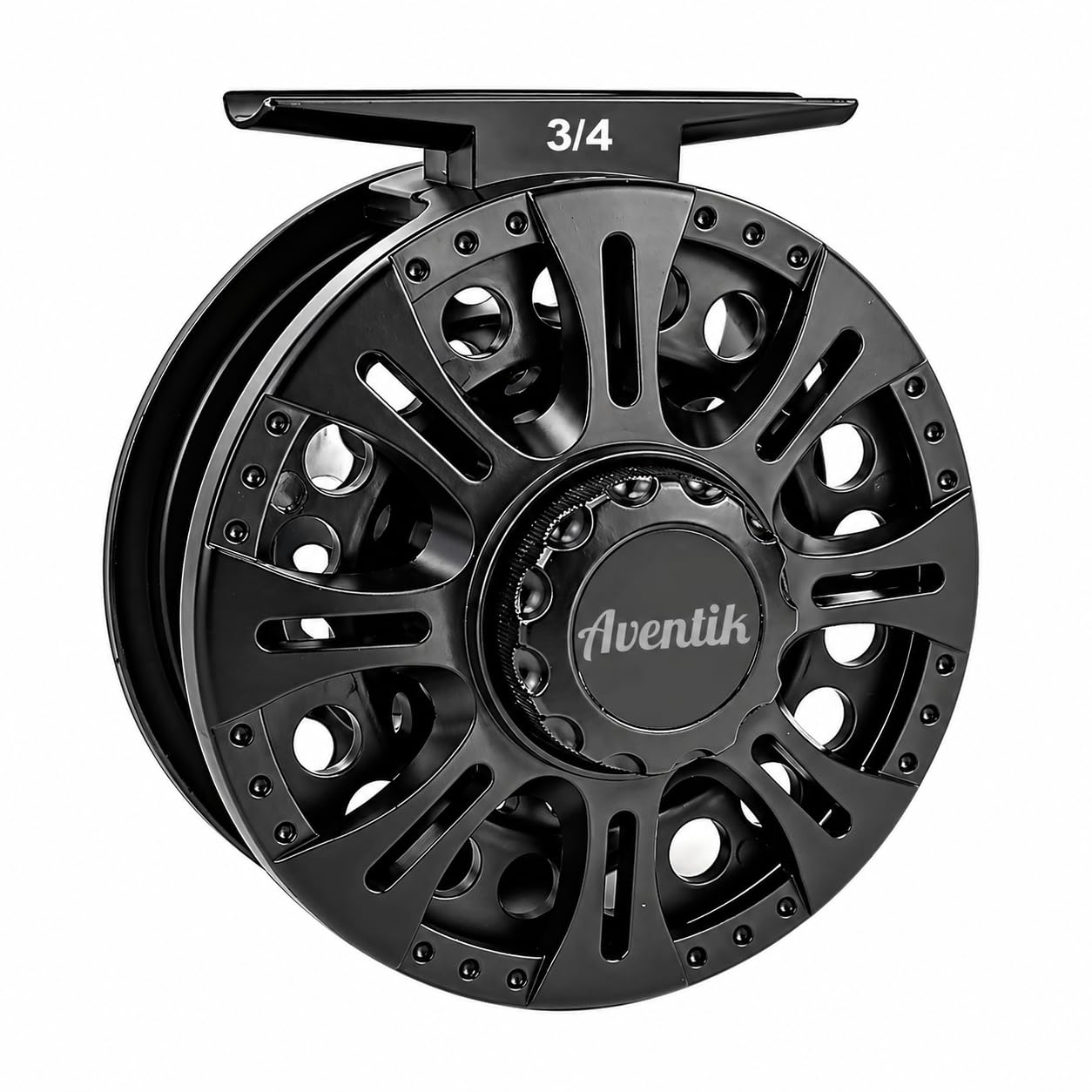
A graphite frame is how this reel stays light and stays inexpensive. The molded body will not corrode, which matters for a reel that lives in a wet vest pocket between trips, and the fit and finish reads closer to metal than the material suggests.

The drag is a central disc with a one-way bearing: silent on the retrieve, with a clicker on the outgoing run so you hear a fish taking line. Behind a WF3F line there is room for 60 meters of backing, more than most small creeks ask for, and the large-arbor spool keeps the whole package compact on a light rod.

As a second reel, a backup, or a first reel on a kid's rod, we think it earns its place: quiet, light and smooth enough that you stop thinking about it. It is the lightest-duty reel here, and that is the trade you are making for the price.

Pros

  • Graphite frame is light and will not corrode
  • Silent retrieve with an audible outgoing clicker
  • Holds 60 m of backing behind a WF3F line

Cons

  • Reel foot is the part that gives in a knock
Our verdict

The least expensive way into a light 3/4 outfit, and good enough that the reel will not be what costs you a fish.

Check Latest Price
7

Sandy Conditions

SF Premium SF005 5/6/7

83 /100
Angler Score Excellent

Key details

Drag
Sealed disc
Included
Neoprene reel case
Line Weight
5/6/7 wt
Reel Weight
4.66 oz
Check Details on Amazon

Sand is the enemy of an open drag, and the SF005 is the only reel in this guide with a sealed, dust-proof drag. If your fishing involves beach approaches, gravel bars or a lot of kneeling in the shallows, that seal is the feature you are buying.

It is also light for its line class at 132 grams, with a hard-anodized 6061 frame, a neoprene case and a two-year warranty. We came away thinking of it as the travel reel of the group: the one that goes in a duffel without a second thought and does not mind a bit of grit. The small audible report on the outbound run is a nice touch when you are watching a fish rather than the spool.

The 5/6/7 sizing gives some flexibility if you are between rods, and the gunmetal finish is the most subdued here. Where it sits in the lineup: a step up in sealing and finish from the Sword, without the Zero's specialist appeal or the Behemoth's drag.

Pros

  • Sealed, dust-proof drag keeps grit out
  • 132 grams across a 5/6/7 frame
  • Neoprene case and two-year warranty included

Cons

  • Sealed drag is not meant to be opened for servicing
Our verdict

For beach approaches and gravel bars, this is the reel we take: a sealed drag that keeps grit out and 132 grams on the rod.

Check Latest Price

How We Tested the Best Fly Fishing Reels

We started with spec sheets, narrowing a long list by line weight, arbor size, drag type, spool capacity, and whether spare spools and replacement parts are actually available. That filtered down to 12 reels spanning click-and-pawl, sealed disc, and carbon drags, from budget models to reels a salmon angler would take seriously. Six months of testing followed, splitting time between lawn casting, wade fishing, drift boat days, and a saltwater trip.

Drag got the most attention. We pulled line off each spool by hand at the lightest setting and felt for stutter or grab, then repeated it with a spring scale to see how much force it took to get the spool moving from a dead stop. We noted whether the drag adjustment had usable range or went from free-spool to locked in a quarter turn, and whether anything changed after a week of heavy use. Noise was logged honestly, both the clicker on a quiet morning and any rattle a reel developed in a gear bag.

For weight, we put each spooled reel on a kitchen scale and matched it to rods of the line weight it's rated for, paying attention to where the balance point landed in the hand. Durability meant dropping reels on gravel, dunking them in a bucket of silty water, leaving them wet overnight, and then checking screws, finish, and drag feel the next day. We also timed spool swaps with cold, wet hands, watched how the anodizing held up to scratches over the season, and set each reel on the counter at the end to compare how it looked after real use rather than out of the box.

How to Choose a Fly Fishing Reel

Match the line weight to your rod

A reel's size is the line weight it is built to carry, not a measure of the fish it can handle. A 5/6 reel holds a 5- or 6-weight line plus backing and is the generalist choice for trout, bass and panfish; 3/4 covers small-stream rods and light tippets; 7/8 and up are for salmon, steelhead, big bass bugs and saltwater.

The trap is over-sizing. A 7/8 reel on a 5-weight rod puts weight past the grip and leaves the rod feeling tip-heavy all day, and the wider spool does nothing for a 30-foot cast. Buy the size printed on the rod, then choose within that class.

Decide between a disc drag and a clicker

Trout do not run far, so a clicker — a spring pressing a pawl against the spool, as on the Redington Zero — is enough resistance for most small-water fishing, and many of us prefer the feel. A disc drag gives you tunable resistance for light tippet, bigger fish and saltwater; the Behemoth's carbon stack is the strongest here.

Ignore the maximum drag figure in pounds. What matters is whether the drag starts smoothly and holds the setting you chose instead of creeping as the session goes on. A modest drag that stays put beats a big number that drifts.

Weigh the reel against the rod

Reel weight is balance, not virtue. The reels here run from just over four ounces to more than ten, and the right one depends on the rod: a light reel keeps a short 4-weight from feeling nose-heavy, while a longer 8-weight wants mass under the grip so it stops tipping forward.

The trap is buying the lightest reel you can find and then wondering why a nine-foot rod feels top-heavy in the hand. If you can, mount the reel on your rod before you commit to it.

Know what the frame material buys you

Machined 6061 aluminum, as on the Sword and both SF reels, gives a rigid frame and a hard-anodized surface that resists scratches and corrosion. Die-cast bodies such as the Zero and the Behemoth cost less to produce and are still strong, but they carry more weight for the same size and ding more readily. Graphite and composites are the lightest and least expensive and will not corrode.

The trap: aluminum on the box does not tell you which process made it. Look for CNC-machined and anodized if toughness is the priority, and rinse any reel with fresh water after salt.

Factor in line, backing and the pre-spooled option

A reel-only purchase is not the end of the spend: you still need backing, a fly line and a leader, and a good line can cost more than a budget reel. Pre-spooled models such as the Maxcatch Tino and the SF mid-arbor remove that step and the guesswork for a first outfit.

The trap is assuming the included line matches what you would have chosen yourself. On a first rod, the convenience usually wins. Fishing a second line weight later, a spare spool for the reel you already own costs less than a second reel.

Frequently Asked Questions

Final Verdict

The Piscifun Sword 5/6 is the reel we point most people to, because it gets the three things that matter right for a general freshwater outfit: a machined frame, a sensible 4.48 ounces and more drag than a 5-weight rod can use. Pair it with a 5-weight and go fish.

If the lightest possible small-stream setup is the goal, the Redington Zero is the alternative we reach for. If your fish regularly reach the backing, step up to the Behemoth.