Best Fly Fishing Strike Indicators of 2026

A strike indicator is the only part of a nymph rig you actually stare at, so it has two jobs at once: hold a weighted fly up in the current and tell you the instant a fish takes. Get it wrong and the afternoon disappears into re-rigging. The failures are rarely dramatic — foam that goes waterlogged by lunch, a float that creeps up your leader after every cast, a bright dot you can't pick out against glare or broken water. The right one handles all of that quietly, and you go back to watching the drift instead of your knot.

I've fished yarn, foam, and air-lock styles for years, and over the past four months my team and I put 16 indicators through real drifts — tailwaters, pocket water, cold dawn starts, breezy afternoons. One lesson I keep relearning: the indicator that finds fish isn't the biggest or brightest one, it's the one that stays where you set it and keeps floating through a long mend. The picks below are the ones that did.

1

Best Overall

Oros Strike Indicators, Small 6-Pack

94 /100
Angler Score Outstanding

Key details

Material
Biodegradable foam
Pack Size
6 small, assorted colors
Attachment
Screw-on foam, centered on leader
Recommended Line Weight
7X and lower
Check Details on Amazon

The feature that keeps this one on our lines is unglamorous: the foam body screws down onto the leader instead of pinching it. Closed up, it sits centered with no post sticking out and no peg to drop in the gravel, so the cast stays balanced. Strip the leader back after a session and it comes away straight, with no corkscrew memory where the indicator sat.

Depth changes are the other thing we noticed. Back the body off a turn, slide it, twist it closed, and your nymph is fishing a foot deeper in about the time it takes to false cast once. Once closed it stays closed; we worked a single seam for a whole morning without touching it again.

For a small foam indicator it rides high and lands soft, which is what you want on flat, clear water. The six-pack is all small, in bright colors, and the tin is worth a look when it arrives — a body that took a knock in transit can carry a flat spot and float lower than the rest of the pack.

Where it stops being the pick: heavy double-nymph rigs in pushy water, where a small foam body runs out of buoyancy and you want something built to suspend weight. For fine tippet, clear water and one or two nymphs, it is the one we tie on without thinking.

Pros

  • Holds its position instead of sliding
  • Centered screw-on body leaves no leader kink
  • Depth changes take seconds on the water
  • Floats high and lands softly

Cons

  • Costs more per indicator than anything else here
Our verdict

The indicator we reach for first: it screws onto the leader, holds the depth you set, and floats high enough for most nymphing.

Check Latest Price
2

Best for Spooky Fish in Clear Water

New Zealand Strike Indicator Tool Kit

90 /100
Angler Score Outstanding

Key details

Size
Large, red handle
Material
100% New Zealand wool
Attachment
Knotless, adjustable
Kit Contents
Tool, wool yarn, cut-your-own tubing
Check Details on Amazon

Slow, clear water is where wool earns its keep. Foam rides on top and lands with a plop; a yarn indicator sits in the film, casts like a dry fly and shows a take as a small stall or twitch rather than a dunk. This kit is the most refined version of that idea we fished — a metal tool, a hank of natural wool and a length of tubing you cut yourself.

Loading it takes practice. You pull a tuft of wool into the tool's notch, slide the tubing over it and roll the whole thing onto the leader. Our first attempts looked lumpy; by the end of an afternoon they looked like the photos, and the wool can be trimmed shorter as the water drops and the fish get fussier. That sensitivity is the point — takes that barely moved our foam indicators showed plainly on the wool.

Stability is where it asks the most of you. On very fine tippet the yarn can creep down the leader, and drying it off before you seat it makes a noticeable difference to the grip. Treated right, it is the softest-landing and most sensitive indicator in this guide, and the one we take when the water is thin and the trout have been educated.

Pros

  • Shows the softest takes in slow water
  • Lands like a dry fly and casts well
  • Knotless attachment slides for depth changes
  • Natural wool in muted tones is unobtrusive

Cons

  • Wool needs floatant and re-dressing to stay high
Our verdict

Best when the water is low and clear: wool yarn shows takes a foam ball never will, as long as you keep it dressed and dry.

Check Latest Price
3

Best for Heavy Nymph Rigs

Air-Lock Strike Indicator 3-Pack

0 /100
Angler Score Fair

Key details

Post
Neutral-colored
Size
1 inch
Design
Hard body with locking post
Pack Size
3 indicators
Check Details on Amazon

Weight is the argument for the Air-Lock. A hard body with a post and a locking ring, it suspends more nymph than the foam teardrops here — enough that a two-fly rig with tungsten beads still rides on top rather than dragging it under halfway through the drift.

It is also the lightest-casting of the round indicators we tried. Less weight in the air means a softer landing on the flat stuff, and the neutral-colored post sits low enough that it does not flash on a bright day. The body is sealed, so you are not watching it fill up after an hour the way a dented foam ball does.

This is a specialist rather than an all-day indicator: when the current has some push and the rig is loaded, it is the one that keeps the flies where you set them and still shows a stall on the drop. On a quiet spring creek with a single small nymph, we leave it in the box.

Pros

  • Suspends weighted nymph rigs that sink foam
  • Casts light and lands softly for its size
  • Locking post holds depth without kinking
  • Neutral post shows less flash to fish

Cons

  • Only three indicators per pack
  • One-inch body is a big target on skinny water
Our verdict

If your rigs are heavy and the current has push, this is the one that keeps them riding — lighter than foam and sealed against water.

Check Latest Price
4

Best Cork Option

CorQs Cork Strike Indicators

85 /100
Angler Score Excellent

Key details

Size
Small
Material
Premium cork
Pack Size
3 cork floats
Attachment
Rubber O-ring
Check Details on Amazon

Cork, a rubber O-ring and not much else. These are the simplest indicators here: push the O-ring over the leader, slide the cork to the depth you want, and the rubber grips without a peg, a screw thread or a loop to tie. The neon top is easy to track in broken water and the cork body lands light.

The grip is what sold us. A cork body held by a rubber ring stays put through a morning of casting, and it comes off without leaving a kink in the leader. Ours ran smaller in the hand than the photos suggest, so check the listed dimensions against the tippet you fish before ordering a card of them. Beyond that, it is the closest thing here to a traditional float and the one we hand to someone who does not want to learn a system.

Pros

  • Cork body floats high and lands softly
  • O-ring grip holds without slipping
  • Comes off without kinking the leader
  • Neon top stays visible in broken water

Cons

  • Just three floats in a pack
Our verdict

A quiet natural-cork float that grips the leader and comes off without a kink; our pick for anyone who wants simple over clever.

Check Latest Price
5

Best Starter Kit

Maxcatch Strike Indicators Kit

80 /100
Angler Score Excellent

Key details

Contents
Yarn and foam mix
Warranty
1 year
Pack Size
12 indicators
Attachment
O-ring
Check Details on Amazon

Twelve indicators, two materials, one small envelope. This is the least expensive way here to find out whether you are a yarn angler or a foam angler — the yarn and foam pieces share the same O-ring attachment, so you can rig both on the same trip and see which one you reach for when the light goes flat.

The O-ring matters more than it sounds. You fold the leader into the ring and slide it, so depth changes cost you no knot, and the leader is wrapped rather than pinched the way a slotted peg wears into it. The foam triangles sit high and show up at distance; the yarn pieces go under on a soft take with almost no resistance, which is the whole reason to fish them.

Call it a learner's kit. The pieces are light enough to cast without thinking, the triangular shape pulls under on a light take, and nothing in the pack costs so much that losing one to a bank-side alder ruins the afternoon. Once you know your preference, buy a pack of that single style and keep this one as the spare.

Pros

  • Yarn and foam in one low-cost pack
  • O-ring attachment slides without cutting the leader
  • Foam triangles read well at distance
  • Negligible weight keeps casting smooth

Cons

  • Yarn pieces need floatant to keep riding high
Our verdict

For a beginner working out whether they like yarn or foam, this kit answers the question for less than one premium pack.

Check Latest Price
6

Traditional Round Float

Thingamabobber 5-Pack

85 /100
Angler Score Excellent

Key details

Size
1/2 inch
Shape
Round
Material
Plastic
Pack Size
5 floats
Check Details on Amazon

If you have spent any time on a trout stream, you have seen one: a hard plastic ball with a peg, the indicator that taught a generation of anglers what a take looks like. We keep a few in the vest for one reason — a half-inch ball suspends a surprising amount of weight and rides high in broken water where foam gets dragged under.

Rigging is the part to learn. The leader runs through the loop on the ball rather than the ball sitting directly on the line, and getting that right is the difference between an indicator that stays put and one that creeps down to the fly after a handful of casts. Wet the leader first, seat the loop properly, and it behaves.

The other cost is the leader itself. A hard ball pivoting at the end of fine tippet leaves memory where it sat, and after a few drifts you can see it in the last few feet of nylon. On 4X and heavier that is a non-issue; on 6X and 7X we choose wool or a soft foam body instead.

None of that stops us carrying them. For fast pocket water, a deep seam or a windy afternoon when you need to see the indicator from twenty feet, the round ball is still the easiest thing on the water to read — and a five-pack means there is always a spare in the boat bag.

Pros

  • Suspends heavy flies in fast water
  • Round body reads from far away
  • Lands softly for a hard float
  • Five to a pack covers a season

Cons

  • Can creep toward the fly if the loop is rigged loose
Our verdict

Still the easiest indicator to read on fast water, and a five-pack means never being caught without one.

Check Latest Price
7

Bulk Budget Floats

Trout Magnet E-Z Trout Floats

91 /100
Angler Score Outstanding

Key details

Color
Multi
Style
Slotted peg float
Length
2.5 inches
Pack Size
36 floats
Check Details on Amazon

Thirty-six floats in a single pack, and the cheapest per indicator in this guide. These are the ones we hand to kids, loan to friends and keep in the glove box: a slotted peg float you rig by laying the line into the slot, pushing the peg home and sliding the float up or down to change depth without a knot.

On light tackle they are genuinely good. A bright float the size of a thumbnail shows a panfish take before you feel it, casts well on an ultralight rod, and moves to a new depth in seconds. Plenty of anglers fish them on a fly rod as well, with a small jig or a light nymph underneath.

Fished that way, they work best at close range: a short line, a small presentation, and a float small enough that a wary fish in shallow water has nothing to inspect. Deeper runs and heavier flies want a different kind of indicator entirely.

What keeps us coming back is how little the whole pack costs relative to what it does. A lost float is not an event, a kid can rig one alone, and a spare rides in a pocket without a second thought. It is not the indicator we nymph with, and it does not pretend to be.

Pros

  • Cheapest per float in this guide
  • Bright colors read at distance
  • Slides to a new depth without retying
  • Great for panfish, kids and small jigs

Cons

  • Gets pulled under by weighted nymphs
  • Slot wears and the float starts to slide
Our verdict

Buy a pack for panfish, kids and spares — the cheapest float here and the easiest one to hand to a beginner.

Check Latest Price
8

Cheap Backups

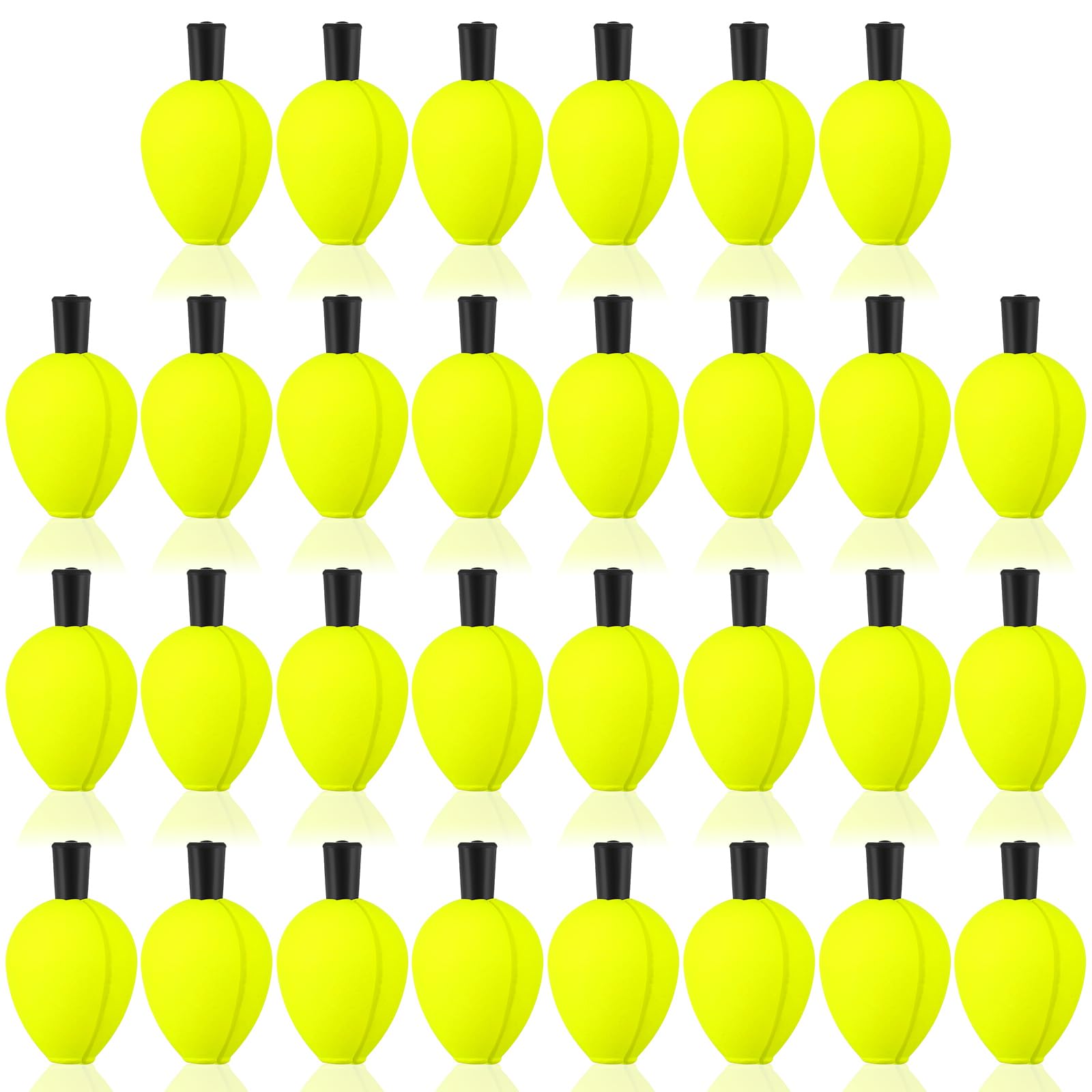
ShinyRelief Foam Teardrop Indicators

84 /100
Angler Score Excellent

Key details

Size
approx. 0.83 x 1.06"
Color
Yellow
Material
High-density foam
Pack Size
30 floats
Check Details on Amazon

Thirty yellow foam teardrops in a bag, each about an inch long. These are the sort of thing you buy once and find in a jacket pocket two seasons later — bright, simple and small enough to sit on a light leader without announcing itself.

They do the basic job. The foam is dense enough to hold up a small jig, the yellow shows against dark water, and losing one costs you nothing more than a walk back to the bag. Because they are small they also land quietly, which is more than you can say for a bigger round float on flat water.

Size is the whole story here. Ours measured right at the listed dimensions, and that is tiny — in low light or glare, the sliver of yellow is easy to lose. Buy them as a bulk pack for panfish, small streams and backups, and keep a bigger indicator for the days when the rig is heavy.

Pros

  • Thirty floats in one bag for bulk backup
  • Bright yellow is easy to spot
  • Small and light enough to land quietly
  • Dense foam holds up a small jig

Cons

  • Rides low under a heavier jig
Our verdict

A bulk bag of small yellow foam for panfish and backups: buy it for volume, not for heavy nymphs.

Check Latest Price

How We Tested These Strike Indicators

We started by gathering every indicator with a genuine following among nymph fishermen — foam, yarn, cork, air-lock, and tool-kit styles — then filtered by size range, how each one attaches to the leader, and price per unit. A three-dollar indicator you lose twice a day is a different purchase than one that lasts a full season, so value got weighed early, not at the end. Sixteen made the cut, and each spent four months in rotation.

All of it happened on the water rather than at a bench. Every indicator got a morning on a tailwater with deep, heavy runs and at least one session on a small brushy creek where a roll cast was the only option. We timed the first rigging with cold, stiff hands, then counted casts before an indicator slid out of position, and noted whether it could be repositioned without cutting the leader. Windy afternoons told us which ones tumbled or dragged the drift; glare and low light told us which colors a tired eye could actually track at twenty feet.

Floatability got the least forgiving test: we watched for the slow sink between mends, squeezed each one out at the end of the day, and marked how quickly it came back up. Durability we judged by what was left in the box in October — foam compressed flat, yarn frayed or matted, rubber rings stretched loose. Each indicator was fished against flies it was actually sized for, since an undersized float is the quiet cause of most drag problems, and we scored the whole group on how little resistance they added while mending.

How to Choose a Fly Fishing Strike Indicator

Match the material to the water you fish

Foam is the all-rounder: it floats hard, comes in colors you can read across a pool and shrugs off being cast all day. It also lands with a bit of a plop and can dent, which matters when the water is flat and the trout are sitting close. Yarn and wool sit in the surface film instead, land like a dry fly and telegraph the softest take — the reason the New Zealand kit earns a place for low, clear water.

Hard-bodied indicators are a third thing entirely. They suspend more weight than foam of the same size and read from far away, but a rigid ball on a fine leader leaves memory where it sat. If you fish 6X and 7X tippet on pressured fish, stay soft.

The attachment decides whether it holds

Four systems cover almost everything: a screw-on foam body, an O-ring you fold the leader through, a slotted peg, and the loop-over-ball rig. Screw-on and O-ring fittings slide for depth without a knot and generally come off without kinking the leader. Slotted pegs are the fastest to rig but the slot is a wear point — once the line eats into the foam, the float starts sliding toward the fly.

One trap: an indicator that grips by pinching the leader will always mark fine tippet if you leave it in one spot. Move it a few inches every hour or so, or choose a fitting that wraps rather than pinches.

Buoyancy against sensitivity

An indicator has one job on the water: hold your flies at depth without dragging them, while still moving when a fish takes. Oversize it and a soft take disappears into the effort of keeping a big float afloat; undersize it and a tungsten bead pulls it under mid-drift. Buy for the heaviest rig you realistically fish, not the lightest.

As a rule, a small foam or yarn indicator covers a single nymph or a light double; add weight and you want a hard body like the Air-Lock, which is built to suspend more nymph without getting bigger.

Size, color and what the fish see

Small is relative. A teardrop listed at about an inch looks tiny in a product photo and reads as a decent target on a skinny spring creek; a half-inch ball is nearly invisible at forty feet. Measure your typical water before choosing: low and clear wants small and soft, broken and fast wants something you can spot from the bank.

On color, orange and fluorescent yellow are the easiest to track in most light, with white a good option in glare and against dark water. Whatever you pick, a dot of floatant on a yarn indicator does more for visibility than a brighter color does.

What a season actually costs

Indicators are consumables. Foam dents and eventually sinks, wool mats and needs re-dressing, hard bodies crack when they hit a rock, and slotted floats go soft at the peg. Price the pack rather than the piece, and count how many you would be comfortable losing in a season of pocket water.

Our rule of thumb: keep one premium pack for the days that matter and a bulk bag of cheap floats for loaners, kids and backup duty. The Trout Magnet pack and the ShinyRelief bag both fill that second role without a second thought.

Frequently Asked Questions

Final Verdict

Start with the Oros small six-pack. It grips a leader without kinking it, changes depth in seconds and holds where you put it, which is most of what an indicator has to do. When the water is low, clear and full of trout that have seen everything, the New Zealand wool kit shows takes the foam never registers. Throwing weighted doubles in pushy current, take the Air-Lock instead: it floats more nymph and casts lighter.

And if you're still working out what you like, the Maxcatch kit puts yarn and foam in your box for the price of one premium pack.