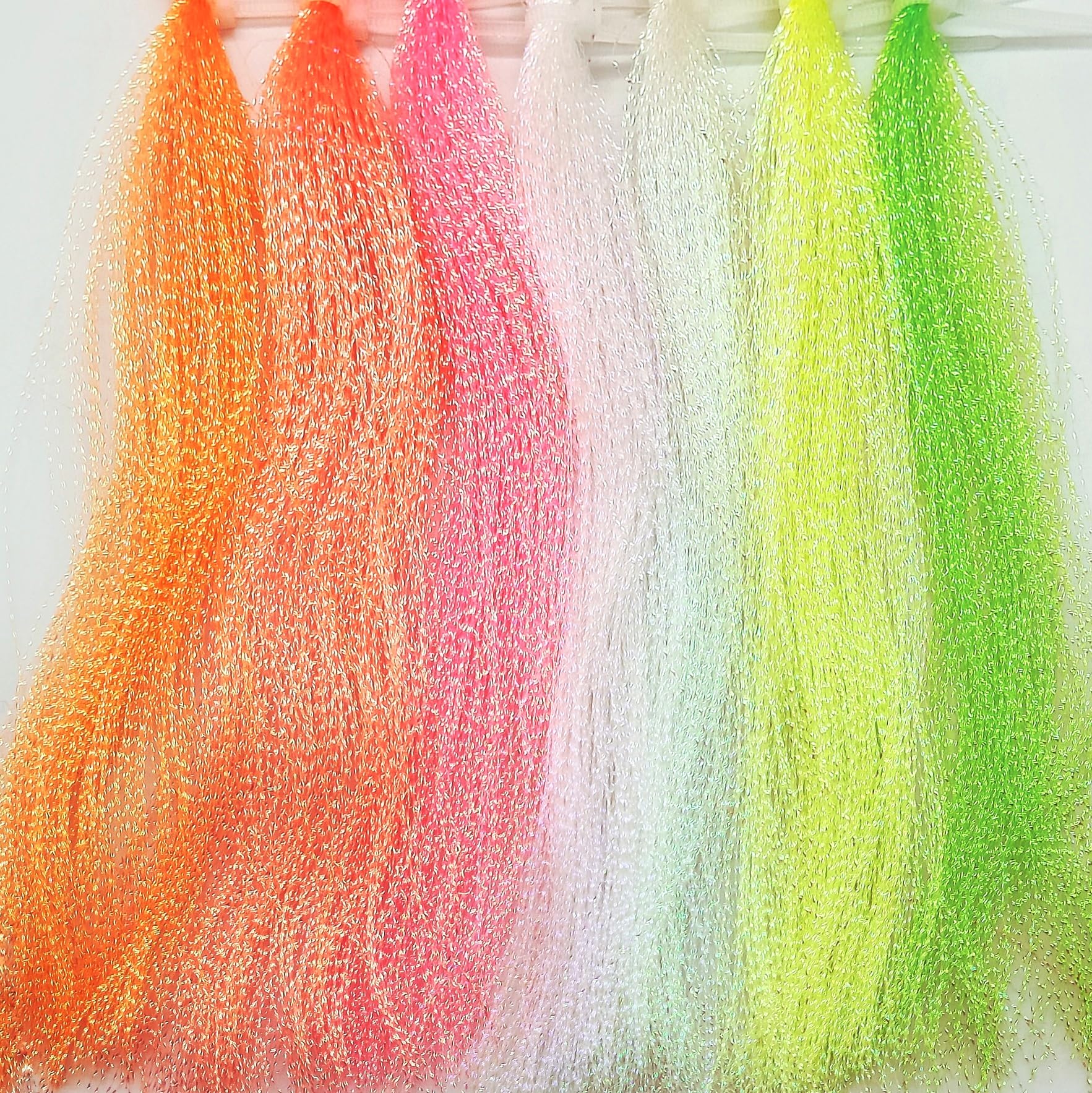
Best Fly Tying Tinsel of 2026

Flash is the cheapest way to make a fly look alive. One strand laid into a wing or ribbed down a body gives a plain hook the pulse of a baitfish, and nothing else in the drawer costs less per fly. What you need from a pack is boring by comparison: strands that peel apart cleanly, keep their crimp, and arrive in the color you saw on screen. Everything else — kinking, flaking, a gold that ties up green — is time spent fighting your materials instead of fishing.

I've tied streamers and ribbed nymphs for years, and I still get suckered by a pretty swatch card. So my team and I spent four months tying with 16 different packs, from big multi-color assortments to small single-shade bundles, and fished what we tied. One thing I'd tell a first-time buyer: buy more colors than you think you need and fewer strands of each, since a wing that's all one shade goes flat fast. The picks below are the packs whose colors arrived as advertised, whose strands separated cleanly, and whose price made sense per usable strand.

1

Best Overall

PHECDA PROFLY Crystal Flash 10 Pack

92 /100
Angler Score Outstanding

Key details

Material
PET with pearl finish
Colors In Set
10
Strand Length
About 30 cm
Strands Per Pack
200 to 230
Check Details on Amazon

Ten separate bags, one per color, is the first thing we appreciated. You open the one you need, cut a few strands, and the other nine stay tidy — which matters more than it sounds once you've spent ten minutes untangling a rainbow. Each bag holds 200 to 230 strands about 30 cm long, so a single purchase stocks a whole box of streamers rather than one pattern. That combination of a broad palette and real quantity is why this is our top pick.

The fiber is where the set separates itself. It's PET with a natural pearl finish, twisted into a permanent spiral instead of left flat, and that twist catches light from every angle rather than only edge-on. Tied as a wing, the kink gives the strands a little body so they don't lie flat against the shank. We also noticed the bundle holds together when you draw strands out, so the cut ends don't wander across the bench mid-fly.

Ten colors is a working palette — enough for silver baitfish, a chartreuse-and-fire combination, and a dark olive for low water — and the material is intended for fresh or salt use. It's a single format, though: twisted flash and nothing else. If you want flat ribbon for a wide profile, or a spool for continuous ribbing, the picks further down this list do those jobs.

What we keep coming back to is the arithmetic. Ten colors at 200-plus strands each is more material than most tyers work through in a season, in a format that flashes hard in the water and stays put on the hook. Buy it to build the base of a flash collection, then add widths and glow separately as your tying narrows.

Pros

  • Ten colors, each in its own bag
  • 200 to 230 strands per pack, about 30 cm
  • Twisted fiber refracts light and holds shape
  • Bundle stays together when strands are pulled

Cons

  • 30 cm strands need splicing on long tails
Our verdict

Ten colors, 200-plus strands apiece, and a twisted fiber that throws light from every angle make this the set we reach for first.

Check Latest Price
2

Best Color Range

Tigofly 22-Color Crystal Flash

88 /100
Angler Score Excellent

Key details

Strand Width
1/64 in (0.3 mm)
Colors In Set
22
Strand Length
About 13 in (33 cm)
Strands Per Pack
About 120 to 150
Check Details on Amazon

At roughly 1/64 inch wide — about 0.3 mm — this is the finest strand in our group, fine enough to rib a size 14 nymph without burying the body underneath it. It's also the reason not to buy it for everything: one strand on a six-inch pike fly vanishes, and you'll be reaching for a wider ribbon instead.

What it does better than anything else here is color. Twenty-two packs, twenty-two holographic shades, each holding about 120 to 150 strands of 13-inch material — long enough to fold into a full wing without splicing. If you're matching a baitfish, a water color, or a specific pattern out of a magazine, this set has the shade and the top pick may not. That breadth is why it holds a place in the roundup.

The trade is quantity per color. Where our top pick hands you 200-plus strands of each shade, this one gives roughly two-thirds of that across far more colors, so it's a reference set rather than a bulk buy. We treat it as the box we open when a pattern calls for a particular tone, and keep the heavier sets for everyday production tying.

Pros

  • 22 holographic colors in one set
  • 0.3 mm width ribs small nymphs cleanly
  • Long 13-inch strands fold into full wings

Cons

  • Only about 120 to 150 strands per color
Our verdict

Twenty-two holographic shades, sold in packs small enough to actually finish — our pick for matching a specific pattern.

Check Latest Price
3

Best for Big Streamers

XFISHMAN 12 Color Krystal Flash

90 /100
Angler Score Outstanding

Key details

Material
Mylar
Saltwater
Won't rust; near-neutral buoyancy
Colors In Set
12
Strand Length
11 in
Check Details on Amazon

Flat mylar moves in a way twisted flash doesn't. Cut a clump of this and the ribbon breathes and pulses in the water instead of hanging stiff, which is the whole reason baitfish imitations are built around flat strands. For pike, muskie, and salmon patterns — the species this set is aimed at — that movement does more than another shade of silver ever will.

You get 12 holographic colors and 11-inch strands, with hundreds of strands in the pack and a 3-D effect running down each one. The material is mylar, so it won't rust in saltwater and it sits at close to neutral buoyancy, which matters when you're building a baitfish profile and don't want the flash dragging the fly down or turning the hook shank into a rust experiment after a day on the coast.

Consistency is the caveat. Some strands come out of the package curly and fight the thread, and thickness varies enough between packs that one clump feels stiff while another splits under tension. Straighten what you need by pulling the strands between your fingers before you tie in, and sort the clump rather than wrestling a bad strand onto the hook. Given how much material arrives in a pack, plenty of it behaves beautifully.

Twelve colors is a working palette without being a library. If your tying runs to big-profile baitfish and saltwater patterns, this is the one to buy; if you want a single flash material for nymphs through streamers, our top pick covers more ground.

Pros

  • Flat ribbon moves like marabou
  • Saltwater-safe, near-neutral buoyancy
  • Hundreds of strands in each pack
  • 12 holographic colors with 3-D effect

Cons

  • Ribbon thickness varies between packs
Our verdict

Flat mylar that swims like marabou, in twelve holographic colors — the streamer pick when movement matters as much as shine.

Check Latest Price
4

Best Budget

GREATFISHING 230 Strand Crystal Flash

89 /100
Angler Score Excellent

Key details

Flash
Fluoresces under UV light
Material
PET
Strand Count
230
Colors In Set
10
Check Details on Amazon

This is the least expensive set in our group, and it doesn't open like one: ten colors, roughly 230 strands, each shade bundled and held with a tie wrap so the bag doesn't greet you as one knotted rainbow. For a first flash purchase or a club tying night, that packaging decision does more work than any spec on the label.

For a beginner or a cheap second box, this is the set we point people to. The fiber is PET treated so it fluoresces under a UV lamp, worth having when you're tying for stained water or last light, and it ties like any flashabou-style strand: cut a pinch, fold it at the midpoint, and bind it down. Ten colors gives you silver-ish, gold-ish, blue, pink and green notes without asking you to commit to a single shade first.

What it won't do is hand you a specific shade in volume, or the fine 0.3 mm width that small nymphs want — for either of those, the next tier up has the answer. Everything else about it is a straightforward bargain: plenty of material, enough colors to learn on, and no anxiety about cutting generously while you're still figuring out what a wing should look like.

Pros

  • Least expensive set in this group
  • Colors separated with tie wraps
  • UV-fluorescent PET fiber
  • About 230 strands across ten colors

Cons

  • Hand-packed, so length and count vary
  • Some shades in the set sit flat
Our verdict

Ten colors and about 230 strands for less than any other set here — the box we start a new tyer with.

Check Latest Price
5

Best for Low Light

Tigofly Luminous Shimmer Flashabou

85 /100
Angler Score Excellent

Key details

Packs
4
Strand Width
1/32 in (0.7 mm)
Strand Length
About 12 in (30.5 cm)
Strands Per Pack
About 150
Check Details on Amazon

Charged under a lamp, these strands glow, and they keep glowing once the lamp is off. That's a small thing at the vise and a large one at dusk, when a streamer needs to read as a silhouette with a hot spot inside it. Of everything here, this is the only set built around glow rather than color, and that alone earns it a place for anyone who fishes the last hour.

Four packs, roughly 150 strands each, 12 inches long and 1/32 inch (0.7 mm) wide — a width that flies nicely as a wing or a tail on pike and bass streamers without overwhelming the hook. Charge them with a UV torch or a headlamp before you fish; daylight does the job too if you're already on the water. Tying in is the same as any flash: fold at the midpoint, bind down, trim to profile.

It works as an accent rather than a whole wing: a few strands over an all-white baitfish pattern give fish something to aim at when the light drops, and a sparse tail on a dark leech pattern picks up a boat light beautifully. Use it as the highlight and the white flash you already own as the body.

Pros

  • Keeps glowing after the light source is gone
  • 1/32 inch width suits streamer wings
  • About 150 strands in each of four packs

Cons

  • All four packs are the same white
Our verdict

White flash that keeps glowing after the light goes — the pick for dusk, night water, and low-light streamers.

Check Latest Price
6

Off-Color Water

wifreo UV Fluorescent Flashabou

85 /100
Angler Score Excellent

Key details

Packs
14
Colors In Set
7 UV fluorescent
Strand Length
9.8 to 11.8 in (25 to 30 cm)
Weight Per Color
About 4 g
Check Details on Amazon

Chartreuse, hot orange, lime green, pink: the seven colors in this set are built for stained water and low light rather than for matching a delicate mayfly. Each strand throws bright, scale-like sparkles down its length, which reads less as ribbon and more as a baitfish's flank turning. If your fly box is mostly white and silver, this is the corrective.

You get 14 packs, two of each color, at about 4 grams per color, with strands running 25 to 30 cm. Selling by weight rather than strand count is unusual among these picks, and it changes how you shop: you're buying a small pile of material rather than a number of pieces, so judge it by how far a pinch goes, not by a count on the label.

Where it earns a place is hot spots — a wing of chartreuse or fire orange over a dark profile, or a few strands worked under a jig collar in muddy water. Fluorescent color needs light to pump, so bright sun or a UV lamp at the vise is what brings it up, and this is the set we reach for when the river is carrying color and a single bright note does more than another shade of pearl.

Pros

  • Seven fluorescent colors, two packs each
  • About 4 grams of material per color
  • Scale-like sparkle along each strand

Cons

  • Sold by weight, so strand count is unknown
Our verdict

Seven fluorescent colors, two packs each, sold by weight — our choice when the water is off-color and a hot spot does the work.

Check Latest Price
7

Ribbing and Bodies

Veevus Holographic Tinsel

87 /100
Angler Score Excellent

Key details

Finish
Holographic pearl
Spool Length
30 m (1/64 in), 20 m (1/32 in), 11 m (1/16 in)
Widths Available
1/64 in, 1/32 in, 1/16 in
Check Details on Amazon

Hanks are fine until you need a continuous rib. This comes wound on a spool, which means you can wind off six inches, tie it in, and wind more without chasing a loose strand across the bench — and a spool keeps the ribbon flat instead of creased, which shows when you're ribbing a smooth body.

The width is the decision, and it's the easiest mistake to make here. The same product comes in 1/64 inch, 1/32 inch, and 1/16 inch, with 30 meters on a spool of the finest, 20 on the middle, and 11 on the widest. Order on the name alone and you may get a ribbon built for pike bodies when you wanted a rib for size 12 nymphs. Check the width first, then the yardage follows.

What it does best is ribbing and lateral lines. The 1/64-inch spool lays a clean, tight rib over floss or dubbing, while the 1/16-inch ribbon builds a wide lateral flash along a big streamer flank. The holographic pearl finish shifts tone as it turns, which is what you want on a body rather than in a tail — the flash should travel down the fly, not sit at the end of it.

One color to a spool is the limit, so this is a supplement to a flash collection rather than a replacement for one. As a supplement, we haven't found a tidier way to keep ribbing tinsel on the bench, and 30 meters of the fine width goes an extremely long way through a season of nymphs.

Pros

  • Spooled, so the ribbon stays flat
  • 30 m of the fine 1/64-inch width
  • Holographic pearl finish shifts tone
  • Three widths for ribs and bodies

Cons

  • One color per spool
Our verdict

Spooled, holographic, and sold in three widths — the ribbing pick, as long as you check which width is in the cart.

Check Latest Price

How We Tested 16 Packs of Fly Tying Tinsel

The shortlist started as a spreadsheet. I pulled about 40 listings, logged strand count and length, the listed color range, and the price per strand, then cut anything that sold one shade across a dozen bundles or showed only a graphic swatch instead of a photograph of the actual material. Sixteen packs made the cut — the ones where the listing gave me enough to judge before I spent anything.

Testing ran four months, mostly at the vise on weeknights with a lamp pulled close. For each pack I tied a streamer, a Clouser, and a ribbed nymph, and noted whether strands peeled off the bundle one at a time or came away in a mat, whether they kinked as they came off the card, and how much of the short end got thrown away per fly. I also held every color against its listing photo in daylight, because a 12-shade assortment is only worth the money if the darks don't all turn out to be the same navy.

Then the flies went fishing — farm ponds for bass, a spring creek for trout, a few saltwater jigs — and I checked whether the flash dulled, matted, or shredded after teeth and rocks. Value got the last pass: I counted how many usable flies a pack really produced once the short strands and dud colors were culled.

How to Choose Fly Tying Tinsel

Start With Strand Width

Width is the first number to check, because it decides what a material can do. Ultra-fine strands around 1/64 inch (roughly 0.3 mm) rib a small nymph without burying the body underneath, and they make a sparse, natural tail on a size 12 streamer. Step up to about 1/32 inch (0.7 mm) for general streamer wings, and to 1 mm or wider for lateral lines and baitfish profiles.

A wide ribbon on a small hook reads as a lump; ultra-fine flash on a six-inch pike fly disappears into the profile. Two widths, one fine and one broad, cover almost everything most tyers build.

Flat Ribbon or Twisted Strand

Flat mylar ribbon moves in the water, breathing and pulsing like marabou, which is why it suits baitfish imitations and the big predatory patterns that imitate them. Twisted crystal flash is a spiral of fiber that refracts light from every angle and gives a wing a little structure so it doesn't collapse against the shank. Crimped and lateral-scale versions sit in between, laying a broken, scaly line down a streamer's flank.

Neither is the better material. A flat ribbon makes a fly swim; a twisted strand makes it flash. Most experienced tyers keep both in the box and choose by what the pattern needs to do.

Count Colors Against Strands

Multi-color sets come two ways: a broad palette with a modest amount of each shade, or a narrower palette with a full bag per color. Twenty-two colors at 120 to 150 strands each is a reference library; ten colors at 200 to 230 strands is a production box. Both are legitimate, and buying the wrong one is the most common way tyers end up with material they never finish.

Be honest about what you tie. If four patterns carry your season, take fewer colors with more material per bag and add single shades as needed. The wide palette suits tyers who chase whatever the water is doing that week.

Saltwater, Sunlight, and Glow

Mylar and PET don't rust, and flash strands hang near neutral buoyancy, so saltwater patterns need nothing special beyond a freshwater rinse after a day on the flats. How the material handles light is what varies: holographic film shifts tone as it turns, fluorescent colors need ultraviolet from sun or a lamp before they pump, and glow strands charge from any light source and then emit on their own.

If you fish dusk or night water, one glow pack earns its place. Otherwise put the budget into width and quantity, which are what you'll notice at the vise.

Frequently Asked Questions

Final Verdict

For one purchase that covers most of what you'll tie, take the PHECDA PROFLY ten-pack: ten colors, 200-plus strands of twisted flash apiece, each bagged separately so the set stays usable rather than turning into a knot. Add the Tigofly 22-color set if you match specific shades, the XFISHMAN if your tying runs to big streamers and saltwater, and one pack of the luminous white for the last hour of light.