Best Freestanding Fishing Rod Racks of 2026

A fishing rod rack has one job, and it's harder than it looks: keep a dozen rod-and-reel combos upright without letting a tip, guide, or reel take the hit. The tradeoff with freestanding models is footprint against stability — a narrow vertical stand tucks into a garage corner, but a top-heavy one that rocks when you brush past is worse than the pile of rods you're replacing. What you're buying is a way to grab the right combo on the way out the door.

I leaned rods against the wall for years, and I have the bent guide to prove it. This spring my team and I built and loaded 11 freestanding racks — aluminum, wood, three-tier, rotating — and the keepers all got the boring parts right: hardware that lined up, a base that stayed put on concrete, and slots spaced for real combos rather than bare blanks. One thing nobody tells a first-time buyer: measure your longest one-piece rod and check it against the rack's height before you fall for a big slot count. The picks below are the ones I'd load up again.

1

Best Overall

Ghosthorn 16-Rod Floor Rack

90 /100
Angler Score Outstanding

Key details

Height
30 in
Assembly
4 screws, no extra tools
Capacity
16 rods
Footprint
12.9 x 12.9 in
Check Details on Amazon

Sixteen rods in a footprint just under 13 inches square is the number that made us stop and look at the Ghosthorn. The solid wood post and wide base give it a steadier stance than the price suggests, and the four anti-slip pads keep it from skating on smooth concrete. We put it together with the supplied screws and no extra tools; the whole job is about as simple as furniture assembly gets. The open layout also means you can reach rods from more than one side, which matters in a corner.

This is the rack we recommend first for most garages because it gets the balance right: enough capacity for a working collection, a small footprint, and a finish that looks intentional rather than utility-grade. We loaded it with a mix of spinning and baitcasting combos and appreciated that the reels did not immediately tangle into each other. The 30-inch height keeps the top row within easy reach without turning the rack into a tower. It is not the place for a 24-rod collection, but for the angler who has been leaning rods against a wall, it is a clean upgrade.

This is not a display cabinet for a collector who wants every reel behind glass; it is a working rack. The open layout makes it easy to grab a rod with one hand, and the small footprint leaves room for a tackle bag beside it. For a garage where rods have been leaning in a corner, that is the upgrade that changes the daily routine.

Pros

  • 16 rods in a 12.9-inch square footprint
  • Four-screw assembly with no extra tools
  • Wide base and anti-slip pads steady the load
  • Wood finish looks tidier than utility racks

Cons

  • No tackle shelf or work surface
  • Wood construction is best kept dry
Our verdict

We recommend the Ghosthorn as the best all-around freestanding rack for most garages: 16 rods in a small square footprint, simple assembly, and a steady wood base.

Check Latest Price
2

Best for Large Collections

Savior Equipment 24-Rod Rack

94 /100
Angler Score Outstanding

Key details

Frame
Aluminum and ABS
Height
30.25 in
Capacity
24 rods
Footprint
24 x 14.75 in
Check Details on Amazon

If your rod collection has outgrown a 16-slot rack, the Savior Equipment rack is the one that makes the jump without turning the garage into a showroom. It is built from aluminum and ABS, measures about 24 inches wide by 14.75 deep, and stands 30.25 inches tall. The frame went together without tools in our hands, and the anodized finish has a clean, retail-display look that we did not expect at this size.

The 24-rod capacity is real, but reels change the math. With reels attached, we found ourselves leaving gaps between some combos so the handles and line guides did not collide; think of it as a 24-rod rack for bare rods or a comfortable 18-to-20-rod rack for working combos. The open slots are wide enough for spinning and saltwater rods, and the light frame is easy to shift into place before you load it.

This is the rack we point to when capacity and a wipe-clean frame matter more than a compact footprint. What you get in return is a sturdier, better-looking rack than the wood budget options, with room to grow. If you have a small corner and a dozen rods, the Ghosthorn is the easier fit; if you are tripping over rods, this is the step up.

Pros

  • 24-rod capacity for growing collections
  • Aluminum and ABS frame wipes clean
  • Tool-free assembly in minutes
  • Open slots fit spinning and saltwater rods

Cons

  • 24-inch width needs dedicated floor space
  • No wheels for moving a loaded rack
Our verdict

We recommend the Savior for anglers with more rods than a 16-slot rack can hold; its 24-rod aluminum frame is sturdy, easy to assemble, and built to last.

Check Latest Price
3

Best Rolling Rack

Jorazor 24-Rod Rolling Rack

85 /100
Angler Score Excellent

Key details

Height
28 in
Capacity
24 rods
Mobility
Four lockable casters
Footprint
28 x 12.6 in
Check Details on Amazon

The first thing we noticed about the Jorazor is that it moves. Four 360-degree casters, all lockable, let you push a loaded rack across a smooth garage floor instead of dragging it. The aluminum frame is light, the click-and-lock assembly took us minutes without tools, and the dual-sided layout holds up to 24 rods. This is the one we take when the rack has to share space with a car, a workbench, or a project that keeps changing.

Mobility comes with a different set of priorities: the open cradles are built for quick in-and-out access, so you load rods deliberately rather than tossing them in. The locking casters keep it parked once it is in place, and the light aluminum frame is easy to steer with one hand. For a smooth concrete garage, being able to clear the bay in one push is a genuine convenience.

The 28-inch width and 12.6-inch depth are still wall-friendly, and the 24-rod capacity gives it a real job beyond a few rods in the corner. It is not the rack for someone who wants furniture-grade wood or individual rod tubes. But if your garage changes uses by the day, the wheels earn their place. We prefer rolling the whole collection out of the way to unloading it rod by rod.

Pros

  • Lockable casters move a full rack easily
  • Light aluminum frame is rust-resistant
  • Tool-free click-lock assembly
  • 24-rod capacity in a wall-friendly footprint

Cons

  • Rods can shift when rolling on rough floors
  • Open cradles leave reels exposed to dust
Our verdict

We recommend the Jorazor when you need to move a full rack around the garage; lockable casters and a light aluminum frame make it the most practical rolling option here.

Check Latest Price
4

Best High-Capacity

SOYEEZE 28-Rod Work Deck

88 /100
Angler Score Excellent

Key details

Height
50.79 in
Storage
Three-tier gear shelves
Capacity
28 rods
Footprint
32.28 x 12.6 in
Check Details on Amazon

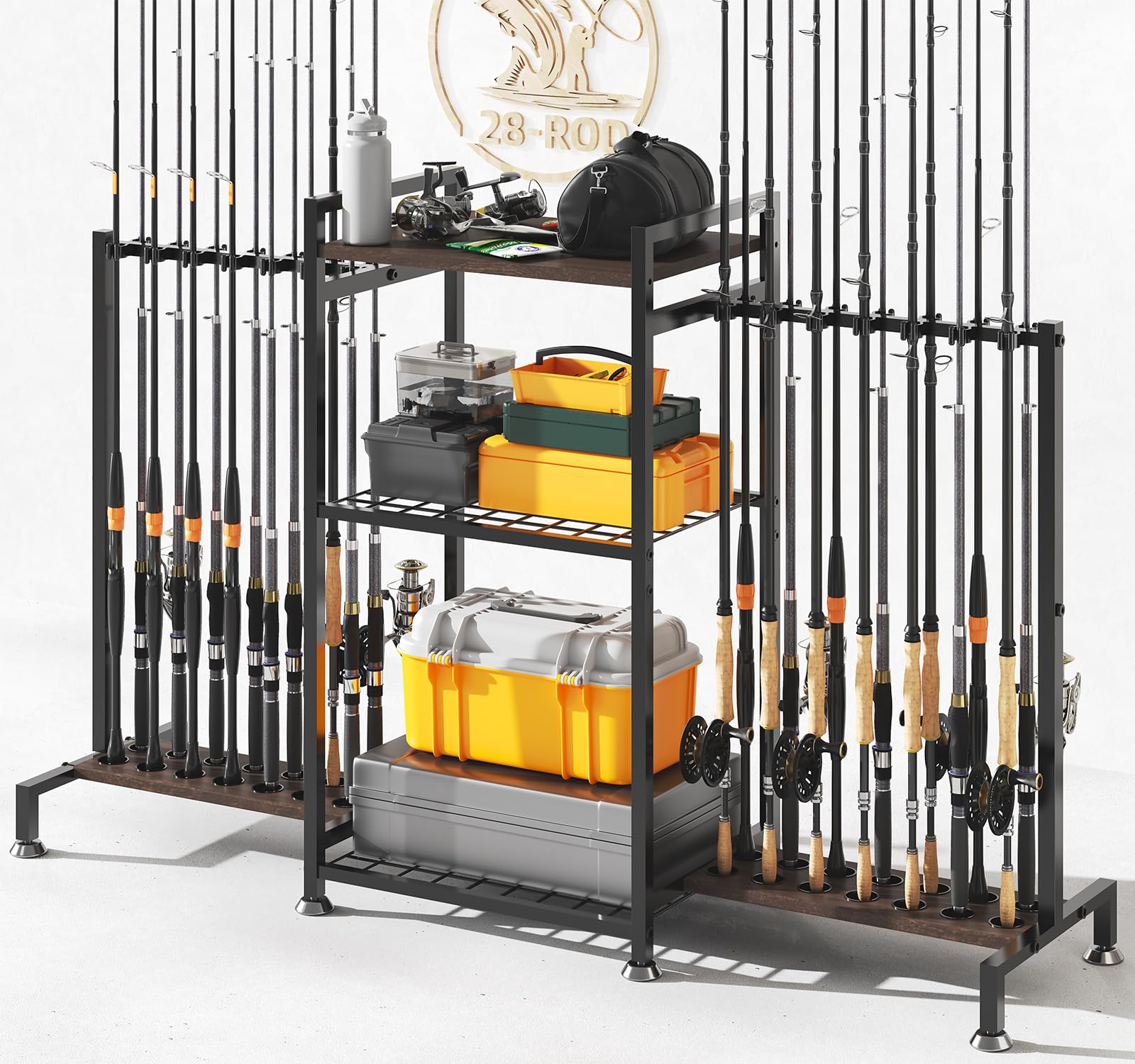
The SOYEEZE is the rack here that gives you a place to set down a reel while you rig. A solid wood work deck runs across the front, and the three-tier frame holds up to 28 rods with shelves for tackle and tools. The powder-coated steel frame and wood shelves make it look more like a fishing station than a storage rack, and the eight pivoting feet auto-level on uneven concrete.

This is the pick for the angler who wants a dedicated prep corner rather than a rack tucked behind the door. The vertical storage is efficient: rods stand in dual-sided jaws, and the tiers keep boxes, line, and tools off the floor. We liked that the work deck gives you a clean surface for tying on a lure or letting a rod dry without balancing everything on a bucket.

The shelves are not a free-for-all. Full-size three-tray tackle boxes fit on the top shelf, while the middle and bottom shelves are better for smaller boxes and soft bags. Measure your largest box before you commit. For a garage with the floor space and a collection that has outgrown a simple rack, the SOYEEZE turns storage into a workspace. If you only need a place for eight combos, the PLUSINNO does the same job in a much smaller footprint.

Pros

  • 28-rod capacity plus a rigging deck
  • Three tiers keep tackle and tools organized
  • Eight pivoting feet level on uneven concrete
  • Powder-coated steel frame with wood shelves

Cons

  • Large 32-inch width needs dedicated floor space
Our verdict

We recommend the SOYEEZE for a dedicated fishing corner: 28 rods, three gear tiers, and a wood work deck turn storage into a usable rigging station.

Check Latest Price
5

Best for Small Spaces

PLUSINNO 8-Rod Shelf Rack

89 /100
Angler Score Excellent

Key details

Frame
H-shaped wood and metal
Storage
Three shelves
Capacity
8 rods
Check Details on Amazon

Eight rods, not sixteen, is the first thing to understand about the PLUSINNO. This is a three-tier storage tower with rod slots on the sides and shelves across the front, built from hardwood and metal in an H-shaped frame. We set it up in a corner and appreciated that it stores rods, a tackle box, and a soft bag in one vertical stack instead of spreading them across the floor. Assembly was straightforward, and the small footprint makes it easy to live with.

This is the small-space solution, not the collection solution. The shelves are the reason to choose it: they hold tackle, line, and tools that would otherwise clutter a workbench, and the rod slots keep eight combos upright and separated. The rack has a compact footprint, and we found the adjustable feet useful for leveling it on a slightly uneven garage floor.

For a rental, a bedroom, or a garage where rods were leaning in a corner, the PLUSINNO brings order without asking for much room. It also handles a surprising amount of weight for its size, as long as you keep the heavy items on the lower shelf. If you have more than a dozen rods, this is not the rack; if you have eight combos and a pile of tackle, it is a neat, compact answer.

Pros

  • Rods and tackle share one compact tower
  • Three shelves get gear off the floor
  • Adjustable feet level it on uneven concrete
  • Easy assembly with a small footprint

Cons

  • Shelf area is smaller than photos suggest
Our verdict

We recommend the PLUSINNO for a small collection and a pile of tackle; its three shelves and eight rod slots bring order without taking over the room.

Check Latest Price
6

Best Rotating Rack

KastKing V16 Rotating Rack

86 /100
Angler Score Excellent

Key details

Base
360-degree rotating
Height
32 in
Capacity
16 rods
Footprint
12.5 x 12.5 in
Check Details on Amazon

A 360-degree base is the reason to look at the KastKing V16. The rack stands 32 inches tall on a 12.5-inch square footprint, with 16 rod slots, foam inserts, and two lower shelves at different heights. We spun it with a partial load and liked being able to reach the back rods without walking around the rack. Assembly is tool-free and quick, and the small shelves give line spools, pliers, and scissors a place to live.

The compact size is the real advantage: it tucks into a corner that a wide rectangular rack would dominate, and the staggered shelves keep reels from clashing. The ABS frame is light enough to move before loading, and the open layout makes it easy to grab a rod with one hand. We also noticed some wobble at the top when the rack is turned with a full load, so we seated the base carefully and balanced the rods around the circle.

This is the rotating pick for a small garage or a corner of a room, not the rack for someone who wants a heavy-duty anchor. The foam cradles are a thoughtful touch for delicate blanks, and the storage shelves make it more useful than a plain ring of slots. If you need a rack that never moves, choose a fixed wood or aluminum design; if you want to spin the collection to the front, the KastKing earns its spot.

Pros

  • 360-degree base puts every rod within reach
  • 16 rods in a 12.5-inch square footprint
  • Foam inserts protect rod blanks
  • Small shelves hold line and tools

Cons

  • Top can wobble when rotating a full load
  • ABS frame feels less substantial than wood or aluminum
Our verdict

We recommend the KastKing V16 for a compact corner where you want every rod within reach; the 360-degree base and foam cradles make a small rack feel generous.

Check Latest Price
7

Wood High-Capacity

Rush Creek 24-Rod Round Rack

87 /100
Angler Score Excellent

Key details

Base
360-degree swivel
Height
31.5 in
Capacity
24 rods
Footprint
14.75 x 14.75 in
Check Details on Amazon

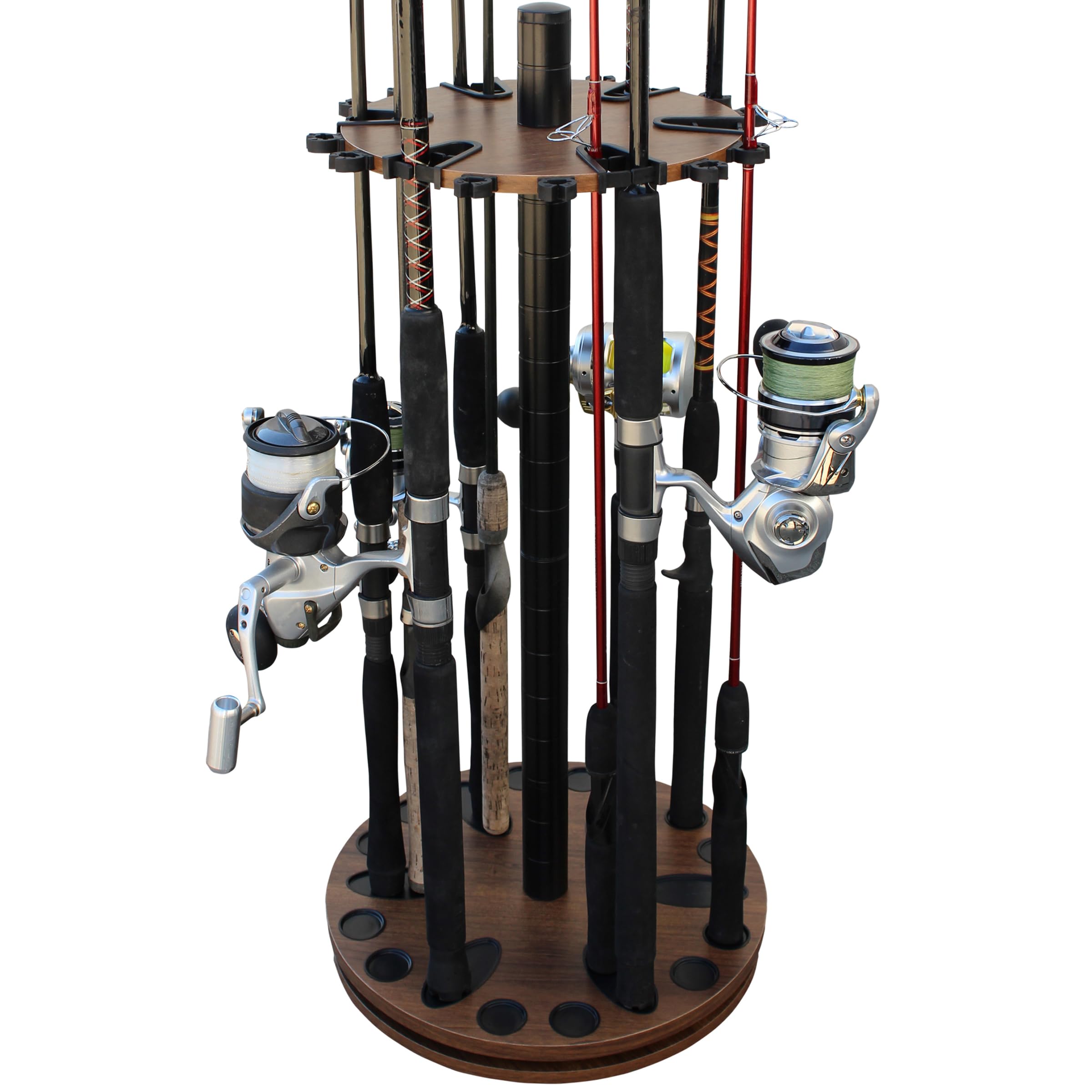
The Rush Creek 24 is the dressiest rack in this group: a dark walnut-finished engineered wood post, a round footprint, and 24 rod slots on a 31.5-inch frame. It is heavier than the small wood racks at 9.6 pounds, but still manageable to move before you load it. The 360-degree swivel is the feature that makes the capacity usable, since you can turn the back rows to the front instead of reaching over the top.

The round shape is a better fit for a corner than a wide rectangular rack, and the 14.75-inch footprint keeps it from eating a whole bay. We liked that the swivel base lets you load rods from one side and then rotate the collection out of the way. The dark finish also looks more like furniture than the light-wood budget racks, which matters if the rack lives in a den or a finished garage.

The load needs some thought. Twenty-four slots is generous, but reels and long handles take up space, so leave gaps and spread the weight around the circle. The swivel is the part to check when it arrives: make sure it seats squarely before you fill the rack. If you want the simplest assembly story, the Ghosthorn is the safer default; if you want 24 rods and a warmer finish, this is the step up.

This is the wood rack we recommend for an angler who wants display-level looks without giving up capacity. It is not the cheapest way to store 24 rods, and it is not the lightest, but the round swivel design solves the access problem that makes deep racks annoying. For a garage corner, it is a satisfying upgrade.

Pros

  • 24-rod capacity in a round footprint
  • 360-degree swivel reaches back rods
  • Dark walnut finish looks less utilitarian
  • Engineered wood post is manageable to move

Cons

  • Needs clearance around it to swivel freely
Our verdict

We recommend the Rush Creek 24 for anglers who want wood furniture looks and 24-rod capacity; the swivel base makes the deep stack usable.

Check Latest Price

How We Tested Freestanding Rod Racks in a Working Garage

We pulled every freestanding rack we could find, then cut the list by the specs that decide whether one works in a real garage: overall height against our longest rods, footprint against the two-foot strip of floor beside the car, slot count and spacing, base design, and whether the hardware is stainless or just painted. That left 11 models — wood floor racks, aluminum vertical stands, three-tier units, and a rotating one — which we bought and assembled ourselves, one person per build with the included tools, timing each one and noting where the instructions lost us.

Every rack spent six months in a working garage that gets dusty, humid, and cold, loaded with real combos: spinning reels left on the rods, 6- to 8-foot two-piece and one-piece sticks, and a couple of surf rods that stress a rack's height and balance. We walked past each one and bumped it with a hip to see whether it rocked on the concrete or crept out of position, and checked clearance slot by slot, since a rack can advertise 24 rods and then choke the moment you leave the reels attached.

Functionality came down to small things: whether a rod slid out without dragging its neighbors, whether the finish snagged line, whether the whole rack could be shifted without unloading it first. At the end of the run we went over the joints and base hardware for rust and loosening, wiped the frames down, and asked whether we'd leave each one visible in a room guests walk into — then compared what each rack held against what it cost.

How to Choose a Freestanding Fishing Rod Rack

Count usable capacity, not just slots

A 24-slot rack can feel like a 16-slot rack once baitcasters, spinning reels, and long handles go on. Reels need lateral space, and rods with long butts crowd their neighbors. We prefer a 16-rod rack with breathing room to a 24-rod rack packed so tightly that every retrieval becomes a negotiation. Count the combos you actually keep ready, then leave room to grow.

The Savior is a good example: it holds 24 bare rods, but with reels attached you may want to skip slots to keep handles and guides apart. If your collection is a dozen rods, the Ghosthorn's 16 slots are plenty and the smaller footprint is the better trade.

Measure the footprint and the height you can live with

Freestanding racks are not a standard size. A round rack like the Ghosthorn takes about 13 inches square; a wide aluminum rack like the Savior takes 24 inches across. A work-station rack like the SOYEEZE needs over 32 inches of width and stands nearly 51 inches tall. Tape the footprint on the floor, then check the height against shelves, a garage door track, or a window.

If the rack rotates, leave clearance on all sides, not just the back. A swivel rack pushed into a tight corner becomes a fixed rack with extra hardware. For a narrow bay, the 12.5-inch KastKing footprint is easier to place than a rectangular rack, provided you can give it room to turn.

Stability is a base-and-joint question

A freestanding rack should sit flat on the floor and resist a tug when you pull out a rod. A wide base, anti-slip pads, and a low center of gravity help; so does loading the heavier combos low and spreading the weight evenly. On a rotating rack, the joint is the weak point. Check that the base seats squarely before you fill it, and do not expect a lightweight ABS rack to feel as planted as a wood or aluminum one.

The KastKing V16 is the clearest example of the trade: the 360-degree base is convenient, but it can wobble at the top with a full load. That does not rule it out for a corner, but it does mean you should balance the rods and check the base. If you want a rack that feels like furniture, choose a fixed wood or aluminum design.

Choose shelves, rotation, or wheels, but not everything

These racks solve different problems. Shelves and a work deck, as on the PLUSINNO and SOYEEZE, get tackle and tools off the floor and give you a place to rig. Rotation, as on the KastKing and Rush Creek 24, makes a deep rack usable in a corner. Wheels, as on the Jorazor, let you clear the bay without unloading. Pick the one convenience that matches your routine; a rack that tries to do all three usually asks for more floor space.

For a garage that doubles as a workshop, wheels are worth more than a shelf. For a dedicated fishing corner, a work deck earns its footprint. For a small collection, a simple tower with three shelves is enough.

Assembly and material affect how long it stays pleasant

Wood racks look warmer and often assemble with a few screws, but they want a dry spot. Aluminum and ABS racks wipe clean and tolerate damp air, which makes them the better choice for a covered porch or a humid boat shed. Tool-free assembly is a real convenience, but check the joints after the first load; a rack that clicks together can also work loose.

The Ghosthorn's four-screw build is about as simple as it gets, while the Savior and Jorazor use tool-free frames that go together in minutes. Neither approach is inherently better; the question is whether you want furniture looks or a hose-down surface.

Frequently Asked Questions

Final Verdict

Start with the Ghosthorn if you want the easiest all-around floor rack: it holds 16 combos in a small square, assembles with four screws, and looks tidy enough for a garage or den. If your collection has grown past that, the Savior's 24-rod aluminum frame is the sturdier step up. For a rack you need to wheel around, choose the Jorazor; for a dedicated rigging corner, the SOYEEZE earns its floor space.