
Best Wall-Mounted Fishing Rod Racks of 2026

A fishing rod is the most fragile thing in the garage and usually the thing stored worst — leaning into a corner, sliding off a shelf, tangled with two others into a knot of line and bent guides. A wall-mounted rack fixes that in an afternoon: rods stand or hang clear of the floor, the reels stop knocking together, and you can see what you own before you back the truck out. It also gets them off the concrete, which is where tips get snapped by a cooler or a snow shovel. What separates a good rack from a frustrating one isn't capacity — it's how it holds the rod, what hardware comes in the box, and whether your wall can take it.

I've had rods living against a rough cinderblock wall for years, and I've learned the hard way that a rack rated for nine rods is worthless if the hooks are spaced so tightly the reels collide. Over the past seven months my team and I hung, loaded, and reloaded 12 racks across garage walls, a basement, and a boat, and the differences showed up fast. Here's the thing nobody tells a first-time buyer: the butt end of the rod does most of the work, so a rack that cradles the handle and lets the blank rest free will outlast one that pinches the rod mid-blank. The picks below cover the range of walls and rod counts people actually have.

1

Best Overall

PLUSINNO V9 Vertical Rack

96 /100
Angler Score Outstanding

Key details

Capacity
9 rods or combos
Material
Powder-coated alloy steel
Rod Diameter
0.12"-0.75"
Wall Footprint
Under 16 inches wide
Check Details on Amazon

Nine rods in less than 16 inches of wall is the first thing that sold us on the V9. We hung it in a garage and loaded it with a mix of spinning and casting combos; the grip cradles each butt in its own arc, so neighboring reels get a little more breathing room instead of sitting shoulder to shoulder. That is the difference between a rack you can use one-handed and one that makes you unload three rods to get the one you want.

The grip is the other reason it earns the top spot. Soft pads cradle rod butts from 0.12 to 0.75 inch, which covers everything from a light ice rod to a heavier salmon setup. Nothing about the holder feels fussy: you push the rod in, the pad takes hold, and the rod comes out with a straight pull. The five mounting holes also give you more leeway than a two-hole bracket when a stud lands a few inches off center.

We appreciate that the V9 keeps the whole collection visible. There are no tubes to peer into and no straps to undo, and that makes it easy to grab a rod on the way out the door. The open design also means you can see at a glance whether a rod is seated all the way in its grip, which is the sort of check that prevents a surprise drop.

One planning note: the V9 is a vertical rack, so it needs height and a clear floor spot rather than a long empty wall. If your rods range from short ice sticks to long surf rods, check that the tips clear the ceiling or shelf above before you commit. For the usual mix of freshwater combos, it is the most sensible default here.

Pros

  • Nine rods in under 16 inches of wall
  • Soft pads fit 0.12-0.75 inch butts
  • Five mounting holes simplify stud placement
  • Open vertical layout keeps rods visible

Cons

  • Caps out at nine rods
Our verdict

We recommend the V9 as the default wall rack for most garages: nine combos fit in a slim strip, the grip range is broad, and mounting is forgiving.
Check Latest Price
2

Best for Maximum Capacity

KastKing V15 Rod Rack

91 /100
Angler Score Outstanding

Key details

Capacity
15 rods or combos
Material
Thermoplastic polymer
Stud Spacing
16 inches on center
Wall Footprint
Under 18 inches wide
Check Details on Amazon

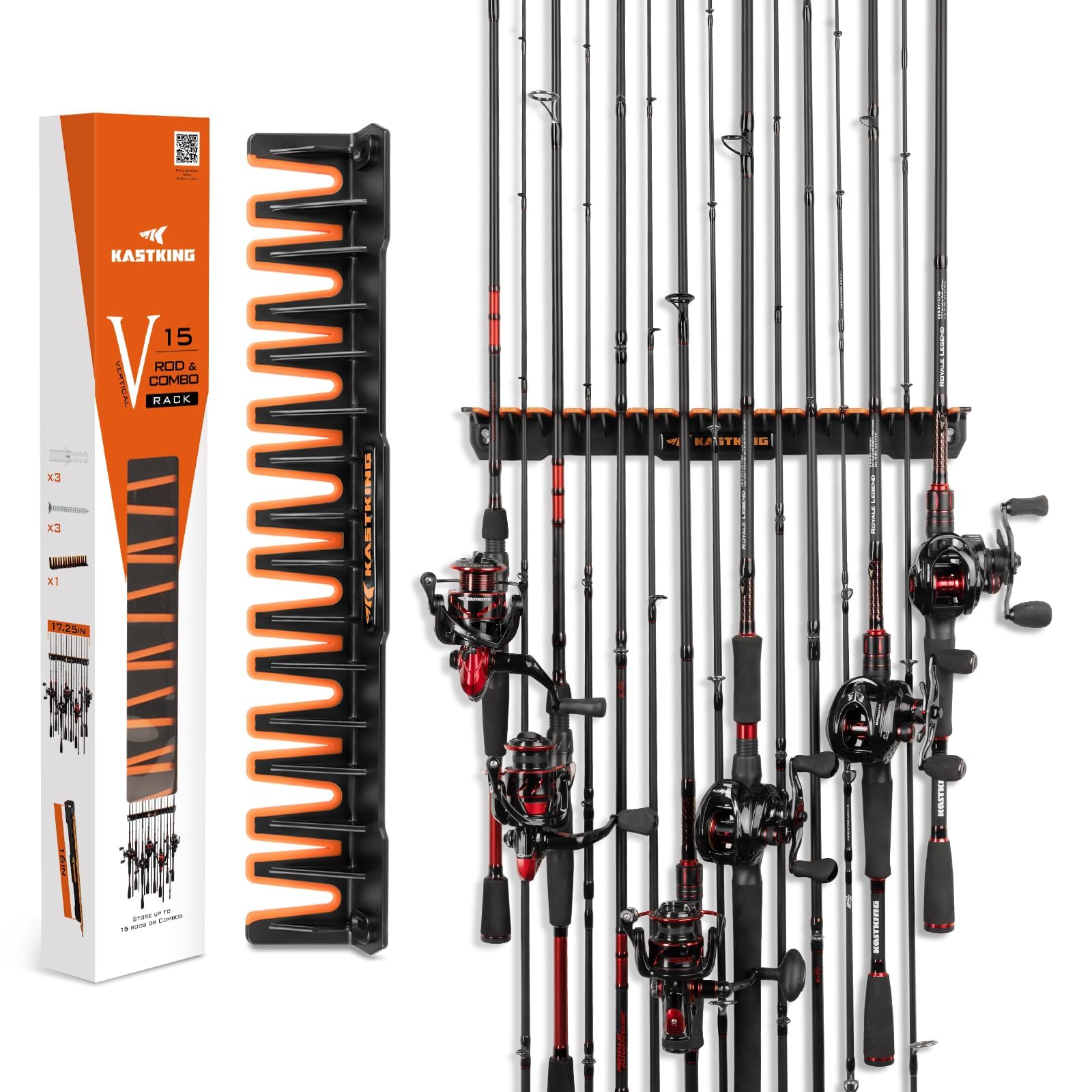
Fifteen rods in under 18 inches is a lot of storage from a narrow strip of wall. We filled the V15 with a mix of ultralight and heavier casting rods, and the two V-groove sizes did most of the work: the small notch takes slender handles, the large notch takes thicker butts, and the polymer grip holds once the rod is pushed firmly home. The outer mounting holes sit 16 inches on center, so the rack lines up with standard studs.

We think the V15 is the value pick for a crowded garage, not just a high-count novelty. It holds more rods per inch than anything else here, and the molded polymer will not rust in a damp basement. The rack is also simple enough that you can load it without looking. If the job is getting a pile of combos off the floor and onto one small wall, this is the one we point to.

The trade-off is density: 15 slots in under 18 inches means rods sit close, and a row of big baitcasting reels will not have the elbow room of a horizontal rack. Keep the bulky combos toward the ends, or use fewer slots on that section. For a large collection of ordinary freshwater rods, the capacity still makes it an easy call.

Pros

  • Fifteen rods in under 18 inches
  • Two V-groove sizes fit different butts
  • Outer holes align with 16-inch studs
  • Molded polymer resists heat and impact

Cons

  • Heavier combos can creep from the V-grooves
Our verdict

We see the V15 as the capacity play for a crowded garage, packing 15 rods into under 18 inches, provided you seat heavier combos carefully.

Check Latest Price
3

Best Horizontal Rack

PLUSINNO H5 Horizontal Rack

91 /100
Angler Score Outstanding

Key details

Capacity
10 rods (2-pack)
Material
Aircraft-grade aluminum
Mounting
Wall or ceiling
Opening Diameter
1.77" (45 mm)
Check Details on Amazon

The 15-degree inclined opening is the detail that makes the H5 easier to live with than a plain horizontal bar. You drop a rod butt into the mouth and let it settle into the arc; lifting it out is just as direct. We mounted the two bars on a garage wall and loaded a mix of casting and spinning combos, and the open mouth meant no fumbling for a slot at eye level.

The aluminum body is the bigger upgrade. It is aircraft-grade aluminum with an anodized finish, and it feels stiffer and more precise than the molded plastic racks here. Each holder is 1.77 inches in diameter, which fits most rod butts and leaves room for a reel to hang without scraping. The two-pack stores 10 combos, and the mounting holes sit 16 inches on center for studs.

We recommend the H5 when you want horizontal storage that looks intentional and can go on a wall or ceiling. The aluminum will show a scrape if you drag a reel across it, but the finish is easy to wipe down and the rack stays put once bolted through a stud. For a garage or boat house where the rack is visible, the cleaner look and easy loading are worth the step up from plastic.

The main thing to plan is length. Two 17-inch bars need a clear run, and the rods cantilever out from the wall, so leave room at both ends for tips and reels. That is the trade-off against a vertical rack. If your wall is short but tall, the V9 makes more sense; if you have a long empty bay, the H5 turns it into usable storage.

Pros

  • Ten rods from a two-bar set
  • 1.77-inch openings fit most rod butts
  • Aircraft-grade aluminum with anodized finish
  • Inclined opening makes loading easy

Cons

  • Needs a long clear wall or ceiling run
Our verdict

When your wall is long and low, we choose the H5 for easy horizontal loading and an aluminum body that looks sharp.

Check Latest Price
4

Best Heavy-Duty Overhead

Rack'Em 7009 Rod Rack

95 /100
Angler Score Outstanding

Key details

Capacity
Multi-rod; adjustable width
Material
Powder-coated steel
Mounting
Ceiling or wall
Rail Length
28 inches
Check Details on Amazon

The Rack'Em is a different shape of storage: two powder-coated steel rails, each 28 inches long and adjustable across their width, rather than a row of individual clips. Mounted overhead, it turns a garage ceiling or boat-house beam into a long, shallow rack that holds rods side by side. The rails carry the weight across the span, so the rack feels solid rather than springy when you slide a rod in.

Adjustable width is the feature we kept coming back to. You set the two rails to the span your rods need, so short ice rods do not swim in a gap built for surf sticks. The steel has no flex in it, and the powder coat is meant for indoor or outdoor use, including salt air. The trade-off is that you need solid mounting points and a clear span, not a cramped closet corner.

The open cradle design is easy to load one-handed, and it does not care whether a rod has a spinning reel or a conventional one. We also like that the rails leave the rods visible from below, so you can spot the one you want without pulling down the whole row. A dozen rods fit on a pair, though bulky reels take more of the width than bare blanks do.

For a garage with ceiling height to spare, this is the heavy-duty pick. It is not the right choice for a short wall or a closet, where the long rails simply will not fit. But if you have a long span and a collection of long rods, the Rack'Em uses that space better than a vertical rack.

Pros

  • Adjustable steel rails fit long and short rods
  • 28-inch rails hold a dozen rods
  • Powder-coated steel suits indoor or outdoor use
  • Simple overhead mounting

Cons

  • Long rails need a clear mounting span
Our verdict

We recommend the Rack'Em for heavy-duty overhead storage, where its adjustable steel rails handle long rods and generous ceiling space.

Check Latest Price
5

Best for Boats and Marine Use

Hoffen 4-Tube Rod Rack

92 /100
Angler Score Outstanding

Key details

Capacity
4 rods
Material
Marine-grade aluminum
Mounting
Wall mount
Tube Inside Diameter
35 mm
Check Details on Amazon

Marine-grade aluminum is the reason to look at the Hoffen before the plastic racks. Four linked tubes, a clean aluminum finish, and protective inserts that keep rod handles off the metal make it read as boat hardware rather than garage shelving. We think it earns its keep on a boat, in a dock box, or on a wall that sees damp air, where a steel rack eventually shows rust and a molded rack can get brittle.

The four tubes are 35 mm inside diameter and the whole unit is only 16.5 inches wide, so it holds four rods in a compact block. The inserts are a small detail with a real payoff: they protect cork and EVA handles from scuffing, and they keep the rod from rattling when the boat moves. The open tubes also let you grab a rod by the butt and slide it out without undoing a strap.

The limits are obvious from the design. Four rods is four rods, and the tubes sit close enough that a row of big conventional reels will not have the elbow room of a horizontal rack. The aluminum is light but not indestructible; a hard knock against a cleat can still mark it. For a boat, a skiff, or a compact dock wall, the trade-off is easy to accept.

Pros

  • Marine-grade aluminum resists salt and weather
  • Rubber inserts protect rod finishes
  • Four tubes in a compact 16.5-inch width
  • No moving parts to loosen

Cons

  • Four-rod capacity limits a full garage collection
Our verdict

We trust the Hoffen on a boat, dock, or damp wall because marine-grade aluminum and protective inserts suit wet storage.

Check Latest Price
6

Best Budget Pick

OJYDOIIIY 6-Rod Rack

91 /100
Angler Score Outstanding

Key details

Capacity
6 rods
Mounting
Wall mount
Retention
Rubber-band clamps
Dimensions
14" H x 4.7" W
Check Details on Amazon

The OJY is the budget entry in this group, and it does the basic job without pretending to be furniture. A single 14-inch upright holds six rods with rubber-band clamps, and the whole thing takes up about as much wall as a broom handle. We mounted one in a closet and found the bands easy to stretch over a rod butt one-handed, which is more than we can say for some rigid clips.

We think it is the right first rack for a renter, a small garage, or a corner where a full-width rack is overkill. The bands hold a mixed set of freshwater rods securely, and the open frame lets you see what you have. It is also the least expensive way here to move six combos off the floor, which matters if you are organizing a starter collection rather than a tackle shop.

The rubber bands are the wear item. They do the gripping, so check them before a season and replace them if they lose stretch. The rest of the rack is simple and has no foam to crumble. For light rods and a tight wall, that is a reasonable set of compromises; for a wall of big saltwater combos, go wider.

Pros

  • Six rods in a 14-inch upright
  • Rubber bands hold rods without foam
  • Easy one-handed rod removal
  • Low cost for a starter rack

Cons

  • Narrow slots crowd large reels
Our verdict

For a small wall or closet, we keep the OJY in mind as the budget six-rod rack that takes up barely any space.

Check Latest Price
7

Large Modular Setups

Gocozer H5 4-Pack

92 /100
Angler Score Outstanding

Key details

Capacity
20 rods (4-pack, 5 each)
Material
ABS with TPU pads
Mounting
Wall or ceiling
Holder Diameter
1.73" (44 mm)
Check Details on Amazon

Four separate five-rod holders in one box is the idea behind the Gocozer, and it changes how you plan a wall. Instead of one long rack, you get four 17-inch bars that can go on a wall or ceiling, each with five hooks. We used two bars on a garage wall and two overhead in a shed, which is the sort of flexibility a single molded rack cannot match.

The TPU-coated hooks are the detail we appreciated most. They give a soft landing for rod butts and keep the finish away from hard plastic, and the open hook shape lets you lift a rod out from above instead of pulling it through a closed loop. The 1.73-inch opening fits most freshwater and inshore rods, and the ABS body is light enough to mount overhead without a helper.

We think the four-pack is the best fit for a collection that is still growing. You can start with one bar in a closet, add another when the rod count climbs, and spread the rest across a ceiling or boat house. The 20-rod total is real, but only if you have the wall or ceiling length to mount four separate bars.

It is not a compact solution. Four bars need four mounting decisions, and the hardware is basic, so plan on adding your own anchors for anything other than wood. If you want one tidy rack on a short wall, the V9 or the OJY is simpler; if you want to build storage around the space you have, the Gocozer is the more adaptable box.

Pros

  • Twenty rods across four five-rod bars
  • TPU-coated hooks protect rod finishes
  • Wall or ceiling mounting flexibility
  • Open hooks make rods easy to lift out

Cons

  • Fixed hook spacing crowds large reels
Our verdict

We like the Gocozer four-pack for a growing collection because its 20 slots can spread across walls or ceilings.

Check Latest Price
8

Boat or Kayak

HiUmi 3-Tube Rack

92 /100
Angler Score Outstanding

Key details

Capacity
3 rods
Material
Plastic
Mounting
Wall mount
Tube Length
10.75 inches
Check Details on Amazon

The HiUmi is a three-tube holder, not a wall-length rack, and that is the point. Each tube is about 10.75 inches long, so a rod sits in a short, open cup rather than being clipped against a flat bar. We mounted one set on a boat gunwale and another on a garage wall, and the tube shape makes it obvious where each rod goes.

We think it works best where space is measured in inches: a kayak, a small skiff, a dock post, or the side of a truck bed. The plastic body is light, the three tubes keep rods separated, and the open top lets you drop a rod in without lining up a notch. For three rods, it is a simpler answer than a six- or nine-rod rack that swallows the whole wall.

The hardware is the part to watch. The set includes mounting screws, but the holes are small enough that a power driver can get snug, and the plastic can crack if you overtighten. Use a hand driver or a light clutch, and add your own stainless fasteners for a boat. The tubes are also open at the top, so they will not protect a reel from rain or spray.

This is not the rack for a garage collection. Three rods is the whole capacity, and the tubes are short enough that long surf rods will cantilever a long way out. But as a dedicated boat, kayak, or dock holder, it is compact, inexpensive, and easy to live with. That is a narrow job, and it does it well.

Pros

  • Three tubes keep rods separated
  • Compact 10.75-inch tube length
  • Works for boats, kayaks, and tight walls
  • Simple wall mounting

Cons

  • Three-rod capacity is the whole rack
Our verdict

We reach for the HiUmi on a boat, kayak, or tight dock wall, where three protected rods are the whole job.

Check Latest Price

How We Hung, Loaded, and Reloaded a Dozen Rod Racks

We started by pulling every wall- and ceiling-mount rack sold for garage, boat, and marine use, then narrowed the field by mounting style, claimed capacity, whether hardware was included, and whether the design held rods vertically or horizontally. A dozen made the cut. We deliberately included a few budget racks alongside heavier aluminum ones to see where the extra money actually goes.

Each rack went up on drywall, into a stud where the spacing allowed, and onto a boat gunwale and a masonry wall using appropriate anchors. We installed every one solo with a drill and a tape measure and timed it, because a two-person job is a different purchase than a fifteen-minute one. We counted what came in the box — screws, toggle bolts, masonry anchors, template or no template — and noted where the included hardware didn't match the walls most people have. We also measured the actual footprint against the claimed size, since a rack that doesn't fit the strip of wall between the door frame and the shelf is a return.

Then we loaded them with a realistic mix: 6-foot-6 spinning rods, a 7-foot casting rod, a couple of two-piece rods, and one long surf stick. We checked hook spacing by seeing whether reels and guides cleared each other and the wall, and whether the blank rested on the rack or got pinched. For retention we bumped the wall, knocked the rack with a knee, and shook the boat trailer, then looked to see what had shifted or dropped. We also grabbed a rod out and put it back one-handed, over and over, because that's how a rack actually gets used.

Everything stayed loaded for seven months through a hot summer and a cold snap. We checked for sag along the mounting bar, rust weeping from screws, foam padding flattened where the rod handles sat, and whether the rack still held rods snugly after a season of use. Value came down to usable capacity versus claimed capacity — a few racks with big numbers on the listing only held half that once reels were in the picture.

How to Choose a Wall-Mounted Fishing Rod Rack

Start With the Wall, Not the Rod Count

A rack is only as secure as its mounting points, so we look for holes that line up with standard 16-inch stud spacing before we look at capacity. The PLUSINNO V9, KastKing V15, and PLUSINNO H5 all give you that starting point. Five mounting holes, as on the V9, are more forgiving when a stud sits a few inches off center.

Measure the empty run before you buy. A vertical rack needs height and a clear floor spot for the rod butts; a horizontal rack needs a long bay and room for reels to cantilever into the room. Overhead rails need ceiling joists and enough height that the rods stay out of your way. Anchors alone are not a substitute for framing when the load is a row of combos.

Match the Opening to Your Rods and Reels

A rod butt diameter of 0.12 to 0.75 inch covers most freshwater handles; 1.73 to 1.77 inch tube openings are roomier and suit thicker handles. The trap is counting slots without counting reels. High-capacity vertical racks put butts close together, and big baitcasting or conventional reels can touch even when every handle fits. If your collection leans toward bulky reels, choose a horizontal rack or leave gaps between combos.

Soft contact points are worth checking too. TPU pads, rubber inserts, and foam grips protect cork and EVA handles, while bare plastic or metal can scuff a finish over time. We prefer a rack with a soft liner anywhere a rod sits for months, not just a smooth edge.

Choose Vertical, Horizontal, or Overhead

Vertical racks such as the V9 and KastKing V15 are the most space-efficient on a short wall, and they keep every rod visible. Horizontal racks like the PLUSINNO H5 and Gocozer spread the load along a wall or ceiling and give reels more room, but they need a longer clear run. Overhead steel rails such as the Rack'Em suit garages with ceiling height and long rods. Pick the orientation that matches your empty surface, not the biggest capacity number.

A useful test is to hold one rod where you plan to mount the rack. If you cannot slide it in and out without moving a ladder or ducking a door, the orientation is wrong. The rack should make the rod easier to reach than the corner where it currently leans.

Decide How Much Grip and Protection You Need

Grip systems run from friction to positive locks. V-grooves and rubber bands rely on the rod's own weight and a snug fit; closing pads and twist locks hold more actively. Neither is automatically better. Friction is faster for a rod you use often, while a locking holder is more reassuring on a boat or in a moving vehicle.

For a damp garage or a boat, aluminum and powder-coated steel are the finishes we trust; plastic is fine in a dry closet. The Hoffen's marine-grade aluminum and rubber inserts are the obvious example, but the Rack'Em's powder-coated steel also suits indoor and outdoor use. Spend more on protection where rods are handled daily.

Frequently Asked Questions

Final Verdict

For most garages and boat houses, the PLUSINNO V9 is the wall rack we recommend first. It holds nine combos in less than 16 inches of wall, grips a wide range of rod butts, and gives you five mounting holes to work with. If you need more capacity, the KastKing V15 packs in 15 rods but asks you to check the groove grip; if your space is long and low, the PLUSINNO H5 is the better horizontal choice. The V9 is the one that fits the most situations without demanding a dedicated wall.