Best Ice Fishing Shelters of 2026

The first hour on the ice is the best part of winter: clear light, a fresh hole, the auger still steaming. Then the wind shifts, your hands stop working, and the hole starts skinning over while you think about the truck. A shelter is what turns a two-hour dash into a whole day out there, and the right one does it without a wrestling match in the cold. The wrong one leaves you wrestling anyway, then drips condensation down your neck by noon.

I've fished out of a borrowed flip-over, a hub that folded itself shut in a gust, and one shelter that was so heavy I only dragged it out twice. The lesson I keep relearning is that the person count on the box is fiction, and a four-person shelter is a comfortable two once you add buckets and a flasher. Over the past five months, my team and I set up, sat in, and broke down 11 shelters, and the gaps between them came down to hub hardware, door design, and whether the fabric stayed dry inside. The ones that earned a spot in the sled are below.

1

Best Overall

Eskimo QuickFish 3i

93 /100
Angler Score Outstanding

Key details

Weight
34 lb
Capacity
3 person
Fishable Area
34 sq ft
Insulated Fabric
600D IQ quilted
Check Details on Amazon

The hub frame is the whole trick: push the roof up, pull each wall out until the hub locks, stake the skirt, and you are fishing. Eskimo quotes 60 seconds, and the mechanism supports the claim — one person can raise this shelter alone, in gloves, without reading the instructions twice.

Inside, the 600D quilted shell is what separates it from a single-skin cube. Insulation does two jobs on hard water: it keeps a small heater's output in the room instead of letting it bleed through the wall, and it keeps the walls themselves from dripping when the temperature swings. Thirty-four square feet at 5.8 feet square gives two anglers room to spread gear and a third a place to sit.

Height is the other quiet advantage. At 6.7 feet, most adults can stand to reset a jig or reach across to a deadstick, and the window panels are removable, so a fogged pane gets swapped instead of tolerated. The anchor grommets sit in the skirt rather than the wall, which is exactly where they belong when the wind picks up.

What settles it for us is how little the shelter asks of the trip. It goes up in about a minute, it holds heat without much fuel, and it packs back into a bag one person can carry. That combination is why it is the shelter we recommend first and the one the rest of this list gets measured against.

Pros

  • One-person hub setup in about a minute
  • 600D quilted insulation holds a small heater's warmth
  • 34 sq ft under a 6.7 ft ceiling
  • Removable window panels and skirt-mounted anchor grommets

Cons

  • 34 pounds before gear, so plan on a sled
Our verdict

The insulated three-person hub we recommend first: it goes up alone in about a minute and holds heat without a heater running wide open.

Check Latest Price
2

Best Insulated Value

Your Choice 3-4 Person

84 /100
Angler Score Excellent

Key details

Weight
23 lb
Capacity
3-4 person
Floor Area
33 sq ft
Insulation
120 g high-loft
Check Details on Amazon

One hundred and twenty grams of high-loft insulation is the number to hold on to here. That is real loft bonded into a three-layer shell rather than a token coating, which gives the walls some body: they resist flapping in a crosswind and the interior warms quickly once a heater is lit. On a sunny afternoon the greenhouse effect alone can carry the room.

The layout is what we appreciate most. Two zippered doors on a 5.7-foot-square footprint mean nobody has to shuffle past a partner's hole to step outside, and the hook-and-loop vent flaps let you crack the air without unzipping a window in the cold. Twenty-three pounds goes into a sled without a second thought, and the bag arrives with four ice spikes, ropes, and a repair kit.

Four anchors is on the lean side for open ice; add a couple and a drill adapter, and staking takes seconds instead of minutes. Otherwise this is the midrange shelter that behaves like a much more expensive one, and for two anglers fishing a full day in real cold, that is the whole argument.

Pros

  • 120 g of insulation in a three-layer shell
  • Two doors on a 5.7-foot-square footprint
  • 23 pounds with vents, spikes and a repair kit

Cons

  • Two adults plus gear is the realistic limit
Our verdict

Buy this one if you want an insulated two-angler hub with two doors and real loft without paying premium-shelter money.

Check Latest Price
3

Best Non-Insulated for Space

ThunderBay Ice Cube

88 /100
Angler Score Excellent

Key details

Fabric
300D with blackout coating
Footprint
90 x 90 in hub to hub
Insulation
Non-insulated
Ceiling Height
80 in
Check Details on Amazon

There is no insulation in the Ice Cube, and that is the trade it offers: a single layer of 300D fabric instead of a quilted thermal shell, in exchange for 90 inches hub to hub and an 80-inch ceiling at a price near the bottom of this group. If you already own a propane heater, it is a good trade, because a cube this size heats up fast.

The blackout coating is the detail we like most. The fabric is laminated so daylight stays out, which keeps a flasher screen or a lit hole readable on a bright February afternoon instead of washing it into glare. The extra-wide skirting is the other piece worth praising: bank it with snow or leave it lying, and the draft that usually crawls in around the floor stops where it starts.

Setup is the usual pop-out hub — one person, a minute or two — and the box includes six self-tapping anchors, a carry bag, and a six-inch nylon auger, which is more hardware than most shelters here ship with. For an angler with heat, a sled, and two buddies, this is a lot of space for the money; fish it without a heater and it is a windbreak, not a warm room.

Pros

  • 90-inch hub-to-hub span with an 80-inch ceiling
  • Blackout coating keeps a flasher screen readable
  • Six anchors, an auger, and a bag in the box

Cons

  • Zippers and seams are weak points in deep cold
Our verdict

The pick for anglers who already own a heater and want the most floor for the least money, as long as they handle the zippers kindly.

Check Latest Price
4

Best Budget Solo Shelter

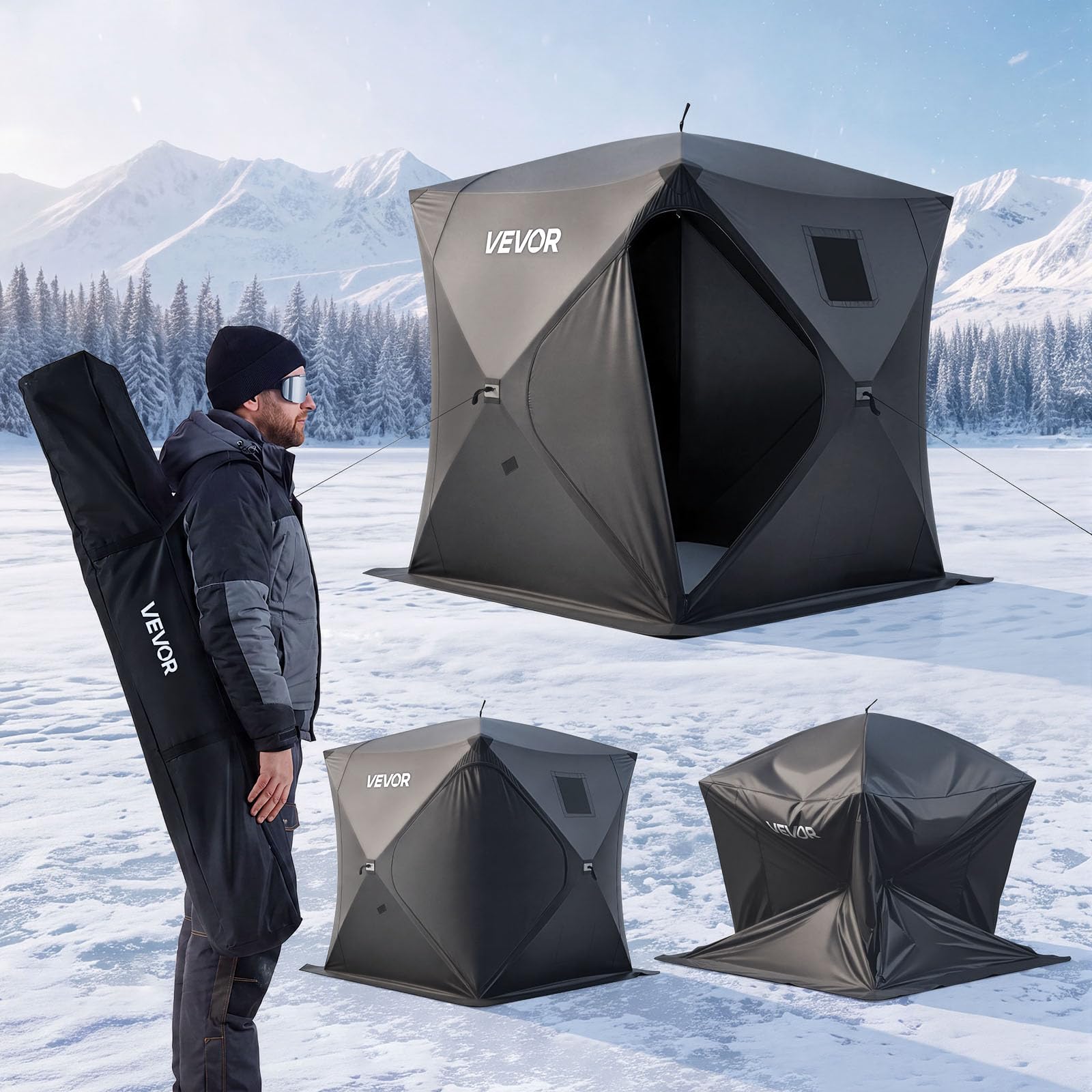
VEVOR Pop Up 1-2 Person

82 /100
Angler Score Excellent

Key details

Weight
14.8 lb
Capacity
1-2 person
Floor Area
24 sq ft
Peak Height
65 in
Check Details on Amazon

If you walk on and fish alone, the VEVOR is shaped around that trip: 14.8 pounds, a 59-inch square footprint, a four-corner hub that pops in about a minute, and a bag light enough to carry with the auger in your other hand. Nothing about it is luxurious. Everything about it is easy to get onto the ice, which is the only thing a solo shelter really has to be.

Twenty-four square feet under a 65-inch peak is one angler, two holes, a bucket, and a flasher, not a card game. The 300D Oxford shell carries a three-layer PU coating rated PU3000, the windows are three-layer panels with mesh behind them, and there is a top vent for moisture. The door unzips fully as well, which removes the trip hazard a lot of budget hubs leave at the threshold.

Condensation is the one behavior to manage: run a heater with everything sealed and the walls will sweat, so crack the top vent and one window and the interior stays dry. Otherwise this is the shelter we hand to a beginner, a kid, or anyone adding a second shack so a friend can come along. The money is small and the job gets done.

Pros

  • 14.8 pounds, easy for one person to carry
  • PU3000 coated Oxford shell and three-layer windows
  • Door unzips fully, so no threshold to trip on

Cons

  • Zippers are the weak point at this price
Our verdict

The shelter we hand to a solo walk-on angler or a beginner: barely 15 pounds, cheap, quick to pop, and honest about its limits.

Check Latest Price
5

Best for Big Groups

Eskimo Outbreak 650XD

87 /100
Angler Score Excellent

Key details

Weight
52 lb
Capacity
7 person
Fishable Area
94 sq ft
Insulated Fabric
StormShield, 80 g
Check Details on Amazon

The door zips all the way down to the ice, and that single detail is why the Outbreak 650XD is the group shelter we recommend. There is no threshold to catch a boot and no frame to step over in the dark, and with 94 square feet of flared floor inside, four anglers, a heater, and a couple of sleds can spread out without negotiating elbow room.

The fabric is Eskimo's StormShield, three bonded layers with 80 grams of loft, and the gray interior earns its keep: light bounces off the walls instead of disappearing into them, so tying on a jig at dusk is easier than in a black-lined hub. The frame is where the money goes — all-metal ball-and-socket hubs and oversized fiberglass poles, the parts that decide whether a big shelter holds its shape in a gust.

What it changes in practice is how often you get up. A walk-through door turns checking a tip-up into a ten-second errand, and a group that would otherwise fish out of two trucks ends up in one room. It is a lot of shelter, and priced like it.

Pros

  • Trip-proof door zips down to the ice
  • 94 sq ft of flared fishable floor
  • StormShield insulated fabric with 80 g loft
  • All-metal hubs and oversized fiberglass poles

Cons

  • 52 pounds with a 74-inch packed length
  • More shelter than two anglers need
Our verdict

The group shelter for people who drive onto the ice: 94 square feet behind a door that zips to the ice, at a price and weight to match.

Check Latest Price
6

Best for Overnight Trips

Outsunny Pop-Up Ice Shelter

84 /100
Angler Score Excellent

Key details

Doors
Two zippered
Weight
36 lb
Floor Area
69.6 sq ft
Listed Capacity
8 person
Check Details on Amazon

Eight people is the number on the box; 69.6 square feet is what decides the trip. That is a 141-by-71-inch rectangle — three or four adults fishing holes along both walls with room left for a cot or a stove, and a floor long enough that nobody sits knee to knee. For an overnight on the ice, the shape does more than the number on the label.

Two doors on opposite ends is the layout we prefer in a shelter this long: nobody climbs over anybody to get out, and cracking the downwind door for air does not turn the whole room into a wind tunnel. Four double-layer windows with oxford flaps, six guy lines, and ten stakes come in the box, and 36 pounds rides fine in a sled. For a group that stays out past dark, this is the sensible spend.

The shell is where our enthusiasm cools. It is insulated and warms quickly with a lantern or a small heater, but durability is the dimension where it sits lowest against the others here — panels, stitching, and waterlogged fabric are the recurring weak spots. Keep it dry, patch tears early, and it earns its keep.

Pros

  • About 70 sq ft in a long rectangle
  • Two doors on opposite ends
  • Insulated shell, four flap windows, ten stakes

Cons

  • Takedown is fussier than setup
Our verdict

A long two-door rectangle that suits a group staying out overnight, provided you accept that durability is not its strongest card.

Check Latest Price
7

Premium Six-Sided Thermal

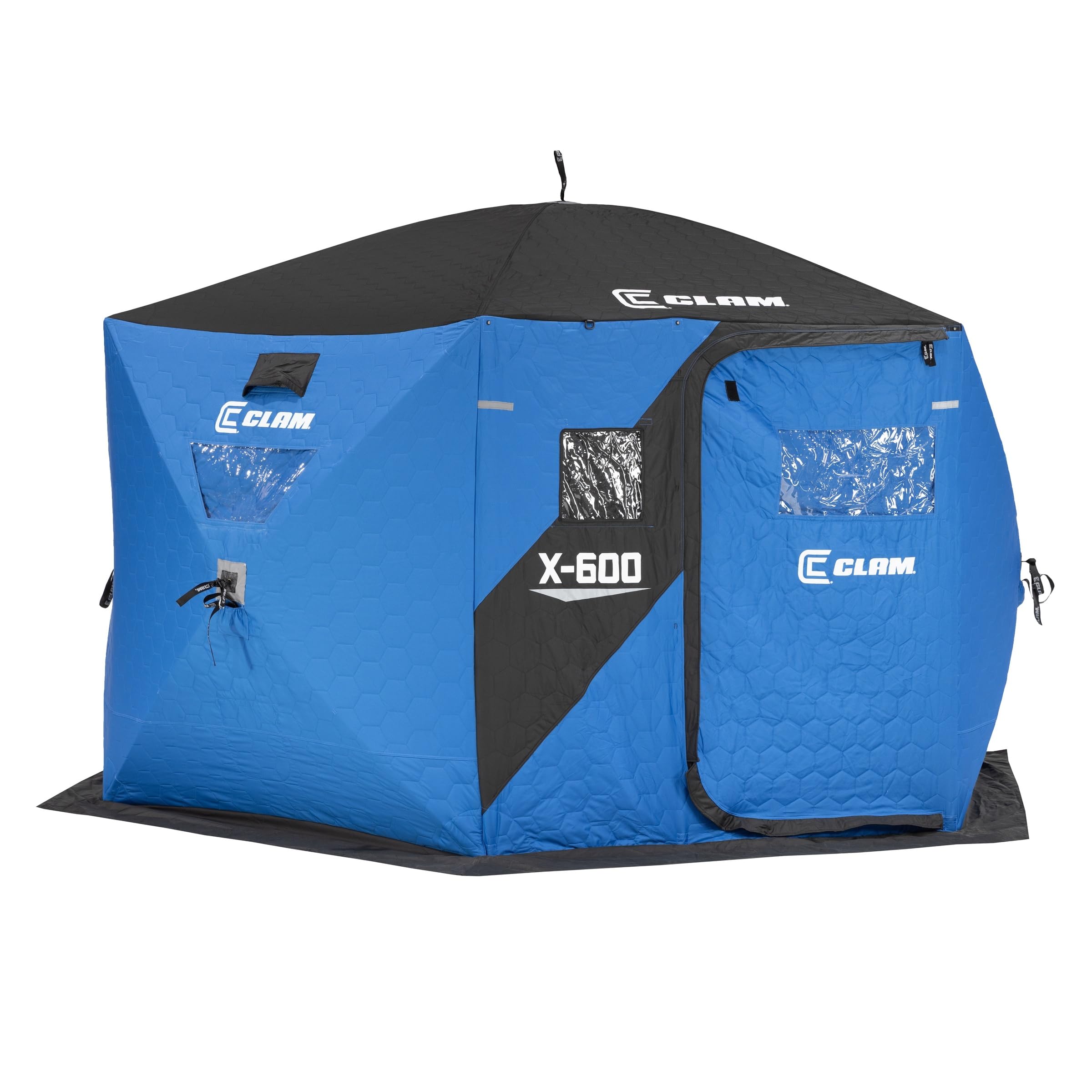
Clam X-600

87 /100
Angler Score Excellent

Key details

Sides
6-sided hub
Fabric
Full thermal
Weight
68 lb
Packed Size
75 x 15 x 15 in
Check Details on Amazon

Sixty-eight pounds and a 75-inch bundle is the honest starting point for the X-600: this is a hub that travels by sled, snowmobile, or truck, not on a back. What the weight buys is six wall panels instead of four, wrapped in Clam's full thermal fabric, in a shape with fewer square corners for gear to disappear into.

Six sides is the reason we keep it on this list for a crowd. Corners are dead space in a square hub, and a hexagon puts a wall in front of every seat, so everyone can face a hole and still see the group. The thermal shell is the other half of the argument: it takes a heater's output and holds it, which is what a long sit on a big lake actually asks for.

Where that leaves it is a shelter for someone with a machine, a fixed spot, and people to keep warm — set it at the truck in the morning and fish out of it all weekend. The six-sided shape and full thermal fabric do the rest.

Pros

  • Six-sided hub in full thermal fabric
  • Hexagonal shape puts a wall at every seat
  • Thermal shell holds a heater's output

Cons

  • Premium price for a group-only shelter
Our verdict

A premium six-sided thermal hub for a group with a machine to move it: the roomiest shape here, and the heaviest thing in the guide.

Check Latest Price
8

Largest Room for a Family

Nordic Legend Aurora Lodge

78 /100
Angler Score Very Good

Key details

Doors
Two diamond-shaped
Windows
6
Floor Area
129 sq ft
Center Height
83 in
Check Details on Amazon

A hundred and twenty-nine square feet of fishable floor and an 83-inch ceiling make the Aurora Lodge a room rather than a seat. The footprint runs 80 inches square with 143 inches hub to hub, wide enough to fish holes along two walls and still walk between them.

The doors are the first thing we noticed. Two oversized diamond-shaped openings with a webbing guard let you step through a panel instead of ducking under a wall, and six windows and six pockets around the perimeter keep every rod in sight and every small item off the ice.

Insulation is a 300D textured fabric with a silver coating rather than quilted batting, and it does the job it is asked to: with a small wood stove or a portable heater, the interior stays in sweatshirt territory on a day that never climbs above zero. That is the point of a room this size — you are not just out of the wind, you are comfortable enough to stay.

What it asks in return is care. It is a tall shelter with a lot of fabric to handle in wind, the zippers want a gentle hand, and the stakes only work if you place them properly. Do that and you have one of the biggest shelters here, which for a family that sets up once and fishes all weekend settles most of the question.

Pros

  • 129 sq ft of floor under an 83-inch ceiling
  • Two oversized diamond doors with a webbing guard
  • Insulated 300D fabric holds heat with a stove

Cons

  • Window panels and seams are the leak points
Our verdict

The biggest room in this guide for a family that drives on and sets up once, as long as the seams get sealed before the season starts.

Check Latest Price

How We Chose and Tested the Best Ice Fishing Shelters

To build the shortlist, we read spec sheets and customer reviews for more than 30 shelters and filtered hard by fabric type, hub count, packed dimensions, and price. That narrowed things to 11 worth sitting inside, from two-person cubes to shelters marketed for eight, and we ran them through five months, from first ice in December to late ice in March.

Setup got timed on the ice, solo, in mittens and boots, usually with wind pushing at the panels. We counted the steps, noted whether each hub popped with a thumb or needed a knee and a few choice words, and watched whether the door opened without unzipping half the wall. Then we packed every shelter back into its bag while it was wet, and again dry, because that's where most of them fight back.

Weight matters over a long drag, so we hauled each one from the truck to the spot and paid attention to where it pulled. For water resistance, we sprayed the seams and left shelters out in freezing drizzle for an hour, checking for drips at the ceiling and standing water on the floor. Condensation was the bigger tell: after two hours with a heater going, we looked at whether the walls were sweating onto our shoulders.

Inside, we set up two adults plus buckets, a flasher, and an auger, and measured the floor we could actually use rather than the number printed on the box. We also noted headroom, whether a hole was reachable from a seated position, and how each price lined up per square foot of fishable space.

How to Choose an Ice Fishing Shelter

Insulation Is a Heater Multiplier

A quilted thermal shell does two things a single-layer cube cannot: it holds a small heater's output in the room instead of bleeding it through the wall, and it keeps the inner surface from dripping when the outside temperature swings. That is worth paying for if you sit in one spot all day with a propane heater ticking over on low.

If you hole-hop with the shelter and rarely run heat, skip the insulation and take the lighter, cheaper shell. The ThunderBay Ice Cube is exactly that trade, and it is a good one for anyone who already owns a heater.

Read the Floor Plan, Not the Person Count

Person counts are the least reliable number on an ice shelter listing. A rectangle sold as an eight-person shelter often fishes three or four adults comfortably; 24 square feet is one angler and a bucket; 33 to 34 square feet covers two with gear spread out.

Sketch where the holes go before you buy. Holes sit along the walls, so a long rectangle suits two anglers fishing opposite ends, while a square or hexagonal hub puts everyone in a circle around the middle and leaves the center for a heater.

Weight and Bulk Decide How Far You'll Walk

Packed weights here run from under 15 pounds to 68, and the bundle lengths from about four and a half feet to more than six. Under 30 pounds goes in a sled without complaint; past 50 pounds you want a machine, a partner, or a very short pull from the truck.

Portable in a listing means it fits in a vehicle and a sled, not that you will carry it a mile. Be honest about your walk first, then fall for the floor plan.

Doors, Anchors, and Setup Manners

The details that decide whether you still like a shelter in February are the ones you handle with gloves on. A door that unzips down to the ice removes the threshold you trip over in the dark, and two doors on a long shelter stop the crawl-over when someone needs out.

Count the anchors in the box: four to six is a starter set, and an anchor driver for a cordless drill turns a five-minute job into thirty seconds. Every hub here goes up in a minute or two once you have done it twice; none of them goes up quickly the first time in wind.

Frequently Asked Questions

Final Verdict

The Eskimo QuickFish 3i is the shelter we recommend to most people. It goes up in about a minute, its quilted shell turns a small heater into a genuinely warm room, and 34 square feet is right for two anglers and their gear.

If your crew is four or more and you drive onto the ice, the Outbreak 650XD earns its price: the walk-through door and 94 square feet change how the day feels. Fishing alone on a budget, the VEVOR delivers the same job at less than half the weight.